Saturday, February 18, 2012

An embarrassing confession...

We all make mistakes, right?
There’s no call for embarrassment.
But some mistakes make you feel sillier than others...

Now I’m not talking about those absent-minded slip ups that everyone makes (they do, don’t they?).
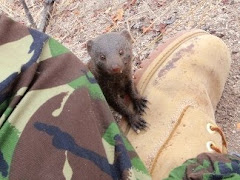
You know, like realising in the supermarket that your shirt’s on inside out or that you’ve forgotten to change out of your mismatched trainers (the red pair’s left shoe is raggedy and the blue pair’s right shoe... Well, the mongooses don’t mind!).

No, the kind of blunder I’m talking about springs from ignorance, pure and simple uncouth and ugly.

I remember my sister discovering that her rural high-school pupils didn’t believe dinosaurs ever existed. They thought that these prehistoric beasts – along with King Kong, Godzilla and the Muppets – were creations of the media.
Well that’s the sort of mistake that I’m guilty of.

It all started when I was pottering about the local newsagent and noticed a stack of glossy, movie-spinoff booklets.
A sweat-streaked Harry Potter glared up from the cover of the top one, below that peeped the earnest blue face of a Na’vi from Avatar, and on a third, two CGI aliens stared nonchalantly off into space. They were lankily humanoid but clothed in a stylised uniform of fur: pure white with chocolate brown insets on their arms, chest and thighs. Disconcertingly golden eyes stared from their smooth black faces, and black elf-like ears peeped from the fur on their heads.
‘What will they come up with next’, I wondered before sauntering on.

But that image kept haunting me; there was something disquieting about it. They were so humanlike, but...
It was as if the artist had melded human facial features with those of a llama or guanaco. It was uncanny. And unnerving.

So you can imagine my shock - on my very first day in Madagascar – when I rounded a bend on a forest trail and found myself face to face with just such an alien. In fact, two real, living, breathing aliens.
Oh, and did I mention the excruciating embarrassment?


Extraterrestrials assessing the chemical composition of Earth’s flora? No, Coquerel’s sifakas (Propithecus coquereli) contemplating lunch. But you can see how one could be mistaken, can’t you? Oh sure you can.  Please...
 
When not impersonating computer-generated aliens, Coquerel’s sifakas hang out in groups of 2-10, in the dry forests of NW Madagascar. Like all sifakas, they're strictly vegan and the ladies rule the roost.

Named after their explosive, hissing alarm call (shee-fark!), sifakas are the bounders of the lemur world. I’m not being judgemental here; I mean it literally. They’re made to hop. With legs 35% lankier than their arms (the figure for people is 65%), these lemurs leap frog-like from tree trunk to tree trunk, and cling there vertically with their knees pressed against their chests. They’ve artistically long fingers, and utterly outrageous big toes, to clamp vice-like around tree trunks.


A toe of note.

Now if my first encounter with sifakas made me feel like Bridget Jones at the launch of Kafka’s Motorbike, my second interaction was almost as disquieting.

We’d just arrived at Berenty Private Reserve in southern Madagascar after a long, hot morning jolting over crumbling tarmac (last road mending, the 1950s). Trudging through the heat and dust towards the promise of lunch, I glanced up into a huge tamarind tree that overhung the tourist cabins.
There, almost within arm’s reach, was a fluffy white tangle of Verreaux’s sifakas. Pristine white, apart from a Santa’s cap of chestnut brown, they lounged along the tree’s massive branches or hung languidly upside down from the branch tips like an angelic manifestation of spider monkeys. As I gasped, they gazed down at me interestedly, golden eyes bright in their intelligent sooty faces. I can’t begin to describe the emotional impact of their unexpected and incongruous appearance; try to imagine the warmth invoked by fluffy white bath-towels coupled with the enchantment of snow.
Needless to say, I was very late for lunch.


Of the nine sifaka species bouncing around Madagascar, only the Verreaux’s sifaka (Propithecus verreaux) is not endangered (it’s considered vulnerable). It’s also my favourite (why court heartbreak?).

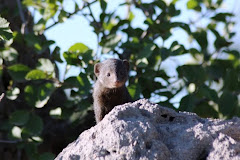
The Verreaux's sifaka groups at Berenty hold territories of only 2-3 ha (5-7 acres); that means 15 groups of sifaka could ricochet around happily within the territory of one dwarf mongoose group! 


Hanging loose. Verreaux's sifakas live in mixed-sex groups where love is free. However, the reigning honcho fathers most of the kids because he dogs the steps of any female on heat.
  
Now if, like me, your enthusiasm for wildlife is tainted by vices (laziness, for example, or voyeurism), Berenty Reserve is the place to be.
Protected since 1936, this tiny pocket (250 ha /620 acres) of gallery forest is set within a vast sisal plantation (the spiky aloe used to make ‘green’ shopping bags) and is chockfull of lemurs. Alison Jolly began studying ring-tailed lemurs here in 1963, so the furred inhabitants are enchantingly blasé about non-furred primates. You can lounge on your veranda and happily spy on three species of lemur as they blithely scent-mark, squabble or snooze. And of course you can also potter at leisure in the forest, blissfully unchivvied by zealous park guides.
It was certainly a highlight of my trip. 

No, not a sifaka, but a typical Berenty scene. Ring-tailed lemurs (Lemur catta) and red-fronted brown lemurs also smooch around camp.

High density living is the norm for sifakas. Groups of crowned sifaka (Propithecus coronatus) claim ownership to just 1.5 ha (3.7 acres) of dry deciduous forest (in NW Madagascar) and they advertise possession by smearing around goo from their chest and anal glands.

Sifakas, of course, are famous for another trait. Designed to leap, tree to tree, they aren’t well equipped to negotiate flat land. Bizarrely, they stand up on their lanky hind legs and skip along sideways, twisting their torsos back and forth and holding their arms up effeminately for balance. If you haven’t seen footage of these guys ‘dancing’, treat yourself by clicking here or here.
 
Leaping lemurs!
 

'No, I've never heard of the Ministry of Funny Walks.
Why do you ask?'


Let's move it, move it, move it!
 
Strutting their stuff by day, sifakas kip in the tree tops after dark. But despite this safety measure, being eaten is still a serious problem for them (well for anyone, I guess). Fosas, who specialise in chomping mammals, cunningly clamber up and nab them in the night. Raptors also won't say no to an occassional lemur. 
In an effort to evade these lemur-eaters, sifakas employ the usual arsenal of ‘functionally referential’ alarm calls (i.e. they shriek ‘Run!’ or ‘Hide!’ or ‘Get down!’ rather than ‘Harrier-at-10 o’clock!’ or ‘Bloody fosa!’).

What’s interesting is that different populations use the standard calls in different ways. While everyone seems to know that roaring barks warn of raptors (the lemurs look up and climb down), researchers found that playbacks of the iconic shee-fark cry invoked mixed responses.
Coquerel’s sifakas, and Verreaux’s sifakas who lived within fosa territory, believed it warned of ground predators (they looked down and climbed up), but Verreaux’s sifakas living in a fosa-free local just ran away. Growls were even more personalised. Coquerel's sifakas living in places with many birds of prey interpreted a growl as warning of aerial predators, while Verreaux's sifakas residing in fosa-rich habitat thought a growl meant prowling carnivores. The other populations, of both species, associated growls with minor disturbances.
Now this shows that the sifakas learn the meaning of their calls from others, and it lets them adapt calls to meet local needs. But what happens when we come along and translocate animals from one population to another?
 
'What? He's growling?! It's all Greek to me.'
The diademed sifakas (Propithecus diadema) living in Analamazoatra Special Reserve (aka Perinet) were translocated into the park in 2006 from three different sites (the original inhabitants were hunted to extinction in 1973). They appear to be prospering despite any language barriers.   

Like all the larger lemurs, Milne Edward's sifakas (Propithecus edwardsi) are hunted by humans as well as fosas. Although 'fady' (taboo) prevents certain tribes from consuming particular species, it often doesn't prohibit them from catching and selling the animals to people who do. Lemur is a delicacy in city restuarants.


Fossa snack food. Milne Edward’s sifakas bear only a single sprog every second year. 40% of their ankle-biters don’t make it to their first birthday, and only a third reach puberty.


A Milne Edward's sifaka (in Ranomafana National Park) awaiting the arrival of a Hollywood talent scout.

Friday, February 3, 2012

Masked weavers revealed

If you’ve come here expecting an exposé on the criminal activities of textile workers, you’re in for a disappointment.

This post is about something much less exciting: SEX.

Now I don’t know how you choose your sexual partners, and I wouldn’t dare suggest that anything is inappropriate... But whatever traits turn you on, you can be certain that somewhere out there someone with feathers is already doing it.

Regardless of whether your interest is sparked by a lover’s apparel, their talent in the performing arts, their real-estate holdings, the colour of their footwear (you’d have to be a real booby to go for this), their artistry or – let’s get down to it – the size of their gender-specific endowments (excuse me, I was referring to tail plumes), your tastes don’t differ from millions of birds.

But there’s one group of feathered critters whose predilections are genuinely perverse.
For them, sweaty singlets and wolf-whistles are all the go.
That’s right; construction workers rule the roost in weaver society.

Now if DIY skills were the currency of ardour in humans, I’d be destined for barren spinsterhood (hey, wait a minute, I am a barren spinster...). Although home-building skills may seem a tepid way to woo a lover, it hasn't held back weavers. Around 62 species (all in the genus Ploceus) are out there busily knocking up their edifices, mostly in Africa but also in southern Asia too.
And with all the recent rain, a large proportion of these creatures seem to be doing it right here.


A macho lesser masked weaver (Ploceus intermedius) kitted out for love. He only dons his mask - in bad-boy warning colours - when the talent weather is hot.

Gathering in rowdy hordes in trees overhanging water, the local lesser masked weavers are in a state of frenzy.
Males dash back and forth with long grass stems trailing from their bills, and there’s a constant buzz of chirping and squawking, which swells periodically into a goal-score roar when a flirtatious chick drops by.

Before a weaver on the make can fabricate an alluring boudoir, he must first stake out his own patch within the colony. This involves lunging at intruders and grappling tooth and nail beak and talon with any persistent rivals. Once he's scored an exclusive building site, Romeo gets to work weaving a collection of finely-laced, retort-shaped homes (if you're not a closet alchemist, a retort is a glass flask with a spherical base and a long tapering neck that's bent downward; it’s designed for distilling things). The male’s goal is to distil a harem of lady tenants who’ll considerately raise his chicks for him.

Using only fresh green grass, plucked straight from the clump, he twists and pokes and pulls, entwining the strips intricately, while emanating an air of intense and bad-tempered concentration. As the grass strands dry, they shrink, tightening up the weave and strengthening the structure. But with nest sites at a premium, a male can’t afford to keep any untenanted premises on his books, so pissed-off males demolish nests that have proven unpopular.

In the quest for the most beguiling nest, males also indulge in a bit of landscape gardening, clipping the leaves from all branches near their homespun abodes. This - along with the nest’s funnel entrance - is thought to make things tricky for those iniquitous nest robbers, the harrier hawk and the boomslang.


‘These damn things just keep growing BACK!’


‘Well, that’s an improvement anyway.’


When a lady weaver approaches, all the males get very excited, snatching up a grass stem and dashing to their best construction. Hanging from the base, a hopeful male flutters his wings enticingly, sticks his tail out horizontally and points his beak suggestively into his nest. He also chirps in a frenzied manner (precise translation unavailable, but I daresay you know all the usual pick up lines...).


‘If you come in here, you can see the playroom has a northerly aspect...’


‘I think someone should really tell George that the can-can is so yesterday.’


For any inept handymen out there, consoling themselves that bird's nest-building skills are hardwired anyhow, let me disabuse you. Male weavers must learn their trade.

While yearling females rush headlong into motherhood, their brothers eschew sex for a year or two. These young bloods get together in colonies of their own where they can work on their erections without censure. Experiments show that if adolescent males are deprived of this early practice (by denying them building materials), their DIY skills are seriously retarded. However, just like riding a bicycle (which you may be please to know male weavers cannot do), building prowess - once learned - is never forgotten; even if callous researchers blockade building supplies for years on end.


Slipshod workmanship will not escape the eye of a lady lesser masked weaver. However, the landlord's only responsible for creating the nest’s outer walls; all soft furnishings must be provided by the tenant.

But what does today’s lady weaver seek in a family residence?

Researchers working with village weavers (Ploceus cucullata) found that mothers-to-be aren’t swayed by outward appearances; neatness and closeness of weave are, after all, mere superficialities. What counts is the strength of the materials and the newness of construction. The girls will have no brook with old, browned off nests and, like master chefs, they’re canny at detecting what’s fresh and what’s not. Merely painting a good nest brown will not fool them, although the same cannot be said for males, who are three-times more like to demolish a nest if it’s been artificially dyed brown.


‘Hmm, I do like a Paspalum veneer; it gives a much fresher ambience than the traditional Poa finish...’


‘Yes Martha, I’ll join you in a mo’. That little minx Estella is looking real interested in Number 3.’


Saturday, January 28, 2012

Hey, I ain't drowned yet!

Do you ever have one of those days?
You know, when getting out of bed turns out to be a seriously bad decision?

Well Wednesday (18th Jan) was that kind of day for me.
Things actually started going pear-shaped on Tuesday afternoon, I just didn't notice.
That was when the rain started.

Now rain is good; we need rain.
I’m thoroughly sick of providing halfway housing for dispossessed tadpoles.
OK, I did spend much of Tuesday night emptying drip-buckets, mopping up indoor waterways and rearranging electrical appliances, but that’s only to be expected.
Yet perhaps if someone had mentioned the word ‘cyclone’ I may have been more wary.
Maybe I wouldn't have headed out into the downpour at 5am to collect an Australian friend who was flying into Nelspruit (200 km/124 miles south of here).

The 3 km (1.9 miles) slalom run to the front gate was an eye-opener. Skidding through sticky red mud, plunging into overflowing creeks, circumventing hitherto unknown lakes and careening into culverts was somewhat off-putting. When I finally crept onto the tarred road (with one headlight blearily water-filled and my fan-belt squealing in protest), I thought my troubles were over.

Hmm...
I can’t see anything in this torrential rain.
Did those oncoming cars have their hazard lights on? I wonder..?

Next minute I’m aquaplaning at 100 kph (60 mph) down a road that’s a river. The water is almost 18 inches (45cm) deep and bubbling along at a merry pace. When my tyres finally touchdown, I figure I’d better keep going, since I’m already in it (in every sense of the phrase). So on I chug... and on... and on... milk chocolate water churning against the windows. I’m getting nervous: how deep is this water going to get?
Then looming through my deluge-smeared windscreen are the rabbit-dazzling headlights of a massive truck.
In the centre of the bloody river road!
The behemoth’s horn blares deafeningly and just as I’m thinking my end has come, the truck’s huge bow wave catches my car and swirls it sideways. Shit, shit, where does the tarmac end?? Once I regain steering, I manage to lurch back on to what could be the road.
Oh God!
Can I really reach the airport?

By the time I slew, skid and slosh my way into Hoedspruit (35 km/22 miles from home) I have the demeanour of a druggie in rehab.

I’ll just stop here, calm down and decide what to do, I think.
Oh.
The petrol station is hidden behind Lake Geneva. The supermarket’s car park is an ocean vista.
Maybe not.

But how is an aeroplane going to land in this??

Still unable to see more than a foot in front of my beleaguered windscreen wipers, I decide to flee for home before the road is cut entirely. So back I chug, through hell and high water.

Just as I reach my front gate, the deluge stops. My mood lightens with the sky. I phone the airline: oh yes, the flight touched down right on time. I envision my friend sitting, waiting...
Maybe I gave up too easily.
Maybe I’m just being a wimp.
After all, the water is probably no more than runoff from the actual downpour. Give it a few minutes and it’ll all flow away...
So round I go again and head back.

There’s more traffic about now and big 4-wheel-drives cluster nervously at the edge of the floodwaters, like bathers in winter. Their occupants stare open-mouthed as I zip past them in my little bakkie/ute/truck/van (a 1989, 2-wheel-drive, 1800 Hilux), plunging fearlessly into the swirling torrent (heck, I’ve forded it twice already!).

This time I’m determined not to give up. My grim resolve carries me through rushing, log-toting rivers, over-pouring dams and vast brown lakes. But 50 km (30 miles) from home I’m defeated. Up ahead a long line of motorists sit gazing in dismay at an endless expanse of water. In the middle a single car sits. Its tail lights still blaze defiantly although they’re submerged, and water's gently lapping over its bonnet/hood.

Ahh. Time to head back home.

But I don’t make it home. Just one kilometre (half a mile) from pay dirt I’m forced to abandon my waterlogged trusty car on the edge of a waist-deep beck. After wading through, I squelch home on foot.

Now this should be the end of the tale, shouldn’t it?

I'd love to be able to describe how I snuggled up on the sofa with my dogs and a warm cup of cocoa and listened to the falling rain.

But I can’t. Or rather I couldn’t (hear the rain, or anything else for that matter). You see outside my backdoor a jumbo jet was taxiing. Or at least that’s how it sounded. In reality it was the Oliphants River and it was in FULL flood. 


The view from my spare bedroom.
The nice caramelly bit is raging floodwater.

The caramelly bit up close.
Not something you want to find on your doorstep.

Now for those of you, like myself, who didn’t think South Africa suffered cyclones, let me introduce you to the wonders of climate change.
Cyclone Dando made landfall in Mozambique on Sunday the 15th and after successfully inundating 4000 homes decided to try its luck in South Africa. Fortunately its overland trek exhausted the 120 kph (75 mph) winds, but didn't prevent it from dumping 380 mm (15 inches) of rain in the Hoedspruit area (in about 36 hours). The town suffered its worst floods on record; every access road was cut and both the Blyde and Klaserie rivers broke their banks, destroying shops, businesses and homes. Floods swept through the nearby Kruger National Park where several camps had to be evacuated and stranded tourists airlifted to terra firma.


Kruger National Parks’ Sabie River (viewed from the Lower Sabie restaurant). Photo by Arno & Louise Meintjes.
 

Not the best choice for a game drive (the Sabie River showing its teeth). Photo by Arno & Louise Meintjes.


With the rain still bucketing down, I stood gazing at the river racing below my house. Huge waves and eddies churned the water and spume flew high into the air. Enormous tree trunks surfed by as fast as a car on the highway, and breakers crashed against the banks.

When you live on the banks of a major river you formulate plans for this sort of an eventuality. But mine did not involve being car-less.
And NO vehicle could breast the torrent that I’d just waded through.

I looked like I'd have to abandon all my possessions, and just trudge off into the hills with my pets, singing Climb every mountain.

Surveying my house, I was a bit disconcerted to find that I really didn’t mind losing most of its contents (is this one of the benefits of being a hoarder?). But there were my books; and the computer. And all my work equipment.

I spent several hours packing. The moment I opened the front door to move the boxes, my dogs hurtled out, disappearing off into the rain-soaked bush. Was this some eerie animal ‘presentiment’ thing, I wondered? Or just the irresistible lure of displaced cane rats? Sans dogs, I carted my books through the rain to an old shed (on slightly higher ground) and shoved and hauled my ‘valuables’ (in lidded plastic crates) up the slope into the bush.

As the river continued to rise during the afternoon, army helicopters zoomed back and forth overhead, presumably searching for hapless victims stranded by the flood. I stood outside hopefully, looking pathetic, but I guess I wasn’t hapless enough because they just whop-whopped on by. (I’ve since heard about an 80-year-old who sat up a tree for several hours awaiting rescue - OK, her need was greater than mine.)


The Oliphants River roaring past my house (at 3118 cubic metres/110,111 cubic feet per second). Just enough to fill my house - floor to ceiling - in one-twelfth of a second.


My back garden. The little black blobs in the water are the uprights of a picnic table. The top is already scudding its way to Mozambique.
 
The water continued to rise all evening and I kept dashing outside with my torch to check where the surf was breaking. If it rose another 2 m (6 ft), my house was a goner.

I wasn’t relishing the prospect of sitting out the night on a hilltop in the rain. The pets wandered about restlessly with widened eyes, and my head throbbed painfully from the constant roar. I’d intended to mount an all-night vigil (so as not to wake surrounded by swirling, crocodile-infested floodwater) but tiredness overcame anxiety and prudence. Huddled in a heap, the pets and I eventually fell asleep.

And lo and behold, at dawn the next day we were still there!
And the river was starting to fall.

Yay!


The aftermath. The riverbed below my house now looks ravaged.


The Sabie River a week after the flood. Check out the railings torn from the bridge (on second thoughts you’ll need a magnifying glass; see below instead).


Flood-wracked railings.


Tuesday, January 10, 2012

Three's a crowd

‘twas the night before Thursday
And all through the house
Not a creature was stirring
Not even a mouse.

Huh?
THIS house??

Where bushbabies hold nightly gumboot races in the ceiling, cheered on by a squeakery of bats?
Where three species of gecko brawl raucously over the rights to my mealworm colony, and resident gerbils sharpen their teeth - without pause - on my electrical appliances?
Oh, and let’s not forget the live-in toads who are convinced that beetle-hunting is most lucrative deep within my store of recycled plastic shopping bags.

THAT house??
Yep.

Silent as the grave (and the simile wasn’t chosen idly).

What catastrophe has befallen us?
Did my housemates succumb to radio-active fallout from the gnawed microwave? Or maybe deadly spores wafted from the dishes mouldering in my sink? Was our water supply craftily poisoned by delinquent baboons?
No. We simply have a visitor come to stay.

In truth, we’ve had three visitors (all equally ostracized by my roommates) but I managed to persuade the other two to leave.

Now don’t imagine that these houseguests turned up unannounced.
It’s just that sometimes I have trouble understanding the local lingo.
Still, the first warning came through loud and clear.

I was beavering away on my computer on Tuesday afternoon when a large toad hopped by. Now this is nothing unusual as I share my domicile with at least four of the beasts.
Hey, but wait... It’s daytime!
I leapt to me feet in panic.
You see my toads are nocturnal beings, and there’s only one thing that will drag them from their beds before sundown: a professional toad-muncher.


A red toad (Schismaderma carens): snake-detector extraordinaire.


As the toad hurried out the back door, I cautiously crept into the kitchen (from whence the refugee had hopped). On route I passed a panic-stricken gecko, fleeing its daytime haunt behind the fridge.
Not a good sign.
A wary search of the kitchen’s nooks and crannies revealed the culprit: a Mozambique spitting cobra, lurking behind the stove.

Now I’ve written about spitting cobras before (here, here and here). With appalling manners (spitting in the faces of strangers) and a lethal overbite, they’re not the sort of guest you want loitering in your food preparation area. But, fortunately, the judicious application of a broom induced the creature to retreat into a poster tube (ah, one of life’s essentials), and in no time at all I was trudging off into the bush to liberate it.

The following day I was once again plugging away at my computer (see how diligent I am?) when Magic (my husky-cross) leapt up and rushed to the backdoor. We knew that something was loitering immediately outside because its shadow was moving in the strip of light under the door. I was gazing at this dark shape when, suddenly, a thin, black filament flicked, just for a moment, in under the door.
It’s a skink’s tail, I assumed erroneously.


Rainbow skinks (Trachylepsis quinquetaeniata) frequently skitter in and out of my house, hunting for any creepy-crawlies the toads may have missed (or maybe just to taunt the dogs).

Since the skinks are masters at evading canine pursuit, I opened the door to let Magic out.
Standing there on the doorstep was a two meter (6 ft) long rock monitor. Grey and gnarly-looking, it was bent forward with its stubby nose pressed to the crack below the door, and was flicking its long, forked tongue in underneath. I managed to grab Magic’s collar as she lunged for the reptile, and while I struggled to hold her, the monitor took off, racing in a claw-scritching, side-to-side, swayback sort of way for the back fence.

Once rational thought had returned, I sagely concluded that the monitor was hunting skinks, and nonchalantly went back to the computer.
Big mistake. It was not hunting skinks.


The rock monitor (Varanus albigularis) actively pursues its meals, licking up its victim’s scent with its forked tongue. The tongue’s prongs slot neatly into the paired opening of its vomeronasal organ, snugged away on the roof of its mouth.


Some hours later, when I lifted the lid from a mega carton of eggs sitting on my countertop (the carton, not me), I discovered what the monitor was hunting. A very large spitting cobra was coiled neatly among the eggs. The unexpectedness of this rendezvous sent me reeling backwards out of the kitchen, and the wily serpent slipped away beneath an immovable cupboard.

Oh dear.

Hence the complete exodus of my roomies.

Those of us brave enough to remain behind for the night (just myself and the pets) congregated by silent consent in my bed. As the kitchen has no door, we all hoped that a massed pile of big, warm furry mammals would be sufficient disincentive to a roving serpent.

MISSING
Mozambique spitting cobra (Naja mossambica).
Last seen wearing a smug expression,
in the vicinity of my saucepan cupboard.
Photo posted on Flickr by Jeppestown.

My hopes that our scaly tenant would do a moonlight flit were dashed when I went to feed the birds next morning. I discovered it curled up asleep in the spilled birdseed (clearly a strategic thinker). Once again, it exploited its shock-value to zip into hiding. My frantic efforts to find the beast failed, and the pets and I crept about the house on hyper alert, cringing from any object even remotely reminiscent of a snake.


Serpent induced chaos. Emptying all my kitchen cupboards did not reveal the felon.

My state of mind was not improved when I arrived home from my weekly shopping trip to discover my third caller, schlepping on the bed in my spare room.
What was this, a cobra convention??

As much as I wanted to believe that this creature was my overnight guest, its wholemeal-tinted sheen gave the game away (my kitchen resident was decidedly terracotta). Fortunately, this one zipped into the poster tube lickety-spit split, but I was still feeling shaken.
The prospect of immediately resuming a snake-hunt was more than I could face.

No, I thought, I’ll just take a wee break; let myself calm down a bit.
I know, I’ll treat myself and open the Christmas package I just picked up from the post office.
My mouth was already watering because it was from my sister (in Oregon USA) who normally sends me candy.

Now I don’t know whether you’ve noticed, but siblings – even those you rarely see – have an uncanny knack for ‘hitting the spot’; and not always in a good way. That day was no exception.

Ripping impatiently at the packaging, my heart suddenly stopped. Hidden within the torn wrapping paper - right beneath my fingers! - were the unmistakable coils of a snake!
Oh my God!
I let out a shriek and hurled the package across the room. My dozing pets, seeing a metre-long serpent uncoiling on the floor, careered away in all directions.

It took us all some time to regain our composure.

And there, lying in the middle of the lounge room floor, was a cellophane-wrapped, confectionary snake.
The label read, “The world’s largest gummy snake”.
“Almost 36 inches long” (almost?).
And then, just in case you were worried, “Artificially flavoured”.


While munching belligerently on this snake (delicious, by the way), I decided that this would be a symbolic gesture. No more would I be terrorized in my own home by a mere elongated reptile. As I devoured the snake, so I would annihilate my fear. After all, my houseguest clearly didn’t want to meet me (and was skilled at achieving this) and I didn’t want to meet it. All in all, I daresay we could get by.


POSTSCRIPT:
I didn’t meet our unwelcome tenant again, and you’ll be relieved to know (or at least I was) that all my wild acquaintances have now moved back in. I’m presuming this means that the cobra's made tracks.


Has it gone? I've never been so pleased to see a bushveld gerbil (Gerbilliscus leucogaster) peeping from my cupboard.


Saturday, December 31, 2011

Why raw bamboo shoots are a no no

I was sitting on a wet, slimy boardwalk watching tiny leeches inch their way up my mud-caked boots.
Huge trees loomed all around, their foliage heavy and dripping from a recent downpour. Dark clouds still pressed low, making the forest as gloomy as I was feeling.

The conversation didn’t help.

My companions were debating how long a species could remain unseen before it should be declared extinct.

There was good reason for both the topic and our despondency.

You see we were awaiting the impossible.


How did we get into this predicament? Well we’d clambered up this steep, slippery hillside, in the rainforest of Ranomafana National Park, in the hopes of glimpsing one of the world’s rarest primates. Critically endangered, the greater bamboo lemur (Prolemur simus) once frolicked across the entire island of Madagascar but today it clings on in just twelve isolated forest fragments. Fewer than 200 of the critters draw breath.


Ranomafana National Park is a 39,200 ha (96,900 acre) tuft of rainforest growing on the bald pate of eastern Madagascar. It was protected after a new species of lemur (the golden bamboo lemur) was discovered here in 1985.

We’d been shepherded up to this isolated spot by our park guide and his posse of ‘wildlife spotters’.
You see gawking at lemurs is big business in Madagascar and Ranomafana (home to 13 species) runs a tight ship.
When you rock up at the park you're allocated an (unexpectedly knowledgeable) guide, who specialises in visiting just one specific lemur group (of each of the common species). The guide's bevy of spotters race off into the forest to locate the beasts, while you saunter along the forest trails marvelling at minutia (bugs, frogs, chameleons, weird geckos, weirder tourists). Then a cell phone trills. ‘They’re found!’ With agitated hast the guide musters any stragglers and chivvies you off to do your gawking.


A minutia. The tree frog, Boophis viridis, or so I was told.
It could be a Martian for all I know.


Another rainforest skulker: a pitta-like ground roller (Atelornis pittoides). Ground rollers raise their families underground and are endemic to Madagascar.


Now I can’t deny that this system is efficient and lemur-friendly (any one lemur group is subjected to gawking for a limited time only). But it’s also surreal.
Lemur home ranges are small, so bands of gawkers are constantly drifting by, like ships in the night, and the forest echoes with excited cell phone conversations. And woe betide anyone who inadvertently stumbles across the wrong group of lemurs. You’re expected to avert your eyes shamefully and hurry on by.


The eastern grey bamboo lemur (Hapalemur griseus) is one of three species of bamboo lemur (also known as gentle lemurs) that call Ranomafana home.

So it was our guide who’d parked us beside a towering stand of giant bamboo while he and his posse sought our quarry. But before he left, he shared a few facts.

He told us that this group of greater bamboo lemurs was the ONLY ONE surviving in Ranomafana National Park.
‘You mean, it’s the only one tourists visit?,’ we suggested hopefully.
‘No, no. There is just one.’ 
We stared at him non-plussed.
He explained that the lemurs’ nearest neighbours lived 200 km (124 miles) away in a forest fragment on the slopes of the Andringitra massif.

Oh.

We asked how many lemurs were in the group.
‘There used to be eight, but when we last found them, there were only two left.’
‘When was that?’, a brave soul asked.
'Six weeks ago.'

Ahh.

We were still standing gob-smacked, mouths opening and closing like goldfish, when he and his team trooped off into the trees. Our dismay hadn't yet coalesced into cogent thought, so we didn't manage to holler,
‘Hey, why are we squandering our precious time in this park pursuing phantoms?!’

So we waited.
Miserably.


Now don’t get me wrong. Bamboo lemurs are worth investing time to see. They’re intriguing critters. With atypical accuracy, their common name really does reflect their tastes: they dine almost exclusively on bamboo, and giant bamboo (Cathariostachys madagascariensis) usually makes up 80-90% of their munchies.
The problem is, giant bamboo contains cyanide.

To thwart plant-nibblers big and small, many bamboo species stuff their tasty young shoots with taxiphyllin, a cyanogenic glycoside. When digested, taxiphyllin breaks down into deadly hydrogen cyanide. The bamboo’s branch shoots (which thrust up out of the ground like whopping asparagus spears) are the most heavily fortified; in giant bamboo they tote 15-40 mg of cyanide per 100g of shoot.
The lethal dose for humans is 0.5 to 3.5 mg per kilo of body weight.
Fortunately, cooking destroys the cyanide.
Unfortunately, lemurs don’t cook.


Lucky to be alive? If so, this eastern grey bamboo lemur is intending to waft the message to the world. It's smearing its tail with its own personal 'eau de lemur' from the scent glands on the inside of its wrists. 

No one knows how bamboo lemurs cope. They're the only primates to specialise on bamboo. Golden bamboo lemurs, who prefer to dine on the branch shoots, routinely guzzle 12 times the dose of cyanide needed to snuff out your average mammal. Researchers have found that the urine of all three of Ranamofana's bamboo lemur species is tainted with hydrogen cyanide (but their droppings aren't) showing that they really do digest and absorb the poison.
  

A golden bamboo lemur (Hapalemur aureus). Feeling a touch of indigestion?
    
Eastern grey bamboo lemurs sensibly favour bamboo leaves which are relatively low in cyanide. Tipping the scales at less than a kilogram (< 2.2 lbs), they're the smallest lemur to romp about by day.

For those of you fond of Asian cuisine, who might doubt the toxicity of the humble bamboo shoot, beware! Eight people keeled over in a well containing pickled bamboo shoots, blacking out instantly due to the hydrogen cyanide gas given off by the pickles. Two of the victims never recovered, their hearts having failed them entirely. Frustratingly, the research paper fails to address the most obvious question: what were eight people and a load of pickled vegetables doing down a well anyway? Although suspiciously mute about the veggies, the authors do allude to a ‘botched rescue attempt’.

But I digress distressingly.
Back to the rainforest.

We’d been sitting about despondently for around twenty minutes, and conversation had lapsed into a silent contemplation on the nature of loss (or the loss of Nature). We weren’t really listening to the surround-sound screech of frogs, cicadas and other unseen stridulators; in fact most of us were staring off – unseeing - into the eerie, primeval gloom. One of our group, glancing up at the huge bamboo thicket looming above us, said chirpily (in a transparent attempt to lighten the mood), ‘I keep expecting to see fairies or something suddenly pop out.’

And within a matter of minutes they did.

It started as a rustling overhead, and then a clump of bamboo canes swayed wildly as something dark clambered down among them. We snatched up our binoculars and jostled one another for the best view of the moving fronds.
OK, there was some fur...
Oh, and look a tail.
Yes, yes, they’re lemurs for sure... But what sort...?
Oh my God!

The impossible had happened.

Above our heads, the last two greater bamboo lemurs in Ranomafana National Park were nibbling bamboo!

About the size of small house cats and clothed in dark brown fur, they sinuously wound between the bamboo canes. One peered down at us, his bald nose and prominent grey ear tufts giving him a nutty professor look. As we watched, he began gnawing at the woody stem of a bamboo cane. Once he'd made a small hole, he clasped an edge of the wood in his teeth and pulled down a strip to reveal the soft pith inside. This he munched with enthusiasm. Greater bamboo lemurs are alone in using this part of bamboo plants.

Greater bamboo lemurs (Prolemur simus) specialise more exclusively on bamboo than any other lemur. This reliance makes them very vulnerable because bamboo is also coveted by humans. Used as scaffolding, it's often removed from forest remnants, even in protected areas.

Greater bamboo lemurs normally hang out in groups of 7-11 individuals. These two survivors are father and adolescent daughter.

About ten minutes after the lemurs had disappeared further up the mountainside our posse of lemur spotters trudged back. Sweaty and bedraggled, they shook their heads glumly, only to be greeted by an uproar of excited exclamations. As they peered at the images on our cameras, their eyes widened and smiles broke out all round; there was much back-slapping and laughter. I must admit that I was greatly heartened by their obvious delight and relief over the continued existence of their greater bamboo lemurs.

As we slipped and slithered back down the muddy track, we talked of our amazing good fortune in seeing these rarities. But somehow our elation and sense of privilege just wasn’t strong enough to lift the heavy, underlying despair. These creatures were almost certainly doomed.

I found myself wishing that I could give the good luck back; somehow pass the blessing over to the lemurs like a vial of golden Felix Felicis (Liquid Luck).
They were going to need every drop they could get.


Praying for a future?


Related Posts Plugin for WordPress, Blogger...