Saturday, April 17, 2010

The perils of porcupines


As I type this, my palms are growing sweaty and I'm starting to feel nauseous.
Why? Because snuffling around outside my front door is an animal that poses a very serious threat to my well-being.
A lion? Elephant? Burglar?
No. It's a porcupine.
Now you think I'm exaggerating, but I'm not.

Alright, I admit that southern African porcupines (Hystrix africaeaustralis) are not life-threatening. They're big (about waist-high when they've erected their quills) and generally fearless, and they suddenly charge backwards at you which is hugely disconcerting. But this is not the problem. I can cope with quills.

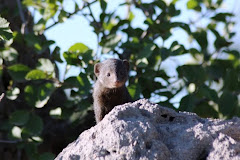
One of three porcupines that visit my compost heap nightly.

The problem is noise. My house is located directly across the river (about 200m away) from a commercial lodge, and one of the conditions of my living here is that I remain inconspicuous and make no noise.
Well, it all started harmlessly enough, with me tossing my household scraps onto the compost heap at night for the porcupines to munch. If the porcupines arrived before I'd put the scraps out (and I waited until nightfall to avoid attracting baboons), they'd trundle up to the house, making the dogs bark. Concerned about the noise, I'd dash out with the scraps, drawing the porcupines away and restoring peace.

Sadly, porcupines aren't dumb. With time, they learnt that the more the dogs barked, the quicker they got food. Now anytime they're feeling peckish they tramp up and down the garden fence, scraping their quills against the mesh and sending my dogs into a frenzy. And of course excited huskies don't just bark, they yip and yodel and give dreadful ululating howls, and it all sounds as if some animal is being torn limb from limb. Lodge guests don't respond well to this, particularly here, where poaching using dogs is rife. Thus eviction looms!

I'm currently shutting the dogs indoors when the porcupines come dog-baiting, and hopefully they'll learn that it's pointless. Fingers-crossed.

Wednesday, April 14, 2010

Telltale footprints

While searching for Bugbears today, I came across these tracks.

They followed the road for about 200m before veering off into the bush towards the dam.

At first I was completely baffled. They look like crocodile tracks but something isn't right. The curving line you can see on the left was made by the crocodile's tail, swinging back and forth as the animal walked. And on either side of the tail line you can make out the reptile's foot prints. But why are there two gouged lines?

A crocodile with two tails? Two crocodiles walking in single file?

It took me a while to figure it out, and then I felt stupid for not realising immediately: the crocodile was carrying something which was scraping along the ground.
It's not unusual to find crocodile tracks here, because the animals use the roads to move between rivers and dams. They can travel long distances, especially to exploit to temporary water bodies.

This dam in Bugbears' territory is about 2 km from the nearest water, and it dries up completely each winter. But within 24 hours of it refilling (at the start of the wet season), a large crocodile always moves in.

If disturbed far from water, crocodiles pursue the strategy beloved by tortoises and chameleons everywhere: they freeze and try to blend into their surroundings. Their camouflage is surprisingly effective out in the bush (and I've got the scars to prove it) but less so on the road. Several times I've come across large crocodiles stretched motionless across the highway. I think, 'Oh my God, it's been run over!' and start madly worrying how on earth I can get an injured crocodile to the vet. But as soon as the traffic is gone, the croc just gets up and marches off. And you'll be amazed the length to which motorists will go, NOT to run over a 3 m crocodile!

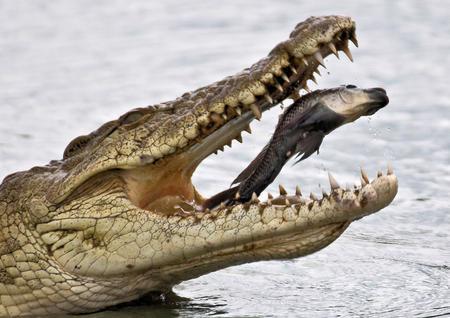
I don't know what today's crocodile was carrying at Bugbears, and I don't really want to think about it. The photos below will help your imagination conjure up images as vivid as my own. These pictures were taken by visitors to Kruger National Park (which is just next door) and posted on the Public Sightings Gallery at the South African National Parks' website. Check it out: it's amazing what people get to witness.

Baby hippo. Photo by Yolande Oelsen.


Fish. Photo by Peter Winnan.


Warthog. Photo by Bernard Steele.

Sunday, April 11, 2010

An afternoon stroll...


Walking the dogs here can be challenging.

The problem is, they like to chase wildlife. And yesterday, as I was being dragged headlong through the undergrowth (and let me tell you, huskies can drag), I began to feel nervous about what we might be pursuing. It's not as if I don't have cause: I've seen my dogs chase elephants, crocodiles, porcupines and mambas. And somewhere up ahead I could hear something big, growling.

As we emerged from a tangle of thorn bushes on to the fence line, I sighted our quarry: a large bush pig struggling to squeeze under the lower wire of the fence. Bush pigs (Potamochoerus porcus) are lovely: classically pig-shaped but with shaggy rufous fur and a long white mane that extends right along their backs. Their ears are tasselled at the ends and their faces patterned with white eye rings and side whiskers.
This is only the fourth time I've glimpsed the species (they're nocturnal and favour dense cover) but I was too preoccupied to really enjoy the moment. Bush pigs, you see, are famous for their viciousness when cornered (bailed up against a fence?) or attacked (by slavering huskies?). They are very powerful (weighing 60 kg) and use their 7 cm, razor-sharp lower incisors to slash at their adversary, leaving deep, vertical gashes. My vet says they're expert at disembowelling dogs. Fortunately - before we could put legend to the test - the bush pig managed to squirm under the fence and crash off into the undergrowth.

Bush pigs don't only use their tusks for self-defence. They tusk trees and vegetation, gouging out scars and applying an odorous secretion from their tusk glands. The pungency of this goo is heightened by the bacterial decay of vegetation in the pig's cheek pouches (located behind the upper tusks). It gets worse: bush pigs greet one another by blowing their breath into one another's faces.

Photo from Wikipedia.

Wednesday, April 7, 2010

‘tis the season to be anxious


Work-related stress is often seasonal.

Maybe it's the pre-Christmas rush that leaves you panicky? Or the build up to the financial year end? For me, it's the change of seasons.

No, I don't suffer a phobia about falling leaves or daffodils. I just can't cope with moulting mongooses.
Right now the mongooses are shedding their summer coats. This may seem unremarkable (they don't change colour after all) but it's really a crisis waiting to happen. Along with their fur, they lose their ID marks too.
Each mongoose in my study population has a unique ID mark so I can easily recognise who is doing what. Using a long-handled paint-brush, I crawl around the group while they're lounging at their refuge, surreptitiously dabbing a little blob of blonde hair dye on each animal's fur. Although the dye (which gives a golden colour) lasts only a couple of weeks, the bleached patch remains for around 6 months until the fur is shed.

Bugbears, last week, when they still had ID marks. Look closely to identify Cinnamon (right rib), Baloo (right shoulder) and Koda (upper tail).

Because it's been raining almost continuously for the last three days, I've been working at home. There's no point visiting the mongooses because they stay in bed when it's raining (or very hot, or very cold: the world's most civilised study animals). But today, with the sun shining brightly and everything sparkling and green, I set out enthusiastically. No go: every drainage channel, every tiny creek, is now a raging torrent of swirling, muddy water. Fortunately, I was still able to reach part of Bugbear's range (after some nail-biting creek-crossings), but was appalled to find that almost every animal had lost its mark! Sitting shivering in a leaky termite mound, what else has a mongoose got to do but grow fur?

Fortunately, I was able to figure out who was who from their various idiosyncrasies (Baloo has a missing toe, Black a scar on his neck, Iorek a bald patch under her chin from an old abscess, etc.) and I slopped the dye around accordingly. But I'm now freaking out about what's happening at the other three groups. It'll be at least a couple of days before the water recedes enough for me to reach them.
Yes, I know I could avoid all this bi-annual anxiety by marking the mongooses permanently, using freeze branding (the fur on their scar-tissue grows back white). However, I feel that burning sores into my mongooses is more invasive than I wish to be.

I guess I just cross my fingers and hope.

Two of the creeks I chose not to drive through today.

Monday, April 5, 2010

Wet and froggy


It's raining heavily today and my house is full of frogs.

I'm typing to the accompaniment of numerous 'pings' - as drips fall into saucepans - and I'm hedged in on all sides by books rescued from the flood that's seeping under my front door. The frogs, however, are having a great time. I've counted four species so far.

Apart from general wetness, I'm feeling bad because last night's storm flooded my tadpole dish, washing away half the tadpoles. Secretly, I'm also a little relieved. You see, about 8 weeks ago, while walking the dogs, I came across a patch of muddy ooze filled with 1000s of squirming tadpoles. The rains have been poor this year with several weeks elapsing between each rain storm. This is bad news for the local frogs who depend on temporary pools to breed. All summer I've been stumbling across almost dried-up puddles filled with writhing tadpoles, which I surreptitiously transfer to deeper pools. It's all been useless, of course: when next I pass, there's no trace of water anywhere. The ants are making a killing.
The Tadpoles that Lived.


Anyway, on this occasion, I scooped a few hundred into my water bottle and - unable to find an alternative - stuck them in my birdbath. This act of altruism (bunny-hugging?? frog conservation??) has been costly. The little blighters nibble their way through two lettuces a week, require twice daily water changes and - once they find their feet, so to speak - must be caught and transferred to a dish embedded in the garden. I'm getting a bit sick of it. I don't even know what species they are (at least two); fingernail-sized frogs are mighty difficult to identify.

More easily dealt with are those that are currently hopping around my feet.


The plain grass frog (Ptychadena anchietae)
is less than 2 inches long but is the most amazing jumper I've ever seen. They cross the room in one bound, nonchalantly leaping high over my head. The pets, who normally ignore frogs, can't resist giving chase, so these little guys go flying all over the house, ricocheting off the walls and roof before ultimately disappearing out a window. The sharp-nosed grass frog (Ptychadena oxyrhynchus) – which is what I think some of my tadpoles are growing into – is listed in the Guinness Book of Records for the longest amphibian leap: in 1977  'Santjie', a resident of Kwa-Zulu Natal, hopped 10.3 metres.

Tropical plantanas (Xenopus muelleri)
are supposed to live permanently in water. They're certainly built for it, with eyes perched on top of their heads and huge webbed hind feet that leave them virtually unable to hop. Covered in poisonous slime, they squirm across my floor and die within 12 hours if I don't put them outside. I haven't seen them in previous years; I assume the poor rains have left them besieged at the river and they're now out searching for newly filled pans. My house must lie on an ancient, plantana migration route because they're all utterly determined to traverse my lounge room.

Red toad (Schismaderma carens).
This large toad is a permanent resident. Although he eagerly gulps mealworms each evening, our relationship has deteriorated considerably since 'Take your toad to work day'. Of all the idiot places he's chosen to snooze the day away (and he's picked some doozies: in the toe of my boot, in the cats' food bowl, inside the teapot), his biggest mistake has been my backpack. Nestled away inside, he inadvertently spent the morning with me in the field and then accompanied me on my weekly shopping trip to town. I only discovered him when retrieving my wallet at the supermarket checkout; much to the cashier's consternation.

Saturday, April 3, 2010

How to find a mongoose


Regardless of how much you love your job, there's always some aspect of the work that's tiresome, frustrating or just plain disheartening.

For me, it's finding the mongooses.

Take today: while everyone else was happily munching hot-cross buns or overindulging on chocolate, I was out there struggling through thorn-thickets, hour after hour, totally failing to find my mongooses.

I've got nothing against radio-collaring study animals, but dwarf mongooses are – well – dwarf. The small collars they need have a limited battery life, so the mongooses need to be recaptured every few months. As a biologist working with wild animals, I believe that if it's possible to obtain your data non-invasively, you should, even if it means you're sometimes inconvenienced.
Just at the moment, I repeat this mantra to myself frequently. You see dwarf mongoose groups have territories of 30-40 hectares, and while it's fairly straight forward to find them eight months of the year, in the summer wet season, when the bush transforms into a lush, tangled jungle, the 'inconvenience' sets in.

So how do you find a 3-inch-high mongoose in 40 hectares of bush?
You get up early!
The mongooses sleep in the ventilation shafts of disused termite mounds, and each group has about 30 of these sleeping mounds in its territory. In the cooler winter months, the mongooses sleep late and lounge around their refuge for hours, soaking up the sun, romping in play and grooming one another. To find them, I simply have to check each of their refuges first thing in the morning.

Latrine left by Bugbears at their overnight refuge.

Even if the group has already set out foraging, I still know where to start searching because they considerately leave behind a latrine at their sleeping place. They are also very keen on scent-marking, so whenever the group passes a scent-marking site (and they have about 40 of these scattered through their territory), they'll smear pongy anal secretions on the logs and rocks, and leave a dropping or two. By checking these 'message posts' (all plotted on my GPS), I can track where the group has gone.

Keni contributing to Bugbear's latrine.

But in summer, everything goes pear-shaped. Firstly, the mongooses get up very EARLY. The moment the sun edges over the horizon, they come tumbling out of their mound, climbing over one another in a flurry to latrine, and hurrying off to forage. With daily temperatures reaching the high 30s or low 40s (Celsius), they can't afford to linger - by 9am they'll have to forgo foraging to lie about in the shade. So although I get up at 4 am, I'm usually not able to find them at their refuge. And the difficulties don't stop there. In summer the dung beetles are active. These poxy, little varmints come buzzing in the moment a mongoose defecates. They tussle over the droppings, gathering them up and rolling them away into the undergrowth. Within 10 minutes there is no trace of the latrine.

So I'm left tramping back and forth through the mongooses' overgrown territory, disconsolately sniffing at rocks and feeling thoroughly inadequate!


A dung beetle doing its dastardly deed.


Related Posts Plugin for WordPress, Blogger...