Monday, June 20, 2011

Today a gerbil, tomorrow the world

The first time I saw mongooses out foraging I went into shock (well, that's a slight exaggeration).

It was back in 1995, and I was on holiday in Kruger National Park.
I'd stumbled on a group of about 25 banded mongooses and they were busily searching for dinner around my car. Each animal was scratching through the leaf litter, poking its nose into likely holes and raking around under fallen timber. Every now and again one would unearth a cricket or a juicy grub from a pile of dung or noisily crunch up a beetle.

Now this I was accustomed to.

I'd spent lots of time watching Australia's marsupial carnivores (e.g. quolls, dunnarts, antechinuses) and they obtain their takeaways in exactly the same way.

But what amazed me was that the mongooses totally ignored one another. Here they were trotting about, only a foot or two apart, burbling away companionably and moving along as a troop, but no one paid the slightest attention to what anyone else was eating!

Now if a family of quolls or a pair of dunnarts are out foraging and someone finds a tasty morsel, it's a free for all!
Everyone one dashes over and there's squeaking and brawling and utter fur-flying chaos. Heck, even dogs and cats will rush over to investigate if a companion makes a killing.

I guess, in retrospect, I shouldn't have been so shocked because flocks of birds hunt like this all the time, but mongooses have FUR for Heaven's sake!

An eastern quoll (Dasyurus viverrinus). Quolls are Australia's best attempt at a mongoose; regrettably they're solitary and nocturnal.
Photo posted on Flickr by Shuttergirl3.

Sociality doesn't come easily to mongooses. Of the 37 species snooping about the world today, only eight (all African) have mastered the art of living together. You see mongooses are descended from a Christmas eve checkout queue of solitary, skulking killers and their physiques have remained unchanged for 30 million years.

But as the African climate dried out and savannah replaced forest, the mongooses – now perilously gadding about in the open – banded together so they'd always have someone to watch for predators. So, unlike other pack-living carnivores (such as wolves, lions or dholes), the mongooses ganged up to outsmart the beasts that ate them, rather than to up-size the beasts that they ate.

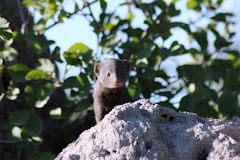
So while my little dwarf mongooses are now among the planet's most sophisticated socialites, at mealtimes their ancestral proclivity for independence shows through: everybody does their own thing, together.

Now I've explained all this, I'm going to contradict myself by describing the hour I spent with Ecthelion yesterday morning.
They were gerbil hunting - cooperatively.

I've only seen my mongooses behave this way a couple of times before, but it's always disconcerting. Their quarry, the local bushveld gerbils (Gerbilliscus leucogaster; you can see a photo of one here), live in big colonial warrens which they dig in sandy soil.
And yesterday morning, Merlin sniffed out an occupied warren. He immediately hollered for the group with a special rodent-hunting call (a bubbling, staccato version of their usual 'follow me' squeak) and the group came running. While Merlin and one or two others dug madly at the warren's main burrow entrances, everyone else milled about excitedly, watching and sniffing, pushing their noses down the many minor entrance holes, and peering under logs or into clumps of grass. They were all searching, impatiently, for any gerbil foolish enough to flee its underground home.


Putting in the spade work.

'We seek him here, we seek him there...'

Now this cooperative effort isn't exactly egalitarian because the group's reigning monarchs will filch the spoils from anyone who manages to bag a rodent. However, gerbils are big (about one-third the size of a mongoose, which makes the kill protracted, noisy and traumatic for soft-hearted observers), so lesser group members are usually able to snatch up some bloody, dismembered bits.
At the last hunt I witnessed, Koppiekats (a group of 18) snagged three of the five fleeing gerbils, and eight mongooses scrounged a meal.


The Lazy Mongoose's Guide to Gerbil Hunting.

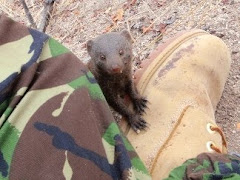
Ecthelion's hunt wasn't successful (to my secret relief) as the gerbils refused to be flushed, and after three-quarters of an hour the 15 milling mouse-hunters were getting frustrated. Widening their search area brought them over to where I was sitting, with my backpack on the ground beside me. I should have foreseen this, but they began eyeing my bag speculatively, and I could see them thinking, 'Well if we can't find them anywhere else, they must be hiding in there'.


'"They must be in that bag..."

Soon half the group was lined up in front of me, glaring accusingly, convinced that I was harbouring their missing rodents. (Do they know me better than I realise?). Since I could think of no conceivable way to convince a group of mongooses that my backpack was gerbil-free, I shouldered the offending article and withdrew. They immediately called off their hunt ('Well, she's pinched the booty!') and headed off to forage normally.


"Gimme the gerbils!"

Now I know that dwarf mongooses hunting gerbils is not on a par with chimpanzees killing monkeys, but there's something worrying about these little creatures teaming up to bring down prey.
Sure, today it's just a few pesky gerbils, but where will this lead?
How long before I come across a felled duiker or a warthog nibbled off at the knees?
Come to think of it, aren't hyenas supposed to be descended from ancestral mongooses?
THAT'S where it will lead!

Just don't say I didn't warn you...

Friday, June 17, 2011

Finding faerie fauna

There are fairies at the bottom of our garden!
It's not so very, very far away;
You pass the gard'ner's shed and you just keep straight ahead -
I do so hope they've really come to stay.                                    

                                               The Fairies.
                                               Rose Fyleman


These are the opening lines of a poem written in the 1920s after a series of fairy photographs had taken the world by storm.

The photos were snapped by two young cousins (Elsie Wright 16 and Frances Griffiths 10) at Cottingley, England. The girls borrowed Elsie's dad's camera and photographed cardboard cut-out fairies (copied from a children's book and fixed with pegs) to persuade Elsie's mum to let them play down by the creek (where the fairies lived).
Mr Wright was so annoyed at their prank he refused them further use of his camera, but his wife believed the girls' story and passed the pictures on to the Theosophical Society. Once the society had established that the photographic plates hadn't been tinkered with, a prominent society member – Sir Arthur Conan Doyle (creator of Sherlock Holmes) - declared the photos authentic, sparking fierce worldwide debate.


One of the purported fairy photos:
Frances Griffiths with the Leaping Fairy.
Image source: Wikipedia.

Elsie and Frances didn't come clean for more than 60 years.
In the 1980s Frances explained,
"I never even thought of it as being a fraud – it was just Elsie and I having a bit of fun, and I can't understand to this day why they were taken in – they wanted to be taken in."

This incident (dramatised in the 1997 film Fairy Tale: A True Story) illustrates our deep-seated need for magical entities. Whether they're dryads, fauns and sylphs, pixies and gnomes, or elves, ents and hobbits, we show an incredible determination to populate the natural world with mystical beings.
But why?
Do we really need nature spirits to feel the enchantment of Nature?

Living here has influenced my thoughts about this. You see it's almost impossible to venture outside without feeling like you've slipped into the world of The Magic Faraway Tree.

All around there are rustles and scurries; an eerie trembling in the grass, a twitch of foliage seen from the corner of the eye, the ever-present feeling of being watched... An eye glints from a rock crevice, a wizened face peers down from the leaves or a huge horned figure looms darkly against the twilit sky.


One of the nature spirits that live at the bottom of my garden: a grey duiker (Sylvicapra grimmia).

Of all the local nymphs, the bushbucks are the most impressive. Haunting leafy thickets, they tiptoe past with an uncanny staccato, high-stepping walk; placing each hind hoof precisely in the print of the forefoot. When alarmed they freeze, disappearing magically into the dappled underbrush. You can look straight at them and see nothing, and then, quite suddenly, there's a face! Right there, staring straight back at you. It's like those optical illusions that jump unexpectedly from vase to human silhouettes and back again, only it's a lot more startling.

A bushbuck sylph. The home-range it uses by day is completely separate from the one it haunts by night.

After experiencing the African bush, I can't help but think that it's the loss of this life-brimming habitat that's created our need for magical entities.
Maybe we conjured a panoply of nature spirits to replace the wild beasts we'd driven away, and to populate northern lands that lie bereft of fauna for half the year. Are we simply trying to recreate our ancestral home: the abundant environment in which we evolved for millions of years?

So what's prompted this reverie on the origins of faerie fauna?

Well a couple of days ago I encountered a little Elemental more adorable than any human mind could conjure.

The dogs and I were returning from our evening walk when we rounded a corner to find a newborn bushbuck lamb standing by the track. 'Standing' isn't entirely accurate; it was sort of teetering on weirdly propped legs. Only knee-high with fluffy dark fur, huge bat-ears and a puppy's wet nose, it gazed at us, all bright-eyed with curiosity. And then, to my horror, it came tottering straight toward us! Of course my dogs went berserk, straining violently at the leash in their attempt to reach it. While I wrestled wildly with the dogs, it wobbled closer and closer, stopping only a metre (3 ft) from their slathering jaws.

I didn't get a photo of this spell-binding creature (although it stood gazing at us in wonder for at least a minute) because I needed both hands to constrain the dogs. I'm sorry I didn't snap my fairy-encounter because images of day-old bushbucks are even rarer than genuine fairy photos.


An anal-retentive fairy? Baby bushbucks won't urinate or defecate unless licked by Mum, and she gulps down all predator-attracting trace evidence (nothing like maternal devotion!). This little cutie is a few days older (and much lighter) than the sprite I met.
The photo was borrowed from here.

Many of the local antelopes leave their newborns hidden in the bull-rushes shrubbery for their first few days or weeks, but bushbuck mums go to an extreme. Their ankle-biters spend four months lying out alone (I wonder if they have imaginary friends?). And they seem to have the gift of invisibility because I've never before glimpsed a bushbuck less than two months old.
So why was this little creature approaching us? In fact, why was it even tottering about at all; I was certain we hadn't flushed it from its hiding spot? Was it a starving orphan? Was it currently imprinting on my huskies, and would be scarred for life (in every sense of the phrase)?

Then the answer suddenly materialised.
Mum, who'd been standing invisibly right next to us (undoubtedly biting her nails hooves to the quick), could stand the tension no longer. She leapt away into the undergrowth, and Junior, realising that something was amiss, wobbled away after her.
I gave a huge sigh of relief.
We must have stumbled on the pair during one of Mum's twice daily visits and her little darling was so obsessed with the prospect of guzzling milk, it paid little heed to who provided it!

Now with encounters like that, who needs fairies?

Back in 1918, Frances Griffiths mailed one of her fairy photos to a friend in Cape Town (where Frances had spent much of her life). On the back of the photo she wrote,
"It is funny, I never used to see them in Africa. It must be too hot for them there."

I'd suggest that there's just too much competition.


Puck? No, a young male bushbuck (Tragelaphus scriptus). Unlike other solitary antelopes, bushbucks aren't territorial (except perhaps mature males) and they enjoy a bit of company. When two meet, they greet each other cordially and mosey about together for the next hour or two.
Photo posted on Flickr by bwana4711.

Tuesday, June 7, 2011

This morning I showered with a murderer

I did it yesterday too.

Now you mustn't imagine that I enter into such liaisons lightly.
But there's only so long that one can go unwashed in order to avoid unsavoury company.

Maybe I should start at the beginning...

About a week ago, I woke at 3 am to the sound of screaming.
Never a good sign.
The dogs, Wobbly Cat and I hurtled out of bed, in a tangle of blankets, flailing limbs and stepped-on paws, and blundered to the bathroom; source of the shrieks. What we found was grisly.

Now I want you to imagine the shower scene from Psycho. Not the bloody bit (which, by the way, was actually the chocolate saucy bit, because Hitchcock thought stage-blood looked wishy-washy in black and white) but the suspenseful build-up. OK, you need to tweak things a little; make the victim rather short and dumpy, and she's snoozing in the cubicle rather than actually showering, but otherwise everything is bona fide horror movie.
The assailant's stealthy approach, the victim blithely unaware... the weapon silently raised, ready to strike... And then AAAAHH!

Well we stumbled in at the AAAH part to find the killer dangling from the light fitting with the terrified victim struggling in his jaws. This was disturbing because the victim was a friend; she'd lived in my house for more than a year. OK, I admit she was a frog, but foam nest frogs are endearing creatures. Creamy coloured with huge jewel eyes and suction-pad toes, she'd munch any mealworm tossed her way, and - along with her gentlemen friend - had faithfully guarded the entry to my shower for the last two months; one atop each door post like a pair of animated gargoyles.

And now here she was scrabbling frantically in mid air, squawking in distress, with the killer's jaws clamped over her back and her huge hind feet wind-milling.


My dearly departed southern foam nest frog (Chiromantis xerampelina). R.I.P.
You can read about this critter's idiosyncrasies here.


And the perpetrator? Still only half-emerged from a small hole in the ceiling, the assassin was slicked out in glistening brown. He was, of course, legless (what else would a snake-phobic expect to find in their bathroom at 3 am). Not large enough to send me into a full-scale panic attack (at a bit less than a metre long (2' 6") and 2 cm (0.8'') thick), the murderer glared down at me with the eyes of a cat: bright gold with a vertical pupil.

'The Beast, I presume', I thought grimly.

Those of you imprudent enough to follow this blog will know I live in fear of The Predatory Beast that haunts my ceiling. Since I've never had the courage to climb up and identify The Beast (you can read of my ongoing cowardice here and here) I guess it's inevitable that he would eventually come to me. But at 3 am, identifying him was beyond me (actually that's an excuse; it's beyond me at anytime).
Was this snake venomous? Was it dangerous?

The frog's shrieks and cries were so heart-rending I considered launching a rescue mission. After all, how in Heaven was this snake going to gobble down an amphibian four times wider than his own head? Yet something in the snake's bitterly determined, clamp-jawed expression ("All I have to do is keep my mouth shut and wait") suggested my shower accessory was already doomed. The pets and I trudged sadly back to bed and lay trying not to hear the pitiful – and now weakening - shrieks.

By 6 am, I knew I had a problem. The snake was still hanging from the bathroom light, his head and throat bizarrely distended to accommodate the first inch of limp, dangling frog. And to me, it was appallingly clear that - like Pooh Bear after a honey binge – this snake, post breakfast, was not going to fit back through the hole from whence it came. Oh God!


The killer - a marbled tree snake (Dipsaloboa aulica) - was identified, from a mug shot, by the folk at SA Reptile Forum. (I guess I'm now honour-bound to stop suggesting they're a little bit barmy). The bulge on the perp's right side is my friend's hind feet, and the rest of her is contained within the swelling on the left.

I didn't photograph the whole frog-swallowing thing (sorry) for fear that any intervention by the paparazzi might induce vomiting, and my friend would then have died in vain. Marbled tree snakes hang out in lush riverside forest in the lowveld (a strip of low-altitude, bushy savannah edging South Africa's eastern border). They specialise in hunting tree frogs and geckos by night and, although venomous, they aren't considered dangerous to people (fingers crossed). I suppose it's fitting that my resident tree frog should die at the hands fangs of an arch nemesis.

By 7 am, breakfast was consumed (miraculously) and The Beast retreated to my shower cubicle, coiling up neatly in the grooves of the aluminium frame over the doorway.
He's been there ever since.


Ophidiophobia mutating into ablutophobia (fear of snakes, and bathing, respectively). This photo was taken from inside my (tiny) shower cubicle looking up at the lintel. When I'm showering, those coils are only 1 foot from my nose; genuine immersion therapy.

Initially I abstained from showering (hoping to wait out the digestion period), but the creature's shown no inclination to leave even now he's svelte. Bathing is tense for us both: he tightens up into a bundle, with just his snout peeping out over his coils, and I edge nervously into the cubicle and press myself against the far wall. We then try to avoid making eye contact more than, oh, forty times per shower. He's an awesome water saving device though.

Figuring that he was pretty harmless, I'd resigned myself to his winter-long presence (snakes have to hibernate somewhere I suppose), but then one of my resident toads came hopping into the bathroom. Instant serpent action! Arrgh! I didn't know snakes could move that fast. Fortunately, I managed to shove the toad out the door before tooth-contact was made, but my fumbling attempts at snake removal (unravelling coils from the light/toilet/tap/shower-head/sink using a broom handle) were laughable (yes, I know snakes don't laugh, but he was doing his best).


Making light of murder. My resident snake (I go cold just writing those words) enthusiastically making dinner plans.

So The Beast continues to squat in my shower cubicle believing my bathroom is a larder. And I'm getting neurotic trying to remember to keep the bathroom door closed to avert further carnage.

Ahh, don't you just love snakes...

My squatter expressing his feelings toward the landlord.

Saturday, May 21, 2011

The month of yes you May

Tra la! It's May!
The lusty month of May!
That lovely month when ev'ryone goes
Blissfully astray.

It's here, it's here!
That shocking time of year
When tons of wicked little thoughts
Merrily appear!

                          
                     It's May! Camelot, the musical.


Now I appreciate that the Arthurian legend originated in the UK, and that Camelot, however mythical, was never situated in the southern hemisphere.
So the above song must refer to the delights of spring.
Nevertheless, it's entirely appropriate to what's going on here right now.

Outside, my neighbours are rushing around in a frenzy of lust.
The air is reverberating with the bellows of macho guys proclaiming their supremacy, and furtive couples peep from behind every bush. 

Yep, it's the mating season. Tra la!

And don't imagine that I've escaped unscathed.
Every day I'm meeting tall, dark strangers who threaten to sweep me off my feet (and trample me under foot hoof too, but I guess you can't have everything).


Winning by a neck. When push comes to shove, a greater greater kudu (Tragelaphus strepsiceros) will win the ladies.
Photo by Arno & Louise Meintjes.

It's all very hectic. Pumped up on a seasonal high of testosterone, the kudus and waterbucks are strutting around like body-builders with a severe case of mumps, and the wildebeests are actually frothing at the mouth. OK, I don't blame the wildebeests. Around here the species doesn't migrate, so the males have been sitting about alone - minding their territories - for the last eleven months. It's understandable that they're a wee bit excited now. They've got just three weeks to get a bit of the action.


You wanted what??

The territories of male wildebeests are absurdly small (around 1 ha/2.5 acres) but, despite this intensive living, fewer than half of the adults manage to bag a suitable domicile. You see any old bachelor pad won't do; it must be a chick-magnet. And when the girls do come wandering through, all Hell breaks loose. The resident bull dances out to meet them, showing off his best rocking canter and calling feverishly (pinch your nose and say 'G-NU' in a deep voice).

For as long as there are ladies visiting, he hasn't time to eat or rest. And all those civilised rituals - of head-shaking, kneeling and ground-horning - that he's been exchanging with neighbours for months, are forgotten. Any male fool enough to poke his nose in, simply gets head-slammed.

When lady guests are present, a male dashes about herding them away from the neighbours and blatantly checking out the talent. With nose and tail outstretched, he sniffs butt, and the girls oblige by dribbling a little tell-tale urine for him to taste. (Yes, it does make his lip curl, but this wafts the pee into his vomeronasal organ for chemical analysis, and does not signify impoliteness or any disrespect for the fairer smaller sex).

When in heat, female wildebeests are usually ready and willing, but if some little floozy starts giving him the run around, he reminds her of what she's missing by rearing up in front of her with a full erection! 

Male wildebeests (Connochaetes taurinus) are not sophisticated lovers. They repeat the act of love dozens of times (twice a minute) for as long as their partner will stand still. But you can't fault them on efficiency: adult females enjoy a conception rate of 95%.

Of course, in the heat of the moment, it's easy for an excited Romeo, wildly pursuing a coy lady friend, to fail to notice a researcher sitting quietly, surrounded by small, busy mongooses.
So far, no one has actually made hoof contact, but there have been some pretty near misses. And the way I've been feeling lately (after losing two of my three cats to Feline Leukaemia Virus), I'm tempted to fling myself down before them, crying, 'Bring on the hooves!'


But I guess trampling isn't likely to be fatal.


Love is in the air... At four months old, this little guy won't join the landed gentry (who corner the mating market) for 4 or 5 years.
But, come on, it doesn't hurt to try!

But much more annoying than amorous wildebeests (everyone loves a lover, after all) are the male waterbucks. These large shaggy antelopes also hold down territories year round, but they're more up-market in their choice of real estate. As suggested by the name, waterbucks must drink daily (slurping up 25% more water even than cattle) so snagging property with water-frontage is a real boon. However, prices are exorbitant and battles fierce.

So for me, driving home (on a track that follows the river) is like blundering into a film shoot of Gladiator. The horse-sized warriors stand broadside on the road, necks arched, tails stuck out and eyes locked. Without warning, they leap toward one another, thrusting and parrying, but without making contact. Eventually someone breaches the gap, slamming into their opponent with a terrifying crash, and the pair staggers back and forth, horns locked together in a battle of might.

Fighting fit. The horns of male waterbucks (Kobus ellipsiprymnus) are heavily ridged so they lock with a rival's weapons, reducing skewering accidents. The male's neck and shoulders are also armour-plated (with 2 cm/0.8" thick skin) but stab wounds to the chest or belly can still prove fatal. Photo by Johann du Preez.

But unlike sparring impalas or love-smitten wildebeests, battling waterbucks let NOTHING distract them. A car? So what.
One evening, as my dogs and I sat in the car waiting (as usual) for two huge males to sidle aggressively back and forth across the road, Magic leapt out of the window. Yapping hysterically, she raced over to lunge and snap at the combatants' fetlocks.

I stopped breathing, envisioning my beloved dog impaled on a 2m (6ft 5") long lance. But I needn't have worried; the champions totally ignored her. Not even a glance.

After a few minutes of valiant effort, she trotted forlornly back to the car, looking as if all joy had gone from the world. Wizard, who's long harboured a mistrust of waterbucks, watched this silently from the security of the vehicle, and then gave me such a look of 'I told you so' that he might as well have uttered the words.

I'm not even going to mention the lunatic way the impalas (Aepyceros melampus) are behaving right now, since I talked about them last breeding season. Suffice to say that any animal whose grunt is audible for 2 km (1.2 miles) should be a little bit more circumspect in its mating habits.
Photo by John Samuel.


Tuesday, May 17, 2011

So you think you know why animals play...


For this post I need to redirect you to Scientific American's guest blogs.

Don't worry, it's no more scientific than usual (hope they don't mind!).


Friday, April 22, 2011

Running scared

Running just isn't my thing.

I've never understood what people gain from jogging (apart from joint problems) or why any sane biped would want to run a marathon.

Of course I did do cross-country running for PE back in high school (we jogged out the school gates, sauntered to a friend's house, drank coffee for two hours and then jogged back in through the gates). I guess that doesn't count.

However, since coming to Africa, I've discovered that there are times when I'm happy to run with the best of them.

And yesterday was one of them.


The occupational hazards of a mongoose researcher: I've taken to my heels to avoid ostriches, bulls, poachers, rhinos, elephants and a hand-raised ground squirrel. Said demonic ground squirrel (sporting HUGE teeth and an ankle-biting fetish) shown above.


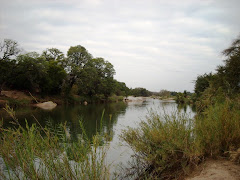
When I first moved into this house (located right on the banks of the Oliphants River) I was very cautious about walking by the water's edge. You see this river is home to a multitude of Nile crocodiles: little cute teeny ones – goggle-eyed and stripy in black, yellow and green - who high-tail it for the water the moment they see you, up to massive behemoths 5 m (16.5 ft) long who just lie there and watch as you pass. They bask on the beaches, waddle along the roads between river and dams, and creep out at night to drag away anything unwise enough to die within 500m of the river.


A Nile crocodile (Crocodylus niloticus) paddling in the dam near my house. When I stopped to photograph his grisly prize (an ill-starred waterbuck the size of a large horse), he hastily towed it further off shore.

So when it came to walking with my dogs in the river bed, I was initially very wary about getting too close to the water. After all, I'd seen those scary wildlife documentaries where the crocodiles leap out of the water to snatch milling wildebeests off the bank. And let's not forget killer whales, beaching themselves on the sand for a mouthful of unsuspecting seal pup.
You simply can't trust aquatic predators to stay in their rightful element.

Yet after three years of riverbank rambles, free of anyone trying to eat me, I've become a little blasé.

Well yesterday I got a shock.

The dogs and I were wending our way along the river bed, ploughing through the drifted sand and clambering over rocks, when I spotted a huge crocodile basking on the beach of a mid-stream island. It was one of the really massive ones, close to 4 m (13 ft) long and it looked more like a felled rainforest tree than an actual animal. I cannot describe to you how awesome these creatures are. It's not so much their length as their immense bulk; they can weigh up to 1000 kg (2200 lbs). I can never look at them without shivering inside and feeling that reptiles simply should NOT get this big. And they've effectively cured me of a lifelong desire to meet a dinosaur.


The world's worst photograph of a mammoth crocodile (sorry!). Crocs have all sorts of spiffy adaptations, like a palatial valve (a fleshy flap at the back of the tongue) which seals their throat when below water. Normally crocs dive for up to 15-20 minutes but, when harassed, they can stay below for 2 hours, reducing their heart rate to 2-3 beats a minute and closing their heart valves to redirect blood to only essential organs.


The dogs and I picked our way across the sandy beach toward the creature, stopping about 3 m (10 ft) from the water's edge. I'd been a bit hesitant about approaching it so directly as I didn't want to disturb it, but these big guys tend to be very confident and there was about 25 m (82 ft) of fast-flowing river swirling between us. The dogs, of course, simply didn't see it (they never see crocodiles unless they move) and I was keen for them to do so, so they'd understand why I keep insisting the water is dangerous.

While we were standing on the beach, enjoying the vicarious thrill of gazing at such an awesome predator, the awesome predator lurched to its feet - standing up on fully straightened legs (called a 'high-walk' in crocodile parlance) which made it waist-height - swung round to face us and plunged into the river. It came surging toward us through the water at full speed (about 15 kph/10 mph according to the books), and it took me a moment or two to realise, 'hey, it's coming straight at us!'

Coincidence, surely.

I walked a few steps downstream and it immediately altered its path so its trajectory would intercept us.

Oh God!

By now it was half way across the river and I felt a rush of alarm, disbelief and dismay as I realised we were now on the menu. I envisioned the beast hurtling out of the water in front of us; a creature at least ten times my own body mass.

It was at this point that I turned and ran.

Fast.

I'm afraid I cannot tell you whether the crocodile actually emerged on to our beach, as I didn't stop to look back.
And neither did the dogs.
We just ran.

And from now on, I'm going be to very cautious again!


I thought you should see what these big guys are capable of. If you go here you can view a series of eight photos showing what happened during this horrible interaction.
Photo by Martin Nyfeler/Barcroft Media, and posted on Flickr by Arno Meintjes.


Related Posts Plugin for WordPress, Blogger...