Showing posts with label rock flipping day. Show all posts

Monday, September 10, 2012

Flipping uncertainties

Yesterday was International Rock Flipping Day.

No, it wasn’t a day of wild celebration for stone-skimming enthusiasts, nor a day of reckoning for designers of rockeries.

On this auspicious day stout-hearted folk from around the globe head out into the wilds to turn over boulders and see what weird and wonderful critters are loitering underneath.

Now each time the event rolls around I’m faced with a quandary. I like the idea of all this collective rock-flipping but quail at the prospect of actually shoving my fingers into the murky haunts of venom-toting beasts.
OK, you may think I’m being overcautious, but the rocks around here harbour 3m (9.5 ft) long black mambas, bad-tempered puff adders and at least two species of cobra (one of whom spits venom with llama-like gusto). It’s a constant fight to keep these creatures out of my home without voluntarily invading theirs!

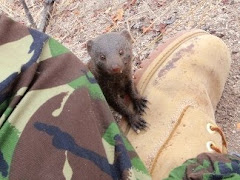
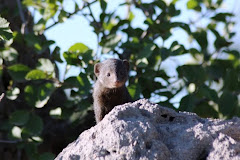
In the past I’ve deviously circumvented this dilemma (see here and here), but this year my ingenuity failed me and I decided to give Rock Flipping Day a miss. So averting my eyes from all rocks, and trying to ignore the skinks and flat lizards skittering about on every outcrop, I set off to find my mongooses. After one and half hours trudging through the heat, scouring the length and breadth of Koppiekats’ range, I finally found the group sprawled in the shade right beside my car.

And they were lying under rocks.
Hmm...

Although I only had my old point-and-shoot camera with me, I dutifully lay in the dirt on my stomach and tried to take some (bad) under-rock photos.


Whatta you lookin at?

What dwarf mongooses (Helogale parvula) do under rocks.

'There are older and fouler things than orcs in the deep places of the world.'

Rock crevices are ever popular when jackals, honey badgers or dogs pay a call.

OK, I admit I didn’t flip anything. But I also didn’t die a slow and painful death by envenomation.
And I defy anyone to find something cuter under a rock.

To discover what the world's other (genuine) rock-flippers found beneath their rocks, check out Wanderin' Weeta blog.


Monday, September 12, 2011

Canniness, cowardice or flipping fraud?

Yesterday was International Rock-Flipping Day.

All around the world eager naturalists were out there turning over rocks and recording their discoveries.

Now this is such a fun idea, I always want to take part... until the actual day.

Then two niggling little doubts start gnawing at my enthusiasm.

What are these misgivings?
1. I will die.
2. I will kill something.

OK, I realise that plenty of people flip rocks in places where deadly critters slither and scuttle in dim, dank crannies. But heck, I really don’t want to stick my fingers under there!
Last year I managed to avoid the whole finger-fang close-encounter bit by fortuitously stumbling upon a rock monitor snuggled away in a rock crevice. But what were the chances of repeating such a serendipitous find?

I was mulling over the problem when it hit me that this was the same conundrum that I face professionally every day. You see I’m always trying to figure out ways to obtain the data I need without inflicting harm. If the aim of rock-flipping is to document what’s living under the rock, isn't there a less invasive way to get the info? Why not find a rock that’s clearly someone’s domicile and try to coax the resident out?

Now I was secretly very pleased with this solution, because although it was primarily motivated by my aversion to legless beasts, I could sell it as a commitment to animal welfare. Triumph!
Umm... but would it work?

Well yesterday, after visiting the mongooses (who were appropriately hiding underneath rocks to avoid the attentions of a black-breasted snake eagle), I set out on a binge of non-invasive rock-flipping.

Clutching my camera, a Tupperware container of mealworms and a water bottle, I tracked down a suitable rock.


The rock. OK, I know this behemoth is way beyond the provenance of conventional rock-flippers, but someone’s got to hang out under there.

Sloshing some water about, I sat down in front of this rock to wait for the alluring aroma to work its magic.
The first face to appear in the gloom beneath the overhang was that of a lady rainbow skink. She made straight for the puddle.


A female rainbow (or five-striped) skink (Trachylepis quinquetaeniata) enjoying a thirst-quencher. Youngsters and adolescent males also dress in female garb to avoid the aggro of territorial males (who wear orange).

Yum!

When I tossed this intrepid pioneer a mealworm pupa, I was immediately surrounded by zipping reptiles. Among the many skittering rainbow skinks were some slicker, racier models.
These were lady common flat lizards.


Common flat lizards (Platysaurus imperator) are dorso-ventrally challenged so they can squeeze under rocks. They favour high density living, and although girls such as this one lay only two eggs annually, she and her rock-mates put all their eggs in one basket crevice.

“Too much lippy?” Flat lizards can live to fourteen in captivity.

I’d been divvying out mealworms for quite a while before the reigning monarch of the flat lizard colony deigned to emerge. In keeping with his status, he was a little more reserved than his courtiers, but I guess it must be difficult being the centre of attention all the time.


Flaunting the royal colours. His highness defends the rock face upon which his harem and progeny live.

Why flat lizards are flat.

When the mealworms were almost spent, a large shadowy figure appeared beneath the rock overhang.


This giant plated lizard (Gerrhosaurus validus) gave me the evil eye but wouldn’t emerge any further. She belongs to an ancient group of lizards (which includes the girdled lizards) endemic to Africa.

Giant plated lizards are... well... giant. They grow to a whopping 70cm (2ft 4in) and hang around in family groups. If you startle one when it’s basking it'll toboggan down the rock face on its tummy (not that I enjoy doing this, of course). Although these lizards guzzle berries and flowers, they’re also keen hunters, tracking down bugs and small vertebrates using their flickering tongues. My dwarf mongooses often run into them, and while this is a non-event for most of the year, during the summer breeding season (when both species have bite-sized young) suspicions run high. Exactly who chases whom depends on which species’ nursery is nearest. Mongoose pups, just big enough to look after themselves, find these scraps endlessly exciting.

After failing to coax mum from the shelter of the rock, I was just wondering whether to call it a day when junior appeared.


A non-giant giant plated lizard.

This little juvenile shared none of mum’s reticence and came dashing out into the sunshine in pursuit of mealworms. In fact, much to my surprise, it came zipping straight up to me, even climbing up onto my shoe to plead for further handouts.


“Please, please, just one more...”

So all in all, I feel that my non-invasive rock-flipping went quite well.
And all of us are still alive!

You can discover what other rock-flippers found beneath their rocks at Wanderin' Weeta.


God’s own creatures contributing to my under-rock species count.

Sunday, September 12, 2010

Flipless rock flipping


Today is international rock flipping day.

Nature bloggers from around the world are out there vigorously overturning boulders and stones, and recording all the grisly details of what's underneath.

Unfortunately, my intention to take part in this global event began to waiver as the big day approached. A little nagging voice kept whispering, 'Don't you encounter enough life-threatening beasties without going looking for them?'
My resolve was further eroded by today's cool, blustery weather – perfect for cobras, mambas and puff adders to be hiding snugly in subterranean crevices.

Maybe if I flipped only little rocks...

Of course, there were still the scorpions. But only two of the thirteen species that live around here are actually lethal to adults... If only I didn't have to stick my fingers under the to-be-flipped rock before I knew what was underneath!

Then this rock saved the day.


Alright, I admit I didn't flip it.
Herculean strength (like courage) is not one of my blessings.
To be totally honest, I wasn't even thinking about flipping rocks; I was crawling about in search of a trace of Koppiekats. As I peered into this crevice, diligently hunting for mongoose poop, I was startled to see an eye.

Can you see it?


Of course, the eye was equally startled to see me.
We gazed at each other for a bit, before I dashed to the car for my camera. I was jubilant. After all, I'd definitely found this creature under a rock - so it must qualify - yet I'd managed to evade 'death-by-venomous-beast'.

Appropriately, my saviour was a rock monitor (Varanus exanthematicus).


These heavy, thickset lizards grow to more than a metre (3 - 4 ft) and like to loiter in rock crevices, disused mammal burrows or hollow trees. This one was pressed as far back into its crevice as its bulk would allow. It had even folded its stumpy forelegs back along the side of its body for a better fit. Of course, you can't blame it for shyness; I wouldn't be forthcoming either if my scientific name meant 'skin eruptions' in Greek.

Impressive claws: all the better to scratch you with.

Of the 30 species of monitor that stalk the earth, only three live in Africa, and only two hang out here. I could see this one wasn't a Nile monitor (V. niloticus) because of its stubby, bulbous snout, and the weird placement of its nostrils (nearer its eyes than nose tip). Monitors (called leguaans in South Africa) have long forked tongues that they flick in and out as a snake does. Unlike most lizards, their tongues have no taste-buds, and are designed solely to pick up molecules and insert them - for chemical analysis - into the double opening of the vomeronasal organ on the roof of the mouth. However my prone monitor was clearly playing the cryptic card and appeared to be concentrating very hard on flicking nothing (maybe I just smell appalling).

This rock monitor (also called savannah monitor) was photographed on a previous occasion.

September is the season of love for rock monitors, but I'm not up on how to sex non-furred critters; particularly ones that defend themselves by lashing a hefty tail, biting and holding with bulldog-like tenacity, and squirting out the nauseating contents of from their cloacae. Of course, if all else fails, they sham death. I could probably handle that.

If this one was female, she'll bury her 10 to 40 eggs (soft-shelled and the size of small hens' eggs) in a deep pit dug in the rain-softened soil. Although the eggs take four months to hatch in captivity, out here it's usually twelve. Why? Well there's no point in leaving your egg if the soil above you is rock hard because of the dry season. Does this mean - that at this very moment - there are hundreds of little monitor lizards sitting inside their eggs, drumming their toes and waiting for the rain? Well I never.

Although rock monitors mostly dine on millipedes, beetles and land snails, they're also very fond of carrion and any animal small enough to scoff down (including mongoose pups). Do you recognise the crevice in the photo below? Yep, it's the same one; only here it's sheltering a little Koppiekat pup.


 To discover what other exciting creatures the world's (much braver) rock-flippers have found, visit the compilation at Wanderin Weeta.
Related Posts Plugin for WordPress, Blogger...