Showing posts with label rodents. Show all posts

Sunday, July 29, 2012

A prickly situation

I am besieged.
Outside my door is a gang of heavily armed assailants. They’re stamping their feet, rattling their weapons and chanting war songs.
Five are picketed outside the window, but I know they’ve reinforcements waiting in the shrubbery.

They’ve come for provender, and they won’t go until they get some.

Alright, I admit it, they’re only rodents.
But they’re SERIOUSLY scary rodents.

You can forget all that tremulous, big-eyed, be-whiskered stuff.
There aint no wee cowrin, tim’rous beasties here.
The creatures patrolling my garden weigh in at 12-18 kgs (26-40 lbs) and stand waist-high when agitated.
Their endlessly-growing incisors are the very least of my concerns.


What I face nightly when I venture out my door.
The troops at my compost heap, noshing on their ill-gotten gains.

Disconcertingly, Cape porcupines (Hystrix australis) hang out in mobs. Big mobs.
You see, like many African beasts, they’ve gone cooperative.
Mum and Dad are so profoundly dedicated to one another that their progeny can’t bear to leave the family home, and they stay on, year after year, with everyone pitching in to help rear their little brothers or sisters. Now you might consider this laudable (and I’m the first to applaud it in darling mongooses), but something’s gone horribly awry in porcupine society.


Cape porcupines are a romantic lot. Couples are sexually active all year round even though Mrs Porcupine can only conceive for 2-3 days annually (and she won’t even do that unless she’s enjoyed the attentions of her spouse for at least 3 months). Her hubby’s penis (which sports small prickles!) is equipped with a baculum (shovel-shaped bone) and a backward-facing opening (no, I don’t know why). And despite the couple’s devotion, he doesn't take risks: his semen quickly sets into a jelly plug: a chastity-belt porcupine-style.

You see the beneficiary of all this praiseworthy cooperation is just one solitary little porcupette (yes, that is the official name for a baby porcupine). Cape porcupine groups (comprised of up to 12 adults) normally rear only one porcupette annually (average litter size is 1.5), so I guess it’s not surprising that the family’s ‘baby’ is as spoiled, precocious and demanding as only an only child can be.

This one-week-old porcupette raises Hell at Basil Zoo in Switzerland.
Photo borrowed from the ever-beguiling Zooborns blog (click here to see more porcupettes of various species).


More gratuitous cuteness.
Photo borrowed from here (copyright conditions unknown, but just too irresistable not to include).

So when I venture outside at night, clutching the household scraps to my chest and stumbling toward the compost heap, I blame the porcupines’ social system for what happens next.
Out of nowhere an almost full-grown porcupette comes hurtling; galloping straight at me with head lowered and quills erect in a rattling dazzle of spikes. There’s something quite unnerving about being charged by a porcupine; it’s reminiscent of the fabled avenging aardvarks, only with more spiky bits.

While the adults will peaceably trundle along beside me to the compost heap, their quills lowered companionably along their backs, Junior – bristling like a giant sea urchin - repeatedly sidles up to my legs or races in front of me to lunge backwards, weaponry aimed mercilessly at my shins. At first I thought that all this belligerent sashaying was due to nervousness. But no, I’ve realised that tantrum-throwing is how charming little porcupettes scrounge victuals from their betters.
Tooth-gnashing, foot-stamping, hip-slamming, twirling and quill-clashing all seem to be an integral part of persuading big bro to relinquish his supper. To Junior, I’m just another member of the clan.


A standoff between me and the porcupette. I’ve now become a proficient porcupine mutterer (like a whisperer only with more expletives). Photo by Amy Hill.
 
African porcupines (unlike their Yankee cousins) are earth-bound creatures, retreating by day down massive, multi-roomed burrows. Cape porcupine (Hystrix africaeaustralis) groups normally have 1 to 3 of these palatial bunkers within their 100-300 ha (250-740 acre) territory.

 
Is that an apple I see before me?
When not scoffing household refuse, Cape porcupines dine on bulbs, roots, fruit, tree bark and carrion. A leash-walking study (!) revealed that they mark important feeding sites with scent.


I’d just resigned myself to this nightly trauma, when things got appreciably worse.
You see the porcupines aren’t the only critters snooping around my compost heap.


African civets (Civettictus civetta) – my all time favourite beasts – are also very partial to leftovers.

Now, as in the classic scenario of birds and worms, the early scavenger gets the yummiest scraps, and this has led to an escalating race between the civets and porcupines. Who can arrive first? As a consequence (and much to my dismay), the porcupette now comes trundling in a full half-hour before sunset, whiling away his/her time by patrolling the garden and violently molesting anyone (dog, cat or human) unwise enough to venture out.
I’m wondering whether I shouldn’t start trading in ‘guard porcupines’.


An anxious competitor in the apple-eating race.
Photo by Amy Hill.

Desperate to escape the attentions of impatient, marauding porcupettes, I decided to try offering a distraction.
Porcupines, you see, have an unusual fondness for bone-gnawing (presumably quill-growing is a mineral hungry business) and they gather up any bones they find lying about, stockpiling them at their burrows. This bone-stashing tendency has proven a boon for researchers studying bygone eras. Unlike nasty old carnivores (whose bone caches are biased toward the yummiest or most easily captured prey), porcupines are completely non-discriminatory bone-collectors. Their hoards accurately reflect what’s living (or dying) out there, so their fossilised caches (recognisable by the extensive gnawing) reveal the abundance of different species, providing information about habitat and climate.

With a feckless disregard for the palaeobiologists of the future, I tossed all my dogs’ old, gnawed, beef bones over the fence. Would this keep the porcupette occupied? To some degree the experiment’s been successful (atrocious grinding/gnawing sounds now accompany all the foot-stamping and quill-rattling outside my door), but it’s also brought its own problems.
Spotted hyenas.
Yes, that’s right, I’m now responsible for the colonisation of my garden by hyenas.
Up until now, I’ve only ever heard these guys whooping in the distance, or seen the occasional paw print after they’ve padded through. But it appears they’ve now moved right in.

OK, I know that many of you out there are shaking your heads sagaciously and thinking,
‘This is what comes of feeding wild animals...”
And of course you’re right.

But it’s mighty cool to have hyenas in your garden.

Except perhaps when they whoop right outside your front door (heart-stoppingly, chest-thrummingly LOUD).
 
I just hope they don’t eat the civets or the porcupines.
Or, um... me.


Did someone mention ‘bones’?
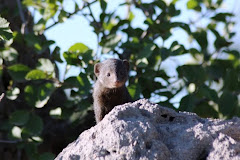
I admit that I took this in Kruger. The locals are far too fleet-of-foot for my blundering photographic skills.
 

NB: I wrote this post about six weeks ago but didn’t get around to posting it (sorry). I’m telling you this, not because I want to draw attention to my ineptitude, but because my circumstances have changed, and I’m now suffering SERIOUS porcupine/civet withdrawal. Oh the misery...


Friday, January 14, 2011

Wearisome wildlife?


Everywhere is flooding, except here.
Miraculous!

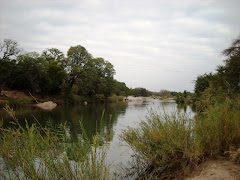
Admittedly, the river at the bottom of my garden (the Oliphants) sounds like an express train, and is tossing up great waves and spume of muddy brown water. But so far the torrent is only just brushing the twisted roots of the fig trees. Walking the dogs along the bank as the water rose, I was amazed by the yellow-billed kites, zooming along the shoreline in search of animals fleeing the flooded reed beds. My dogs nearly went berserk at the tempting scent of displaced cane rats and, down on the water's edge, pairs of blacksmith plovers dashed back and forth snapping up bedraggled insects.


Summer treat. The view of the Oliphants River from my house; normally I only get to see swathes of sand.


Thanks to the rain, everything here is resplendent and green; the grass is waist high and the bush a dense tangle of spiders' webs and foliage. Hidden in the depths of the greenery, the mongooses are busy raising their second litters and the pups from the first round are rushing about self-importantly chivvying and cuddling the new arrivals.

I couldn't imagine a lovelier place to live.
But...
Well sometimes, the wildlife encounters get just a little bit wearisome.

Earlier in the week Magic (my husky-cross) was skewered in the nose by a rapidly reversing porcupine that she was hassling through the mesh fence (blood everywhere). The following day I was startled to find her crunching up and eating the quills. Since she's never shown the slightest interest in quill-consumption before, I can only assume she's desperate to erase all evidence of being bested by a rodent.


An apple a day keeps the dogs at bay
(well, maybe you need some prickles too...)


Last night my wildlife encounters deteriorated further when I accidentally squished a reed frog in the front door (worse for him than me, I know, but it still left me feeling awful). And now I'm eating pasta again - for the fifth day running - because the mouse living in my kitchen (I think it fled the roof) keeps nibbling holes in packets of premade sauce. I've been intending to live trap this bolognaise-mad fiend (since my cats are failing in their only conceivable function) but during the last couple of days my kitchen's rung with the small squeaks of sibling rivalry. So now I can't relocate Mum without inflicting mass death and destruction.

Of course my mouse isn't your ordinary sort of house mouse (I got suspicious when she preferred sultanas and sweet potato to bird seed and peanuts). She is, in fact, a multimammate mouse (Mastomys natalensis); so named for - you guessed it – her extraordinary endowment of mammae (nipples).

To quote the mammal field guide,
"The multimammate mouse is the most fecund of all southern African mammals, 22 foetuses having been recorded in a single female."

Oh good. I wonder if they'll all like pasta sauce.


Staying abreast of the future. Lady multimammate mice are equipped with 8 to 12 pairs of nipples.
Photo posted on Flickr by Batwrangler.

Forthcoming snake-attractant.
These diminuitive multimammate mouselets are 3 days old.
Photo posted on Flickr by Batwrangler.

Since achieving global notoriety, the Large Predatory Beast dwelling in my roof has been lying low. I've taken no proactive steps, apart from shaking my fist at suspicious ceiling noises and shouting 'Stay up there, you bastard!' (ah, the joys of living alone). So I guess I can only blame myself for what took place a couple of days ago.

I was innocently curled up on the sofa reading a book when the dreaded happened.
Something fell out of the ceiling and landed on my head.
It was not small, and it was alive.

Heart-pounding and breath coming in gasps, I forced myself to stay still as the animal slid/slithered down my hair and on to my right shoulder. Not daring to turn my head to see what it was, I sat frozen, fervently hoping I'd be mistaken for an inanimate substrate. I could tell from the feel of it that whatever was poised on my shoulder was reptilian; you know, yielding on the outside but firm beneath (the texture that rubber snakes replicate so scarily). But after about 10 seconds of sitting perfectly still, my apprehension grew too great to bear (imagination is a highly overrated attribute) and - although I knew I may be precipitating a strike (fangs in the neck, urrgh) - I screwed my eyes shut, gritted my teeth and gave a small shrug.

The creature started, and then sIithered rapidly down, onto the arm of the sofa. I was already on my feet by the time I caught a glimpse of it. Sitting staring at me anxiously from the armrest was a very large Turner's gecko!

Now I should have felt relieved. I mean I was relieved; there are many worse things it might have been. But I guess I had too much adrenalin pumping around my system to feel anything but gasping anxiety. The gecko and I stared at one another in mutual antipathy. Still shaking, I guided it up the wall to the shelter of the curtain.

Now I NORMALLY like geckos. The ones in my house achieve gargantuan size because they sneak in and feast on my mealworm colony every night. This one was about 22 cm (9") long and 5 cm (2") across the tummy (no doubt worm-filled). Surprisingly it was still sporting a tail; most of my residents lose this appendage at the paws of my cats (we're only playing...).

Of course geckos are fascinating creatures and I'll probably write a post about them at some point in the future. But right now, I don't even want to think about geckos.

I'm sincerely hoping that my wildlife encounters will take a turn for the better soon.


The culprit. Turner's geckos (Pachydactylus turnerii) are close relatives of Bibron's geckos.

Saturday, April 17, 2010

The perils of porcupines


As I type this, my palms are growing sweaty and I'm starting to feel nauseous.
Why? Because snuffling around outside my front door is an animal that poses a very serious threat to my well-being.
A lion? Elephant? Burglar?
No. It's a porcupine.
Now you think I'm exaggerating, but I'm not.

Alright, I admit that southern African porcupines (Hystrix africaeaustralis) are not life-threatening. They're big (about waist-high when they've erected their quills) and generally fearless, and they suddenly charge backwards at you which is hugely disconcerting. But this is not the problem. I can cope with quills.

One of three porcupines that visit my compost heap nightly.

The problem is noise. My house is located directly across the river (about 200m away) from a commercial lodge, and one of the conditions of my living here is that I remain inconspicuous and make no noise.
Well, it all started harmlessly enough, with me tossing my household scraps onto the compost heap at night for the porcupines to munch. If the porcupines arrived before I'd put the scraps out (and I waited until nightfall to avoid attracting baboons), they'd trundle up to the house, making the dogs bark. Concerned about the noise, I'd dash out with the scraps, drawing the porcupines away and restoring peace.

Sadly, porcupines aren't dumb. With time, they learnt that the more the dogs barked, the quicker they got food. Now anytime they're feeling peckish they tramp up and down the garden fence, scraping their quills against the mesh and sending my dogs into a frenzy. And of course excited huskies don't just bark, they yip and yodel and give dreadful ululating howls, and it all sounds as if some animal is being torn limb from limb. Lodge guests don't respond well to this, particularly here, where poaching using dogs is rife. Thus eviction looms!

I'm currently shutting the dogs indoors when the porcupines come dog-baiting, and hopefully they'll learn that it's pointless. Fingers-crossed.
Related Posts Plugin for WordPress, Blogger...