Showing posts with label mongoose. Show all posts

Friday, January 23, 2015

What, a new blog post??

Yep, that’s right.
I’ve been driven to it by the hardships of my life.

Normally I can handle my self-imposed solitude; month after month alone in the bush, my only human converse, ‘Fill it up with Super, thanks’.
But sometimes it all gets too difficult and I just can’t go on without the comfort of a sympathetic ear (or rather, eye).

What’s brought about this tragic state of affairs?
The unbearable cuteness of mongoose pups.

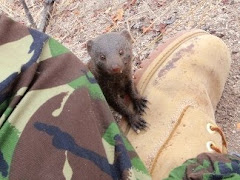
Each day, when I visit my study animals, I have to face them. Waddling out eagerly on their stumpy legs, they look like a swarm of mouse-sized bear cubs. Blunt noses raised, they peer up at me myopically with misty green eyes. As I crouch down, they gather around, clambering over my boots and eagerly placing their tiny paws on my leg, their claws scratchy against my skin. Although, at three weeks old, they’re still primarily milk-guzzlers, they’re hoping I'll give them a mealworm, which they snatch hungrily from my fingers and crunch up with a relish quite disproportionate to their size.


Tended constantly by a babysitter during their first 4 weeks, dwarf mongoose pups first toddle from their termite mound at 2.5 to 3 weeks. These little guys - Periwinkle, Speedwell and Nepenthes (coz she bites) - are from Halcyon’s first litter. Copyright L Sharpe.


A swarm of little Herpestids. In an act of unusual magnanimity, the reigning females in both Bugbears and Halcyon allowed their sisters’ litters to live this year (usually they just munch ‘em) so both groups are raising a bumper crop (7 and 8 pups respectively). Copyright L Sharpe.

If the morning is drear and chilly, one of the pups will clamber laboriously up onto my leg and snuggle down, hearth-rug style, with its belly pressed firmly against the bare skin of my thigh. Since mongoose pups like to huddle, others soon follow suit, until I have the whole litter heaped in a somnolent pile in my lap. They’re so relaxed it looks as if some awful massacre has taken place; at least until the top ones grow chilly and squirm their way underneath their comatose siblings. The babysitters aren’t quite sure that this is kosher of course, and they sit watching anxiously, like mothers on the first day of school.

Here Violet, uncertain about protocol, drags her little brother Mouse-whiskers back to the termite mound. Copyright L. Sharpe.


Hey, play nice! Copyright L Sharpe.


It’s never too early to learn to read. Campion and Rosy deciphering scent-messages at the group’s latrine. Copyright L Sharpe.

Bergamot, the proud dad at Halcyon. Copyright L.Sharpe.


Skipper and Piper (from Bugbears) playing on my heartstrings. Copyright L Sharpe.


So now you've seen the photos maybe you'll understand why it’s all too much for me. Why I just can’t continue without sharing the experience with another human being.

Monday, February 10, 2014

Mongooses, mambas and me


As soon as I arrived at the group I knew something was wrong.

Mongooses were darting everywhere. Small worried faces peered out from beneath a tumble of granite boulders, and the piercing chirps of distressed mongoose pups pulsed from all directions at once. I saw Black (the group’s alpha male) snatch up a youngster and race off, leaping from boulder to boulder, before disappearing into a thicket more than 50 m (165 ft) away. Meanwhile, close to my feet, Iorek, fluffed into the shape of a football, approached in a slow ninja crouch.

Then I saw the cause.

Coiled on a sheet of rock right in front of me was one metre (3 ft) of slate-grey snake. It coiled and writhed and twisted sinuously in an eye-catching way that made my skin creep. But that was just the beginning (or more accurately the end). From this squirming mass stretched another meter of totally inert snake which led (my eyes drawn inexorably on) to the final metre. This rose up vertically, placing the snake’s smooth grey head at waist height. The creature was not looking at me; its gaze was fixed firmly on the mongooses.

Ah, a black mamba.

Black mambas (Dendroaspis polylepis) are the world’s second longest venomous snake (piped at the post only by India’s king cobra). They reach 2 m (6 ft) by their first birthday and can grow to 4 m (13 ft). Reputedly also the globe’s speediest serpent (but who’s clocked them all?), they zip along at 5 m (15 ft) per second, through the branches or down on terra firma.
Photo by Michael Ransburg.


Absurdly, black mambas (Dendroaspis polylepis) aren’t black.
It’s the insides of their mouths that are ebony (oh, of course).
When antsy, a mamba will raise the first third of its body vertically off the ground, flash its sooty maw and hiss ferociously (note to self: avoid black gums).
Photo posted on Flickr by Viperskin.

Now black mambas have almost mythic status here in Africa. Preposterously long and super quick, they might have slithered straight from the novels of Rider Haggard or an Indiana Jones movie. Their bite (if untreated) is 100% fatal, and they’re said to attack without provocation, chase their victims and track them down using scent.

And all this is true ...if you’re a dwarf mongoose.

However, even if you’re a bipedal primate (and I’m assuming you are), black mambas are not to be messed with. Piss one off (by molesting or cornering it) and you’re in serious trouble. Retaliating mambas bite multiple times at a single strike (although normally too rapidly to see), injecting about 100 mg of toxin at each lightning-quick chomp (no inoffensive ‘dry bites’ here I’m afraid). 10-15 mg of the stuff will kill you (by paralysis and suffocation), so unless you can conjure up antivenin and life-support within an hour or so, you may as well start looking for that brightly-lit tunnel. 

Although all this is pleasantly titillating, it must be said that black mambas are masters at avoiding people. And they rarely nibble on humans. A study in the 1960s found that out of more than 1,000 snake-bite victims admitted to Durban hospitals over a seven year period, only eight had fallen foul of black mambas.
And whenever I meet one (usually only a few times a year), it’s always rocketing away from me.
So why was this snake at Bugbears just... er... standing there?
And what was with the whole tail-writhing thingey?

I edged a little closer but the snake still didn’t respond. Black mambas hunt by day, actively tracking warm-blooded critters by scent, so they pose a serious threat to dwarf mongooses.
But if mambas are quick so too are mongooses, and the snake will only make a killing if it can catch one by surprise. So the instant a mongoose detects a whiff of serpent it screams ‘SNAKE!’ and whole group comes running. Fur-fluffed, spitting and growling, they encircle the reptile, creeping forward on their tummies before hurtling backward whenever it stirs. I bite my fingernails and sweat a lot.

Once they’ve harassed it, the mongooses flee (unlike with other large snakes), hotfooting it at least 100-300 m/yds. Yet they always leave someone (usually the second-in-charge male) behind. This guard follows the mamba’s every move for 10-20 minutes (presumably to check it doesn’t pursue the group) before racing off to rejoin his family. (No, I don’t know how he knows where they’ve gone, but he does). This strategy seems to work well and mambas aren’t big mongoose-eaters.

But when the group has small pups the whole ballgame changes.
Pups are not quick. Pups are dim-witted and gullible.
Suddenly mambas appear out of the woodwork.

The mamba in front of me was being guarded by both Iorek and Bear; meanwhile the other adults were dashing back and forth, helter-skelter, snatching up pups from various hiding places and carting them off in different directions (the old eggs-in-one-basket issue). I watched Pooh carefully stow her small burden in a narrow rock crevice before hurrying back to watch the snake. However, the pup, used to being tucked up snugly with its littermates, freaked out at being left all alone. Its anguished chirps, combining with those of its four siblings, rose in a deafening chorus of distress.

The group’s matriarch Iorek (BF010) hastily redistributing a vulnerable pup.

The mamba still stood quite motionless, apart from its absurdly writhing  rear end. Is this how mambas hunt mongooses? Was the snake trying to hold the mongooses’ attention with its nether coils while ambushing them from above? (Is this why mambas are so bloody long??) I can’t find any mention of mambas hunting this way but behavioural studies of wild snakes are as rare as... er... snake’s legs. And doting snake-enthusiasts are unlikely to feed their pets mongooses (at least I hope not!). I became more convinced by this interpretation just a few days later when I came across another mamba doing exactly the same thing with Koppiekats (who also have little pups).


Black mamba venom is a potent concoction that locks down muscle cells in numerous devious ways. However, there’s a bright side: it also contains mambalign, a ‘better-than-morphine’ painkiller. Damaged and inflamed tissue becomes acidic (due to a build up of positive ions) and these ions trigger pain by flooding into nerve cells via special portals (‘acid-sensing ion channels’ or ASICs) on the cell’s surface. Mambalign locks these ASICs tightly closed, thus stopping pain. It’s not clear why mambas provide this unexpected boon to their victims, especially since the venom of many less-considerate snakes actually incites pain by locking ASICs open.You can read a popular account of mambalign research here.
Photo by Ian Turk.


Black mambas are easy to identify thanks to their Witch Weekly-winning smile. The guide books rarely mention this, favouring instead the sensationalist ‘coffin-shaped’ head.
Photo by David Bygott.

As I edged a little nearer to the mamba I dislodged a pebble which bounced down toward the snake. Instantly it shot off into the undergrowth. Iorek and Cricket raced after it, desperate to keep it in sight, but it was moving so fast it had gone in an instant.
Calling constantly to one another, the mongooses fanned out to search. They crept about tentatively on tip-toe and with their backs arched, sniffing and peering under boulders, into crevices and up into the overhead branches. After about 10 minutes, they seemed satisfied that the snake wasn’t loitering nearby and began their exodus. While Black kept guard from the top of a large boulder, the others hurriedly gathered up the five squawking pups and raced off with them toward a distant kopje.


Black (BM003) watching for the enemy while the group evacuates the pups.


Tick (BF038) carrying her little brother/sister out of harm’s way.

The mongooses regrouped about 150m/yrds away beneath a huge granite boulder. After Cricket and Bear had raced back for a last quick check of the area (to ensure no errant pup had been left behind), the group settled down in a huddle to groom one another consolingly. The pups, now happily together again, began to play wrestle.
But everyone was still unnerved.
How could I tell?
Each time I raised my hand unconsciously to shoo a fly, they’d all leap in the air!


Is it safe to come out yet?
 At three weeks old, dwarf mongoose pups are mobile but gormless. This is Arctos (BU061).


Friday, July 19, 2013

Dwarf mongooses: warts and all

 
After seven and a half years working with dwarf mongooses (Helogale parvula), today I discovered the meaning of their scientific name.
And I’m outraged!

Their dreadful scientific moniker was bestowed upon them back in 1847 by Carl Jacob Sundevall. Dr Sundevall was a Swedish ornithologist (yes, that’s right, ornithologist) who was working as curator of the Natural History Museum of Stockholm at the time of his ghastly misjudgement.


The culprit. Image from Wikipedia.

Now let’s be clear. I have nothing against Sundevall’s choice of a species name, parvula.

In Latin parv means little, and ula is a diminutive form; so that’s little, little.
And there’s no question that dwarf mongooses are wee. Even at the height of summer when they’re at their chubbiest, adults clock in at only 270-300g (10 oz). They’re not only the teeniest of the globe’s 31 mongoose species (they’re only one-third the size of meerkats, for example), they’re also Africa’s most petite carnivore.


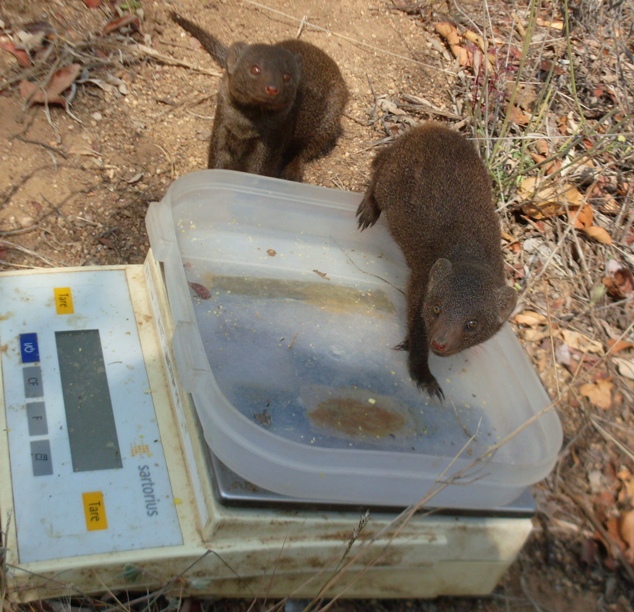
Chimera (EM061) and Doxy (EM066) helping me to document their littleness.

No, no, it’s the genus name, Helogale, that I have problems with.
In Latin gale means weasel.
Mongooses are NOT weasels.
Mongooses do not even belong to the weasel family (the pesky mustelids).
Heck, they don’t even like weasels!

If the mongooses held a family reunion, you’d see genets and aardwolves, linsangs and banded palm civets. There’d be hyenas, overseeing the braai (BBQ), and civets griping endlessly about the perfume industry. The binturong would be annoying everyone by picking up party nibbles with its tail, and the toddy cat, who’s had too much to drink (again), would be delighting the kids with unsavoury re-enactments of kopi luwak manufacture. Even the Madagascan contingent would be there: the falanouc pontificating about earthworms with the white-tailed mongoose, and the fossas and meerkats locked in heated debate over media bias.

BUT THERE WOULD BE NO WEASELS!

Even when the distant cousins rocked up (oh you know, those weirdoes who lost touch eons ago), you wouldn’t see a single weasel. Oh yes, amid the fake smiles and cries of ‘pull up a pew’, you’d spy tigers and ocelots, jaguarondis and cheetahs, clouded leopards and (oh my god) a very obese Persian.

BUT THERE WOULD BE NO WEASELS!

This is the only weasel to sully the lands south of the Sahara. When threatened, striped weasels (Poecilogale albinucha ) squirt stinking anal-gland secretions for a distance of 1 metre/yard. This is one of the many traits they do NOT share with mongooses.
Photo from Wikipedia.  

Nevertheless.
I’m willing to concede that weasels and mongooses do show some (superficial) likenesses. I can understand that a person who spends all their days mulling over dead bodies (and probably has seasonal affective disorder too) could consider these similarities noteworthy.
Yes - if I must - I can cope with gale.

But I cannot accept Helo.
Carl Sundervall what were you thinking??

So what does the dwarf mongooses’ scientific name actually mean?

LITTLE WART WEASEL.


Does this look like a LITTLE WART WEASEL to you?
(This is a rhetorical question. Any reader veering toward the affirmative is strongly advised not to leave a comment.)

 Now Carl Sundervall didn’t actually see a living, breathing (and biting) dwarf mongoose. He described the species from a cadaver sent to him by another Swede, Johan August Wahlberg. Back in the 1840s, Johan Wahlberg toured the length and breadth of South Africa shooting things collecting specimens. Dwarf mongooses were just in the wrong place at the wrong time. A vast mountain of carcasses (of mammal, bird and reptile species) were then shipped back to lucky old Stockholm.
So could it have been gun-happy Johan who was responsible for this dreadful naming travesty? Did he fail to treat the limp little body with sufficent reverence (and preservative)? Was the scrap of lifeless fur that Carl Sundervall lifted from the packing crate pocked with wart-like decay?

Is there an excuse for the inexcusable?


Another victim of Johan Wahlberg’s shooting spree. To add insult to (mortal) injury, this victim got landed with the perpetrator’s name: Wahlberg’s eagle (Aquilla wahlbergi). I guess things can always be worse. Photo by Arno Meintjes.

Now I realise that once a species is officially described and named, its scientific moniker cannot be changed. But surely Anagalligale parvula (delightful little weasel) or Dulcigale parvula (sweet little weasel) or even Maxigale parvula (greatest little weasel), would have been preferable.

Maybe I can just sneak in a different name as a typo...

Dwarf mongooses (Calligale parvula) enjoying a family moment. Ah, beautiful little weasels...

 P.S. Johan Wahlberg was ultimately killed by an elephant. Hee hee.


Tuesday, December 25, 2012

A festivity of pups

One.... two, three....
Crouched in the dappled shade of a marula tree, I was counting pups.
Not pups of the canine persuasion; mongoose pups.
Now this was no easy feat because they were passing me at speed, curled into walnut-sized balls within the mouths of their caregivers.

Four... five...
Number five was having a rough ride, dragged along enthusiastically by nine-month-old Echo. Despite pointing his nose skyward and waddling on tiptoes, he simply wasn’t tall enough to lift his cargo clear of snags.
Six...
Oh, wait a minute, there’s one being carried back again...
Back to five...

Koppiekats group was shifting its week-old pups to a new termite mound and it was my one chance to figure out how many there were.
Frenzied excitement gripped the group as mongooses dashed back and forth; some carrying pups, some not. Calling anxiously to one another, and with agitation-fluffed fur, some individuals raced ahead to check the safety of the new mound while others ran helter-skelter back to huddle the last nest-bound pups. Meanwhile the pup-carriers hurried on past, self-importantly announcing their passage with uninterrupted, high-pitched peeps (‘clear the way, pup coming through’). And the little ones - although tiny, black-fuzzed and blind - gave ear-piercing squawks whenever they were unceremoniously dumped beneath tussock or log.

Six... seven...
Eight!

No wonder the group was so excited.
Four is the normal size of a dwarf mongoose litter.
So how did Koppiekats end up with eight?


Koppiekats’ most recent progeny, venturing out at four weeks old. Pups stay snugged away inside a termite mound for their first three weeks of life, coddled and guarded by babysitters. With so many little ones, Koppiekats felt the responsibility keenly, usually leaving behind two or three minders.

As you probably know, dwarf mongooses - like their celebrated cousins the meerkats – are the living embodiment of the Musketeers’ motto. Dedicated to the ‘all-for-one and one-for-all’ maxim, group members team up to harry snakes, evict trespassers and warn one another of incoming raptors. With heroic selflessness, they forfeit their own romantic aspirations to devotedly care for the offspring of their group’s sovereigns. It’s all heart-warmingly altruistic.
In theory.
In reality, the Queen’s ladies-in-waiting are not quite so chaste. These heirs apparent (sisters and grown daughters of the Queen) are not above indulging in a little hanky-panky. And when the inevitable happens, they try to hush it up by smuggling the consequences into the royal nursery.

To help perpetuate the hoax, they give birth on the same day as the monarch. I don’t know how they manage this because the courtiers normally mate a day or two after the Queen. But when royalty decrees, loyal subjects follow, ready or not. It looks as if the illegitimate pups are simply borne a little premature (they’re smaller and have shorter fur). Even courtiers who are only ‘a bit pregnant’ honour the auspicious day, aborting their litters and discreetly nibbling up the tiny pink foetuses.


When spring is in the air, the ladies of the court don’t seem to be able to say ‘No’, and the sovereign is rarely alone when she delivers the first litter of the summer. This is Cricket, an errant Princess in Bugbears, awaiting the big day.


So what’s the fate of these illegitimate ankle-biters?
Well that’s in the paws of the Queen.
Normally they’re doomed.
Her Majesty swiftly transforms them into a restorative post-partum snack and the bereaved mums then act as wet-nurses for the rightful heirs. Fortunately (from my perspective) dwarf mongooses don’t believe in airing their dirty laundry in public so all I see of the nefarious deed is a bulging tummy and blood-smeared chin. Not so meerkats, who enact a horrifying spectacle in which the whole group tussles over the gory remains.

However, occasionally, if food is plentiful, the Queen grants a stay of execution. A genetic study of Serengeti’s dwarf mongooses found that 18% of pups reared by the group are the progeny of lesser females. Although the rulers of my other study groups were merciless this year, Pleiades, the sovereign of Koppiekats, opted for clemency. So some of the pups that just passed me are actually Pleiades’ nieces, nephews or grandkids.


The brood at six weeks. Notice the size difference between the legitimate pups (on the left) and the little interloper on the right. Yes, there is a question mark over his head: I don’t know who his mum is (because three courtiers - Spark, Helium and Mercury – were in the family way).

But even if they escape the death sentence at birth, illegitimate pups aren’t out of the woods. They face a second test. And it is this that has made me apprehensive every time I've visited Koppiekats.

You see at one month old, mongoose pups begin tagging along on the group’s daily foraging jaunts. Chivvied, cajoled and carried, the little ones are tended constantly. Carefully lodged under a log or boulder, the pups are then presented with half-chewed creepy-crawlies by doting group members.
But when the pups hit five weeks old, this mollycoddling stops. Although everyone still feeds them (and will do so for another five weeks), the youngsters are expected to look out for themselves. If the group runs, so must they. It doesn’t matter how far, or how fast; they must keep up. So if any pup is below par (debilitated from want of food, illness or underdevelopment), they’re simply left behind.

Although I loathe this phase of mongoose-rearing, it serves the mongooses well, ensuring that they channel their efforts only into the healthiest pups.
And I’m very relieved to report that all but one of the little Koppiekats pups managed to pass this trial. Aided and abetted by a timely glut of beetle lava, seven of the roly-poly little creatures live to tell the tale. In fact they’re doing so well, they spend most of their time playing rather than trying to cadge food from their betters.


Shell games.

Leaf games.

Bite-brother games.

If you were wondering, no-one left these pups out in the rain. The rusty patches on their fur are from daubs of ‘Camomile’ blonde hair dye (so I can tell who’s who).

Born on 31 Oct, the Koppiekat pups remain unnamed. I’m trying to come up with Halloween-appropriate monikers, but they also need to be associated with minerals (as in Twenty Questions). Darkness, maybe? Sulphur? Or Silver (for the bullets needed to pot vampires)? Any suggestions gratefully received!

I almost forgot.
HAPPY CHRISTMAS!!


Monday, September 10, 2012

Flipping uncertainties

Yesterday was International Rock Flipping Day.

No, it wasn’t a day of wild celebration for stone-skimming enthusiasts, nor a day of reckoning for designers of rockeries.

On this auspicious day stout-hearted folk from around the globe head out into the wilds to turn over boulders and see what weird and wonderful critters are loitering underneath.

Now each time the event rolls around I’m faced with a quandary. I like the idea of all this collective rock-flipping but quail at the prospect of actually shoving my fingers into the murky haunts of venom-toting beasts.
OK, you may think I’m being overcautious, but the rocks around here harbour 3m (9.5 ft) long black mambas, bad-tempered puff adders and at least two species of cobra (one of whom spits venom with llama-like gusto). It’s a constant fight to keep these creatures out of my home without voluntarily invading theirs!

In the past I’ve deviously circumvented this dilemma (see here and here), but this year my ingenuity failed me and I decided to give Rock Flipping Day a miss. So averting my eyes from all rocks, and trying to ignore the skinks and flat lizards skittering about on every outcrop, I set off to find my mongooses. After one and half hours trudging through the heat, scouring the length and breadth of Koppiekats’ range, I finally found the group sprawled in the shade right beside my car.

And they were lying under rocks.
Hmm...

Although I only had my old point-and-shoot camera with me, I dutifully lay in the dirt on my stomach and tried to take some (bad) under-rock photos.


Whatta you lookin at?

What dwarf mongooses (Helogale parvula) do under rocks.

'There are older and fouler things than orcs in the deep places of the world.'

Rock crevices are ever popular when jackals, honey badgers or dogs pay a call.

OK, I admit I didn’t flip anything. But I also didn’t die a slow and painful death by envenomation.
And I defy anyone to find something cuter under a rock.

To discover what the world's other (genuine) rock-flippers found beneath their rocks, check out Wanderin' Weeta blog.


Monday, August 29, 2011

The mysterious case of the missing mammals

It’s grim struggling out of bed on cold winter mornings but there are compensations.

For me, it’s watching the sunbathers.
Voyeurism, I know, but who can resist all those exposed fluffy tummies.

In the big nyala tree behind my house the vervet monkeys bob about like sailors in the rigging, waiting in the topmost foliage for the sun’s first rays. And when the light catches their coats, they blaze silver. Nearer at hand, dozens of tiny fire finches, blue waxbills and cut-throat finches squabble in the buffalo-thorn outside my bedroom. Lined up in the warming sun, they ruffle their feathers and shuffle their feet and complain non-stop in a cacophony of twittering.

But my favourite sun-worshippers sit about on the koppies (granite outcrops) I pass on route to my study site. Silhouetted against the sky on the giant ears of rock, they look like an infestation of ticks (OK, I’ve been working on small mammals for too long). But up close, they transform into pyjama-filled plush toys.


Rock hyraxes (Procavia capensis) are less adept than most of us at keeping their body temperature just so which makes their early morning sun-bathing session mandatory.

Now I’ve been spying on this unsuspecting colony of rock hyraxes (or dassies) every day for almost six years, so you can imagine my consternation a month or so ago when they all disappeared.

Was I passing by too early? Too late?
I often see eagles hovering about the rocks - clearly with evil intent - but they couldn’t have scoffed everyone. I rushed home to scour the hyrax literature to find what might have happened.
Apparently diseases like mange can wipe out whole colonies (yet no one’s looked moth-eaten) and a colony can include several widely-spaced koppies in their territory, so maybe they'd just changed residences (but they've never left before).

It was at this time too, that I noticed a new set of tracks on the road at the base of the koppies. Amid the usual mosaic of paw prints (laid down by genets and jackals, civets and porcupines) were prints I’d never seen before: the rear paw’s imprint always overlapped that of the fore paw.

Of course I didn’t put two and two together at first.
But then Koppiekats disappeared.

Koppiekats is the mongoose group who hangs out at the base of the koppies (hence their name). For days I scoured their territory (about 40 ha/100 acres of bush), searching every tussock, termite mound and cranny until I was quite certain they simply weren’t in it. But where were they?? A skiing holiday? A winter break in the Riviera? Victims of alien abduction?

Now when a mongoose is snatched by a ground predator, its group will desert that part of its range, sometimes for up to six months. But what could induce Koppiekats to vacate their entire territory? Dwarf mongooses are fiercely territorial critters and trespassing brings swift retribution. As I trudged about disconsolately seeking non-existent mongooses I kept stumbling upon macabre hints: the beak and piebald feathers of a late hornbill, random duiker legs, the half-consumed torso of a puff adder and a veritable fountain of francolin plumes. Hmm... Should I be checking over my shoulder?


Constant vigilance! Twenty-four species of raptor try to dine on my dwarf mongooses (Helogale parvula) and, on an average morning, the group suffers a predator scare once every 11 minutes. Unsurprisingly their repertoire of alarm squeaks is sophisticated. Their cries warn whether the peril is lurking in the grass or circling above and the degree of danger (from, ‘I spot trouble, but everything’s cool’ to ‘OH SH#@*T!!’).

It was at this point that I realised I’d better figure out who was making those weird paw prints. Now, for those without a foot fetish, deciphering the subtle disparities between the mitts of carnivores is wearying. I’ve spent many an hour crawling about in the dirt, clutching a grubby field guide and squinting in puzzlement at fuzzy-edged smudges. But these tracks turned out to be easy; there aren’t many carnivores with such distinctive pacing.
They were made by a caracal.


The caracal (Caracal caracal) may look like the lynx’s long-lost twin – complete with stumpy tail, untrimmed ear tufts and ginormous hind legs – but they’re not closely related. Molecular studies reveal that the caracal’s nearest and dearest is the African golden cat.
Photo posted on Flickr by e3000.

Now things made sense. These big-pawed, russet cats occasionally padded through our study site in the Kalahari Desert and when the meerkats got wind of one, they’d retreat down their burrow and refuse to emerge for 36 hours.
Why? Well caracals are weapons-grade predators. About the size of a small border collie, they’re dangerously opportunistic, slaying anything that's plentiful, from teeny bugs to antelope twice their own weight.
And they do it by ambush; lurking in wait to fell their victim with a single pounce.
And what a pounce!
A pet caracal, startled while sleeping, shot into the air, and measurements taken by the owner revealed that its forepaws only hit the wall at a height of 3.9 m (12ft 10”).

Such acrobatic feats have not gone unnoticed, and for millennia dignitaries in India and Persia (now Iran) kept tame caracals for hunting. In fact, caracals have given us that ever-handy expression, ‘put a cat among the pigeons’. The ancients - combining two favourite pastimes (bloodletting and gambling) - came up with a sport in which two caracals were set upon a flock of feeding pigeons, and wagers were laid on which of the cats would bring down the most birds. Hunting caracals can leap 4-5 metres (13-16 ft) into the air, and a skilled cat was able to snag up to ten birds before the flock escaped.

Dreaming of yummy mongooses? Back in the good ol’ days, caracals terrorised furred beasts throughout the deserts and dry savannahs of Africa, the Middle East and the Near East (as far as India and Russia). They’re now close to extinction in the northern hemisphere, and here in South Africa they’re classified as ‘vermin’ or ‘problem animals’ (depending on the PC-ness of the province) due to their taste for mutton, and are rigorously poisoned, trapped and shot.
Photo by Steve Jurvetson.
 
After a few weeks, the caracal prints stopped appearing on the track below the koppies (caracals have big territories) and, much to my relief, both the hyraxes and mongooses have now returned home. Unfortunately, two members of Koppiekats (Saturn and Shade) are missing, presumed consumed, and everyone else is pocked with bite-marks suggesting that their sojourn with the neighbours was not harmonious.
While I’m pleased that caracals live here (and I’d dearly love to see one), I do hope they don’t pay another visit soon.


Saturn (KM068). R.I.P.


Tuesday, July 12, 2011

Smelly little messages


A gratuitous mongoose piccy.


PLOP!

Something slipped from my thermos flask and splashed into my mug of tea.

I didn't see it happen. I was sitting on a boulder, with one eye on my mongooses, pouring a quick cuppa while they searched for bugs.
But I heard the plop.

What the...?
Oh god!
Bobbing in my tea was a sticky, black mongoose poop nestled in a small plastic bag.

How did this happen?
Well, when I'm out in the field I carry two thermos flasks. One contains my morning brew and the other is filled with ice to keep faecal samples fresh and perky. Unfortunately, the two flasks look very much alike. And sometimes I'm just not paying attention as I stuff a sample into a flask...

As I carefully fished out the neatly labelled bag, I could see that the tea had seeped inside. Presumably, worse things had seeped out. I didn't know which aggrieved me more, the loss of my tea or the sample. You see, after five years working with dwarf mongooses I've come to share many of their perceptions of the world (scary, I know). And for a dwarf mongoose, every poop is sacred.

Unlike other family members, dwarf mongooses don't just broadcast their droppings far and wide. In fact, regardless of the leg-crossing involved, they'll only poop at the group's special scent-marking sites or at latrines located by each of their sleeping mounds. Now you may think the early morning rush to use the bathroom is hectic at your house, but it's nothing to the jostling that goes on when a mongoose group gets out of bed. Tumbling out of hole, they scramble and dash across to the latrine, a dozen little furry bodies jockeying for position all at one time. Even mongooses that don't need to go make a huge effort to squeeze something out. And once the group has headed off to forage, it's not unusual for someone to realise they haven't completed their toilette and, all in a panic, they'll go racing back. But why do they go to all this trouble?


Does scat mean scat? Latrines were once seen as Keep Out signs but, in many species, they're really community notice boards, all aflutter with phone-number fringed personal ads.
Image borrowed from here.

We know from experiments with banded mongooses and meerkats that mongooses can discriminate between the poop of different individuals. And not just their nearest and dearest; they can also tell the droppings of neighbours from those of strangers. And banded mongooses act very edgy indeed if they encounter a neighbour's poop steaming on the wrong border.

But how do they do it? Well like all carnivores (including Fido and Puss) mongooses are blessed with anal glands that secrete a fatty substance. This goo sits about cosily inside an anal pouch where it's feasted on by hungry bacteria. The bugs leave behind an array of volatile carboxylic acids (which stink), and which ones you end up with (and how much of each sort) depends on which types of bacteria are lurking in your anal pouch. Since every individual has its own unique bacterial assortment, everyone's acid profile is unique, and thus so is their pong. (I do have to wonder how antibiotics affects all this, for example in zoo animals.)


Comet leaving a message.

And of course excrement is also chockfull of all the hormones coursing through the depositor's veins. So for those with a sensitive nose, the gen is endless. Is he stressed? Is he feeling mean? Is she willing?

With so much personal information being bandied about, it's not surprising that individuals sometimes indulge in a bit of self promotion.
At meerkat latrines, the ladies post alluring come-hither messages for the guys next door while their male group-mates dash about madly, trying to mask these billets-doux with stinky macho threats. The end result is an absurdly male-biased latrine whose shitty composition bears no resemblance to the actual group make up.


The take away message proffered by a meerkat latrine.
Image borrowed from here.

In contrast to meerkats, banded mongooses are far more narcissistic. They consider poop an in-house affair. Everyone is too interested in getting the low down – or putting one over - their sexual rivals (who come from inside the group, not out) to spare much of a sniff for the leavings of the opposite sex.

But what are the dwarf mongooses up to? Why do they – unlike other mongooses – religiously pile up huge middens outside their sleeping dens? It's not as if dens (i.e. termite mounds) are in short supply; there are 200 to 300 in each group's territory (I know because I've plotted every one) and the group sleeps - and latrines - at only about 30.

It's in an attempt to figure out why my mongooses don't waste their waste that I daily risk the integrity of my morning cuppa. The smelly little samples I spoon up are destined for use in taste sniff tests. The idea is to present a smorgasbord of poo to selected individuals and see exactly what takes their fancy. Are they more intrigued by the droppings of outsiders or group members; rivals or lovers?


A mobile perfume counter. On the right are a male and female poop from the sniffer's own group; on the left they're from a strange group. Don't panic! The one in the middle isn't from a mongoose on steroids; it's an antelope turd, just to be sure they aren't simply attracted to anything that pongs.

My first attempt at this experiment was not a success.
In fact, it was one of those ghastly moments when you see your research career evaporating before your eyes.
No one sniffed anything.
They totally ignored every single dropping.

In desperation, I grabbed up a poop and stuffed it right under Pleiades' nose. She screwed her eyes shut and turned her head away with such overt revulsion I was shocked. I couldn't have evoked a more negative reaction if I'd done this to a human! I could almost see her thinking, 'Who would leave that here!'

That was when it hit me.

Dwarf mongooses never leave their droppings lying about in the field, yet here I was presenting samples to animals as they trotted about foraging. It was like tossing post-it notes under the feet of busy shoppers and wondering why no one read them.

I tried again at one of the group's scent-marking sites.
And low and behold, they scratched and sniffed!
O frabjous day!
Of course this makes the whole procedure much more tedious because the samples must be kept frozen until just before they're presented. So I spend my days trailing after the mongooses, trying to anticipate when they're going to stop in at one of their toilet facilities. When I believe a lavatory stop is imminent, I have to madly thaw the samples down the front of my shirt (and, yes, it does feel as ghastly as it sounds).

I'm still undertaking these trials so I can't yet tell you what messages are encrypted in my mongooses' latrines. However, it looks as if the ladies (who are very status conscious) are most interested in getting the low down on one another, while the guys can't resist a lovely female poop, particularly if it's from someone they haven't met.


Bugbears enjoying themselves at the information exchange (i.e. scent-marking site).


Monday, June 20, 2011

Today a gerbil, tomorrow the world

The first time I saw mongooses out foraging I went into shock (well, that's a slight exaggeration).

It was back in 1995, and I was on holiday in Kruger National Park.
I'd stumbled on a group of about 25 banded mongooses and they were busily searching for dinner around my car. Each animal was scratching through the leaf litter, poking its nose into likely holes and raking around under fallen timber. Every now and again one would unearth a cricket or a juicy grub from a pile of dung or noisily crunch up a beetle.

Now this I was accustomed to.

I'd spent lots of time watching Australia's marsupial carnivores (e.g. quolls, dunnarts, antechinuses) and they obtain their takeaways in exactly the same way.

But what amazed me was that the mongooses totally ignored one another. Here they were trotting about, only a foot or two apart, burbling away companionably and moving along as a troop, but no one paid the slightest attention to what anyone else was eating!

Now if a family of quolls or a pair of dunnarts are out foraging and someone finds a tasty morsel, it's a free for all!
Everyone one dashes over and there's squeaking and brawling and utter fur-flying chaos. Heck, even dogs and cats will rush over to investigate if a companion makes a killing.

I guess, in retrospect, I shouldn't have been so shocked because flocks of birds hunt like this all the time, but mongooses have FUR for Heaven's sake!

An eastern quoll (Dasyurus viverrinus). Quolls are Australia's best attempt at a mongoose; regrettably they're solitary and nocturnal.
Photo posted on Flickr by Shuttergirl3.

Sociality doesn't come easily to mongooses. Of the 37 species snooping about the world today, only eight (all African) have mastered the art of living together. You see mongooses are descended from a Christmas eve checkout queue of solitary, skulking killers and their physiques have remained unchanged for 30 million years.

But as the African climate dried out and savannah replaced forest, the mongooses – now perilously gadding about in the open – banded together so they'd always have someone to watch for predators. So, unlike other pack-living carnivores (such as wolves, lions or dholes), the mongooses ganged up to outsmart the beasts that ate them, rather than to up-size the beasts that they ate.

So while my little dwarf mongooses are now among the planet's most sophisticated socialites, at mealtimes their ancestral proclivity for independence shows through: everybody does their own thing, together.

Now I've explained all this, I'm going to contradict myself by describing the hour I spent with Ecthelion yesterday morning.
They were gerbil hunting - cooperatively.

I've only seen my mongooses behave this way a couple of times before, but it's always disconcerting. Their quarry, the local bushveld gerbils (Gerbilliscus leucogaster; you can see a photo of one here), live in big colonial warrens which they dig in sandy soil.
And yesterday morning, Merlin sniffed out an occupied warren. He immediately hollered for the group with a special rodent-hunting call (a bubbling, staccato version of their usual 'follow me' squeak) and the group came running. While Merlin and one or two others dug madly at the warren's main burrow entrances, everyone else milled about excitedly, watching and sniffing, pushing their noses down the many minor entrance holes, and peering under logs or into clumps of grass. They were all searching, impatiently, for any gerbil foolish enough to flee its underground home.


Putting in the spade work.

'We seek him here, we seek him there...'

Now this cooperative effort isn't exactly egalitarian because the group's reigning monarchs will filch the spoils from anyone who manages to bag a rodent. However, gerbils are big (about one-third the size of a mongoose, which makes the kill protracted, noisy and traumatic for soft-hearted observers), so lesser group members are usually able to snatch up some bloody, dismembered bits.
At the last hunt I witnessed, Koppiekats (a group of 18) snagged three of the five fleeing gerbils, and eight mongooses scrounged a meal.


The Lazy Mongoose's Guide to Gerbil Hunting.

Ecthelion's hunt wasn't successful (to my secret relief) as the gerbils refused to be flushed, and after three-quarters of an hour the 15 milling mouse-hunters were getting frustrated. Widening their search area brought them over to where I was sitting, with my backpack on the ground beside me. I should have foreseen this, but they began eyeing my bag speculatively, and I could see them thinking, 'Well if we can't find them anywhere else, they must be hiding in there'.


'"They must be in that bag..."

Soon half the group was lined up in front of me, glaring accusingly, convinced that I was harbouring their missing rodents. (Do they know me better than I realise?). Since I could think of no conceivable way to convince a group of mongooses that my backpack was gerbil-free, I shouldered the offending article and withdrew. They immediately called off their hunt ('Well, she's pinched the booty!') and headed off to forage normally.


"Gimme the gerbils!"

Now I know that dwarf mongooses hunting gerbils is not on a par with chimpanzees killing monkeys, but there's something worrying about these little creatures teaming up to bring down prey.
Sure, today it's just a few pesky gerbils, but where will this lead?
How long before I come across a felled duiker or a warthog nibbled off at the knees?
Come to think of it, aren't hyenas supposed to be descended from ancestral mongooses?
THAT'S where it will lead!

Just don't say I didn't warn you...
Related Posts Plugin for WordPress, Blogger...