Showing posts with label reptiles. Show all posts

Monday, February 10, 2014

Mongooses, mambas and me


As soon as I arrived at the group I knew something was wrong.

Mongooses were darting everywhere. Small worried faces peered out from beneath a tumble of granite boulders, and the piercing chirps of distressed mongoose pups pulsed from all directions at once. I saw Black (the group’s alpha male) snatch up a youngster and race off, leaping from boulder to boulder, before disappearing into a thicket more than 50 m (165 ft) away. Meanwhile, close to my feet, Iorek, fluffed into the shape of a football, approached in a slow ninja crouch.

Then I saw the cause.

Coiled on a sheet of rock right in front of me was one metre (3 ft) of slate-grey snake. It coiled and writhed and twisted sinuously in an eye-catching way that made my skin creep. But that was just the beginning (or more accurately the end). From this squirming mass stretched another meter of totally inert snake which led (my eyes drawn inexorably on) to the final metre. This rose up vertically, placing the snake’s smooth grey head at waist height. The creature was not looking at me; its gaze was fixed firmly on the mongooses.

Ah, a black mamba.

Black mambas (Dendroaspis polylepis) are the world’s second longest venomous snake (piped at the post only by India’s king cobra). They reach 2 m (6 ft) by their first birthday and can grow to 4 m (13 ft). Reputedly also the globe’s speediest serpent (but who’s clocked them all?), they zip along at 5 m (15 ft) per second, through the branches or down on terra firma.
Photo by Michael Ransburg.


Absurdly, black mambas (Dendroaspis polylepis) aren’t black.
It’s the insides of their mouths that are ebony (oh, of course).
When antsy, a mamba will raise the first third of its body vertically off the ground, flash its sooty maw and hiss ferociously (note to self: avoid black gums).
Photo posted on Flickr by Viperskin.

Now black mambas have almost mythic status here in Africa. Preposterously long and super quick, they might have slithered straight from the novels of Rider Haggard or an Indiana Jones movie. Their bite (if untreated) is 100% fatal, and they’re said to attack without provocation, chase their victims and track them down using scent.

And all this is true ...if you’re a dwarf mongoose.

However, even if you’re a bipedal primate (and I’m assuming you are), black mambas are not to be messed with. Piss one off (by molesting or cornering it) and you’re in serious trouble. Retaliating mambas bite multiple times at a single strike (although normally too rapidly to see), injecting about 100 mg of toxin at each lightning-quick chomp (no inoffensive ‘dry bites’ here I’m afraid). 10-15 mg of the stuff will kill you (by paralysis and suffocation), so unless you can conjure up antivenin and life-support within an hour or so, you may as well start looking for that brightly-lit tunnel. 

Although all this is pleasantly titillating, it must be said that black mambas are masters at avoiding people. And they rarely nibble on humans. A study in the 1960s found that out of more than 1,000 snake-bite victims admitted to Durban hospitals over a seven year period, only eight had fallen foul of black mambas.
And whenever I meet one (usually only a few times a year), it’s always rocketing away from me.
So why was this snake at Bugbears just... er... standing there?
And what was with the whole tail-writhing thingey?

I edged a little closer but the snake still didn’t respond. Black mambas hunt by day, actively tracking warm-blooded critters by scent, so they pose a serious threat to dwarf mongooses.
But if mambas are quick so too are mongooses, and the snake will only make a killing if it can catch one by surprise. So the instant a mongoose detects a whiff of serpent it screams ‘SNAKE!’ and whole group comes running. Fur-fluffed, spitting and growling, they encircle the reptile, creeping forward on their tummies before hurtling backward whenever it stirs. I bite my fingernails and sweat a lot.

Once they’ve harassed it, the mongooses flee (unlike with other large snakes), hotfooting it at least 100-300 m/yds. Yet they always leave someone (usually the second-in-charge male) behind. This guard follows the mamba’s every move for 10-20 minutes (presumably to check it doesn’t pursue the group) before racing off to rejoin his family. (No, I don’t know how he knows where they’ve gone, but he does). This strategy seems to work well and mambas aren’t big mongoose-eaters.

But when the group has small pups the whole ballgame changes.
Pups are not quick. Pups are dim-witted and gullible.
Suddenly mambas appear out of the woodwork.

The mamba in front of me was being guarded by both Iorek and Bear; meanwhile the other adults were dashing back and forth, helter-skelter, snatching up pups from various hiding places and carting them off in different directions (the old eggs-in-one-basket issue). I watched Pooh carefully stow her small burden in a narrow rock crevice before hurrying back to watch the snake. However, the pup, used to being tucked up snugly with its littermates, freaked out at being left all alone. Its anguished chirps, combining with those of its four siblings, rose in a deafening chorus of distress.

The group’s matriarch Iorek (BF010) hastily redistributing a vulnerable pup.

The mamba still stood quite motionless, apart from its absurdly writhing  rear end. Is this how mambas hunt mongooses? Was the snake trying to hold the mongooses’ attention with its nether coils while ambushing them from above? (Is this why mambas are so bloody long??) I can’t find any mention of mambas hunting this way but behavioural studies of wild snakes are as rare as... er... snake’s legs. And doting snake-enthusiasts are unlikely to feed their pets mongooses (at least I hope not!). I became more convinced by this interpretation just a few days later when I came across another mamba doing exactly the same thing with Koppiekats (who also have little pups).


Black mamba venom is a potent concoction that locks down muscle cells in numerous devious ways. However, there’s a bright side: it also contains mambalign, a ‘better-than-morphine’ painkiller. Damaged and inflamed tissue becomes acidic (due to a build up of positive ions) and these ions trigger pain by flooding into nerve cells via special portals (‘acid-sensing ion channels’ or ASICs) on the cell’s surface. Mambalign locks these ASICs tightly closed, thus stopping pain. It’s not clear why mambas provide this unexpected boon to their victims, especially since the venom of many less-considerate snakes actually incites pain by locking ASICs open.You can read a popular account of mambalign research here.
Photo by Ian Turk.


Black mambas are easy to identify thanks to their Witch Weekly-winning smile. The guide books rarely mention this, favouring instead the sensationalist ‘coffin-shaped’ head.
Photo by David Bygott.

As I edged a little nearer to the mamba I dislodged a pebble which bounced down toward the snake. Instantly it shot off into the undergrowth. Iorek and Cricket raced after it, desperate to keep it in sight, but it was moving so fast it had gone in an instant.
Calling constantly to one another, the mongooses fanned out to search. They crept about tentatively on tip-toe and with their backs arched, sniffing and peering under boulders, into crevices and up into the overhead branches. After about 10 minutes, they seemed satisfied that the snake wasn’t loitering nearby and began their exodus. While Black kept guard from the top of a large boulder, the others hurriedly gathered up the five squawking pups and raced off with them toward a distant kopje.


Black (BM003) watching for the enemy while the group evacuates the pups.


Tick (BF038) carrying her little brother/sister out of harm’s way.

The mongooses regrouped about 150m/yrds away beneath a huge granite boulder. After Cricket and Bear had raced back for a last quick check of the area (to ensure no errant pup had been left behind), the group settled down in a huddle to groom one another consolingly. The pups, now happily together again, began to play wrestle.
But everyone was still unnerved.
How could I tell?
Each time I raised my hand unconsciously to shoo a fly, they’d all leap in the air!


Is it safe to come out yet?
 At three weeks old, dwarf mongoose pups are mobile but gormless. This is Arctos (BU061).


Saturday, July 6, 2013

Communiqué from a hermit

I’M SORRY!

That’s an apology for my appalling lack of posts.

Yes relatives, I am still alive.
 

The problem is (okay, one of the problems is) I’m now living in a spot unsullied by modern communications.
Yet hope’s recently arrived in the form of a laptop. If I drive half a dozen kilometres, clamber to the top of a wind-whipped kopje and sit numb-bottomed and squint-eyed (playing spot the cursor), I can communicate with the outside world.
But not very much.
You see my funding ran out last year so I’m trying to survive on... well, nothing at all really. And petrol and internet access are costly. Nevertheless, despite these adversities, I bring you a blog post! 

   
My latest domicile is tucked away beside the river in the reserve in which I potter with mongooses work. I moved in last March and have fallen in love with the place because my neighbours are all non-human.

    
Uninhabited (theoretically) for the last seven years, the house harbours an impressive assemblage of fauna. Fortunately the hippos and hyenas - whose dawn chorus ushers in my days - tend to stay outside, but others are less reticent. Jealously I guard my dogs from the leopards who stamp their pugmarks on my driveway nightly, and struggle (vainly) to oust the bloom-devouring porcupines from the garden. Ah, bliss...


Chez Mongoose (mainly)

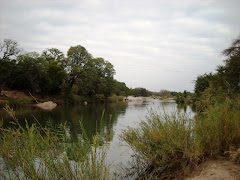
The charming Oliphants River as viewed from my veranda.

Of course, adjusting to the idiosyncrasies of new housemates can be challenging. And some are far from pleased to see me. The incumbent geckos, for example, are the least friendly I’ve ever encountered. They lurk furtively in crevices and crannies, secretly plotting my downfall. Only if I arrive home after nightfall and unexpectedly snap on the light, do I get to see them, frozen guiltily and bristling with insurgency, up there on the walls.

The most welcoming of my new roomies spends much of her time in the kitchen (and sadly has a figure to match). You can usually find her lounging on the bench top beneath the window. Dressed with classic elegance in umber, bistre and pearl, she emanates a proprietorial air but graciously lets me share the facilities. Admittedly she’s only six inches (15 cm) long, but for a striped skink (Tachylepsis striata) this is not to be sniffed at. I have presumptuously christened her Algernon. (I should point out at this stage that although my zoological expertise is profound (naturally), it does not extend to sexing small lizards (well, any lizards at all really); hence the gender-related ambiguity.) 


Embarking on a staring contest with a striped skink (Trachylepis striata) is ill advised. Okay, unlike some reptiles, they do actually blink. But their lower eye lids have a transparent window so that glare never falters.

As might be expected, there was a little friction between us at first. Algernon’s insistence on spending the night tucked up in the egg carton led to heart-stopping encounters every morning. After ten days I finally realised that – in my early morning daze - I was incapable of remembering she was there, and so I hid the eggs away in a cupboard. She ruefully shifted into the washing machine. Of course now I can’t launder my clothes before 11 am (she’s a late riser on these chilly mornings) but we all have to make compromises.

As a striped skink (Trachylepis striata), Algernon is meant to live in trees. The soles of her feet have built-in cleats (special spiny scales) and each absurdly elongated toe sports a bark-catching keel. Unfortunately, these nifty adaptations are less well suited to kitchen fly screens. You see striped skinks are active hunters and - according to the books – they seize their insect prey after a short, fast dash. However, when Algernon is hunting flies on the window screen, her dashes - back and forth, up and down, round and round - are annoyingly protracted. With each step, her impressive grappling-iron toes snare the mesh, so she has to fling her limbs into the air like she’s practising semaphore. As inconvenient as this may be for Algernon, it’s worse for me: each unplucked toe produces a dreadful reverberating clatter that’s audible throughout the house.
Still a girl has to eat; I show forbearance.


Algernon showing off her fine toes and svelte figure.

Our relationship has grown considerably more cordial since Algernon discovered the delights of mealworms. Each day she greets me upon my return from the field, skittering across the counter top to stand gazing up at me in the hopes of cadging any leftover worms. (Yes, that soft susurrus was a gasp of outrage by my mongooses.) After hours basking on the window sill, Algernon moves quicker than the eye can see. I find this unexpectedly disturbing. I mean we’re all used to small critters flitting out of sight in the blink of an eye, but when one flits AT you, it’s a different story entirely. One moment she’s sitting peaceably on the counter top and the next she’s crouched on my wrist, glaring at me fiercely for failing to unhand the mealworm. As far as I’m concerned, teleporting lizards should stay firmly in the realm of science fiction.

I was wondering whether to teach Algernon tricks (is this demeaning?). But what’s the point of a lizard that jumps through a hoop if you can’t see it do it??

Now the advantage of living on the window sill (apart from the whole fly-catching business) is that Algernon can zip back and forth through the gap in the screen whenever danger threatens. The down side - at least from my perspective - is that those with an appetite for striped skinks sometimes pursue her right into the house. So far I’ve discovered a brown-headed kingfisher lurking behind the stove and a little sparrow hawk circling the light fitting in my bedroom. Considering that the hole in the screen is only the size of my fist (or, more accurately, the fist of a bygone burglar), this is impressive.
 

Striped skinks are modern, up-to-date lizards who have no time for all that primitive egg-laying stuff. Mums heroically bear a litter of 3 to 9 mini-skinks each summer (something to look forward to...  hmm).

Now if you’re reading this post, it means:
(a) I still have at least one gallant and faithful reader (I'll add you to my Xmas card list);
(b) I can upload posts despite my wonky internet connection.
Taken together, these suggest that I have no excuse for not resuming blogging. 
Of course, I do have a wide selection of half-written posts on my computer...
Hmm, all I need now is to overcome my self-loathing.... 
Please stay tuned!


Saturday, January 12, 2013

Scarred for life (or what's left of it)

‘Well, it’s going to leave a scar’, the doctor said as we stared at the gaping wound on my lower leg.
He wanted to stitch it.
I was trying to avoid having needles poked through my flesh.
‘I can cope with that’, I said calmly (secretly thinking: Ah ha. Now I can impress people who ask about my scars).

But that was five years ago and NO ONE HAS EVER ASKED.

Now this sad state of affairs is a product of my age.
Have you noticed that when you’re young, people are forever asking you how you acquired this blemish or that. And as a callow youth, all you can do is confess, ‘Okay, I’m a complete klutz’. Yes, I did mishandle a breadknife; yes, I did trip on the stairs.
But as you edge into middle-age, scars shift allegiance, traitorously teaming up with wrinkles, saggy skin and liver spots to become harbingers of age. And, goodness me, no one wants to mention them!

Of course, the phenomenon isn’t limited to bodily blemishes and I’m the first to rejoice in this unexpected benefit of aging. No longer must I endure prolonged and incredulous discussions about why I don’t want children (Oh God, she’s one of those unfortunate women who can’t have kids...) or hours of nonsensical harassment over imbibing distasteful beverages (don’t say anything; she’s obviously on the wagon...).
But I’m digressing shamelessly here (probably senility).
Since no one has ever enquired about the impressive scar on my right calf, I’m going to tell you about it here. And it serves you right for being so polite!

It was a dark and stormy night...
Well it was dark at least. Oh, and it was hot (I was wearing shorts).
Suddenly my dogs shot out the backdoor, barking wildly. Something stirred in the bushes beyond the garden and Magic (my husky cross) clambered straight up and over my dog-proof fence.
Aha, I thought, this isn’t one of our normal passersby.
You see, like all well-brought-up carnivores, my dogs detest other meat-eating beasts. When a porcupine, hippo or waterbuck tippy-toes past the garden they respond with a bark or two, but only a carnivorous creature can arouse them to such athleticism.

Envisaging the potential annihilation of some innocent little furbearer, I girded my loins for a rescue mission (scuffed my feet into thongs/flipflops and grabbed up my semi-flat torch/flashlight).
As I hurried through the thigh-high forbes below the garden, I could see Magic circling a large tree stump, barking frantically. Oh dear, some inoffensive critter must be hiding among the broken roots. A fur-fluffed genet maybe? Or a striped polecat, big-eyed and cowering? Shining my wavering torch beam carefully on the stump, I hastened toward Magic.
Then CRUNCH!
Something had sunk its teeth into my lower leg.
And let me tell you, this was no little mustelid.
With my mind still fixed on nocturnal mammals, I bewilderedly ran through the possibilities. A civet? A honey badger?
But even the most vicious honey badger couldn’t feel like this! Warm wetness was flowing down my leg and pooling stickily in my sandal. As I lowered the torch beam toward my leg, my mysterious attacker gave a head-shake, thrashing the vegetation wildly and almost flinging me off my feet. Then it let go. And I finally managed to get the light focused at my feet.
Oh God!
Right before me was the wide, tooth-filled gape of a crocodile.


What you don’t want to see two inches in front of you.

Now this was a shock. This is NOT what you expect to find at the bottom of your garden! Well sure, I live beside the Oliphants River, but the water’s edge is at least 250m/yards from my house.
The reptile, poised threateningly in a patch of flattened vegetation, was relatively small (for a crocodile) being about the same size as me (1.7 m / 5’6” long). And it was fixing me with a piercing death stare. Without thinking, I immediately stepped backward and the creature lunged toward me, it's mouth still agape. However, this time it kept its teeth to itself and I was able to slowly back away. As I hobbled squelchily back to the house, I found I was shaking head to foot.


Fortunately the teeth of the Nile crocodile (Crocodylus nilotus) are designed to grab and hold, rather than slice and dice. On the downside, crocodiles have the most powerful bite known for any living creature.
Photo by Silvain de Munck.

Now I don’t blame the crocodile for this assault. Clearly I’d blundered straight into it, and who doesn’t bite when stepped upon? I’m just profoundly grateful that it let go! A few years ago I read an article in the local paper about a crocodile that got into a swimming pool at a local game lodge. It grabbed a child (by a limb) and hung on. The girl’s grandfather managed to keep her above water, but it was half an hour before he could persuade the beast to open its maw. Unfortunately, the crocodile had to be put down afterwards because Granddad had had to gouge its eyes right out of their sockets before the crocodile would let go.

Now if you’ve ever lain awake at night worrying about how hard a crocodile can bite (and who hasn’t), a recent study by Gregory Erickson and his colleges in Florida will put your mind at rest. These intrepid researchers persuaded 83 crocodilians to sink their fangs into a waterproof, leather-encased bathroom scale (ain’t science grand). They measured the bite force of all 23 living species, from diminutive little fish-eaters to bloody great wildebeest-snatchers. And what they found was unexpected.


The toothy schnoz of the Indian gharial (Gavialis gangeticus) is a perfect fish-processing tool.
Photo by Josh More.

The Chinese alligator’s (Alligator sinensis) Walt-Disneyesque snub nose is custom-made for crushing mollusc shells.
Photo by Roger Smith.

It didn’t matter what a crocodile ate, or how its snout or teeth were shaped, the force of its bite was the same. What was important was the size of the beast; the bigger the croc (regardless of its species) the worse the chomp (note to self: don’t step on a large crocodile). The most powerful bite the researchers measured was inflicted by a whopping (5.3 m/17 ft long) saltwater crocodile whose teeth crunched down with a force of 3,700 pounds per sq inch (psi) or 16,400 newtons. Compare this to a human’s best bite (150-200 psi or 4,450 newtons) or that of a lion or spotted hyena (1,000 psi or 4,450 newtons) and you can see why crocodiles really are best avoided.

Using the measurements from this study, and scaling down to a 1.7 m crocodile, I figure that my scar was produced by teeth pressing into my flesh at a force of about 335 psi (or 1,500 newtons). This isn’t too bad really (it’s certainly better than a lion). I guess you can stop feeling sympathetic (you were feeling sympathy, weren’t you?).


The little raised black spots on the scales of crocodilians are touch-receptors, ten-times more sensitive than our finger tips. You can read about them here. Nile crocodiles, such as this one, have them sprinkled all over, but in alligators they’re restricted to the snout. Photo by Silvain de Munck.

Now you may be wondering what‘s brought on my current bout of crocobilia. Well I’m currently staying (temporarily I’m afraid) in a beautiful lodge perched on an outcrop above the river. And it has a swimming pool (oh, the luxury). Unfortunately my dogs - who presumably read the local rag - believe the pool is crocodile-infested and won’t set paw anywhere near it. Whenever I take a dip they look at me with tragic reproof, utterly convinced that this folly will cost me my life. And Magic’s paranoia doesn’t stop there; she’s sure we’re facing an invasion. With great heroism, she sits guard, day and night, on the verandah overlooking the pool and barks ferociously each time the floating bottle of pool chemicals drifts in the direction of the house. Sigh.

Magic on sentry duty.


Tuesday, January 10, 2012

Three's a crowd

‘twas the night before Thursday
And all through the house
Not a creature was stirring
Not even a mouse.

Huh?
THIS house??

Where bushbabies hold nightly gumboot races in the ceiling, cheered on by a squeakery of bats?
Where three species of gecko brawl raucously over the rights to my mealworm colony, and resident gerbils sharpen their teeth - without pause - on my electrical appliances?
Oh, and let’s not forget the live-in toads who are convinced that beetle-hunting is most lucrative deep within my store of recycled plastic shopping bags.

THAT house??
Yep.

Silent as the grave (and the simile wasn’t chosen idly).

What catastrophe has befallen us?
Did my housemates succumb to radio-active fallout from the gnawed microwave? Or maybe deadly spores wafted from the dishes mouldering in my sink? Was our water supply craftily poisoned by delinquent baboons?
No. We simply have a visitor come to stay.

In truth, we’ve had three visitors (all equally ostracized by my roommates) but I managed to persuade the other two to leave.

Now don’t imagine that these houseguests turned up unannounced.
It’s just that sometimes I have trouble understanding the local lingo.
Still, the first warning came through loud and clear.

I was beavering away on my computer on Tuesday afternoon when a large toad hopped by. Now this is nothing unusual as I share my domicile with at least four of the beasts.
Hey, but wait... It’s daytime!
I leapt to me feet in panic.
You see my toads are nocturnal beings, and there’s only one thing that will drag them from their beds before sundown: a professional toad-muncher.


A red toad (Schismaderma carens): snake-detector extraordinaire.


As the toad hurried out the back door, I cautiously crept into the kitchen (from whence the refugee had hopped). On route I passed a panic-stricken gecko, fleeing its daytime haunt behind the fridge.
Not a good sign.
A wary search of the kitchen’s nooks and crannies revealed the culprit: a Mozambique spitting cobra, lurking behind the stove.

Now I’ve written about spitting cobras before (here, here and here). With appalling manners (spitting in the faces of strangers) and a lethal overbite, they’re not the sort of guest you want loitering in your food preparation area. But, fortunately, the judicious application of a broom induced the creature to retreat into a poster tube (ah, one of life’s essentials), and in no time at all I was trudging off into the bush to liberate it.

The following day I was once again plugging away at my computer (see how diligent I am?) when Magic (my husky-cross) leapt up and rushed to the backdoor. We knew that something was loitering immediately outside because its shadow was moving in the strip of light under the door. I was gazing at this dark shape when, suddenly, a thin, black filament flicked, just for a moment, in under the door.
It’s a skink’s tail, I assumed erroneously.


Rainbow skinks (Trachylepsis quinquetaeniata) frequently skitter in and out of my house, hunting for any creepy-crawlies the toads may have missed (or maybe just to taunt the dogs).

Since the skinks are masters at evading canine pursuit, I opened the door to let Magic out.
Standing there on the doorstep was a two meter (6 ft) long rock monitor. Grey and gnarly-looking, it was bent forward with its stubby nose pressed to the crack below the door, and was flicking its long, forked tongue in underneath. I managed to grab Magic’s collar as she lunged for the reptile, and while I struggled to hold her, the monitor took off, racing in a claw-scritching, side-to-side, swayback sort of way for the back fence.

Once rational thought had returned, I sagely concluded that the monitor was hunting skinks, and nonchalantly went back to the computer.
Big mistake. It was not hunting skinks.


The rock monitor (Varanus albigularis) actively pursues its meals, licking up its victim’s scent with its forked tongue. The tongue’s prongs slot neatly into the paired opening of its vomeronasal organ, snugged away on the roof of its mouth.


Some hours later, when I lifted the lid from a mega carton of eggs sitting on my countertop (the carton, not me), I discovered what the monitor was hunting. A very large spitting cobra was coiled neatly among the eggs. The unexpectedness of this rendezvous sent me reeling backwards out of the kitchen, and the wily serpent slipped away beneath an immovable cupboard.

Oh dear.

Hence the complete exodus of my roomies.

Those of us brave enough to remain behind for the night (just myself and the pets) congregated by silent consent in my bed. As the kitchen has no door, we all hoped that a massed pile of big, warm furry mammals would be sufficient disincentive to a roving serpent.

MISSING
Mozambique spitting cobra (Naja mossambica).
Last seen wearing a smug expression,
in the vicinity of my saucepan cupboard.
Photo posted on Flickr by Jeppestown.

My hopes that our scaly tenant would do a moonlight flit were dashed when I went to feed the birds next morning. I discovered it curled up asleep in the spilled birdseed (clearly a strategic thinker). Once again, it exploited its shock-value to zip into hiding. My frantic efforts to find the beast failed, and the pets and I crept about the house on hyper alert, cringing from any object even remotely reminiscent of a snake.


Serpent induced chaos. Emptying all my kitchen cupboards did not reveal the felon.

My state of mind was not improved when I arrived home from my weekly shopping trip to discover my third caller, schlepping on the bed in my spare room.
What was this, a cobra convention??

As much as I wanted to believe that this creature was my overnight guest, its wholemeal-tinted sheen gave the game away (my kitchen resident was decidedly terracotta). Fortunately, this one zipped into the poster tube lickety-spit split, but I was still feeling shaken.
The prospect of immediately resuming a snake-hunt was more than I could face.

No, I thought, I’ll just take a wee break; let myself calm down a bit.
I know, I’ll treat myself and open the Christmas package I just picked up from the post office.
My mouth was already watering because it was from my sister (in Oregon USA) who normally sends me candy.

Now I don’t know whether you’ve noticed, but siblings – even those you rarely see – have an uncanny knack for ‘hitting the spot’; and not always in a good way. That day was no exception.

Ripping impatiently at the packaging, my heart suddenly stopped. Hidden within the torn wrapping paper - right beneath my fingers! - were the unmistakable coils of a snake!
Oh my God!
I let out a shriek and hurled the package across the room. My dozing pets, seeing a metre-long serpent uncoiling on the floor, careered away in all directions.

It took us all some time to regain our composure.

And there, lying in the middle of the lounge room floor, was a cellophane-wrapped, confectionary snake.
The label read, “The world’s largest gummy snake”.
“Almost 36 inches long” (almost?).
And then, just in case you were worried, “Artificially flavoured”.


While munching belligerently on this snake (delicious, by the way), I decided that this would be a symbolic gesture. No more would I be terrorized in my own home by a mere elongated reptile. As I devoured the snake, so I would annihilate my fear. After all, my houseguest clearly didn’t want to meet me (and was skilled at achieving this) and I didn’t want to meet it. All in all, I daresay we could get by.


POSTSCRIPT:
I didn’t meet our unwelcome tenant again, and you’ll be relieved to know (or at least I was) that all my wild acquaintances have now moved back in. I’m presuming this means that the cobra's made tracks.


Has it gone? I've never been so pleased to see a bushveld gerbil (Gerbilliscus leucogaster) peeping from my cupboard.


Wednesday, November 23, 2011

Pillow magic

I’m not a superstitious person.

I’ve a deep fondness for black cats, and will happily loiter under even the most rickety of ladders.
But sometimes things just happen...

Last Saturday was one of those times.


Now I’m sure you know those cutesy old-wives-tales about placing things under your pillow.

Sleeping on a chunk of wedding cake brings dreams of your future spouse (or devourment by mice), a spoon ensures a snowfall, a bay leaf conjures prophetic dreams and a mirror lets you see the face of your next lover. Oh, and don’t forget that your boyfriend’s unwashed sock will, when slept upon, guarantee he never leaves you (although, by then, you’ll probably want him to).

But these harmless little myths spring from a much darker tradition.
‘Pillow magic’ is big in the shadowy realm of Voodoo.

The idea is that you sneakily conceal a charm (composed of bones, hair, string, herbs, toenails, morsels of black cockerel) within the pillow of someone you hate. (And if you’re pressed for time, you can buy handy little pre-made ‘voodoo pillow bags’ on the internet). This talisman not only disturbs the victim’s slumber, it saps their very life force. Night after night the charm grows stronger (and the victim wastes away) until finally it bursts forth as a monstrous beast or bird (a tupilek) which kills the sleeper. Pretty natty, huh?

Now bearing this in mind, you can imagine my consternation when my field assistant announced on Saturday that she’d found a monstrous beast lurking under her pillow.

Dashing into her room, I confirmed the worst.
Poking out from beneath the pillowcase was a glistening, terracotta coil.
It belonged to a Mozambique spitting cobra who gazed up at me myopically, flicking in and out its little black tongue.


A Mozambique spitting cobra tucked up enjoying some creature comforts. (Yes, I know the colour of this bedding could induce insomnia, without the aid of voodoo, but it was VERY cheap.)
 
The photograph we failed to take in the heat of the moment.
Photo by Arno and Louise Meintjes


Tradition dictates that all voodoo-related entities must be doused with salt and set alight. But even for someone who suffers a snake phobia, this seemed a trifle harsh.
Yet how were we supposed to remove the beast? Spitting cobras are renowned for their... well, spitting. They can spray venom up to 1.5 m (5 ft) and they shoot for the eyes.

Now if you’ve ever wondered how a cobra manages to accurately target its victim’s eyes (this is something I’ve admittedly taken for granted), science has solved the puzzle.

Brave, goggle-wearing researchers have found that spitting cobras do their stuff in response to a jerky head movement by their assailant.
Sixty-five milliseconds after you’ve unwisely turned your head, the cobra begins to rapidly nod and shake its own head, visually pinpointing your precise location. It then stops nodding, and tracks its head in the same direction (and at the same speed) as your own movement (thus compensating for the moving target). And 200 milliseconds after you first began to move, it squirts a jet of venom from its fangs, jerking its head rapidly from side to side as it does so, to ensure a wide, fan-like spray of eye-searing droplets. (You can read a popular account of this research here.)

While this is all very interesting, it doesn’t leave one feeling particularly optimistic about extracting a spitting cobra from one’s bed.


A Mozambique spitting cobra (Naja mossambica) in action. The species’ venom is more dilute than that of non-spitting cobras. Of course, it can still kill you, if you let the critter bite.
Photo by Steven Gilham.
 

After some deliberation, we opted for the strategic placement of a postal tube and a bit of judicious prodding with a broom.
Oh yeah, and we squinted a lot.
And - hey presto - it worked like a charm: pre-packaged cobra ready for translocation.

However, while I was busily wielding the broom (and trying in vain not to move my head), I noticed something (even more) disturbing.
The snake was not alone under the pillow.
There was a book there too.
Edging it out from beneath the covers, I looked at the title: ‘Mongoose Watch’ by Anne Rasa.

Now this is a very readable account of a field study of dwarf mongooses carried out in the 1980s. I’d recommend it.

But might it explain our ‘pillow serpent’?

You see everyone KNOWS that mongooses like to kill and eat snakes.

If sleeping on wedding cake can conjure up spouses, and stinky socks, boyfriends, what happens when you snooze on a book about mongooses??

I’ll let you decide.
Not that I believe in superstitions...  


Monday, September 12, 2011

Canniness, cowardice or flipping fraud?

Yesterday was International Rock-Flipping Day.

All around the world eager naturalists were out there turning over rocks and recording their discoveries.

Now this is such a fun idea, I always want to take part... until the actual day.

Then two niggling little doubts start gnawing at my enthusiasm.

What are these misgivings?
1. I will die.
2. I will kill something.

OK, I realise that plenty of people flip rocks in places where deadly critters slither and scuttle in dim, dank crannies. But heck, I really don’t want to stick my fingers under there!
Last year I managed to avoid the whole finger-fang close-encounter bit by fortuitously stumbling upon a rock monitor snuggled away in a rock crevice. But what were the chances of repeating such a serendipitous find?

I was mulling over the problem when it hit me that this was the same conundrum that I face professionally every day. You see I’m always trying to figure out ways to obtain the data I need without inflicting harm. If the aim of rock-flipping is to document what’s living under the rock, isn't there a less invasive way to get the info? Why not find a rock that’s clearly someone’s domicile and try to coax the resident out?

Now I was secretly very pleased with this solution, because although it was primarily motivated by my aversion to legless beasts, I could sell it as a commitment to animal welfare. Triumph!
Umm... but would it work?

Well yesterday, after visiting the mongooses (who were appropriately hiding underneath rocks to avoid the attentions of a black-breasted snake eagle), I set out on a binge of non-invasive rock-flipping.

Clutching my camera, a Tupperware container of mealworms and a water bottle, I tracked down a suitable rock.


The rock. OK, I know this behemoth is way beyond the provenance of conventional rock-flippers, but someone’s got to hang out under there.

Sloshing some water about, I sat down in front of this rock to wait for the alluring aroma to work its magic.
The first face to appear in the gloom beneath the overhang was that of a lady rainbow skink. She made straight for the puddle.


A female rainbow (or five-striped) skink (Trachylepis quinquetaeniata) enjoying a thirst-quencher. Youngsters and adolescent males also dress in female garb to avoid the aggro of territorial males (who wear orange).

Yum!

When I tossed this intrepid pioneer a mealworm pupa, I was immediately surrounded by zipping reptiles. Among the many skittering rainbow skinks were some slicker, racier models.
These were lady common flat lizards.


Common flat lizards (Platysaurus imperator) are dorso-ventrally challenged so they can squeeze under rocks. They favour high density living, and although girls such as this one lay only two eggs annually, she and her rock-mates put all their eggs in one basket crevice.

“Too much lippy?” Flat lizards can live to fourteen in captivity.

I’d been divvying out mealworms for quite a while before the reigning monarch of the flat lizard colony deigned to emerge. In keeping with his status, he was a little more reserved than his courtiers, but I guess it must be difficult being the centre of attention all the time.


Flaunting the royal colours. His highness defends the rock face upon which his harem and progeny live.

Why flat lizards are flat.

When the mealworms were almost spent, a large shadowy figure appeared beneath the rock overhang.


This giant plated lizard (Gerrhosaurus validus) gave me the evil eye but wouldn’t emerge any further. She belongs to an ancient group of lizards (which includes the girdled lizards) endemic to Africa.

Giant plated lizards are... well... giant. They grow to a whopping 70cm (2ft 4in) and hang around in family groups. If you startle one when it’s basking it'll toboggan down the rock face on its tummy (not that I enjoy doing this, of course). Although these lizards guzzle berries and flowers, they’re also keen hunters, tracking down bugs and small vertebrates using their flickering tongues. My dwarf mongooses often run into them, and while this is a non-event for most of the year, during the summer breeding season (when both species have bite-sized young) suspicions run high. Exactly who chases whom depends on which species’ nursery is nearest. Mongoose pups, just big enough to look after themselves, find these scraps endlessly exciting.

After failing to coax mum from the shelter of the rock, I was just wondering whether to call it a day when junior appeared.


A non-giant giant plated lizard.

This little juvenile shared none of mum’s reticence and came dashing out into the sunshine in pursuit of mealworms. In fact, much to my surprise, it came zipping straight up to me, even climbing up onto my shoe to plead for further handouts.


“Please, please, just one more...”

So all in all, I feel that my non-invasive rock-flipping went quite well.
And all of us are still alive!

You can discover what other rock-flippers found beneath their rocks at Wanderin' Weeta.


God’s own creatures contributing to my under-rock species count.

Tuesday, June 7, 2011

This morning I showered with a murderer

I did it yesterday too.

Now you mustn't imagine that I enter into such liaisons lightly.
But there's only so long that one can go unwashed in order to avoid unsavoury company.

Maybe I should start at the beginning...

About a week ago, I woke at 3 am to the sound of screaming.
Never a good sign.
The dogs, Wobbly Cat and I hurtled out of bed, in a tangle of blankets, flailing limbs and stepped-on paws, and blundered to the bathroom; source of the shrieks. What we found was grisly.

Now I want you to imagine the shower scene from Psycho. Not the bloody bit (which, by the way, was actually the chocolate saucy bit, because Hitchcock thought stage-blood looked wishy-washy in black and white) but the suspenseful build-up. OK, you need to tweak things a little; make the victim rather short and dumpy, and she's snoozing in the cubicle rather than actually showering, but otherwise everything is bona fide horror movie.
The assailant's stealthy approach, the victim blithely unaware... the weapon silently raised, ready to strike... And then AAAAHH!

Well we stumbled in at the AAAH part to find the killer dangling from the light fitting with the terrified victim struggling in his jaws. This was disturbing because the victim was a friend; she'd lived in my house for more than a year. OK, I admit she was a frog, but foam nest frogs are endearing creatures. Creamy coloured with huge jewel eyes and suction-pad toes, she'd munch any mealworm tossed her way, and - along with her gentlemen friend - had faithfully guarded the entry to my shower for the last two months; one atop each door post like a pair of animated gargoyles.

And now here she was scrabbling frantically in mid air, squawking in distress, with the killer's jaws clamped over her back and her huge hind feet wind-milling.


My dearly departed southern foam nest frog (Chiromantis xerampelina). R.I.P.
You can read about this critter's idiosyncrasies here.


And the perpetrator? Still only half-emerged from a small hole in the ceiling, the assassin was slicked out in glistening brown. He was, of course, legless (what else would a snake-phobic expect to find in their bathroom at 3 am). Not large enough to send me into a full-scale panic attack (at a bit less than a metre long (2' 6") and 2 cm (0.8'') thick), the murderer glared down at me with the eyes of a cat: bright gold with a vertical pupil.

'The Beast, I presume', I thought grimly.

Those of you imprudent enough to follow this blog will know I live in fear of The Predatory Beast that haunts my ceiling. Since I've never had the courage to climb up and identify The Beast (you can read of my ongoing cowardice here and here) I guess it's inevitable that he would eventually come to me. But at 3 am, identifying him was beyond me (actually that's an excuse; it's beyond me at anytime).
Was this snake venomous? Was it dangerous?

The frog's shrieks and cries were so heart-rending I considered launching a rescue mission. After all, how in Heaven was this snake going to gobble down an amphibian four times wider than his own head? Yet something in the snake's bitterly determined, clamp-jawed expression ("All I have to do is keep my mouth shut and wait") suggested my shower accessory was already doomed. The pets and I trudged sadly back to bed and lay trying not to hear the pitiful – and now weakening - shrieks.

By 6 am, I knew I had a problem. The snake was still hanging from the bathroom light, his head and throat bizarrely distended to accommodate the first inch of limp, dangling frog. And to me, it was appallingly clear that - like Pooh Bear after a honey binge – this snake, post breakfast, was not going to fit back through the hole from whence it came. Oh God!


The killer - a marbled tree snake (Dipsaloboa aulica) - was identified, from a mug shot, by the folk at SA Reptile Forum. (I guess I'm now honour-bound to stop suggesting they're a little bit barmy). The bulge on the perp's right side is my friend's hind feet, and the rest of her is contained within the swelling on the left.

I didn't photograph the whole frog-swallowing thing (sorry) for fear that any intervention by the paparazzi might induce vomiting, and my friend would then have died in vain. Marbled tree snakes hang out in lush riverside forest in the lowveld (a strip of low-altitude, bushy savannah edging South Africa's eastern border). They specialise in hunting tree frogs and geckos by night and, although venomous, they aren't considered dangerous to people (fingers crossed). I suppose it's fitting that my resident tree frog should die at the hands fangs of an arch nemesis.

By 7 am, breakfast was consumed (miraculously) and The Beast retreated to my shower cubicle, coiling up neatly in the grooves of the aluminium frame over the doorway.
He's been there ever since.


Ophidiophobia mutating into ablutophobia (fear of snakes, and bathing, respectively). This photo was taken from inside my (tiny) shower cubicle looking up at the lintel. When I'm showering, those coils are only 1 foot from my nose; genuine immersion therapy.

Initially I abstained from showering (hoping to wait out the digestion period), but the creature's shown no inclination to leave even now he's svelte. Bathing is tense for us both: he tightens up into a bundle, with just his snout peeping out over his coils, and I edge nervously into the cubicle and press myself against the far wall. We then try to avoid making eye contact more than, oh, forty times per shower. He's an awesome water saving device though.

Figuring that he was pretty harmless, I'd resigned myself to his winter-long presence (snakes have to hibernate somewhere I suppose), but then one of my resident toads came hopping into the bathroom. Instant serpent action! Arrgh! I didn't know snakes could move that fast. Fortunately, I managed to shove the toad out the door before tooth-contact was made, but my fumbling attempts at snake removal (unravelling coils from the light/toilet/tap/shower-head/sink using a broom handle) were laughable (yes, I know snakes don't laugh, but he was doing his best).


Making light of murder. My resident snake (I go cold just writing those words) enthusiastically making dinner plans.

So The Beast continues to squat in my shower cubicle believing my bathroom is a larder. And I'm getting neurotic trying to remember to keep the bathroom door closed to avert further carnage.

Ahh, don't you just love snakes...

My squatter expressing his feelings toward the landlord.
Related Posts Plugin for WordPress, Blogger...