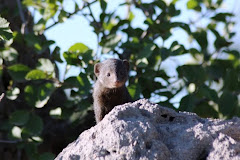
As soon as I arrived at the group I knew something was wrong.
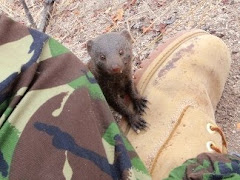
Mongooses were darting everywhere. Small worried faces peered out from beneath a tumble of granite boulders, and the piercing chirps of distressed mongoose pups pulsed from all directions at once. I saw Black (the group’s alpha male) snatch up a youngster and race off, leaping from boulder to boulder, before disappearing into a thicket more than 50 m (165 ft) away. Meanwhile, close to my feet, Iorek, fluffed into the shape of a football, approached in a slow ninja crouch.
Then I saw the cause.
Coiled on a sheet of rock right in front of me was one metre (3 ft) of slate-grey snake. It coiled and writhed and twisted sinuously in an eye-catching way that made my skin creep. But that was just the beginning (or more accurately the end). From this squirming mass stretched another meter of totally inert snake which led (my eyes drawn inexorably on) to the final metre. This rose up vertically, placing the snake’s smooth grey head at waist height. The creature was not looking at me; its gaze was fixed firmly on the mongooses.
Ah, a black mamba.
 |
| Black mambas (Dendroaspis polylepis) are the world’s second longest venomous snake (piped at the post only by India’s king cobra). They reach 2 m (6 ft) by their first birthday and can grow to 4 m (13 ft). Reputedly also the globe’s speediest serpent (but who’s clocked them all?), they zip along at 5 m (15 ft) per second, through the branches or down on terra firma. Photo by Michael Ransburg. |
 |
| Absurdly, black mambas (Dendroaspis polylepis) aren’t black. It’s the insides of their mouths that are ebony (oh, of course). When antsy, a mamba will raise the first third of its body vertically off the ground, flash its sooty maw and hiss ferociously (note to self: avoid black gums). Photo posted on Flickr by Viperskin. |
Now black mambas have almost mythic status here in Africa. Preposterously long and super quick, they might have slithered straight from the novels of Rider Haggard or an Indiana Jones movie. Their bite (if untreated) is 100% fatal, and they’re said to attack without provocation, chase their victims and track them down using scent.
And all this is true ...if you’re a dwarf mongoose.
However, even if you’re a bipedal primate (and I’m assuming you are), black mambas are not to be messed with. Piss one off (by molesting or cornering it) and you’re in serious trouble. Retaliating mambas bite multiple times at a single strike (although normally too rapidly to see), injecting about 100 mg of toxin at each lightning-quick chomp (no inoffensive ‘dry bites’ here I’m afraid). 10-15 mg of the stuff will kill you (by paralysis and suffocation), so unless you can conjure up antivenin and life-support within an hour or so, you may as well start looking for that brightly-lit tunnel.
Although all this is pleasantly titillating, it must be said that black mambas are masters at avoiding people. And they rarely nibble on humans. A study in the 1960s found that out of more than 1,000 snake-bite victims admitted to Durban hospitals over a seven year period, only eight had fallen foul of black mambas.
And whenever I meet one (usually only a few times a year), it’s always rocketing away from me.
So why was this snake at Bugbears just... er... standing there?
And what was with the whole tail-writhing thingey?
I edged a little closer but the snake still didn’t respond. Black mambas hunt by day, actively tracking warm-blooded critters by scent, so they pose a serious threat to dwarf mongooses.
But if mambas are quick so too are mongooses, and the snake will only make a killing if it can catch one by surprise. So the instant a mongoose detects a whiff of serpent it screams ‘SNAKE!’ and whole group comes running. Fur-fluffed, spitting and growling, they encircle the reptile, creeping forward on their tummies before hurtling backward whenever it stirs. I bite my fingernails and sweat a lot.
Once they’ve harassed it, the mongooses flee (unlike with other large snakes), hotfooting it at least 100-300 m/yds. Yet they always leave someone (usually the second-in-charge male) behind. This guard follows the mamba’s every move for 10-20 minutes (presumably to check it doesn’t pursue the group) before racing off to rejoin his family. (No, I don’t know how he knows where they’ve gone, but he does). This strategy seems to work well and mambas aren’t big mongoose-eaters.
But when the group has small pups the whole ballgame changes.
Pups are not quick. Pups are dim-witted and gullible.
Suddenly mambas appear out of the woodwork.
The mamba in front of me was being guarded by both Iorek and Bear; meanwhile the other adults were dashing back and forth, helter-skelter, snatching up pups from various hiding places and carting them off in different directions (the old eggs-in-one-basket issue). I watched Pooh carefully stow her small burden in a narrow rock crevice before hurrying back to watch the snake. However, the pup, used to being tucked up snugly with its littermates, freaked out at being left all alone. Its anguished chirps, combining with those of its four siblings, rose in a deafening chorus of distress.
 |
| The group’s matriarch Iorek (BF010) hastily redistributing a vulnerable pup. |
The mamba still stood quite motionless, apart from its absurdly writhing rear end. Is this how mambas hunt mongooses? Was the snake trying to hold the mongooses’ attention with its nether coils while ambushing them from above? (Is this why mambas are so bloody long??) I can’t find any mention of mambas hunting this way but behavioural studies of wild snakes are as rare as... er... snake’s legs. And doting snake-enthusiasts are unlikely to feed their pets mongooses (at least I hope not!). I became more convinced by this interpretation just a few days later when I came across another mamba doing exactly the same thing with Koppiekats (who also have little pups).
 |
| Black mamba venom is a potent concoction that locks down muscle cells in numerous devious ways. However, there’s a bright side: it also contains mambalign, a ‘better-than-morphine’ painkiller. Damaged and inflamed tissue becomes acidic (due to a build up of positive ions) and these ions trigger pain by flooding into nerve cells via special portals (‘acid-sensing ion channels’ or ASICs) on the cell’s surface. Mambalign locks these ASICs tightly closed, thus stopping pain. It’s not clear why mambas provide this unexpected boon to their victims, especially since the venom of many less-considerate snakes actually incites pain by locking ASICs open.You can read a popular account of mambalign research here. Photo by Ian Turk. |
 |
| Black mambas are easy to identify thanks to their Witch Weekly-winning smile. The guide books rarely mention this, favouring instead the sensationalist ‘coffin-shaped’ head. Photo by David Bygott. |
As I edged a little nearer to the mamba I dislodged a pebble which bounced down toward the snake. Instantly it shot off into the undergrowth. Iorek and Cricket raced after it, desperate to keep it in sight, but it was moving so fast it had gone in an instant.
Calling constantly to one another, the mongooses fanned out to search. They crept about tentatively on tip-toe and with their backs arched, sniffing and peering under boulders, into crevices and up into the overhead branches. After about 10 minutes, they seemed satisfied that the snake wasn’t loitering nearby and began their exodus. While Black kept guard from the top of a large boulder, the others hurriedly gathered up the five squawking pups and raced off with them toward a distant kopje.
 |
| Black (BM003) watching for the enemy while the group evacuates the pups. |
 |
| Tick (BF038) carrying her little brother/sister out of harm’s way. |
The mongooses regrouped about 150m/yrds away beneath a huge granite boulder. After Cricket and Bear had raced back for a last quick check of the area (to ensure no errant pup had been left behind), the group settled down in a huddle to groom one another consolingly. The pups, now happily together again, began to play wrestle.
But everyone was still unnerved.
How could I tell?
Each time I raised my hand unconsciously to shoo a fly, they’d all leap in the air!
 |
| Is it safe to come out yet? At three weeks old, dwarf mongoose pups are mobile but gormless. This is Arctos (BU061). |