Showing posts with label invertebrates. Show all posts

Monday, August 5, 2013

Beedevilled

I’m sure you’ve seen those documentaries about social insects where the camera snakes you down into the depths of the colony and there - lit by a ghostly green glow - you witness eerie fungal gardens, ants herding caterpillars and grotesque monarchs stuffing themselves on delicacies.

Well at the moment I feel as if I’ve somehow got trapped down there.

It all started a few days ago when I arrived home to find my living room abuzz.
Literally.
As I opened the front door the sound hit me like a palpable wave; a droning, wrap-around buzz so intense I could almost see it.
There were bees everywhere. The air was thick with them. They were hovering and crawling and revving for takeoff. There were bees doing their waggle dance, pirouetting and tangoing within a circle of spectators; there were bees conferring quietly in small huddles and bees sitting calmly in apparent contemplation. The windows were coated, inside and out, with a mass of small bodies, but – and this worried me the most - they weren’t angry bees, striving to get out. Disconcertingly, they all had a laidback, we-want-to-be-here kind of manner.
All my pets had retreated outside and were looking as dismayed as I felt.

 
Of the 20,000 known species of bee (argh!), only seven are honey bees (all in the genus Apis). This select group (whose colonies cache honey is waxy combs) is thought to have originated in SE Asia, and our much loved common honeybee (Apis mellifera) started life in tropical east Africa before buzzing on northward.
Photo posted on Flickr by Goshzilla-Dann.

What was going on?
Had a swarm settled in my house?
I prowled disconsolately through the bee-clouded rooms, searching vainly for the tell-tale ball of bees. Then I tried following one of the bustling trade routes, and the hovering, buzzing hordes led me slowly back to my mealworm colony (housed in large plastic basins on top of a cupboard in the lounge room). Peering into a basin I was appalled to find a seething mass of bees, all rolling and writhing in apparent ecstasy, among the mealworms.
What the...??
Had I stumbled upon some dreadful orgy; a bizarre bacchanalia of miscegenation? 
Then I noticed that the writhing bees looked as if they were wearing cargo-pants whose bulging pockets were stuffed with something white.
Ah ha!  (A light bulb moment.)
They were gathering flour!

Err... flour??

Bees sifting flour from my mealworms’ bran.

Tentatively edging my way through the miasma of bees in the kitchen, I discovered another orgiastic clump squirming about in an open pack of maize meal.
Why had I never heard of bees behaving like this?
I mean, sure, bees show an unhealthy interest in sweet beverages. But dry goods? And it’s not as if I’m a complete neophyte when it comes to bees. As a child I shared home and hearth with a feral swarm (which resided in the chimney). Bee-stings were a routine hazard of television viewing, but never once did the little beasts attempt to pilfer our baking supplies.

With a reckless disregard for personal safety, I grabbed up the flour-bearing items and rushed them out to the veranda. A stream of bees accompanied me, and I prayed that the thousands still humming about inside the house would follow the food.

Could it be that they were starving? It’s been a bad year for bugs (as my skinny mongooses can attest); maybe the colony has scoffed its winter honey stores and is simply desperate? 
But then I looked at the exuberance of daisies currently blooming in my garden.
Nary a bee.
Hmm...

My scorned Namaqua daisies.


Evidence that other pollinators find my daisies attractive.

Craftily I moved the mealworm basins in amongst the flowers, hoping the bees might get the hint.
They didn’t.
But at least they all drifted out of the house, gathering in a massive, swirling column above the victuals. I discovered that if I laid out a smorgasbord of titbits (sugar water, maize meal and an open packet of cake flour), they deserted my traumatised mealworms and I was able to sneak the containers back indoors.
To what extent my mealworms have been scarred by this ghastly experience, I do not know. Caterpillars go off their food when bees buzz overhead (nibbling only one-third as much as usual). But the species used in this experiment (beet armyworms) sport special sensory hairs that respond to the vibration of buzzing wings (to track incoming parasitic wasps). As far as I know, my mealworms are hairless, so maybe they’ll make a full recovery.

Of course the bees are behaving most amicably and I remain unstung. However, the psychological impact on my dogs may be a problem. It was while I was fishing drowning bees out of a 0.5 mm smear of sugar water, that I noticed Wizard staring at me with a look of astonished disbelief. He’d come dashing over to interpose himself between me and whoever I was talking to (as alpha male he feels he has the right of veto), only to discover I was conversing with bees. Since then his attitude to our insect plague has changed: whenever a bee buzzes him, or lands in his bowl, or entangles in his fur, he fixes me with a look of profound reproach.


‘Hey look: it's a squashed bee!’
My dogs aren’t alone in disliking bees. When researchers played bee recordings to herds of snoozing elephants, the pachyderms immediately fled the scene, retreating about 60 m (200 ft) with their tails in the air. This little guy, however, hasn’t fallen victim to a bee (or car); he’s just annoying Mum by playing on the road.

Now it’s no surprise that bees are well-equipped to garner pollen (and flour?) but they’ve got one adaptation that’s genuinely electrifying. When bees zip around in their busy buzzing way, their bodies are bombarded by dust motes and other little bits of air-borne grunge. These minor collisions scrape electrons off the bee’s outer waxy cuticle and, voila, you get a positively charged bee. Flowers - in contrast to bees - sport a negative electrical field (at least on sunny days) and we all know how opposites attract. So when a positive little bee comes hovering down, the flower’s pollen flies up to the bee, like iron filings to a magnet.

But the niftiness doesn’t stop there.
Bees can also discern the electrical fields of flowers. When a conscientious worker bee touches down on a bloom, she neutralises its negative charge, and it takes a couple of minutes for the flower’s negativity to restore itself (rather like when I eat a piece of chocolate). This means that bees zooming about above a field of flowers can spot which ones have just been plundered and save themselves a fruitless nectarless visit.


It’s the bees’ flagella (the very tips of their antennae) that sense electrical fields. Pushed or pulled by an electrical charge, the flagellum’s tiny movements are monitored by touch-sensitive fibres within the bee’s antenna joints. When researchers unkindly immobilised these joints (by covering them with wax), the bees could no longer tell positive from negative.
Photo posted on Flickr by Johan J. Ingles-Le Nobel.

I have decided that today is D-day. I’m withdrawing all aid. I’ve carefully hidden my mealworm containers away inside my wardrobe (hey, who needs clothes?) and have locked up all cereal products.
Fingers crossed that the bees will leave!


Sweet-toothed, mead-guzzling humans have kept Apis mellifera for at least 3000 years. Archaeologists uncovered 30 hives (made of straw and unbaked clay) dating from about 900 BC at a dig in Israel’s Jordan Valley. However, it wasn’t until the 18-19th century that people learnt how to pinch the honey without killing the golden goose colony. Photo by Gwendolyn Stansbury.


The local little bee-eater family (Merops pusilla): possible justification for indoor foraging?

Monday, November 1, 2010

Beasts for the bedridden


"The universe contains any amount of horrible ways to be woken up...

A dog's wet nose is not strictly speaking the worst of the bunch, but it has its own peculiar dreadfulness which connoisseurs of the ghastly and dog owners everywhere have come to know and dread. It's like having a small piece of defrosting liver pressed lovingly against you."

Terry Pratchett (Moving Pictures)


This quote holds particular significance for me this week because I spent the better part of it in bed, fighting off the horrible ravages of malaria (you're allowed to use phrases like 'horrible ravages' when you've got a bona fide tropical illness).

It's only been 'the better part' because of the regular intervention of the aforesaid noses. Oh, and don't let's forget cats' whiskers; equally unnerving when pressed into the face of a sleeper.

Of course their eyes are reproachful:  you know it's time to let us out...  feed us breakfast...  refill our water bowl...  turn on the air conditioner...  clean out the litter tray...  take us walking...  prepare our dinners...  shut the leopards out...

They've watched with deep concern as I trembled and shook, coughed and spluttered and fed-the-fishes (a phrase that's not as euphemistic as I'd like, given the state of the house's plumbing). Being cynical (a consequence of the illness, I'm sure), I couldn't decide whether they were genuinely worried about me or simply monitoring symptoms indicative of their continued neglect. But on Friday I decided it WAS true love. When I ate my first meal for four days, I had an utterly transfixed and joyous audience; and no one tried to beg a thing!

Being bedridden restricts one's wildlife encounters, so I thought I'd write a nice gentle post about the vervet monkeys who hang out in the trees beside my bedroom window. I love these little guys, silvery-furred and lithe, they're like wood sprites or dryads as they dance through the foliage. But my contemplative mammal post was not to be. The local wildlife came inside.

On Thursday night I was just drifting off to sleep - in a semi-drugged daze - when I felt something brush against my thigh. Magic's tail, I wondered? Tentatively I reached down and felt about a bit: no tail. Magic was lying too far away. Since our recent serpent-visitations, we've all been a little paranoid (Wobbly Cat still hasn't placed a paw outside and Magic won't sleep there), so I decided miserably I'd better wake up and check it out. I groped sleepily for my torch and shone the wavering beam toward my feet.

Within seconds I was out of bed.

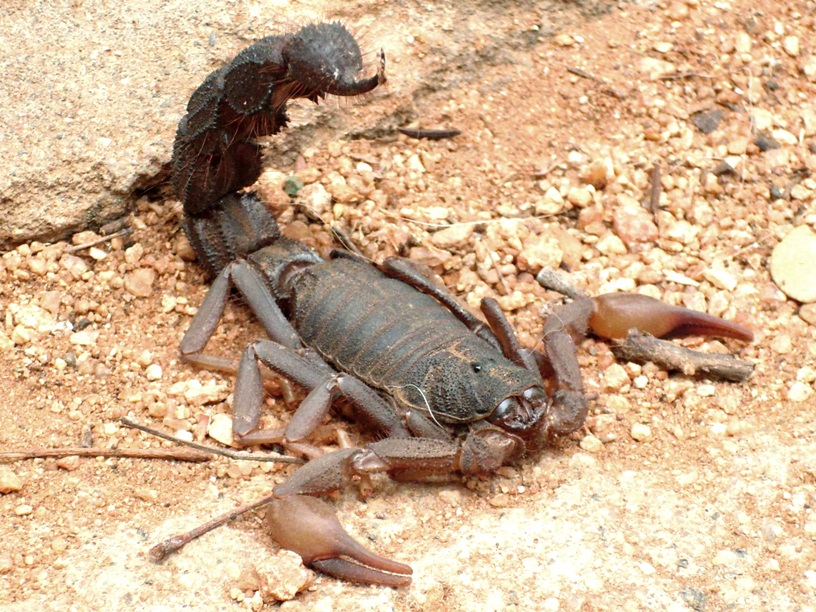
There was a large black scorpion crouched among the sheets.
It was about 12 cm (5") long with a huge armoured tail upraised threateningly over its back.

Oh, S#%*T!

It wasn't just any scorpion, it was a Parabuthus transvaalicus, one of the most lethal scorpions in southern Africa.

ISN'T MALARIA ENOUGH? I thought in anguish.

Parabuthus transvaalicus grows to 15 cm (6") long. But size isn't what counts. As a rule of thumb (although it's best to keep them out of the way), your scorpion-related panic can be accurately tuned by examining the beasty's body bits. Scorpions with whopping pincers live hand to mouth, so to speak, crushing their prey to death, and so they have wimpy tails and weak venom. But scorpions (like this one) with petite little pincers kill with their sting (both prey and those that piss them off) so they have hefty tails that produce lots of lethal venom.


Trying to ignore my throbbing headache, I began bundling the pets out of the room.
Fleetingly I considered taking a photo, but thought 'To hell with the blog'. (Forgive me, dear reader, but I'm sure it was the wicked malady speaking, and I also remembered I'd taken a few shots of a dead specimen in the garden last August.)

Wielding a plastic drinking cup, I rumpled the sheets behind the scorpion and it obligingly trundled into the cup. Then, while stuffing a blanket over the beaker, I fumbled it and the scorpion scuttled out again. Not good. I should probably point out, at this stage, that this species doesn't just sting like normal scorpions, it can also spray it's venom for distances of about one metre/yard. Thankfully, it didn't. My second attempt was more successful, and despite a few nervous moments, trying to keep the lid on the cup with my chin while unlocking the back door, the release went smoothly.

While I'm not keen on scorpions, I have to admit their interesting little guys; especially when it comes to romance.
After following the trail of his true love's pheromones, the smitten male performs a little tap dance, juddering his body, tapping his pincers or wagging his tail (depending on his species). His lady detects these 'love vibes' through highly sensitive hairs on her feet and body, and sensibly curbs her predatory inclinations. Next the couple embrace, lovingly locking pincers or - more intimately - mouth parts. The male then whisks his sweetheart into a waltz (lasting 5 to 30 minutes), fanning out his pectines (fluffy sensory combs on his stomach that feel the ground) in search of the ideal place to consummate their love. The dance only halts when he finds a smooth hard surface. Here he deposits his spermataphore: a little package of sperm that's sticky on the bottom and hooked at the top. Once it's stuck firm, he helps his paramour move above it; they have to get the position just so, because the hook on the spermataphore must catch and pull open the covering of her genital opening. Ain't Nature grand!

While this is the end of the story for the male, the female's destined to a 2 to 18 month pregnancy (depending on her species). She then gives birth to live young, a feat virtually unheard of among arachnids. Withdrawing to the safety of a burrow or shelter, she arches her tail over her back and places her front two pairs of legs beneath her genital opening to create a birth basket for the emerging babies. She then helps the newborns (tiny, but pale and soft, versions of the adult) clamber up on to her back. Here they remain, safe and snug, (while she forgoes foraging) for their first 9-14 days.


Parabuthus transvaalicus' monstrous tail churns out large quantities of neurotoxin (drop for drop as potent as any snake's). It causes severe pain, muscular cramps, uncontrolled limb movements, numbness, difficulty breathing and swallowing and death by respiratory failure (depending on the victim's body size and health- yikes!). To be fair, the species also uses its tail to excavate burrows, and to sing. Metaphorically. It emits a 'chick-chick' sound by rubbing its sting against the roughened surface of its second tail segment. Oh, and those spiffy hairs detect the air vibrations generated by hapless prey.


Sharing a bed with a scorpion is not my idea of fun, especially when I'm already feeling under the weather. But my sense of persecution evaporated instantly when I read the latest blog post by the hyena researchers  in the Masai Mara Reserve in Kenya. Oh my! I urge you to check out  what intruded on their sleep this week. Your life will suddenly seem so much better!

Friday, March 26, 2010

Come into my parlour...


At this time of year, I don't envy flying insects.
In truth, I don't envy them anytime, but now, at the end of the wet season, their lot is particularly grim. The bush is brimming with orb-web spiders.
Tier upon tier of vast, disc-like webs tremble between every tree and bush. Each web spans about 1.5 m and shimmers golden when viewed from the side. A stroll through my study site leaves me feeling like Frodo in the tunnel of Torech Ungol.
The most common species is the massive golden orb-web spider, Nephila senegalensis. The females are daunting, with a body 25-30mm long (add legs and they're larger than my spread hand). They weave a web so strong it ensnares small birds (I released a struggling blue waxbill recently). Fortunately, they're harmless to humans and flee rapidly when their web is blunderingly destroyed, so the pitter-patter of scuttling feet on one's face lasts only a second or two.

Golden orb-web spider, Nephila senegalensis.


The golden orb-web spider is named for the colour of its silk. This is the patch of silk at the centre of the web.

An altogether more clinging species, is the black and yellow garden orb-web spider (catchy name, huh). It is also very large (25mm body) but is a bit less common.


 Black and yellow garden orb-web spider, Argiope australis.

You can see the zig-zags of white silk (called stabilimenta) that span its web, forming a cross at the centre where the spider hangs. The function of stabilimenta is still hotly debated, but these decorations may camouflage the spider, breaking up its outline, attract insects by imitating the ultraviolet runways of flower petals, or warn blundering vertebrates of the presence of a web.

From my point of view, the little (8 mm) yellow and black kite spider
is relatively inoffensive because it usually strings its web a couple of metres above the ground.

Yellow and black kite spider, Gasteracantha versicolor.

Related Posts Plugin for WordPress, Blogger...