Showing posts with label carnivores. Show all posts

Friday, November 22, 2013

Halloween callers (er... belated)


Sorry I’ve taken such a ridiculous amount of time to upload this post...

Outside North America, the heart-warming tradition of extorting candy from strangers (trick or treating) is often met with less than enthusiasm. A survey in the UK, for example, found that more than half of British householders turn off their lights and pretend to be out, come All Hallows Eve.
But living as a hermit, tucked away in the African bush, I wasn’t expecting callers.
I was wrong.

Now trick or treating can trace its roots back to the Middle Ages, when the financially-challenged celebrated All Saints’ Day (or All Hallows’ Day) by dressing as demons and bartering prayers and songs (to help the wealthy’s departed mosey on through Purgatory) for cash and cakes. This jolly festivity was called souling and it was definitely a souler who visited my house on Halloween night.

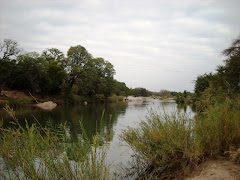
But I’m jumping ahead of myself here because my exchanges with soulers really started a few days earlier when I was walking my dogs down along the river. At this time of year (end of the dry season) the river is braided with sand and fringed by dense thickets of reeds. It was late afternoon and heavy clouds were leaching away the light when we heard a loud, rasping grunting coming from the far bank. The dogs and I crept upstream until we were directly opposite the hidden caller and hunkered down in a thicket of raisin-bushes in the hopes of catching a glimpse of the vocalist. With no more than 30m (100 ft) between us and the vociferous beast, its deep, grating calls were deafening, thrumming uncomfortably inside my chest.

Embarrassingly, it took me almost six years to figure out who utters this call. I’d always assumed it was a baboon expletive (something about one’s mother??) because it inevitably invoked a cacophony of outraged bellows from the local baboon troop. But it’s actually voiced by a much more impressive beast (my apologies to all Papiophiles). The books describe it as sounding ‘a lot like someone sawing wood’. I used to find this description unconvincing, but up close and personal, it’s spot on (in an age of chainsaws, perhaps I just don’t know what a distant wood-saw sounds like). The leopard utters its rasping ‘strokes’ while both inhaling and exhaling, and the result is shockingly loud. You can hear it here (click on leopard), but it's a recording of very distant animal (can't find anything better however).


Big cats (members of the genus Panthera) - unlike small cats (members of Felis) - can utter astoundingly loud roars because their hyoid bone (you know, the one that snaps during strangulation, as per CSI) has been replaced with cartilage.
Photo by Arno Meintjes.


Leopards (Panthera pardus) are the most cosmopolitan of the world’s cats (apart from our little domestic moggies, of course). They prowl almost every habitat in Africa and sneak about in Asia as far as China and Malaysia. They also sometimes munch people - mostly in India and Nepal - annually killing 1.9 Nepalese per million. Photo by Arno Meintjes.


The vocalist was hidden among the reeds by the water’s edge, and while we were trying to spot spots, I realised that the cat was actually dueting. Further upstream on our side of the river another leopard was answering. Fortuitously, we were downwind of both animals and it was clear that this second leopard was hot-footing its way downstream toward us. Were the two engaged in an acoustic border dispute? Or was one of them on the make?

I very much wanted to see what would happen when the two cats met. My dogs, however, weren’t too keen on the idea. I don’t know what’s changed their minds about leopards (they used to try to chase them) but these days the merest whiff of fresh leopard spoor makes them panic. They press up against each other and - glancing nervously over their shoulders - tow me away as rapidly as possible. They also now refuse to lie outside on moonless nights...
Thinking about it - maybe it’s better I don’t know...


Like almost all cats, leopards are solitary beasts. They stake claim to their territories using pee and song, and ferociously oust all members of their sex.
Photo by Steve Jurvetson.


She-leopards also use the species’ long-distance roar as a siren call for suitors. Like lions, leopards mate repeatedly for days at a time (he has to coax her into ovulation) but - unlike consorting lions - it’s very rare to catch them at it.
Photo (of captive Persian leopards) posted on Flickr by Tambako the jaguar.


As the leopard on our side of the river drew closer and closer, the dogs became more and more agitated, tugging frantically on their leashes. I began to wonder if I was acting prudently. I mean leopard fatalities are a rarity here in Africa but every few years the odd person gets chomped (and I’m certainly odd). In fact - I suddenly recalled as we sat hidden in our waterside thicket - a leopard attacked someone just a few weeks ago up near Pundia Maria (Kruger National Park). With the leopard on our bank no more than 50m (165 ft) off and closing fast, and the rasping roars of both cats now reverberating in our chests, Wizard’s nerve finally broke and he dragged me, sprawling, out of the shrubbery (let me tell you, huskies can pull). The leopard across the river immediately stopped roaring: our cover was blown. Although the cat on our bank continued to call, I figured that they wouldn’t interact normally, so I let the dogs haul me away inland.

Now I thought that this was the end of it.
But then the souler arrived on Halloween.

It was about 8pm and I was innocently watching TV when the roars began. Once again two leopards were dueting, with one far off and the other quite close. And getting closer... and closer... and CLOSER! Oh God, it’s roaring from the reeds just below my garden. Sitting no more than 15m (50 ft) from my back door, it gave its thunderous grating roars - one every three minutes or so - for more than an hour.

Now I don’t think this creature was seeking a treat (at least not from me) but I felt its performance would certainly hurry any passing spirits on their way, through Purgatory or otherwise. I mean leopards have harried our ancestors for millennia. Modern forensics show that at least one fossil hominid (who dwelt in South Africa 1.8 million years ago) fell victim to a leopard: the puncture wounds piercing the back of his/her skull perfectly match the bite impressions of a leopard’s lower canines. Researchers have even suggested that humans owe their intelligence to the leopard via an evolutionary arms race in which we combated stealth and might with cleverness. And I have to admit that while it was hugely exhilarating having a leopard at the bottom of my garden, it was also a little scary.
A leopard just isn’t something you want to stumble over when you pop out to move the sprinkler.
Would that be the trick I wonder?
Ah, spooky ol’ Halloween...


What better emissary to communicate with the dead than a professional killer? Photo by Arno Meintjes.

P.S. I always carry a nifty little pepper spray when I’m out dog-walking (I thought I’d mention that for the sake of nervous relatives).


Friday, July 19, 2013

Dwarf mongooses: warts and all

 
After seven and a half years working with dwarf mongooses (Helogale parvula), today I discovered the meaning of their scientific name.
And I’m outraged!

Their dreadful scientific moniker was bestowed upon them back in 1847 by Carl Jacob Sundevall. Dr Sundevall was a Swedish ornithologist (yes, that’s right, ornithologist) who was working as curator of the Natural History Museum of Stockholm at the time of his ghastly misjudgement.


The culprit. Image from Wikipedia.

Now let’s be clear. I have nothing against Sundevall’s choice of a species name, parvula.

In Latin parv means little, and ula is a diminutive form; so that’s little, little.
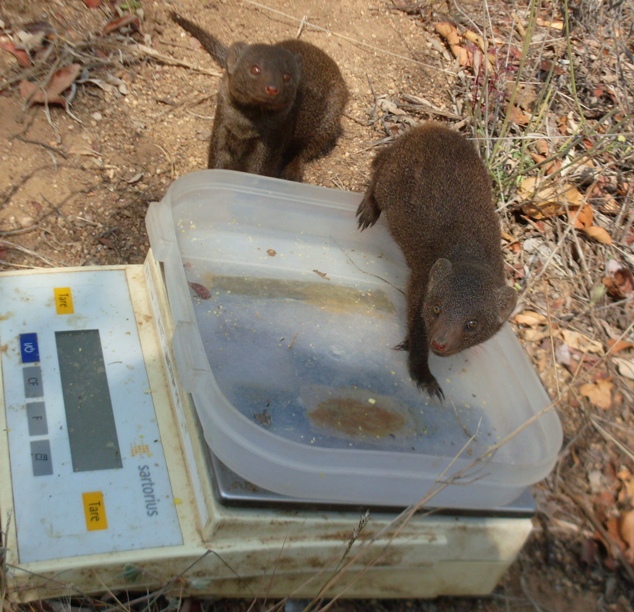
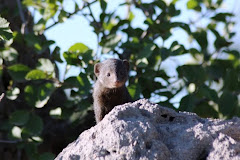
And there’s no question that dwarf mongooses are wee. Even at the height of summer when they’re at their chubbiest, adults clock in at only 270-300g (10 oz). They’re not only the teeniest of the globe’s 31 mongoose species (they’re only one-third the size of meerkats, for example), they’re also Africa’s most petite carnivore.


Chimera (EM061) and Doxy (EM066) helping me to document their littleness.

No, no, it’s the genus name, Helogale, that I have problems with.
In Latin gale means weasel.
Mongooses are NOT weasels.
Mongooses do not even belong to the weasel family (the pesky mustelids).
Heck, they don’t even like weasels!

If the mongooses held a family reunion, you’d see genets and aardwolves, linsangs and banded palm civets. There’d be hyenas, overseeing the braai (BBQ), and civets griping endlessly about the perfume industry. The binturong would be annoying everyone by picking up party nibbles with its tail, and the toddy cat, who’s had too much to drink (again), would be delighting the kids with unsavoury re-enactments of kopi luwak manufacture. Even the Madagascan contingent would be there: the falanouc pontificating about earthworms with the white-tailed mongoose, and the fossas and meerkats locked in heated debate over media bias.

BUT THERE WOULD BE NO WEASELS!

Even when the distant cousins rocked up (oh you know, those weirdoes who lost touch eons ago), you wouldn’t see a single weasel. Oh yes, amid the fake smiles and cries of ‘pull up a pew’, you’d spy tigers and ocelots, jaguarondis and cheetahs, clouded leopards and (oh my god) a very obese Persian.

BUT THERE WOULD BE NO WEASELS!

This is the only weasel to sully the lands south of the Sahara. When threatened, striped weasels (Poecilogale albinucha ) squirt stinking anal-gland secretions for a distance of 1 metre/yard. This is one of the many traits they do NOT share with mongooses.
Photo from Wikipedia.  

Nevertheless.
I’m willing to concede that weasels and mongooses do show some (superficial) likenesses. I can understand that a person who spends all their days mulling over dead bodies (and probably has seasonal affective disorder too) could consider these similarities noteworthy.
Yes - if I must - I can cope with gale.

But I cannot accept Helo.
Carl Sundervall what were you thinking??

So what does the dwarf mongooses’ scientific name actually mean?

LITTLE WART WEASEL.


Does this look like a LITTLE WART WEASEL to you?
(This is a rhetorical question. Any reader veering toward the affirmative is strongly advised not to leave a comment.)

 Now Carl Sundervall didn’t actually see a living, breathing (and biting) dwarf mongoose. He described the species from a cadaver sent to him by another Swede, Johan August Wahlberg. Back in the 1840s, Johan Wahlberg toured the length and breadth of South Africa shooting things collecting specimens. Dwarf mongooses were just in the wrong place at the wrong time. A vast mountain of carcasses (of mammal, bird and reptile species) were then shipped back to lucky old Stockholm.
So could it have been gun-happy Johan who was responsible for this dreadful naming travesty? Did he fail to treat the limp little body with sufficent reverence (and preservative)? Was the scrap of lifeless fur that Carl Sundervall lifted from the packing crate pocked with wart-like decay?

Is there an excuse for the inexcusable?


Another victim of Johan Wahlberg’s shooting spree. To add insult to (mortal) injury, this victim got landed with the perpetrator’s name: Wahlberg’s eagle (Aquilla wahlbergi). I guess things can always be worse. Photo by Arno Meintjes.

Now I realise that once a species is officially described and named, its scientific moniker cannot be changed. But surely Anagalligale parvula (delightful little weasel) or Dulcigale parvula (sweet little weasel) or even Maxigale parvula (greatest little weasel), would have been preferable.

Maybe I can just sneak in a different name as a typo...

Dwarf mongooses (Calligale parvula) enjoying a family moment. Ah, beautiful little weasels...

 P.S. Johan Wahlberg was ultimately killed by an elephant. Hee hee.


Monday, July 15, 2013

Intruder rampant


Last night I was victim to a ‘break and enter’.
Although (to be honest) ‘enter and break’ would be more apt.

It was 2 am when I was flung from sleep by a loud, tinkling crash coming from the kitchen. A quick head count revealed that all my pets – now struggling groggily to their paws – were with me in the bedroom.
There was an intruder in the house.

Snatching up my bedside torch, I and the pets (two huskies and a cat) stumbled drowsily toward the noise.
Now call me unwise, but it never occurred to me that the intruder might be human. From the china-shattering sound effects, I knew someone had knocked over the dishes I’d left teetering on the sink (for security purposes only, of course). This suggested an arboreal offender, and my sleep-clogged brain was shuffling inefficiently through alternatives... a bush baby, maybe?
Hopefully, NOT a leopard.

I snapped on the kitchen light and all Hell broke loose.
Instantly a slim, cat-sized creature was hurtling around the room, bouncing off the walls, the fridge-top, the sink, the cupboard. Every gargantuan leap was accompanied by a cacophony of breakages as jars, pans, egg cartons, canisters and plates crashed to the floor (not that my kitchen is untidy, of course). My dog Magic leapt after the frightened animal, knocking over the garbage can and bounding through the broken crockery and glass. Over and above this chaos there arose a burgeoning stench: acrid, sweet and musky.
With everything happening so quickly, and the animal moving so fast, I couldn’t get a good look at it. My only impression was of a long, ringed tail.
Ahh, a genet.

Now genets are very special animals. Of all the carnivores pussyfooting about the globe today, genets are the ones most closely resembling the ancient grand-pappy of the whole toothy mob (a little miacid who hunted 50 million years ago). In fact, the genet’s teeth and skeleton have barely changed since way back then. This isn’t to say that genets are primitive; they’re simply traditionalists who like to do things the way their mammies’ did.
They’re also amazingly beautiful.
Clothed in the softest, pale silver fur, they’re brushed with delicate streaks of inky droplets. A trim of silky black fur crests along their spines, and their long, long tails - the ultimate accessory - are shockingly aposematic, ringed spectacularly in white and black.


The small spotted genet (Genetta felina) is one of ten species that haunt the African night. Their nearest and dearest are the civets, linsangs and mongooses (so how could they not be charming?).
Photo by Fredric Salein.


My intruder hurtled through the kitchen doorway and circumnavigated the lounge room in seconds by ricocheting off the walls. Leaping at the French windows, it slid spread-eagled down the glass, Sylvester-like, its claws screeching all the way. Magic (who’s mania for hunting ratchets into insanity in the presence of a small carnivore) saw this as her big chance and plunged across the room. I pelted after her in a valiant attempt to avert certain carnage. But I’d underestimated the genet. Touching ground, it instantly sprang again, bouncing off the top of Wizard’s head and disappearing into the bedroom.


Genets, like cats, have sharp, retractile claws that let them climb and snare small beasts efficiently. Their paws also have 5 toes (cats and dogs have 4).
Photo by David Bygot.


By this stage the musky fetor was almost making my eyes water. You see genets are masters in the art of perfumery. As professional serial killers, they favour a solitary lifestyle and operate only under the cover of darkness. This makes conversing with lovers and rivals challenging. Yet with typical mammalian ingenuity, they’ve hit on a solution: they leave little aromatic messages that convey their identity, sexual orientation and level of libido.
While most carnivores make do with bog-standard anal glands - brimful with pungent bacteria - (this, by the way, includes your sweet little cat and dog), genets brandish a perineal gland too (a little slit located between their anus and their naughty bits). When marking is imminent, muscles pull open this innocuous looking slit to expose an inbuilt paintbrush of fine white hairs oozing a clear oily emulsion. As if this isn’t scary enough, the animal then uses acrobatics to apply the malodorous stuff. Backing up to an object, it flings its hind legs up over its back and teeters around on its forepaws (in a perfect handstand) to smear the goo, back and forth, as high as genetly possible. (Okay, my dwarf mongooses also indulge in handstanding, but I’m sure they’re much more mannerly).

Oh, and I forgot to mention that when genets get anxious they release every possible excretion.
Urgh!


Genets munch any small critters they can lay their paws on, from bugs to duiker lambs. They’re also partial to fruit and nectar.
Photo by Isidro Martinez.

When I followed the procession of animals into the bedroom, I found Magic trampolining on the bed in an attempt to reach the genet, who was scrabbling up the wardrobe. Launching a flying tackle, I pinned the dog to the mattress with my body, and everything fell still. Panting quietly, we all took stock. The genet stood frozen on top of the dresser, one forepaw raised and nose uplifted like a wondrous heraldic beast (argent genet passant).

Unfortunately, I was so busy devising an escape plan for the frightened creature, I forgot to check out its tail. Now this may seem an understandable oversight but two genet species lurk around here, and they’re not easy to tell apart. The tail of the large spotted genet (Genetta tigrina) sports a black tip, while the small spotted genet’s (Genetta felina) tail usually concludes in white (I’m sure you’ve noticed the flaw in this masterly technique). Unfortunately, the whole ‘large’ and ‘small’ business is a red herring (to confuse newbies); it refers to the spots not the beasts.

Large spotted genets (Genetta tigrina) are found in the moister bits of southern Africa. Their spots are rust-coloured and ringed in black rather than being charcoal (hmm, a bit subtle...).
Photo posted on Flickr by West Chester Dumonts.

Common or European genets (Genetta genetta) are the only species to venture beyond Africa (they also prowl the Middle East and southern Europe). However, it’s uncertain whether they were introduced to Europe (by the Moors to Spain) as they were routinely kept as mousers throughout the Middle Ages (before cats got popular). Photo by Ricardo Sanchez.


After careful thought, I concluded the best way to help my nameless genet was to neutralise Magic. I wasn’t worried about Wizard: he’s not much of a hunter and he was still recovering from the whole head-bouncing incident. While I dragged a whimpering Magic off to the bathroom, the genet quietly slipped back into the lounge room and escaped out the window. 
Phew!

Now I’m just left with a complete ruin of a kitchen and an overpowering stench.
It’s not entirely unpleasant, but... er... very animally!

This image is for those of us who secretly suffer tail-envy. Presumably it’s of Mum and the kids (but there seem too many). Maybe - like other solitary mammals - small spotted genets are willing to bend the rules when food is bounteous.
Photo by David Bygott.

Tuesday, December 25, 2012

A festivity of pups

One.... two, three....
Crouched in the dappled shade of a marula tree, I was counting pups.
Not pups of the canine persuasion; mongoose pups.
Now this was no easy feat because they were passing me at speed, curled into walnut-sized balls within the mouths of their caregivers.

Four... five...
Number five was having a rough ride, dragged along enthusiastically by nine-month-old Echo. Despite pointing his nose skyward and waddling on tiptoes, he simply wasn’t tall enough to lift his cargo clear of snags.
Six...
Oh, wait a minute, there’s one being carried back again...
Back to five...

Koppiekats group was shifting its week-old pups to a new termite mound and it was my one chance to figure out how many there were.
Frenzied excitement gripped the group as mongooses dashed back and forth; some carrying pups, some not. Calling anxiously to one another, and with agitation-fluffed fur, some individuals raced ahead to check the safety of the new mound while others ran helter-skelter back to huddle the last nest-bound pups. Meanwhile the pup-carriers hurried on past, self-importantly announcing their passage with uninterrupted, high-pitched peeps (‘clear the way, pup coming through’). And the little ones - although tiny, black-fuzzed and blind - gave ear-piercing squawks whenever they were unceremoniously dumped beneath tussock or log.

Six... seven...
Eight!

No wonder the group was so excited.
Four is the normal size of a dwarf mongoose litter.
So how did Koppiekats end up with eight?


Koppiekats’ most recent progeny, venturing out at four weeks old. Pups stay snugged away inside a termite mound for their first three weeks of life, coddled and guarded by babysitters. With so many little ones, Koppiekats felt the responsibility keenly, usually leaving behind two or three minders.

As you probably know, dwarf mongooses - like their celebrated cousins the meerkats – are the living embodiment of the Musketeers’ motto. Dedicated to the ‘all-for-one and one-for-all’ maxim, group members team up to harry snakes, evict trespassers and warn one another of incoming raptors. With heroic selflessness, they forfeit their own romantic aspirations to devotedly care for the offspring of their group’s sovereigns. It’s all heart-warmingly altruistic.
In theory.
In reality, the Queen’s ladies-in-waiting are not quite so chaste. These heirs apparent (sisters and grown daughters of the Queen) are not above indulging in a little hanky-panky. And when the inevitable happens, they try to hush it up by smuggling the consequences into the royal nursery.

To help perpetuate the hoax, they give birth on the same day as the monarch. I don’t know how they manage this because the courtiers normally mate a day or two after the Queen. But when royalty decrees, loyal subjects follow, ready or not. It looks as if the illegitimate pups are simply borne a little premature (they’re smaller and have shorter fur). Even courtiers who are only ‘a bit pregnant’ honour the auspicious day, aborting their litters and discreetly nibbling up the tiny pink foetuses.


When spring is in the air, the ladies of the court don’t seem to be able to say ‘No’, and the sovereign is rarely alone when she delivers the first litter of the summer. This is Cricket, an errant Princess in Bugbears, awaiting the big day.


So what’s the fate of these illegitimate ankle-biters?
Well that’s in the paws of the Queen.
Normally they’re doomed.
Her Majesty swiftly transforms them into a restorative post-partum snack and the bereaved mums then act as wet-nurses for the rightful heirs. Fortunately (from my perspective) dwarf mongooses don’t believe in airing their dirty laundry in public so all I see of the nefarious deed is a bulging tummy and blood-smeared chin. Not so meerkats, who enact a horrifying spectacle in which the whole group tussles over the gory remains.

However, occasionally, if food is plentiful, the Queen grants a stay of execution. A genetic study of Serengeti’s dwarf mongooses found that 18% of pups reared by the group are the progeny of lesser females. Although the rulers of my other study groups were merciless this year, Pleiades, the sovereign of Koppiekats, opted for clemency. So some of the pups that just passed me are actually Pleiades’ nieces, nephews or grandkids.


The brood at six weeks. Notice the size difference between the legitimate pups (on the left) and the little interloper on the right. Yes, there is a question mark over his head: I don’t know who his mum is (because three courtiers - Spark, Helium and Mercury – were in the family way).

But even if they escape the death sentence at birth, illegitimate pups aren’t out of the woods. They face a second test. And it is this that has made me apprehensive every time I've visited Koppiekats.

You see at one month old, mongoose pups begin tagging along on the group’s daily foraging jaunts. Chivvied, cajoled and carried, the little ones are tended constantly. Carefully lodged under a log or boulder, the pups are then presented with half-chewed creepy-crawlies by doting group members.
But when the pups hit five weeks old, this mollycoddling stops. Although everyone still feeds them (and will do so for another five weeks), the youngsters are expected to look out for themselves. If the group runs, so must they. It doesn’t matter how far, or how fast; they must keep up. So if any pup is below par (debilitated from want of food, illness or underdevelopment), they’re simply left behind.

Although I loathe this phase of mongoose-rearing, it serves the mongooses well, ensuring that they channel their efforts only into the healthiest pups.
And I’m very relieved to report that all but one of the little Koppiekats pups managed to pass this trial. Aided and abetted by a timely glut of beetle lava, seven of the roly-poly little creatures live to tell the tale. In fact they’re doing so well, they spend most of their time playing rather than trying to cadge food from their betters.


Shell games.

Leaf games.

Bite-brother games.

If you were wondering, no-one left these pups out in the rain. The rusty patches on their fur are from daubs of ‘Camomile’ blonde hair dye (so I can tell who’s who).

Born on 31 Oct, the Koppiekat pups remain unnamed. I’m trying to come up with Halloween-appropriate monikers, but they also need to be associated with minerals (as in Twenty Questions). Darkness, maybe? Sulphur? Or Silver (for the bullets needed to pot vampires)? Any suggestions gratefully received!

I almost forgot.
HAPPY CHRISTMAS!!


Sunday, December 9, 2012

Fraternizing with the locals


WHOOOOP... WHOOOOOP... WHOOOOP...

The deep, resonant calls - each ascending smoothly in pitch - were spine-tinglingly loud.
I dashed outside into the cool, river-scented darkness. The night reverberated with the machinery-clatter of toads, cicadas and crickets, yet the eerie, other-worldly whoops were loud enough to thrum within my chest.

Somewhere, down below me in the riverbed, a spotted hyena was calling to his/her clan.

Now even if you’ve never been to Africa (and if you’re into wildlife, WHY NOT?); even if you’ve never seen a hyena in the fur, you’ll recognise these calls. Beyond any other sight or sound, the hyena’s whoops epitomize the African night (and feature in virtually every wildlife documentary ever made on this continent).
And of all the wild places in the world, Africa - at night - is probably the scariest. It's also our ancestral home. For millions of years our forebears stared out into the dark, shivering at the sound of the hyena’s call. It’s no surprise then, that the eerie whoops stir a deep, atavistic trepidation. Grinning insanely into the dark, I stood revelling in the trills of fear that fluttered up and down my spine.

[You can listen to a spotted hyena whooping here (button no 2)].


Hyena-kind evolved from mongooses and civets about 10 million years ago. The spotted hyena (Crocuta crocuta) has haunted the African savanna for as long as humankind's existed. It can also digest teeth (I just thought you’d like to know that).

Now I don’t want you to start thinking that hyenas whoop simply for our titillation. This long-distance call (audible up to 5 km/3 miles) is the SMS of the hyena-world. Roaming clan-members use it to keep in touch and call for assistance when uninvited visitors rock up for dinner.

Whoop-studying researchers - plotting the calls of different hyenas on spectrograms - found that each hyena has its own distinctive whoop; something I guess the hyenas already knew.
Although an individual’s voice gets deeper as it ages, the unique pattern of its whoops remain consistent year after year; so hyenas can recognise one another from whoop alone.

When researchers played back recordings of cubs (who start whooping at 3-4 weeks), the whooper’s mum (but not other mothers) rushed to the speaker (oh, that is unless Mum was dining, in which case she just glowered in the right direction – hey, you gotta get your priorities right). Close family members also responded, and the amount of time they spent eyeing the speaker was directly proportional to how closely related they were to the little whooper. In fact, hyenas seem to use whoops to flaunt their identity during brawls (and no one scraps as well as spotted hyenas).

Now I have to admit I wasn’t thinking about any of this as I stood at the bottom of my garden the other night. I was peering into the darkness, straining to pinpoint the exact location of the caller.
Umm, exactly which side of the river was the creature prowling?
Then my heart-stopped.
Directly behind me (and I’m talking one or two metres/yards) an answering call rose up. Fear clutched my chest as the eerie, resonant wail swelled upwards. But after a few moments I realised that the call was not a hyena’s. Although almost as loud, and with the same deep, tonal qualities, it continued to rise, and then undulate, in pitch. It was probably the most desolate sound I’ve ever heard. Still barely able to breathe, I crept toward the uncanny, penetrating wail.
What could make such a call?
And there it was; lying on my door mat.
My husky, Wizard.


‘You won’t believe the riffraff you meet around here these days’.
 
Now in truth, I couldn’t have been more shocked if I’d stumbled upon the cat reciting Shakespeare. This was like no dog’s howl I’d ever heard. It was a blood-curdling keening, evocative of wildness, primal instinct and vast empty lands. It was NOT something that should be emanating from a household pet! In the seven years that Wizard has companionably shared the humdrum domesticity of my life, I’ve never heard him utter such a sound.


Wizard, pining for the tundra?

I guess the whole incident made me realise that, just as our own hearts and minds were honed by millions of years on the African savanna, so too our domestic animals carry within them the legacy of their ancestors’ lives. It’s so easy to overlook our pets, to somehow believe they’re creations of our own (like TV or motor cars or computers). But our companion animals are profoundly wild beings, gifted to us with just the flimsiest wrappings of domesticity.
And what an utterly amazing privilege it is to share so intimately in the life of a wholly different species.

Monday, August 29, 2011

The mysterious case of the missing mammals

It’s grim struggling out of bed on cold winter mornings but there are compensations.

For me, it’s watching the sunbathers.
Voyeurism, I know, but who can resist all those exposed fluffy tummies.

In the big nyala tree behind my house the vervet monkeys bob about like sailors in the rigging, waiting in the topmost foliage for the sun’s first rays. And when the light catches their coats, they blaze silver. Nearer at hand, dozens of tiny fire finches, blue waxbills and cut-throat finches squabble in the buffalo-thorn outside my bedroom. Lined up in the warming sun, they ruffle their feathers and shuffle their feet and complain non-stop in a cacophony of twittering.

But my favourite sun-worshippers sit about on the koppies (granite outcrops) I pass on route to my study site. Silhouetted against the sky on the giant ears of rock, they look like an infestation of ticks (OK, I’ve been working on small mammals for too long). But up close, they transform into pyjama-filled plush toys.


Rock hyraxes (Procavia capensis) are less adept than most of us at keeping their body temperature just so which makes their early morning sun-bathing session mandatory.

Now I’ve been spying on this unsuspecting colony of rock hyraxes (or dassies) every day for almost six years, so you can imagine my consternation a month or so ago when they all disappeared.

Was I passing by too early? Too late?
I often see eagles hovering about the rocks - clearly with evil intent - but they couldn’t have scoffed everyone. I rushed home to scour the hyrax literature to find what might have happened.
Apparently diseases like mange can wipe out whole colonies (yet no one’s looked moth-eaten) and a colony can include several widely-spaced koppies in their territory, so maybe they'd just changed residences (but they've never left before).

It was at this time too, that I noticed a new set of tracks on the road at the base of the koppies. Amid the usual mosaic of paw prints (laid down by genets and jackals, civets and porcupines) were prints I’d never seen before: the rear paw’s imprint always overlapped that of the fore paw.

Of course I didn’t put two and two together at first.
But then Koppiekats disappeared.

Koppiekats is the mongoose group who hangs out at the base of the koppies (hence their name). For days I scoured their territory (about 40 ha/100 acres of bush), searching every tussock, termite mound and cranny until I was quite certain they simply weren’t in it. But where were they?? A skiing holiday? A winter break in the Riviera? Victims of alien abduction?

Now when a mongoose is snatched by a ground predator, its group will desert that part of its range, sometimes for up to six months. But what could induce Koppiekats to vacate their entire territory? Dwarf mongooses are fiercely territorial critters and trespassing brings swift retribution. As I trudged about disconsolately seeking non-existent mongooses I kept stumbling upon macabre hints: the beak and piebald feathers of a late hornbill, random duiker legs, the half-consumed torso of a puff adder and a veritable fountain of francolin plumes. Hmm... Should I be checking over my shoulder?


Constant vigilance! Twenty-four species of raptor try to dine on my dwarf mongooses (Helogale parvula) and, on an average morning, the group suffers a predator scare once every 11 minutes. Unsurprisingly their repertoire of alarm squeaks is sophisticated. Their cries warn whether the peril is lurking in the grass or circling above and the degree of danger (from, ‘I spot trouble, but everything’s cool’ to ‘OH SH#@*T!!’).

It was at this point that I realised I’d better figure out who was making those weird paw prints. Now, for those without a foot fetish, deciphering the subtle disparities between the mitts of carnivores is wearying. I’ve spent many an hour crawling about in the dirt, clutching a grubby field guide and squinting in puzzlement at fuzzy-edged smudges. But these tracks turned out to be easy; there aren’t many carnivores with such distinctive pacing.
They were made by a caracal.


The caracal (Caracal caracal) may look like the lynx’s long-lost twin – complete with stumpy tail, untrimmed ear tufts and ginormous hind legs – but they’re not closely related. Molecular studies reveal that the caracal’s nearest and dearest is the African golden cat.
Photo posted on Flickr by e3000.

Now things made sense. These big-pawed, russet cats occasionally padded through our study site in the Kalahari Desert and when the meerkats got wind of one, they’d retreat down their burrow and refuse to emerge for 36 hours.
Why? Well caracals are weapons-grade predators. About the size of a small border collie, they’re dangerously opportunistic, slaying anything that's plentiful, from teeny bugs to antelope twice their own weight.
And they do it by ambush; lurking in wait to fell their victim with a single pounce.
And what a pounce!
A pet caracal, startled while sleeping, shot into the air, and measurements taken by the owner revealed that its forepaws only hit the wall at a height of 3.9 m (12ft 10”).

Such acrobatic feats have not gone unnoticed, and for millennia dignitaries in India and Persia (now Iran) kept tame caracals for hunting. In fact, caracals have given us that ever-handy expression, ‘put a cat among the pigeons’. The ancients - combining two favourite pastimes (bloodletting and gambling) - came up with a sport in which two caracals were set upon a flock of feeding pigeons, and wagers were laid on which of the cats would bring down the most birds. Hunting caracals can leap 4-5 metres (13-16 ft) into the air, and a skilled cat was able to snag up to ten birds before the flock escaped.

Dreaming of yummy mongooses? Back in the good ol’ days, caracals terrorised furred beasts throughout the deserts and dry savannahs of Africa, the Middle East and the Near East (as far as India and Russia). They’re now close to extinction in the northern hemisphere, and here in South Africa they’re classified as ‘vermin’ or ‘problem animals’ (depending on the PC-ness of the province) due to their taste for mutton, and are rigorously poisoned, trapped and shot.
Photo by Steve Jurvetson.
 
After a few weeks, the caracal prints stopped appearing on the track below the koppies (caracals have big territories) and, much to my relief, both the hyraxes and mongooses have now returned home. Unfortunately, two members of Koppiekats (Saturn and Shade) are missing, presumed consumed, and everyone else is pocked with bite-marks suggesting that their sojourn with the neighbours was not harmonious.
While I’m pleased that caracals live here (and I’d dearly love to see one), I do hope they don’t pay another visit soon.


Saturn (KM068). R.I.P.


Tuesday, April 12, 2011

Spots before my eyes...

During the last couple of days I've been seeing spots.
And no ordinary spots.
Yesterday's were sublime; today's ghastly.

Let's start with the sublime.

When I set out to walk the dogs last night, I forgot to put my camera in my pocket. Realising while still in the garden, I chose not to go back. 'Bring on the leopards', I quipped to the dogs (dogs respond more favourably to quipping than cats or mongooses).

Twenty minutes later, Magic (my husky-cross) began tugging at the leash, eager to chase something she'd spotted up ahead. There was a noisy mob of guinea-fowl strutting about the track where it crested the hill ahead of us, so I assumed Magic was keen to sup on fowl (which are very spotted too, by the way).

We trekked on up the hill, Magic dragging me along (boy, can huskies pull) and the guinea-fowl squawked and squabbled their way off into the bush. But as we rounded the next bend, two things happened simultaneously. My dogs caught a whiff of something VERY exciting at the edge of the path (jerking me almost off my feet as they doubled back to investigate) and I glanced up to see a very large leopard 30 m (100 ft) away. He was nonchalantly strolling along the track ahead of us, oblivious to our presence. His pace was so relaxed and leisurely, I could almost see him smelling the flowers.


The cat's whiskers. Meeting a leopard (Panthera pardus) is a rare and wonderful privilege.
Photo by A & L Meintjes.

White-tipped tail held jauntily high, he sauntered over to a trackside shrub, sniffed at the foliage and then luxuriously rubbed his cheeks against the twigs. He then turned, backed up to the shrub and sprayed a jet of urine up on to the leaves. With his scent-marking efforts complete, he strolled on. Meanwhile my dogs, busy feasting (metaphorically) on his previous contribution, didn't even see him.

Although I regularly come across leopard prints, I've only met a leopard in-the-fur twice before; despite three years of daily dog walking. This macho lad regularly enlivens our walks by leaving stinky stop signs at all the prominent road junctions. Worryingly large, these piles of droppings are always chockfull of fur, so while the dogs enjoy a sniffing-fest, I struggle to identify the ill-fated fur-bearer.

Yesterday's leopard was big. I don't know why our leopards are bigger than other people's, but every time I see a documentary on the leopards of the Cedarburg, or the Cape, or the coast, I go into shock. How can those squat little animals be leopards? Yesterday's cat was almost hip-height and close to 2 m (6 ft) long. I guess it's part and parcel of the species' versatility: these professional killers pad about all over Africa and across Asia as far as Korea and Manchuria. They're the only large carnivore stalking around the rainforests of Africa, and a frozen leopard carcass was found stuck in the ice at 5692 m (18,700 ft) on Mt Kilimanjaro (perhaps not a wise choice of habitat, in retrospect). They even cling on in places where smaller carnivores have been eradicated. How? Catholic tastes. A study in the Serengeti, for example, found that leopards munched 30 different prey species compared with only 12 chomped by lions.


Room with a view. Leopards are renowned for hauling their meals up into trees, but they only indulge in this habit if other big meat-eaters live in the area.
Photo by A & L Meintjes.

At about the same time that my dogs caught sight of yesterday's leopard, he became aware of us, turning to look back over his shoulder. Instantly he dropped into a low, slinking crouch and bounded away into the bush. I was left wrestling with my dogs (trying desperately to thwart their suicidal desire to give chase) and was quite unable to stop smiling.

Well they were the sublime spots, now for the ghastly.

Pepper ticks.
The Devil's own condiment.

Pepper ticks are just like normal, everyday ticks except they're tiny. Three could sit comfortably on the head of a pin (maybe four if they scrunched up). Just like regular ticks, they guzzle blood, inject you full of horrible parasites and leave huge, itchy lumps. And each one must be individually extracted and crushed (they do make a satisfying pop). However, unlike normal ticks, they hunt in swarms. Stumble on a pepper-tick hideout and you're polka-dotted with misery.

I'm not going to tell you how much pepper ticks make me suffer, or how they drive me into a frenzy of rage. Suffice to say that today, after a very pleasant morning with Ecthelion, I painstakingly removed 437 of them. And yes, I did count every one.


Overcome by pepper ticks?
Photo by Arno & Louise Meintjes (what wonderful people).

Thursday, August 12, 2010

Step-dads from Hell


"Better a serpent than a stepmother."
     Euripides (480-406 BC)

Over the millennia, step-mums have received some seriously bad press. From Cinderella to Hansel and Gretel, our folklore is brimful of stepmothers behaving badly. But where are the wicked step-dads? Stepfathers have gotten away with murder. And of course they still are, if you happen to be a lion.

Alright, I admit it, this post is about lions.  Again.
Not that I'm becoming obsessed by the creatures...

It's just I've got a horrible suspicion they've followed me home (my house is six kilometres from my study site, as the lion pads).
Just paranoia? Well if so, I'm not the only one. Last night a herd of waterbucks (shaggy, horse-sized antelope) settled down to sleep 12 metres (39 feet) from my backdoor. There they all sat, nonchalantly chewing their cuds, while the TV blared and my lights blazed, and the dogs yapped at the porcupine and I hollered at the dogs. This is NOT normal waterbuck behaviour. Even the dogs knew something was up, and pointedly ignored them (Wizard's aberrant feelings about waterbuck are elucidated here).

It reminded me worryingly of my visit to Yellowstone National Park, where I spent several days fruitlessly searching for an elk (a species I'd never seen) before stumbling upon dozens, all sitting about calmly amid the shops, cars and people inside the (wolf-free) camps. Were the local waterbucks using me as an anti-predator device? If so, it didn't work. A couple of hours after the dogs and I had retired, we were startled awake by a volley of explosive alarm barks and the wild crashing of waterbucks taking flight... from something...


On average, a lion eats 5-7 kg (11-15 lbs) of meat a day. But when push comes to shove, it can put away 50 kg (110 lbs) at one sitting (that's 30% of its own weight). Phew! Photo by Arno and Louise Meintjes.

The two lions that may, or may not, be wandering around outside my house are not step-dads. In fact, it's pretty safe to say any male lion you see lounging about is not a step-dad. When a male lion has step-kids, he's busy: hunting them.

You see, at the heart of every lion pride is a sisterhood of lionesses (mothers, sisters, aunts, nieces) who happily fix dinner together and suckle one another's cubs. The pride males are outsiders; war-hardened fighters who've forged alliances to overthrow their rivals. Now you probably already know that when new males take over a pride, they kill any cubs less than 12 months old. This isn't just wanton violence: freed from the needs of their cubs, the pride's mums will be ready to mate with their offspring's murderer in just a few days or weeks. What I hadn't realised, is the precariousness of this system.
The problem is, a lioness only gives birth once every two years (all being well) because it takes 18 months for her ankle-biters to learn to fend for themselves. But the average tenure of a pride male is only two years (at least in the Serengeti, where the long term studies have been done). So even the most paternal, fun-loving and altruistic step-dad simply can't afford not to get blood on his paws. Unless he rids the pride of dependent cubs, he won't have enough time to rear his own brood before his successor rushes in and murders them. It amazes me that any cubs survive at all (as it is, only 50% make it to 12 months of age).


Like an exclusive coffee circle, the number of adult lionesses in a pride is fixed (by the size of the pride's territory) and stays stable, year after year, even though individual members change. If the circle is full, the pride's daughters must leave home, but if places fall vacant - and there are no female cubs to fill them - even unrelated lionesses are allowed to join. Photo by Arno Meintjes.

Of course the whole system is pretty poxy for the lionesses too; after all, they invest much more in the cubs. Sometimes the girls will band together and successfully drive out the new males, and occasionally a mum will go into exile to save her cubs. But even when the wicked step-dads have done their evil deed, the lionesses still have some tricks up their... er... fur. After a change in males, the lionesses go through three or four months when they're very interested in sex. But they don't actually enter oestrus or conceive. This honeymoon period, not only encourages the males to hang around (rather than mating and abandoning the pride) but also allows time for any bigger and better males that might be lurking in the area, to overthrow the incumbents, before the girls have invested in their cubs.

It's been calculated (field biologists are a sad lot) that lions copulate 3000 times for every cub that survives to yearling age. Ovulation in lady lions is brought on by love-making, so he's got to get it right, if he wants to be a dad. Photo by Arno and Louise Meintjes.


Of one thing you can be sure, if lions have folklore, wicked stepfathers will be a very prominent feature.

A cub of one's own. Photo by Arno and Louise Meintjes.

Monday, August 9, 2010

Megafauna meltdown


The Lion

If you're attacked by a lion
Find fresh underpants to try on
Lay on the ground quite still
Pretend you are very ill
Keep like that day after day
Perhaps the lion will go away

Spike Milligan


Why am I writing a post about lions?

After all, I live and work in a lion-free environment.
In fact, I went to a lot of trouble to find a study site that didn't harbour big and bitey beasts (lions and elephants) so I could walk with the mongooses, fear-free.
So why am I now concerning myself with these massive, great carnivores?

Yesterday, when I arrived at Bugbears' favourite termite mound, I didn't find the usual merry gathering of giraffes. I was a bit surprised, but then I saw why they'd disappeared. Trailing past Bugbears' termite mound were the tracks of two large lions. Now, I'm no great tracker. I tend to waste hours poring over smudgy paw marks, vainly hunting for the forensic subtleties that separate hyena from dog, leopard from cheetah. But when it comes to an adult lion, there's no mistake. Spread your hand as wide as it will go, and you still won't span the pug mark of a lion.

These two males are enjoying a holiday from the nearby Greater Kruger Park. Much to my chagrin, lions tend to wander through here once or twice a year. Generally, once they'v left the park, they don't have much of a shelf-life; sooner or later they chow down on a valued commodity (cow, buffalo calf, sable, roan, etc.) and get themselves shot as a result. I've never yet encountered a lion when on foot and, since Kruger's lions tend to retreat from pedestrians (unless, of course, you stumble upon their kill or cubs), I began to cross my fingers that I'd see them.


But then I met the stump-lions. Stump-lions will be familiar to anyone who's tried to spot lions when game-viewing (i.e. on safari). They're actually close relatives of stick-snakes, and they're normally quite rare around here. Not this morning. It only took a couple of encounters - my heart leaping and the gasping panic tingling through to my finger tips – before I realised I didn't really want to meet a lion on foot after all. I mean what does one do? Obviously retreat slowly, but to where? How wide is a wide berth for lion? With more than half a kilometre of bush between myself and the car, there's no 'place of safety'.

It was while I was pondering these weighty questions, that I realised my stump-lions weren't even realistic. They were more like stump-St Bernards. Thanks to our familiarity with large dogs, we all have a mental picture of big predatory mammals, and most wild carnivores (from jaguars and wolves to hyenas and cheetahs) fit the bill. But lions are outside the box. Put simply, lions are BIG. And I'm not just talking Great Dane/Irish Wolfhound big. The shoulder height of your average male lion is 1.2 metres (4 feet) which is also my shoulder height (give or take an inch). And lions weigh three times as much as I do. Oh, and did I mention their length? From nose tip to rump, males can measure 3.3 metres (11 feet) which is bigger than your average four-seater lounge.

Having scared myself silly thinking about all this, I decided to give up on Bugbears and visit Ecthelion instead. Here I found even fresher lion tracks and was treated to a rousing chorus of yowling by the local jackals (who undertake such performances when they've sniffed out a body).
I spent less time in the field yesterday than perhaps I should have.

To cap off a stressful day, I arrived home to find two sets of massive elephant prints marching down my driveway. A few of Kruger's elephants usually roll up here in the late dry season (searching out fresh greens) but they're a month early this year. Although I think it's wonderful that such animals exist, and l love seeing them mooching past the house, walking the dogs becomes an exercise in courage as we venture forth into Jurassic Park.


Photo by Arno & Louise Meintjes


NOTICES:

 Check out the blog carnival I and the Bird (# 131) at The Flying Mullet for lots of intriguing posts about our feathered friends.

Friday, July 16, 2010

Surprises, mischief and loss


After Saturday's poaching fiasco, I felt very apprehensive about venturing back into the bush.
I kept picturing myself stumbling upon wounded dogs or disembowelled wildlife. Or, worst of all, finding my mongooses mauled or missing.

My anxiety levels were on the rise (I hadn't been able to find Koppiekats or Ecthelion) when a large dog-like animal lumbered out of a bush at my feet. My heart sank. It's not unusual for poachers to leave a dog behind, and I've tried before (unsuccessfully) to help these pathetic, starving creatures. But my dread turned instantly to delight as I realised that it wasn't a dog at all; it was a civet.

I adore African civets. They're decked out in amazingly luxuriant fur, blotched garishly in black and white, and they look like huge soft toys. They usually only prowl about at night, so it's a rare privilege to glimpse one (I've written about them before here). This one quickly disappeared into the vegetation, but I felt I'd received a gift and continued my search for Ecthelion with a lighter heart.

African civets (Civettictis civetta) aren't fussy about what they munch, happily scoffing fruit and veggies, insects, snails and carrion. They also hunt vertebrates up to the size of new-born antelope (e.g. mongooses) and are one of the few creatures to dine on large millipedes (which exude toxins). Image borrowed from here.

Click here to see a photo on one pinching leftovers; I love his portly profile.

It wasn't long before I found Ecthelion or rather they found me. Firstly I glimpsed a small black shape hurrying toward me and then excited mongooses appeared everywhere, some calling (they use the same high-pitched squeak they give when looking for lost group members) and others clambering up on boulders to weave eagerly back and forth (the mongoose equivalent of waving).
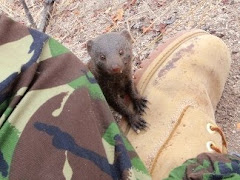
Why was I getting all this attention? I don't radio-collar my study animals (see here for an explanation), so if I'm to find the three-inch-high critters (in their 40 ha home range), it's important that they want to be found. To ensure a warm welcome, I reward them each time I join the group with some boiled egg, a few mealworms or some water. So during the winter dry season, when bugs are scarce, they're often very pleased to see me.

Ecthelion all came bouncing around eagerly, and I crouched down to try to count them (counting swarms of mongooses features regularly in my nightmares). Was anyone missing? I was so busy peering at individuals trying to identify who was present, I didn't notice one of the youngsters, Thor, creeping toward my backpack. Flattened against the ground, he inched forward, closer and closer, and then leapt up to seize the plastic bag poking out of the side pocket of my pack. He raced off at full gallop, the plastic bag - containing a boiled egg - flapping wildly behind him.


Thor (EM038) plotting egg theft.


The pilfering of 'egg bags' is an occupational hazard when working with mongooses. The meerkats were master criminals; some even learnt how to open zippers. One meerkat pup perfected the technique of clambering up his victim's back, onto their head, and then launching himself into the air. He'd plummet down onto the hand holding the egg bag, fixing his teeth in the plastic as he passed and letting gravity carry him - and the bag - away (it worked every time). While the dwarf mongooses are comparatively unsophisticated larcenists, they do tend to drag their spoils off down a burrow, so I immediately rushed after Thor. Unfortunately, I left behind the mealworm container, open and unguarded beside my pack. Returning with the slightly chewed egg bag, I found Jen and Binky (named after Death's horse in the Terry Pratchett novels) madly excavating bran from the container and gorging themselves on worms.

Once I'd regained a semblance of control, I was able to figure out that no one was missing from Ecthelion. The same transpired to be true of Koppiekats and Halcyon. Unfortunately, Bugbears was not so lucky. Melursus, a youngster born last Christmas, is AWOL and he almost certainly fell victim to the poachers' dogs. Thankfully no one else in the group appears to be injured, so it could have been much worse.

Melursus (BF034) at two months of age.
Related Posts Plugin for WordPress, Blogger...