Showing posts with label leopard. Show all posts

Friday, November 22, 2013

Halloween callers (er... belated)


Sorry I’ve taken such a ridiculous amount of time to upload this post...

Outside North America, the heart-warming tradition of extorting candy from strangers (trick or treating) is often met with less than enthusiasm. A survey in the UK, for example, found that more than half of British householders turn off their lights and pretend to be out, come All Hallows Eve.
But living as a hermit, tucked away in the African bush, I wasn’t expecting callers.
I was wrong.

Now trick or treating can trace its roots back to the Middle Ages, when the financially-challenged celebrated All Saints’ Day (or All Hallows’ Day) by dressing as demons and bartering prayers and songs (to help the wealthy’s departed mosey on through Purgatory) for cash and cakes. This jolly festivity was called souling and it was definitely a souler who visited my house on Halloween night.

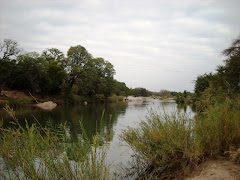
But I’m jumping ahead of myself here because my exchanges with soulers really started a few days earlier when I was walking my dogs down along the river. At this time of year (end of the dry season) the river is braided with sand and fringed by dense thickets of reeds. It was late afternoon and heavy clouds were leaching away the light when we heard a loud, rasping grunting coming from the far bank. The dogs and I crept upstream until we were directly opposite the hidden caller and hunkered down in a thicket of raisin-bushes in the hopes of catching a glimpse of the vocalist. With no more than 30m (100 ft) between us and the vociferous beast, its deep, grating calls were deafening, thrumming uncomfortably inside my chest.

Embarrassingly, it took me almost six years to figure out who utters this call. I’d always assumed it was a baboon expletive (something about one’s mother??) because it inevitably invoked a cacophony of outraged bellows from the local baboon troop. But it’s actually voiced by a much more impressive beast (my apologies to all Papiophiles). The books describe it as sounding ‘a lot like someone sawing wood’. I used to find this description unconvincing, but up close and personal, it’s spot on (in an age of chainsaws, perhaps I just don’t know what a distant wood-saw sounds like). The leopard utters its rasping ‘strokes’ while both inhaling and exhaling, and the result is shockingly loud. You can hear it here (click on leopard), but it's a recording of very distant animal (can't find anything better however).


Big cats (members of the genus Panthera) - unlike small cats (members of Felis) - can utter astoundingly loud roars because their hyoid bone (you know, the one that snaps during strangulation, as per CSI) has been replaced with cartilage.
Photo by Arno Meintjes.


Leopards (Panthera pardus) are the most cosmopolitan of the world’s cats (apart from our little domestic moggies, of course). They prowl almost every habitat in Africa and sneak about in Asia as far as China and Malaysia. They also sometimes munch people - mostly in India and Nepal - annually killing 1.9 Nepalese per million. Photo by Arno Meintjes.


The vocalist was hidden among the reeds by the water’s edge, and while we were trying to spot spots, I realised that the cat was actually dueting. Further upstream – on our side of the river – another leopard was answering. Fortuitously, we were downwind of both animals and it was clear that this second leopard was hot-footing its way downstream toward us. Were the two engaged in an acoustic border dispute? Or was one of them on the make?

I very much wanted to see what would happen when the two cats met. My dogs, however, weren’t too keen on the idea. I don’t know what’s changed their minds about leopards (they used to try to chase them) but these days the merest whiff of fresh leopard spoor makes them panic. They press up against each other and - glancing nervously over their shoulders - tow me away as rapidly as possible. They also now refuse to lie outside on moonless nights...
Thinking about it - maybe it’s better I don’t know...


Like almost all cats, leopards are solitary beasts. They stake claim to their territories using pee and song, and ferociously oust all members of their sex.
Photo by Steve Jurvetson.


She-leopards also use the species’ long-distance roar as a siren call for suitors. Like lions, leopards mate repeatedly for days at a time (he has to coax her into ovulation) but - unlike consorting lions - it’s very rare to catch them at it.
Photo (of captive Persian leopards) posted on Flickr by Tambako the jaguar.


As the leopard on our side of the river drew closer and closer, the dogs became more and more agitated, tugging frantically on their leashes. I began to wonder if I was acting prudently. I mean leopard fatalities are a rarity here in Africa but every few years the odd person gets chomped (and I’m certainly odd). In fact - I suddenly recalled as we sat hidden in our waterside thicket - a leopard attacked someone just a few weeks ago up near Pundia Maria (Kruger National Park). With the leopard on our bank no more than 50m (165 ft) off and closing fast, and the rasping roars of both cats now reverberating in our chests, Wizard’s nerve finally broke and he dragged me, sprawling, out of the shrubbery (let me tell you, huskies can pull). The leopard across the river immediately stopped roaring: our cover was blown. Although the cat on our bank continued to call, I figured that they wouldn’t interact normally, so I let the dogs haul me away inland.

Now I thought that this was the end of it.
But then the souler arrived on Halloween.

It was about 8pm and I was innocently watching TV when the roars began. Once again two leopards were dueting, with one far off and the other quite close. And getting closer... and closer... and CLOSER! Oh God, it’s roaring from the reeds just below my garden. Sitting no more than 15m (50 ft) from my back door, it gave its thunderous grating roars - one every three minutes or so - for more than an hour.

Now I don’t think this creature was seeking a treat (at least not from me) but I felt its performance would certainly hurry any passing spirits on their way, through Purgatory or otherwise. I mean leopards have harried our ancestors for millennia. Modern forensics show that at least one fossil hominid (who dwelt in South Africa 1.8 million years ago) fell victim to a leopard: the puncture wounds piercing the back of his/her skull perfectly match the bite impressions of a leopard’s lower canines. Researchers have even suggested that humans owe their intelligence to the leopard via an evolutionary arms race in which we combated stealth and might with cleverness. And I have to admit that while it was hugely exhilarating having a leopard at the bottom of my garden, it was also a little scary.
A leopard just isn’t something you want to stumble over when you pop out to move the sprinkler.
Would that be the trick I wonder?
Ah, spooky ol’ Halloween...


What better emissary to communicate with the dead than a professional killer? Photo by Arno Meintjes.

P.S. I always carry a nifty little pepper spray when I’m out dog-walking (I thought I’d mention that for the sake of nervous relatives).


Tuesday, April 12, 2011

Spots before my eyes...

During the last couple of days I've been seeing spots.
And no ordinary spots.
Yesterday's were sublime; today's ghastly.

Let's start with the sublime.

When I set out to walk the dogs last night, I forgot to put my camera in my pocket. Realising while still in the garden, I chose not to go back. 'Bring on the leopards', I quipped to the dogs (dogs respond more favourably to quipping than cats or mongooses).

Twenty minutes later, Magic (my husky-cross) began tugging at the leash, eager to chase something she'd spotted up ahead. There was a noisy mob of guinea-fowl strutting about the track where it crested the hill ahead of us, so I assumed Magic was keen to sup on fowl (which are very spotted too, by the way).

We trekked on up the hill, Magic dragging me along (boy, can huskies pull) and the guinea-fowl squawked and squabbled their way off into the bush. But as we rounded the next bend, two things happened simultaneously. My dogs caught a whiff of something VERY exciting at the edge of the path (jerking me almost off my feet as they doubled back to investigate) and I glanced up to see a very large leopard 30 m (100 ft) away. He was nonchalantly strolling along the track ahead of us, oblivious to our presence. His pace was so relaxed and leisurely, I could almost see him smelling the flowers.


The cat's whiskers. Meeting a leopard (Panthera pardus) is a rare and wonderful privilege.
Photo by A & L Meintjes.

White-tipped tail held jauntily high, he sauntered over to a trackside shrub, sniffed at the foliage and then luxuriously rubbed his cheeks against the twigs. He then turned, backed up to the shrub and sprayed a jet of urine up on to the leaves. With his scent-marking efforts complete, he strolled on. Meanwhile my dogs, busy feasting (metaphorically) on his previous contribution, didn't even see him.

Although I regularly come across leopard prints, I've only met a leopard in-the-fur twice before; despite three years of daily dog walking. This macho lad regularly enlivens our walks by leaving stinky stop signs at all the prominent road junctions. Worryingly large, these piles of droppings are always chockfull of fur, so while the dogs enjoy a sniffing-fest, I struggle to identify the ill-fated fur-bearer.

Yesterday's leopard was big. I don't know why our leopards are bigger than other people's, but every time I see a documentary on the leopards of the Cedarburg, or the Cape, or the coast, I go into shock. How can those squat little animals be leopards? Yesterday's cat was almost hip-height and close to 2 m (6 ft) long. I guess it's part and parcel of the species' versatility: these professional killers pad about all over Africa and across Asia as far as Korea and Manchuria. They're the only large carnivore stalking around the rainforests of Africa, and a frozen leopard carcass was found stuck in the ice at 5692 m (18,700 ft) on Mt Kilimanjaro (perhaps not a wise choice of habitat, in retrospect). They even cling on in places where smaller carnivores have been eradicated. How? Catholic tastes. A study in the Serengeti, for example, found that leopards munched 30 different prey species compared with only 12 chomped by lions.


Room with a view. Leopards are renowned for hauling their meals up into trees, but they only indulge in this habit if other big meat-eaters live in the area.
Photo by A & L Meintjes.

At about the same time that my dogs caught sight of yesterday's leopard, he became aware of us, turning to look back over his shoulder. Instantly he dropped into a low, slinking crouch and bounded away into the bush. I was left wrestling with my dogs (trying desperately to thwart their suicidal desire to give chase) and was quite unable to stop smiling.

Well they were the sublime spots, now for the ghastly.

Pepper ticks.
The Devil's own condiment.

Pepper ticks are just like normal, everyday ticks except they're tiny. Three could sit comfortably on the head of a pin (maybe four if they scrunched up). Just like regular ticks, they guzzle blood, inject you full of horrible parasites and leave huge, itchy lumps. And each one must be individually extracted and crushed (they do make a satisfying pop). However, unlike normal ticks, they hunt in swarms. Stumble on a pepper-tick hideout and you're polka-dotted with misery.

I'm not going to tell you how much pepper ticks make me suffer, or how they drive me into a frenzy of rage. Suffice to say that today, after a very pleasant morning with Ecthelion, I painstakingly removed 437 of them. And yes, I did count every one.


Overcome by pepper ticks?
Photo by Arno & Louise Meintjes (what wonderful people).

Tuesday, May 18, 2010

Jackal matters


Yesterday, while checking one of Koppiekat's favourite termite mounds, I came upon a jackal.

Yes, jackals eat mongooses.

But not this one. This one had gone to its last great mongoose hunt in the sky.

Given the location of the body, I wondered at first if the mongooses had pulled off some David-and-Goliath type of act; maybe standing on one another's shoulders (like the sheep in Wallace and Gromit's A close shave) to pull down their mighty foe.
But up close, I could see that the newly dead jackal had huge puncture wounds in its throat. These stab wounds were not only massive, they were alarmingly widely spaced, and that - combined with the aforesaid 'newly' - had me glancing nervously over my shoulder. There wasn't much blood about and the jackal looked as if it had been choked to death, in classic big cat style. Presumably it had fallen foul of one of the leopards who live in the koppies. I actually took a (yucky) photo!


This Black-backed jackal (Canis mesomelas) either suffocated to death or, in its death throes, decided to stitch-up its arch enemy by posing that way.

What I don't understand is why the leopard didn't eat it. Richard Estes (author of The Behavior Guide to African Mammals) describes how a leopard visited his camp in the Ngorongoro Crater (Tanzania) almost nightly for several weeks, and during that time it brought back 11 jackals, to consume beside his cabin. Had my inopportune arrival at Koppiekats' mound RK001 disturbed the killer (more hasty over-the-shoulder glances)? It was at this point that I decided to resume my search for my innocent, harmless little mongooses.   

Later in the morning, I returned to find two bateleur eagles happily feasting on the carcass.
Well, it's an ill wind...

  
Bateleurs (Terathopius ecaudatus) are very common here and, despite what the books say, they don't seem to prey on mongooses (favouring carrion). At least that's what the mongooses believe (they don't alarm at cruising bateleurs), and they should know.
Photo taken by Tollie Botha and borrowed from here.

Thursday, May 13, 2010

Why I don’t take photos


Everywhere on the internet you'll find stunning photographs. There are thousands of photo-streams, galleries and blogs showcasing people's images.
Nature blogs, in particular, are just brimming with breathtaking photos.

Except for mine.

Now don't get me wrong. I enjoy beautiful photos as much as anyone. There was even a time when I took wildlife photos myself (never very good ones, mind you) and - out in my shed – I've a stack of dusty transparencies to prove it.
But I stopped. Why?
Because gradually I came to realise that photography was changing the way I perceived the world.
Instead of thinking, 'Oh what a glorious place!', I'd be wondering, 'Would this make a good photo?'. I started seeing nature in snapshot-sized pieces, framing everything within a view finder in my mind. Photography doesn't prevent you from observing wonderful things (unless, of course, you happen to be fighting to open your camera bag, or changing lenses, or searching for that spare battery). On the whole, you still get to see the cheetah racing after the springbok lamb, or the baby baboons dangling wrong-way-up from their father's tail. But what do you feel?
Awe? Enchantment? Joy?
Who has time for these, while stressing about shutter-speeds, aperture settings, composition and lighting?


This lovely photograph of a leopard was NOT taken by me (even though I found fresh leopard prints on my driveway yesterday). It was, however, taken in Kruger (by Penny Maddocks) and was scrounged - as usual - from the park's public sightings gallery.

For me, the clincher came one day in Kruger National Park. I was driving beneath the fig trees along the Timbavati River when a leopard stepped on to the road in front of me. Now, leopards are truly stunning animals. Apart from the shock value of a large 'professional killer', the leopard has a coat that almost dazzles your eyes, like some sort of iridescent optical illusion.
This leopard sauntered off the road and sat down in the dry grass right next to my car. I couldn't believe it. I was so excited I could barely grab up my camera.
But there was the grass. Try as I might, I just couldn't get a photo that didn't have stalks of grass in front of the cat's face. 'If only he'd sat a meter to the left', I thought in anguish. 'If only he'd turn his head two inches to the right!'
He didn't. After a few minutes, he rose to his feet, stretched languidly and strolled off into the vegetation. For the rest of the morning I felt awful. Angry, frustrated and disappointed, I just couldn't settle back into the tranquillity of watching wildlife. Yet I'd just witnessed something amazing; an unbelievably rare privilege. Why wasn't I elated? Why wasn't I dancing on air?! It was then that I knew. No more photographs.

Ever since then I've left my camera at home. I seem to be the only person in the universe who thinks this way. If you don't believe me, try holidaying in a National Park or tourist destination sans camera, and watch how people react.
Starting this blog has thrown me into a quandary. Blogs need pictures. Reluctantly, I've started carrying a camera again. But when it comes to the crunch, when I have to choose between experiencing a wildlife encounter or taking a photo, I'm afraid I'm going to opt for wonder and joy every time.
I just thought I'd better warn you!
Related Posts Plugin for WordPress, Blogger...