Showing posts with label vocalisations. Show all posts

Friday, November 22, 2013

Halloween callers (er... belated)


Sorry I’ve taken such a ridiculous amount of time to upload this post...

Outside North America, the heart-warming tradition of extorting candy from strangers (trick or treating) is often met with less than enthusiasm. A survey in the UK, for example, found that more than half of British householders turn off their lights and pretend to be out, come All Hallows Eve.
But living as a hermit, tucked away in the African bush, I wasn’t expecting callers.
I was wrong.

Now trick or treating can trace its roots back to the Middle Ages, when the financially-challenged celebrated All Saints’ Day (or All Hallows’ Day) by dressing as demons and bartering prayers and songs (to help the wealthy’s departed mosey on through Purgatory) for cash and cakes. This jolly festivity was called souling and it was definitely a souler who visited my house on Halloween night.

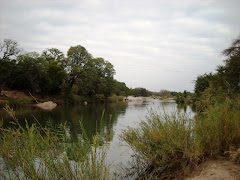
But I’m jumping ahead of myself here because my exchanges with soulers really started a few days earlier when I was walking my dogs down along the river. At this time of year (end of the dry season) the river is braided with sand and fringed by dense thickets of reeds. It was late afternoon and heavy clouds were leaching away the light when we heard a loud, rasping grunting coming from the far bank. The dogs and I crept upstream until we were directly opposite the hidden caller and hunkered down in a thicket of raisin-bushes in the hopes of catching a glimpse of the vocalist. With no more than 30m (100 ft) between us and the vociferous beast, its deep, grating calls were deafening, thrumming uncomfortably inside my chest.

Embarrassingly, it took me almost six years to figure out who utters this call. I’d always assumed it was a baboon expletive (something about one’s mother??) because it inevitably invoked a cacophony of outraged bellows from the local baboon troop. But it’s actually voiced by a much more impressive beast (my apologies to all Papiophiles). The books describe it as sounding ‘a lot like someone sawing wood’. I used to find this description unconvincing, but up close and personal, it’s spot on (in an age of chainsaws, perhaps I just don’t know what a distant wood-saw sounds like). The leopard utters its rasping ‘strokes’ while both inhaling and exhaling, and the result is shockingly loud. You can hear it here (click on leopard), but it's a recording of very distant animal (can't find anything better however).


Big cats (members of the genus Panthera) - unlike small cats (members of Felis) - can utter astoundingly loud roars because their hyoid bone (you know, the one that snaps during strangulation, as per CSI) has been replaced with cartilage.
Photo by Arno Meintjes.


Leopards (Panthera pardus) are the most cosmopolitan of the world’s cats (apart from our little domestic moggies, of course). They prowl almost every habitat in Africa and sneak about in Asia as far as China and Malaysia. They also sometimes munch people - mostly in India and Nepal - annually killing 1.9 Nepalese per million. Photo by Arno Meintjes.


The vocalist was hidden among the reeds by the water’s edge, and while we were trying to spot spots, I realised that the cat was actually dueting. Further upstream on our side of the river another leopard was answering. Fortuitously, we were downwind of both animals and it was clear that this second leopard was hot-footing its way downstream toward us. Were the two engaged in an acoustic border dispute? Or was one of them on the make?

I very much wanted to see what would happen when the two cats met. My dogs, however, weren’t too keen on the idea. I don’t know what’s changed their minds about leopards (they used to try to chase them) but these days the merest whiff of fresh leopard spoor makes them panic. They press up against each other and - glancing nervously over their shoulders - tow me away as rapidly as possible. They also now refuse to lie outside on moonless nights...
Thinking about it - maybe it’s better I don’t know...


Like almost all cats, leopards are solitary beasts. They stake claim to their territories using pee and song, and ferociously oust all members of their sex.
Photo by Steve Jurvetson.


She-leopards also use the species’ long-distance roar as a siren call for suitors. Like lions, leopards mate repeatedly for days at a time (he has to coax her into ovulation) but - unlike consorting lions - it’s very rare to catch them at it.
Photo (of captive Persian leopards) posted on Flickr by Tambako the jaguar.


As the leopard on our side of the river drew closer and closer, the dogs became more and more agitated, tugging frantically on their leashes. I began to wonder if I was acting prudently. I mean leopard fatalities are a rarity here in Africa but every few years the odd person gets chomped (and I’m certainly odd). In fact - I suddenly recalled as we sat hidden in our waterside thicket - a leopard attacked someone just a few weeks ago up near Pundia Maria (Kruger National Park). With the leopard on our bank no more than 50m (165 ft) off and closing fast, and the rasping roars of both cats now reverberating in our chests, Wizard’s nerve finally broke and he dragged me, sprawling, out of the shrubbery (let me tell you, huskies can pull). The leopard across the river immediately stopped roaring: our cover was blown. Although the cat on our bank continued to call, I figured that they wouldn’t interact normally, so I let the dogs haul me away inland.

Now I thought that this was the end of it.
But then the souler arrived on Halloween.

It was about 8pm and I was innocently watching TV when the roars began. Once again two leopards were dueting, with one far off and the other quite close. And getting closer... and closer... and CLOSER! Oh God, it’s roaring from the reeds just below my garden. Sitting no more than 15m (50 ft) from my back door, it gave its thunderous grating roars - one every three minutes or so - for more than an hour.

Now I don’t think this creature was seeking a treat (at least not from me) but I felt its performance would certainly hurry any passing spirits on their way, through Purgatory or otherwise. I mean leopards have harried our ancestors for millennia. Modern forensics show that at least one fossil hominid (who dwelt in South Africa 1.8 million years ago) fell victim to a leopard: the puncture wounds piercing the back of his/her skull perfectly match the bite impressions of a leopard’s lower canines. Researchers have even suggested that humans owe their intelligence to the leopard via an evolutionary arms race in which we combated stealth and might with cleverness. And I have to admit that while it was hugely exhilarating having a leopard at the bottom of my garden, it was also a little scary.
A leopard just isn’t something you want to stumble over when you pop out to move the sprinkler.
Would that be the trick I wonder?
Ah, spooky ol’ Halloween...


What better emissary to communicate with the dead than a professional killer? Photo by Arno Meintjes.

P.S. I always carry a nifty little pepper spray when I’m out dog-walking (I thought I’d mention that for the sake of nervous relatives).


Sunday, December 9, 2012

Fraternizing with the locals


WHOOOOP... WHOOOOOP... WHOOOOP...

The deep, resonant calls - each ascending smoothly in pitch - were spine-tinglingly loud.
I dashed outside into the cool, river-scented darkness. The night reverberated with the machinery-clatter of toads, cicadas and crickets, yet the eerie, other-worldly whoops were loud enough to thrum within my chest.

Somewhere, down below me in the riverbed, a spotted hyena was calling to his/her clan.

Now even if you’ve never been to Africa (and if you’re into wildlife, WHY NOT?); even if you’ve never seen a hyena in the fur, you’ll recognise these calls. Beyond any other sight or sound, the hyena’s whoops epitomize the African night (and feature in virtually every wildlife documentary ever made on this continent).
And of all the wild places in the world, Africa - at night - is probably the scariest. It's also our ancestral home. For millions of years our forebears stared out into the dark, shivering at the sound of the hyena’s call. It’s no surprise then, that the eerie whoops stir a deep, atavistic trepidation. Grinning insanely into the dark, I stood revelling in the trills of fear that fluttered up and down my spine.

[You can listen to a spotted hyena whooping here (button no 2)].


Hyena-kind evolved from mongooses and civets about 10 million years ago. The spotted hyena (Crocuta crocuta) has haunted the African savanna for as long as humankind's existed. It can also digest teeth (I just thought you’d like to know that).

Now I don’t want you to start thinking that hyenas whoop simply for our titillation. This long-distance call (audible up to 5 km/3 miles) is the SMS of the hyena-world. Roaming clan-members use it to keep in touch and call for assistance when uninvited visitors rock up for dinner.

Whoop-studying researchers - plotting the calls of different hyenas on spectrograms - found that each hyena has its own distinctive whoop; something I guess the hyenas already knew.
Although an individual’s voice gets deeper as it ages, the unique pattern of its whoops remain consistent year after year; so hyenas can recognise one another from whoop alone.

When researchers played back recordings of cubs (who start whooping at 3-4 weeks), the whooper’s mum (but not other mothers) rushed to the speaker (oh, that is unless Mum was dining, in which case she just glowered in the right direction – hey, you gotta get your priorities right). Close family members also responded, and the amount of time they spent eyeing the speaker was directly proportional to how closely related they were to the little whooper. In fact, hyenas seem to use whoops to flaunt their identity during brawls (and no one scraps as well as spotted hyenas).

Now I have to admit I wasn’t thinking about any of this as I stood at the bottom of my garden the other night. I was peering into the darkness, straining to pinpoint the exact location of the caller.
Umm, exactly which side of the river was the creature prowling?
Then my heart-stopped.
Directly behind me (and I’m talking one or two metres/yards) an answering call rose up. Fear clutched my chest as the eerie, resonant wail swelled upwards. But after a few moments I realised that the call was not a hyena’s. Although almost as loud, and with the same deep, tonal qualities, it continued to rise, and then undulate, in pitch. It was probably the most desolate sound I’ve ever heard. Still barely able to breathe, I crept toward the uncanny, penetrating wail.
What could make such a call?
And there it was; lying on my door mat.
My husky, Wizard.


‘You won’t believe the riffraff you meet around here these days’.
 
Now in truth, I couldn’t have been more shocked if I’d stumbled upon the cat reciting Shakespeare. This was like no dog’s howl I’d ever heard. It was a blood-curdling keening, evocative of wildness, primal instinct and vast empty lands. It was NOT something that should be emanating from a household pet! In the seven years that Wizard has companionably shared the humdrum domesticity of my life, I’ve never heard him utter such a sound.


Wizard, pining for the tundra?

I guess the whole incident made me realise that, just as our own hearts and minds were honed by millions of years on the African savanna, so too our domestic animals carry within them the legacy of their ancestors’ lives. It’s so easy to overlook our pets, to somehow believe they’re creations of our own (like TV or motor cars or computers). But our companion animals are profoundly wild beings, gifted to us with just the flimsiest wrappings of domesticity.
And what an utterly amazing privilege it is to share so intimately in the life of a wholly different species.

Saturday, February 18, 2012

An embarrassing confession...

We all make mistakes, right?
There’s no call for embarrassment.
But some mistakes make you feel sillier than others...

Now I’m not talking about those absent-minded slip ups that everyone makes (they do, don’t they?).
You know, like realising in the supermarket that your shirt’s on inside out or that you’ve forgotten to change out of your mismatched trainers (the red pair’s left shoe is raggedy and the blue pair’s right shoe... Well, the mongooses don’t mind!).

No, the kind of blunder I’m talking about springs from ignorance, pure and simple uncouth and ugly.

I remember my sister discovering that her rural high-school pupils didn’t believe dinosaurs ever existed. They thought that these prehistoric beasts – along with King Kong, Godzilla and the Muppets – were creations of the media.
Well that’s the sort of mistake that I’m guilty of.

It all started when I was pottering about the local newsagent and noticed a stack of glossy, movie-spinoff booklets.
A sweat-streaked Harry Potter glared up from the cover of the top one, below that peeped the earnest blue face of a Na’vi from Avatar, and on a third, two CGI aliens stared nonchalantly off into space. They were lankily humanoid but clothed in a stylised uniform of fur: pure white with chocolate brown insets on their arms, chest and thighs. Disconcertingly golden eyes stared from their smooth black faces, and black elf-like ears peeped from the fur on their heads.
‘What will they come up with next’, I wondered before sauntering on.

But that image kept haunting me; there was something disquieting about it. They were so humanlike, but...
It was as if the artist had melded human facial features with those of a llama or guanaco. It was uncanny. And unnerving.

So you can imagine my shock - on my very first day in Madagascar – when I rounded a bend on a forest trail and found myself face to face with just such an alien. In fact, two real, living, breathing aliens.
Oh, and did I mention the excruciating embarrassment?


Extraterrestrials assessing the chemical composition of Earth’s flora? No, Coquerel’s sifakas (Propithecus coquereli) contemplating lunch. But you can see how one could be mistaken, can’t you? Oh sure you can.  Please...
 
When not impersonating computer-generated aliens, Coquerel’s sifakas hang out in groups of 2-10, in the dry forests of NW Madagascar. Like all sifakas, they're strictly vegan and the ladies rule the roost.

Named after their explosive, hissing alarm call (shee-fark!), sifakas are the bounders of the lemur world. I’m not being judgemental here; I mean it literally. They’re made to hop. With legs 35% lankier than their arms (the figure for people is 65%), these lemurs leap frog-like from tree trunk to tree trunk, and cling there vertically with their knees pressed against their chests. They’ve artistically long fingers, and utterly outrageous big toes, to clamp vice-like around tree trunks.


A toe of note.

Now if my first encounter with sifakas made me feel like Bridget Jones at the launch of Kafka’s Motorbike, my second interaction was almost as disquieting.

We’d just arrived at Berenty Private Reserve in southern Madagascar after a long, hot morning jolting over crumbling tarmac (last road mending, the 1950s). Trudging through the heat and dust towards the promise of lunch, I glanced up into a huge tamarind tree that overhung the tourist cabins.
There, almost within arm’s reach, was a fluffy white tangle of Verreaux’s sifakas. Pristine white, apart from a Santa’s cap of chestnut brown, they lounged along the tree’s massive branches or hung languidly upside down from the branch tips like an angelic manifestation of spider monkeys. As I gasped, they gazed down at me interestedly, golden eyes bright in their intelligent sooty faces. I can’t begin to describe the emotional impact of their unexpected and incongruous appearance; try to imagine the warmth invoked by fluffy white bath-towels coupled with the enchantment of snow.
Needless to say, I was very late for lunch.


Of the nine sifaka species bouncing around Madagascar, only the Verreaux’s sifaka (Propithecus verreaux) is not endangered (it’s considered vulnerable). It’s also my favourite (why court heartbreak?).

The Verreaux's sifaka groups at Berenty hold territories of only 2-3 ha (5-7 acres); that means 15 groups of sifaka could ricochet around happily within the territory of one dwarf mongoose group! 


Hanging loose. Verreaux's sifakas live in mixed-sex groups where love is free. However, the reigning honcho fathers most of the kids because he dogs the steps of any female on heat.
  
Now if, like me, your enthusiasm for wildlife is tainted by vices (laziness, for example, or voyeurism), Berenty Reserve is the place to be.
Protected since 1936, this tiny pocket (250 ha /620 acres) of gallery forest is set within a vast sisal plantation (the spiky aloe used to make ‘green’ shopping bags) and is chockfull of lemurs. Alison Jolly began studying ring-tailed lemurs here in 1963, so the furred inhabitants are enchantingly blasé about non-furred primates. You can lounge on your veranda and happily spy on three species of lemur as they blithely scent-mark, squabble or snooze. And of course you can also potter at leisure in the forest, blissfully unchivvied by zealous park guides.
It was certainly a highlight of my trip. 

No, not a sifaka, but a typical Berenty scene. Ring-tailed lemurs (Lemur catta) and red-fronted brown lemurs also smooch around camp.

High density living is the norm for sifakas. Groups of crowned sifaka (Propithecus coronatus) claim ownership to just 1.5 ha (3.7 acres) of dry deciduous forest (in NW Madagascar) and they advertise possession by smearing around goo from their chest and anal glands.

Sifakas, of course, are famous for another trait. Designed to leap, tree to tree, they aren’t well equipped to negotiate flat land. Bizarrely, they stand up on their lanky hind legs and skip along sideways, twisting their torsos back and forth and holding their arms up effeminately for balance. If you haven’t seen footage of these guys ‘dancing’, treat yourself by clicking here or here.
 
Leaping lemurs!
 

'No, I've never heard of the Ministry of Funny Walks.
Why do you ask?'


Let's move it, move it, move it!
 
Strutting their stuff by day, sifakas kip in the tree tops after dark. But despite this safety measure, being eaten is still a serious problem for them (well for anyone, I guess). Fosas, who specialise in chomping mammals, cunningly clamber up and nab them in the night. Raptors also won't say no to an occassional lemur. 
In an effort to evade these lemur-eaters, sifakas employ the usual arsenal of ‘functionally referential’ alarm calls (i.e. they shriek ‘Run!’ or ‘Hide!’ or ‘Get down!’ rather than ‘Harrier-at-10 o’clock!’ or ‘Bloody fosa!’).

What’s interesting is that different populations use the standard calls in different ways. While everyone seems to know that roaring barks warn of raptors (the lemurs look up and climb down), researchers found that playbacks of the iconic shee-fark cry invoked mixed responses.
Coquerel’s sifakas, and Verreaux’s sifakas who lived within fosa territory, believed it warned of ground predators (they looked down and climbed up), but Verreaux’s sifakas living in a fosa-free local just ran away. Growls were even more personalised. Coquerel's sifakas living in places with many birds of prey interpreted a growl as warning of aerial predators, while Verreaux's sifakas residing in fosa-rich habitat thought a growl meant prowling carnivores. The other populations, of both species, associated growls with minor disturbances.
Now this shows that the sifakas learn the meaning of their calls from others, and it lets them adapt calls to meet local needs. But what happens when we come along and translocate animals from one population to another?
 
'What? He's growling?! It's all Greek to me.'
The diademed sifakas (Propithecus diadema) living in Analamazoatra Special Reserve (aka Perinet) were translocated into the park in 2006 from three different sites (the original inhabitants were hunted to extinction in 1973). They appear to be prospering despite any language barriers.   

Like all the larger lemurs, Milne Edward's sifakas (Propithecus edwardsi) are hunted by humans as well as fosas. Although 'fady' (taboo) prevents certain tribes from consuming particular species, it often doesn't prohibit them from catching and selling the animals to people who do. Lemur is a delicacy in city restuarants.


Fossa snack food. Milne Edward’s sifakas bear only a single sprog every second year. 40% of their ankle-biters don’t make it to their first birthday, and only a third reach puberty.


A Milne Edward's sifaka (in Ranomafana National Park) awaiting the arrival of a Hollywood talent scout.

Tuesday, December 13, 2011

I think I'm going cuckoo


Thrice welcome, darling of the Spring!
Even yet thou art to me
No bird, but an invisible thing
A voice, a mystery.

                     Wordsworth (who clearly didn't live around here)


Firstly, let me point out that this post is not about lemurs.
In fact it isn’t even about Madagascar.

I’m taking a break from my lemur litany to indulge in a bit of a gripe.

I need it.

You see my neighbourhood ‘invisible thing’ is driving me to distraction.


I’m sure you know how it feels to be assailed by an apparently innocuous sound, endlessly repeated.
Whether it’s the plink of a dripping tap or a tune circling in your mind, incessant repetition can push the sanest of us into madness. (And after eight years as a recluse, sanity is not my strong suit.)

My own personal bugbear comes feather-coated. He swept in about a month ago, all fresh and perky after a winter vacation in equatorial Africa. Dressed elegantly in soft grey, with a waistcoat of pinstripes and salmon cravat, he’s far too dapper for his slightly embarrassing moniker: the red-chested cuckoo (Cuculus solitarius).

 
Like other cuckoos, the red-chested (Cuculus solitarius) is dressed to impress. His slick hawk-like shape, raptorish eye-ring and sparrow-hawk chest stripes are no accident. Experiments show that the stripes alone are enough to intimidate potential cuckoo-rearers, allowing the wearer access to nests. Photo by Johann du Preez.

My red-chested cuckoo is out for a good time.
Having staked out a bachelor pad in the trees along the river, he dallies at special ‘song posts’ hidden in the foliage (essential, to avoid the shot-gun blasts of irate listeners) and sends forth his message. Repeatedly.

Now his descending, three-note call is not unpleasant per se (you can listen to it here).
But repeated stridently - at one second intervals – for hour after hour after hour, it’s simply soul destroying. And don’t imagine that nightfall brings relief. Mere darkness is no deterrent to a red-chested cuckoo on the make.

Tossing and turning sleeplessly, I’ve had plenty of time to ponder the purpose of his incessant advertising. Is he warning off rivals or serenading the ladies? At the risk of eroding your sympathy, I’ll admit (solely for scientific purposes) that he does occasionally take a break; sometimes for several days at a stretch (ah, blessed relief).
But this is weird behaviour for a bird that defends its territory with song. Does he only engage in operatics when he has an audience?
I’ve come to the conclusion that what he’s really shouting is,
“Have I got a nest for you!”

You see, in red-chested cuckoo society, it’s the male who screens prospective foster parents. When not driving innocent bystanders insane, he skulks about spying on the neighbours. Once he spots a happy couple preparing their nursery, he hurriedly leads (one of) his true loves to the spot and helpfully distracts the parents-to-be while she sneaks in and lays an egg. To make the crime scene less conspicuous, she then scoffs a resident egg (why waste a good egg?).


Like all his kind, this cute red-chested cuckoo chick won his spoiled, only-child status by murder (struggle, push, shove... ‘Oh look, chick/egg overboard. Now how did that happen?’).
Photo by Arno & Louise Meintjes.

As I’m sure you know, cuckoos produce eggs that look similar to those of their victims to assist them in their evil egg-switching.
This is all good and fine if you’re a cuckoo species that freeloads on only one type of bird. But my annoying red-chested cuckoos don’t put all their eggs in one basket (that way, they could become extinct... or so I fantasize).
No, my cuckoos foist their ankle-biters off on to 18 different species of sucker, all of whom produce very different looking eggs. So how do the cuckoos mix and match?

Well not all red-chested cuckoos are born equal. In any one place, you’ll find several different races (called gentes), each of which specialises in hoodwinking just one particular host, and produces the eggs to match.
But how do the cuckoos maintain this racial purity? What happens when a girl from the Cape robin gens (gens is the singular of gentes) is swept off her feet by a boy from the wagtail gens. Will the couple’s daughters ever find a suitable nest for their miscegenated eggs?
Alternatively if maiden cuckoos always abide by family tradition and only choose lovers from within their own gens (i.e. there’s no racial mixing), surely the races are really different species?

The answer is devious. Unlike mammals - where it’s the male who totes the whacky, sex-defining Y chromosome - birds do things the other way around. Macho birds carry two Z chromosomes while the ladies are ZW. Egg colour is craftily encoded on the W chromosome, so it’s always passed on – unadulterated - from mother to daughter regardless of what or whom Dad is (as he can only ever contribute a Z chromosome).

A recent study of greater honeyguides (OK, not a cuckoo but employing the same nefarious means of reproduction) found that their gentes are extremely ancient. When the researchers looked at the honeyguides’ mitochondrial DNA (which comes only from Mum) they found that the gentes had remained entirely separate and unsullied for millions of years. But when they looked at the chromosomal DNA (which comes from both Mum and Dad) they could find no difference between gentes (because everyone happily interbreeds).


The eye of the beholder. Some gentes of red-chested cuckoo lay eggs that don’t match those of their target species. So why do the victims accept them? Unlike us, birds are able to see near ultraviolet wavelengths. When researchers examined the eggs using ultraviolet-visible spectrophotometery, they found that they were similar. Oops.
Photo by Johann du Preez.


Among their other weird traits, cuckoos are renowned for their fondness for hairy caterpillars (they munch them, not keep them as pets). They develop this predilection only in adulthood because no sensible foster parent offers a chick such noxious fare. Furred caterpillars are eschewed by almost all birds thanks to their urticating hairs (I love that word; it means ‘stinging like a nettle’). The tips of these hairs are detachable and dispense irritating poison. Although cuckoos scrub their dinner thoroughly (you can see footage here), the lining of their gizzard still ends up bristling with cactus-like spines. To rid themselves of these, European cuckoos slough off and regurgitate bits of mucous membrane lining (a trick most of us employ only after dining on dodgy prawns).


Local cuckoo food.
Who wouldn't want one as a pet?

It was perhaps this ability to stomach noxious things that encouraged our ancestors to link cuckoos with wedlock. The sceptre of the ancient Greek goddess of marriage is normally topped by a cuckoo rampant, and folklaw stipulates that to hear a cuckoo is good luck for those about to tie the knot, and a portent of adultery for those already wed. Since I fall into neither category, I’ll opt for the alternative claim: the number of cuckoo calls you hear signifies the number of years until you marry or die (whichever comes first).

By my calculation, I should still be going strong in 9011.
How long my sanity will last is another question entirely.


Friday, February 18, 2011

Crying out loud


Have you ever lain awake in the night listening to the terrible shrieks, yowls and screams of something unknown?

Inevitably it happens when you're out camping, and all that separates you and the night is a thin smear of nylon.

Of course you know it's only some animal. Right?

I mean, there's no way it's a banshee, a victim of torture or that second-grade teacher you knew was a witch.
And while you're rationally thinking this, your body is preparing for the worst. Your palms grow sweaty, your breathing quickens and you leap neurotically at the smallest noise. Meanwhile your mind, consciously refusing houseroom to thoughts of ghouls, ghosts and gremlins, merrily conjures images of maimed animals; innocent creatures twisting in the agony of trap or snare, desperately gnawing at their own mangled legs.

What's prompted me to reminisce about such fun experiences?
Well I recently came across an entertaining article ('5 lovable animals you didn't know are secretly terrifying') and one of the critters it lists is the red fox. In an amusing transcript, the article describes - with quite uncanny accuracy - my own first reaction to red fox calls (although I hasten to add I wasn't stoned at the time). If you're not familiar with the dreadful noises a red fox can make, there's video clip in the article. But be warned: humans aren't alone in responding badly. An innocent click on the play button launched a large husky into my lap as she lunged head first into my computer screen, and the cats' fur took more than an hour to resume normal orientation.


Black-backed jackals are up there with the best when it comes to weird calls. Listen to them here (by clicking the website's speaker icon) if you doubt me.
Photo by Johann du Preez.

Of course animal calls are usually only harrowing because you don't know who's doing the shrieking. And like a good crime novel, it's always the most unlikely suspect. A top contender for the 'shock-value' award must surely be the hyrax (or dassie). These innocuous little creatures look like those fabric-covered brick doorstops (complete with button eyes and nose) that kids make at school in the lead up to Father's Day. Rock hyraxes have no appreciable legs, and spend most of their time sitting about in clusters atop boulders, soaking up the sun. Sometimes they'll scamper down the rocks to munch grass or totter about - with endearing ineptitude – in the branches, snacking on leaves. A colony hangs out on the koppies at my study site, and although I see them daily, nary a squeak do they make. But on bright moonlit nights, when you're least expecting it, male hyraxes let rip. Their shocking, maniacal cries (please listen to one here) terrify rivals and humans alike. Tree hyraxes have gone even further to perfect their cover, secreting themselves away by day in tree hollows so they can creep out at night and horrify unsuspecting bystanders.


A rock hyrax (Procavia capensis) trying to look innocent although clearly it's just mugged a picnicker. Hyraxes have changed little during the last 45 million years, apart from varying in size – one species grew lion-sized (urrgh!).
Photo by Arno & Louise Meintjes.

But my favourite alarming call comes from the Kalahari Desert. I worked for many years on the Kalahari Meerkat Project, and each year a new crop of volunteer field assistants arrived. They were mostly young graduates from urban UK, and, initially, they tended to be a bit unsettled by the isolation and wide, desolate landscapes. Now you need to understand that these young people hadn't spent their childhood playing cowboys and Indians; this was the generation that duelled with light sabres, rescued Princess Leia and verbs at the end of their sentences put, hmmm. Now as it happens, the Sand People in Star Wars (those scary hooded entities that ambush Luke Skywalker in the desert of his home planet) communicated with eerie calls virtually indistinguishable from the braying of mules (used for transport by our farm workers). So for me at least, it was a wonderful moment when - trekking with a new volunteer across the dunes in the middle of nowhere - the brays of the Sand People reverberated around us. I loved the look of utter shock and consternation as - just for one moment - they were plunged within their childhood fantasies.

I've heard that the bugling calls of wapiti (North American elk) are very similar to the cries of the Nazgul in the Lord of the Rings movies, so perhaps a whole new generation will experience this same heart-stopping magic. I wonder where the calls of the Dementors in Harry Potter came from...


Impala aglow. This antelope's grunts and roars (hear them here) routinely send my new field assistants scuttling for home.
Photo by Arno & Louise Meintjes.

But the most alarming animal noise that I've ever experienced was made by creatures that potter around my garden nightly. And no, it's not the hippos.

It happened one night a couple of years ago. I was just getting ready for bed when the roaring growl of heavy machinery began emanating from my front garden. Above the steady roar of engines was a very loud pulsing whirr that had that ululating, come-and-go quality of an ambulance siren. The combined noise was so deafening that the student staying here at the time was convinced a helicopter had landed in the garden. To me, it sounded exactly like a UFO (or what a special effects team would conjure up as a scary, unearthly spaceship sound). Since my garden seemed to be free of luridly flashing green light, helicopters or earth-moving equipment, I decided I'd better go out and find out what was happening. Admittedly I did feel a touch of apprehension but, hang it, if a UFO was landing on my doorstep I wanted to know about it.

What I found couldn't have surprised me more, even if it had been a delegation of little green aliens.

Clumped around my compost heap were three highly agitated porcupines and one small honey badger. The honey badger (a species renowned for its 'nothing's too fearsome' approach to life) had clearly been trying it on, and the porcupines were rallying in defence. Now, when my dogs harass the porcupines (a nightly occurrence), the creatures respond by stamping their hind feet (like petulant children), coughing out a growl, and rattling their spines. Their tail quills are hollow so when the porcupine shivers its tail (as a horse shivers its skin to dislodge a fly) they do make quite a dramatic clashing sound (which you can hear here). But I'd no idea that, when seriously pressed, porcupines combined their cacophony of noises into such an amazing and other-worldly din.

If you know of a potential contender for 'Most Alarming Animal Noise', please, please nominate it in a comment.


Never underestimate a rodent. One of the Cape, or southern African, porcupines (Hystrix africaeaustralis) that visits my garden nightly.

Tuesday, July 6, 2010

Noisy neighbours


This morning I was woken at 3 am by a heart-stopping bellow.

It was a hippo, standing at the garden fence, two metres from my bedroom window.

Hippos bellow at a volume of 115 decibels. A jack hammer at five metres has a volume of 100 decibels, and 107 decibels is the level at which you begin to feel pain. So this was a bit of a shock. Of course, at that hour any noise sounds unnaturally loud. I wondered sleepily whether to stagger out and measure the din with my nifty little decibel meter (which I use for playback experiments with the mongooses), but drowsiness overcame scientific curiosity.
I don't think the hippo intended it as a personal message, he was simply answering other hippos, near and far, who were also bellowing their hearts out. I've no idea why.

 A hippo's huge lower incisors and scimitar-like canines (bigger in males than females) are designed solely for fighting. When cropping grass, hippos use the hard inner linings of their lips, then grind up the spoils with their rear molars. Photo by Arno Meintjes.

Rude awakenings aside, I love living right next door to one of the world's last species of megafauna. I adore hearing them snuffle and snort, and grunt and chortle, throughout the day. At night, of course, I never know when a hippo is going to trundle by, leaving behind splashes of chaff-like faeces sprayed on prominent trees or shrubs. One evening I walked right into a hippo that was standing in the front yard. The dogs were madly barking, and I assumed it was at the resident porcupine, so I dashed out with an armful of root vegetables (see here for an explanation of this bizarre reaction). I wasn't using a flashlight so I didn't see the hippo (they are dark grey) until I was about one metre away. We both stared at one another for a moment and then I fled. They don't seem to eat root vegetables.

While the hippos around here always behave with the utmost courtesy, I've heard scary stories of them attacking people further upstream, where they cultivate mangos and tensions run high. You see, in the dry season the hippos venture into the orchards in pursuit of the lush grass, but they inadvertently break the trees so the orchardists shoot them. Consequently the hippos don't feel too fond of people. If you've ever wondered what it'd be like to be chased by an angry hippo, you can see some dramatic photos of it here (it's worth looking at all three shots).


The hippo's closest living relatives are the whales, but they no longer keep in touch. Whales and hippos have their own order, called – wait for it - Whippomorpha (who is responsible for these names??) 

When I first came to Africa, hippos were the species I found most shocking and delightful. You see rivers and lakes look pretty much the same the world over (the usual bog standard plants and ubiquitous waterfowl), so when you're driving over a bridge on the highway and glance down, you're subconsciously expecting to see a duck or an egret, or maybe even a kingfisher. The sight of a massive great mammal lolling in the water is an utter shock. After six years living in the low veld, I think I've become used to them because when I travel overseas I find myself staring disconsolately at waterways, feeling bereft.

I have to admit that I initially assumed hippos to be slow, lethargic animals, fully preoccupied with their own watery concerns. I couldn't have been more wrong. Take a stroll down to the river bank and every eye is on you; constantly. Hippos are very astute and immensely interested in any comings and goings on land. For example, about a month ago I was defrosting my freezer (which sits in a roofed area outside) and I accidentally dropped a large bag of dog bones (that's bones for dogs, not bones of dogs; contrary to the signs, I'm not a psychopathic killer). The bones made a stupendous clatter hitting the concrete floor, which set the hippos bellowing, their calls relaying - animal to animal - both up and down river. 'Oh dear', I thought, feeling strangely embarrassed by the cacophony I'd caused, 'they won't be grazing around here tonight.' Half an hour later, as soon as it got dark, three huge hippos appeared at my back fence, peering in to find out what all the noise was about.

Relaxing in the bath all day doesn't just help you escape from the heat, bugs and predators, it lets you take the weight off your feet. And when you're hippo-sized (up to 3000 kg) buoyancy is a real energy saver. In water, a hippo's pulse drops from 60 to 20 beats per minute and its breathing slows from 7-10 breaths per minute to less than one. Now that's what I call winding down! Photo by Louise Meintjes.

Wednesday, June 2, 2010

No sleep


Winter is sleep-in time for me.
Mongooses are wimpy about the cold, so when the nights grow chilly (down to 7C last night) they stay tucked up snugly in their termite mound until a couple of hours after dawn. This means I too can stay tucked up snugly asleep.
Or it usually does.
At 6 am this morning I was torn from my dreams by an electric buzz saw – no, three electric buzz saws - screaming outside my window.
Not renovations or a mad clear-felling operation: trumpeter hornbills.
Trumpeter hornbills are not aptly named. They're considerably louder than your average trumpet. Their beaks are cunningly designed to amplify their ghastly, chainsaw-like shrieks, with the sound reverberating in a natty, hollow casque on their upper bill. Despite their excruciating voices, they are spectacular birds - something you'd expect to find in a rainforest in Borneo, not the African bush.

Trumpeter hornbills (Bycanistes bucinator) dine almost exclusively on fruit and, around here, while away their days in the trees along the river. Photo by Francesco Veronesi and borrowed from here.

As with all hornbills (other than ground hornbills), the female trumpeter is the ultimate stay-at-home mum.
Once she and hubby have chosen their dream tree-hollow, she starts on the plastering, closing up the front entrance with a wall of mud. Squirming inside through a small hole, she pastes this closed (leaving only a thin vertical slit) using her own droppings. Here she sits alone in the dark, brooding her eggs, and later the chicks. With house-wifely efficiency, she uses this downtime to upgrade her wardrobe, indulging in a full-monty feather moult. Meanwhile dad is responsible for feeding the family, poking bits of fruit in through the mail chute, and receiving the little packages of bird-droppings that mum posts out in return.
Although some hornbill mothers stay locked indoors until their youngsters fledge (four months), trumpeters usually make a break for it when their little darlings are half grown. And who can blame them. Can you imagine that racket, resonating inside a hollow tree?

 Photo by Martin Heigan and borrowed from here.

Friday, May 7, 2010

What’s the gardener saying?

When I opened my front door this morning I found a massive footprint on my door step.

It was a hippo's.

But this signature print was just the finale in a very weird performance.

Continuously, for about two hours last night, one of the local hippos performed a deafening serenade of growls, grumbles, wails, chortles and elephant-like trumpeting. Now I'm used to the hippos making a noise: their bellows reach 115 decibels (which is the volume recorded 5m from the speakers at a heavy metal rock concert). Nevertheless, it's only once every couple of months that a hippo indulges in these strange soliloquies. I have no idea why.

Local hippos.

After I retired to bed, the illustrious singer visited my garden. Of course, around here, it's not unusual for a hippo to crop your lawn, and I'm the first to admit that the waist-high grass in my front yard needs slashing. But last night's gardening activities were peculiar. The hippo awkwardly clambered down the three steps to my front door (where he left his print) and then chomped away a two metre-wide strip of grass, right along the wall of my house. He totally ignored the self-same grass growing everywhere else in the garden.
Was it just coincidence that my gardener 'performed' before coming to the house? Was he trying to warn me, or vocally intimidate me, to ensure undisturbed grazing? Or was his visit to my house, the final act of bravado in some macho display for a rival or potential mate?

OK, not crop-circles, but this awful photo shows the cropped strip on the left and the untouched grass on the right.

My ignorance of hippo vocalisations is a constant frustration. Unfortunately no-one (except hippos) knows what they're saying. For example, the classic hippo bellow that you'll have heard on wildlife documentaries is thought to be a territorial call because when one animal bellows, other hippos in the distance respond in kind. But after living by the river for two years, I'm sure this call is used to warn of intruders, and that the hippos 'pass it along'. They bellow whenever a human approaches the river (including me walking the dogs) and, for me, it's a fail-safe warning of someone being about.

But hippos have a problem. As you'll have noticed when swimming, the surface of the water blocks sound. When you're swimming underwater, you can't hear someone shouting from the bank, and they can't hear you scream (you can tell I live next to a crocodile-infested river). So if you're a hippo and half your pod is submerged, while the other half is drifting with their ears and eyes above the water, how do you warn them of an intruder?

Hippo facial features are designed so hippos can keep their ears and eyes above water while remaining safely submerged.
Photo by Lloyd Nel and borrowed from here.

Recent research by William Barklow, from Framingham State College in Massachusetts, has found that when hippos bellow, they snort the sound into the air through their nostrils (like an explosive sneeze), yet they simultaneously keep their mouth and lower jaw submerged, so as to call underwater too. Using underwater microphones, Barklow found that hippos are extremely 'talkative', but 80% of their calls are inaudible to us because they're given underwater. Hippos produce a huge range of sounds, including 'clicks' similar to those made by killer whales and, like elephants, they use infrasound (frequencies too low for our hearing) which carry for many kilometres.
Unfortunately, despite all these exciting discoveries, we still have no idea what hippos are actually saying to one another.

Photo by Neil van Asselt and borrowed from here.


Barklow, W. E. 1997. Some underwater sounds of the hippopotamus (Hippopotamus amphibius). Marine and Freshwater Behaviour and Physiology: 29, 237-249.
Barklow, W.E. 2004. Amphibious communication with sound in hippos (Hippopotamus amphibius). Animal Behaviour: 68, 1125-1132.

Sunday, May 2, 2010

I’m stuck in a rut

All around, the bush is reverberating with deep snarling roars and growls.

Imagine the rumbling growl of an attacking Rottweiler, only crank up the volume until it's audible 2 km away. Oh yeah, and there's the occasional explosive snort too.

For the uninitiated these bursts of apparent violence are quite intimidating. I've become accustomed to my new volunteer assistants returning prematurely from the field, ashen faced and muttering, "Er... um... I heard this growling...".

Lions?  Wild dogs?  Fighting hyenas?   Impala.

Impala (Aepyceros melampus) are the most numerous antelope in southern Africa, with more than one million living in the region. And right now it sounds like they're all just outside!

Each May (synchronised between the two full moons) the local impalas mate. Now, before you start thinking that impalas have wildly exotic sex lives, the mating itself isn't noisy. It's the males arguing over breeding territories that create the racket. A study of rutting males at Sengwa, in Zimbabwe, noted 180 roaring displays in just one hour, on a romantic moonlit night.

Displacement grooming is frequent in territorial conflicts, as males waver between attacking their rivals and playing it safe (just as humans scratch their heads when making up their minds).

In East Africa, male impalas hold territories all year round, but here in southern Africa, they relax in mixed-sexed herds for most of the year. However, as the short, intense breeding season approaches, their testosterone levels soar and they go into a frenzy of aggressive competition. In a bid to stake out breeding territories (of around 8 – 13 ha), they use macho displays to intimidate rivals, standing very erect while flexing their neck muscles, tossing their heads, roaring, horning vegetation and even flicking their tongues in and out like professional punk-rockers.

Actual horn-clashing fights are rare (occurring in around 7% of conflicts) and males have a 'dermal shield' of thickened skin that protects their head and neck from stab wounds. Photo by Dougie Cunningham and borrowed from here.

Males that fail to gain a territory retreat to bachelor herds, where they spar with one another to establish a pecking order. Only those at the top of this hierarchy go forth to challenge the territory holders.

Territorial males spend up to a quarter of their time tending the females that pass through, chasing them into the territory's core, tasting their urine for signs of oestrus and, of course, mating. They also patrol their boundaries, face down trespassing neighbours and fight off challengers. As a consequence, they rarely get a chance to feed or sleep, and quickly exhaust themselves. Their average tenure, during the peak rut, is only 8 days. Once they're ousted by a rival, males limp back to the bachelor herd (rejoining at the bottom of the hierarchy) to regain weight and recuperate.

Horning vegetation is not only an impressive visual display, it leaves behind a smear of strong-smelling secretion, from the skin on the male's forehead, that indicates his status.

Female impalas show little interest in the males' squabbles, wandering from territory to territory. Although the population is female-biased, with 1.5 to 2 females for every male, most of the mating is monopolised by just a handful of prime territory holders.

Related Posts Plugin for WordPress, Blogger...