Showing posts with label nesting. Show all posts

Thursday, January 23, 2014

Oh, the ingratitude

Everyone has days when they feel unappreciated.
You know how it is: those around you not only take your help for granted, they then go on to presume.
Well this is one of those days for me.

What’s caused this sad state of affairs?
Well, with the summer rain, my garden’s transformed into a jungle. The ‘lawn’ has reached head-height and the local avifauna have moved in.
This is not the problem.
I love watching the common waxbills clamber about the tussocks, scissoring off grass seeds with their redder than red bills. Down below the firefinches and blue waxbills hop about searching diligently for windfalls, and garrulous flocks of red-billed queleas swoop in to chatter and squabble among the trembling seed heads.


The joys of being lawn-mowerless
(Common waxbill, Estrilda astrild)

But these little seed eaters aren’t alone. In the wild mango, a pair of scarlet-chested sunbirds are canoodling, and tucked beneath my eaves, four families of white-rumped swifts noisily discuss the pleasures of the day.
But my grievances don’t rest with any of these critters.
It’s the garden’s tiniest feathered bug-eaters that have earned my ire.

Now tawny-flanked prinias aren’t a species you usually notice. They flit about in the undergrowth, pausing now again, with jauntily cocked tails, to peer around for ill-fated bugs. Only if something’s bothering them do you become aware of their loud and persistent complaints: przzt-przzt-przzt.


Tawny-flanked prinias (Prinia subflava) are Africa’s best attempt at a fairywren. However they’re traditionalists at heart, opting for monogamy and nuclear families. This juvenile was photographed by Neil Strickland.

Tawny-flanked prinias were once thought to flutter over much of Africa, India and east Asia (prinia is the Javan name for the species). However, the elegant inhabitants of the orient have recently gained taxonomic independence (becoming Prinia inornata) - presumably to their huge relief (my prinias could never look this refined).
Photo taken in Taiwan and posted on Flickr by John&Fish.

I was sitting on my veranda one morning, with my dogs and cat sprawled around me, when a prinia fluttered down to perch in a tangle of weeds almost at my elbow. Oh how charming, I thought, as I watched it throw out its chest excitedly and clarion its territorial przzts. It then zipped away, returning a moment or two later with a long, wavering grass stem.
Oh no, it couldn’t be...
Surely, not there...
But yes, it was determinedly twining the grass stem around a weed stalk.
I watched aghast: the creature was building a nest at perfect dog nose-height.

Now please bear in mind that while one of my dogs (Wizard) is a dyed-in-the-wool husky who sensibly eschews feathery aperitifs in favour of whale carcasses, the other is a husky-cross. I don’t know what her husky forebear coupled with, but it was certainly purpose-bred to exterminate rodents. Magic’s blood-lust for small defenceless critters is enough to turn even Wizard’s stomach.
I couldn’t decide whether the kamikaze homemakers, busily weaving a nursery just 1.2 m (4 ft) away from us, were the silliest birds to fly God’s airspace... or the most fiendishly cunning.
What snake, what monitor, what raptor would dare attack them there??

The pair dashed back and forth excitedly, hopping up and down on their toes and eagerly entwining leaf blades into their globe-shaped construction. Every now again one (the male?) would alight exuberantly on a weed top and przzt in triumph (just in case some predator hadn’t noticed them). I’m sure birds feel euphoric when they’re nest-building. These two just looked so, well... pleased with themselves.

Hmm, scissor truss joists here I think...

Both Ma and Pa prinia enjoy DIY but since they favour matching outfits (and both don their glad rags for the occasion (brighter with tail extensions)), I don’t know who this is.


The completed nursery.

I was convinced that sooner or later they’d realise the error of their ways and abandon the whole hare-brained scheme, but after a few days three tiny eggs – salmon-brown mottled with purple – appeared inside the rattan ball.

Having borne witness to this folly, I felt obliged to assist the venture. So, for the last month, I’ve been creeping about the garden, calling my dogs away dozens of times a day, dashing outside whenever a harrier hawk or coucal drops by and generally worrying over the hatchlings’ long-term prospects.

Now I do not expect accolades for this effort. I don’t expect the little creatures to sing my praises or bring me gifts (bugs?) or help with the housework. But their actual response left me speechless.

I was busily working on my computer (I do work sometimes) when I noticed a prinia hopping past the back door. I’d seen them flitting about there before and assumed they were hunting bugs. But this one was carrying something in its beak. It hopped on to the back door step, paused, examined the step with its head on one side, looking first to the left and then to the right, and then it carefully put down its burden – placing it meticulously, just so. It then flew off.

Curious, I went to see what it had been doing.
Bad move.
There, right before my door, was a little moist package of bird poop.
And when I looked closely I realised that the whole step was scattered with small white faecal sacs.They were using my door step as a waste dump for their nestlings’ poop!

Now I know that most birds remove (or swallow) their ankle-biters’ droppings so they don’t attract potential chick-munchers.
But why put the stuff on my doorstep?
Do they think my house stinks so badly it will mask the faeces’ odour?
Why not place the goo further along the veranda amid the piles of swift droppings? 
Why not put it, well... ANYWHERE else??

Sigh.
I’m just NOT appreciated.


Yeah, so?

Saturday, June 26, 2010

Weird sunbather


One of the challenges of winter is getting out of bed.
But if it's cold here, at least it's sunny, with glorious blue skies every day.

As I waddle out to the car every morning, swathed in jumpers, scarves and gloves, I gaze longingly at the pools of golden sunshine. Ah... just to sit and soak up the warmth... Then, moments later, I drive past someone doing exactly that.

About 300m from my house, my drive mounts the embankment of a manmade dam, and runs along the dam wall amid a jungle of tall reeds and grasses.
It's here that I meet the sun-worshipper.
Pressed against the tangle of reeds, wings extended and tail lowered, he epitomises sun-soaking contentment. Slowly he opens his eyes as I approach and then, as my car makes its second faltering attempt to crest the slope, he gives an irritated shrug, shuffling his raised feathers back into place. But he doesn't move away, mind you, even though we both know I must drive within a couple of metres. Only if I stop beside him does he scramble away into the undergrowth.

He's a Burchell's coucal (Centropus burchelli) and like all his kind he's got attitude. Coucals are large striking birds with bright chestnut wings, a black hood and creamy front. Their flight is slow and clumsy (and they've a tendency to crash land) but on the ground they run with speed and agility.


A Burchell's coucal basking in the sun. Unlike most birds, coucals have two toes that face forward and two that point backward (zygodactylism) to help them clamber in the shrubbery. They also sport a huge, scimitar-like claw on one of their rear toes. Photo by Arno Meintjes.

Coucals used to be members of the cuckoo family, but they've now been banished to a family of their own (Centropodidae), probably because they subversively raise their own chicks. Actually, it's only the male coucal who's made this radical break from tradition; his mate continues to fritter away her time, mating and egg-laying. The diligent male (distrustful of foster families?) weaves the domed grass nest, sits on the eggs and ferries assorted bugs to the chicks. The closely related black coucal (Centropus grilli) takes this domestic arrangement even further. Female black coucals team up with multiple males and each one raises a nestful of chicks just for her.

Burchell's coucals are fierce predators, doing in large insects, eggs, nestlings and any other unfortunate beast that crosses their path. They happily raid mist-nets, and sprint along ahead of grassfires snatching up fleeing refugees. Photo by Arno Meintjes.

Whether it's a consequence of maternal neglect, or the embarrassment of being reared by a biological parent, coucal chicks turn out VERY weird. They look like gremlins, with ink black skin and spiky white hair. Actually, the hairs are really simple, tubular feathers (called trichoptiles) which bear an unhealthy resemblance to the earliest feathers of the earliest birds. When the coucals' nest is threatened, the chicks give an excellent rendition of snake-like hissing, and if this fails to deflect the intruder, they high-tail out of the nest, squirting a foul-smelling jet of excrement as they go. Their legs develop much more rapidly than their wings, so even young nestlings are well equipped to scramble off into the undergrowth. Once the danger's passed, they all come clambering back into the nest to resume the pretence of normality.

This chick is actually an Australian pheasant coucal (Centropus phasianinus) and the photo was taken by Ian Sutton. Click here to see pictures of Burchell's coucal chicks (different but still mighty weird).

If Burchell's coucals have a strange family life (and who doesn't) at least they have beautiful calls. Colloquially known as rainbirds, pairs tend to duet when the humidity climbs. Their resonating calls have an other-worldly feel and are reminiscent of water gurgling from a bottle (I know that doesn't sound like it would be nice, but it is). Decide for yourself by listening to the call here (the second recording - a pair dueting - is best).

There are around 30 species of coucal loitering in the rank thickets of the world, with five species living in southern Africa. This Burchell's coucal was photographed by Arno Meintjes.

Wednesday, June 2, 2010

No sleep


Winter is sleep-in time for me.
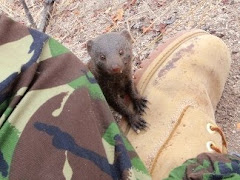
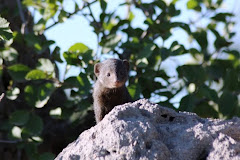
Mongooses are wimpy about the cold, so when the nights grow chilly (down to 7C last night) they stay tucked up snugly in their termite mound until a couple of hours after dawn. This means I too can stay tucked up snugly asleep.
Or it usually does.
At 6 am this morning I was torn from my dreams by an electric buzz saw – no, three electric buzz saws - screaming outside my window.
Not renovations or a mad clear-felling operation: trumpeter hornbills.
Trumpeter hornbills are not aptly named. They're considerably louder than your average trumpet. Their beaks are cunningly designed to amplify their ghastly, chainsaw-like shrieks, with the sound reverberating in a natty, hollow casque on their upper bill. Despite their excruciating voices, they are spectacular birds - something you'd expect to find in a rainforest in Borneo, not the African bush.

Trumpeter hornbills (Bycanistes bucinator) dine almost exclusively on fruit and, around here, while away their days in the trees along the river. Photo by Francesco Veronesi and borrowed from here.

As with all hornbills (other than ground hornbills), the female trumpeter is the ultimate stay-at-home mum.
Once she and hubby have chosen their dream tree-hollow, she starts on the plastering, closing up the front entrance with a wall of mud. Squirming inside through a small hole, she pastes this closed (leaving only a thin vertical slit) using her own droppings. Here she sits alone in the dark, brooding her eggs, and later the chicks. With house-wifely efficiency, she uses this downtime to upgrade her wardrobe, indulging in a full-monty feather moult. Meanwhile dad is responsible for feeding the family, poking bits of fruit in through the mail chute, and receiving the little packages of bird-droppings that mum posts out in return.
Although some hornbill mothers stay locked indoors until their youngsters fledge (four months), trumpeters usually make a break for it when their little darlings are half grown. And who can blame them. Can you imagine that racket, resonating inside a hollow tree?

 Photo by Martin Heigan and borrowed from here.
Related Posts Plugin for WordPress, Blogger...