This morning I was woken at 3 am by a heart-stopping bellow.
It was a hippo, standing at the garden fence, two metres from my bedroom window.
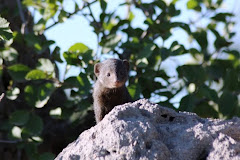
Hippos bellow at a volume of 115 decibels. A jack hammer at five metres has a volume of 100 decibels, and 107 decibels is the level at which you begin to feel pain. So this was a bit of a shock. Of course, at that hour any noise sounds unnaturally loud. I wondered sleepily whether to stagger out and measure the din with my nifty little decibel meter (which I use for playback experiments with the mongooses), but drowsiness overcame scientific curiosity.
I don't think the hippo intended it as a personal message, he was simply answering other hippos, near and far, who were also bellowing their hearts out. I've no idea why.

A hippo's huge lower incisors and scimitar-like canines (bigger in males than females) are designed solely for fighting. When cropping grass, hippos use the hard inner linings of their lips, then grind up the spoils with their rear molars. Photo by Arno Meintjes.
Rude awakenings aside, I love living right next door to one of the world's last species of megafauna. I adore hearing them snuffle and snort, and grunt and chortle, throughout the day. At night, of course, I never know when a hippo is going to trundle by, leaving behind splashes of chaff-like faeces sprayed on prominent trees or shrubs. One evening I walked right into a hippo that was standing in the front yard. The dogs were madly barking, and I assumed it was at the resident porcupine, so I dashed out with an armful of root vegetables (see here for an explanation of this bizarre reaction). I wasn't using a flashlight so I didn't see the hippo (they are dark grey) until I was about one metre away. We both stared at one another for a moment and then I fled. They don't seem to eat root vegetables.
While the hippos around here always behave with the utmost courtesy, I've heard scary stories of them attacking people further upstream, where they cultivate mangos and tensions run high. You see, in the dry season the hippos venture into the orchards in pursuit of the lush grass, but they inadvertently break the trees so the orchardists shoot them. Consequently the hippos don't feel too fond of people. If you've ever wondered what it'd be like to be chased by an angry hippo, you can see some dramatic photos of it here (it's worth looking at all three shots).

The hippo's closest living relatives are the whales, but they no longer keep in touch. Whales and hippos have their own order, called – wait for it - Whippomorpha (who is responsible for these names??)
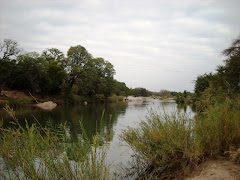
When I first came to Africa, hippos were the species I found most shocking and delightful. You see rivers and lakes look pretty much the same the world over (the usual bog standard plants and ubiquitous waterfowl), so when you're driving over a bridge on the highway and glance down, you're subconsciously expecting to see a duck or an egret, or maybe even a kingfisher. The sight of a massive great mammal lolling in the water is an utter shock. After six years living in the low veld, I think I've become used to them because when I travel overseas I find myself staring disconsolately at waterways, feeling bereft.
I have to admit that I initially assumed hippos to be slow, lethargic animals, fully preoccupied with their own watery concerns. I couldn't have been more wrong. Take a stroll down to the river bank and every eye is on you; constantly. Hippos are very astute and immensely interested in any comings and goings on land. For example, about a month ago I was defrosting my freezer (which sits in a roofed area outside) and I accidentally dropped a large bag of dog bones (that's bones for dogs, not bones of dogs; contrary to the signs, I'm not a psychopathic killer). The bones made a stupendous clatter hitting the concrete floor, which set the hippos bellowing, their calls relaying - animal to animal - both up and down river. 'Oh dear', I thought, feeling strangely embarrassed by the cacophony I'd caused, 'they won't be grazing around here tonight.' Half an hour later, as soon as it got dark, three huge hippos appeared at my back fence, peering in to find out what all the noise was about.

Relaxing in the bath all day doesn't just help you escape from the heat, bugs and predators, it lets you take the weight off your feet. And when you're hippo-sized (up to 3000 kg) buoyancy is a real energy saver. In water, a hippo's pulse drops from 60 to 20 beats per minute and its breathing slows from 7-10 breaths per minute to less than one. Now that's what I call winding down! Photo by Louise Meintjes.