Showing posts with label civets. Show all posts

Friday, July 16, 2010

Surprises, mischief and loss


After Saturday's poaching fiasco, I felt very apprehensive about venturing back into the bush.
I kept picturing myself stumbling upon wounded dogs or disembowelled wildlife. Or, worst of all, finding my mongooses mauled or missing.

My anxiety levels were on the rise (I hadn't been able to find Koppiekats or Ecthelion) when a large dog-like animal lumbered out of a bush at my feet. My heart sank. It's not unusual for poachers to leave a dog behind, and I've tried before (unsuccessfully) to help these pathetic, starving creatures. But my dread turned instantly to delight as I realised that it wasn't a dog at all; it was a civet.

I adore African civets. They're decked out in amazingly luxuriant fur, blotched garishly in black and white, and they look like huge soft toys. They usually only prowl about at night, so it's a rare privilege to glimpse one (I've written about them before here). This one quickly disappeared into the vegetation, but I felt I'd received a gift and continued my search for Ecthelion with a lighter heart.

African civets (Civettictis civetta) aren't fussy about what they munch, happily scoffing fruit and veggies, insects, snails and carrion. They also hunt vertebrates up to the size of new-born antelope (e.g. mongooses) and are one of the few creatures to dine on large millipedes (which exude toxins). Image borrowed from here.

Click here to see a photo on one pinching leftovers; I love his portly profile.

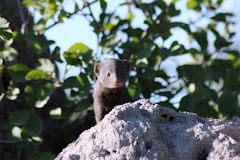
It wasn't long before I found Ecthelion or rather they found me. Firstly I glimpsed a small black shape hurrying toward me and then excited mongooses appeared everywhere, some calling (they use the same high-pitched squeak they give when looking for lost group members) and others clambering up on boulders to weave eagerly back and forth (the mongoose equivalent of waving).
Why was I getting all this attention? I don't radio-collar my study animals (see here for an explanation), so if I'm to find the three-inch-high critters (in their 40 ha home range), it's important that they want to be found. To ensure a warm welcome, I reward them each time I join the group with some boiled egg, a few mealworms or some water. So during the winter dry season, when bugs are scarce, they're often very pleased to see me.

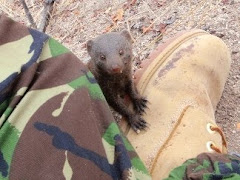
Ecthelion all came bouncing around eagerly, and I crouched down to try to count them (counting swarms of mongooses features regularly in my nightmares). Was anyone missing? I was so busy peering at individuals trying to identify who was present, I didn't notice one of the youngsters, Thor, creeping toward my backpack. Flattened against the ground, he inched forward, closer and closer, and then leapt up to seize the plastic bag poking out of the side pocket of my pack. He raced off at full gallop, the plastic bag - containing a boiled egg - flapping wildly behind him.


Thor (EM038) plotting egg theft.


The pilfering of 'egg bags' is an occupational hazard when working with mongooses. The meerkats were master criminals; some even learnt how to open zippers. One meerkat pup perfected the technique of clambering up his victim's back, onto their head, and then launching himself into the air. He'd plummet down onto the hand holding the egg bag, fixing his teeth in the plastic as he passed and letting gravity carry him - and the bag - away (it worked every time). While the dwarf mongooses are comparatively unsophisticated larcenists, they do tend to drag their spoils off down a burrow, so I immediately rushed after Thor. Unfortunately, I left behind the mealworm container, open and unguarded beside my pack. Returning with the slightly chewed egg bag, I found Jen and Binky (named after Death's horse in the Terry Pratchett novels) madly excavating bran from the container and gorging themselves on worms.

Once I'd regained a semblance of control, I was able to figure out that no one was missing from Ecthelion. The same transpired to be true of Koppiekats and Halcyon. Unfortunately, Bugbears was not so lucky. Melursus, a youngster born last Christmas, is AWOL and he almost certainly fell victim to the poachers' dogs. Thankfully no one else in the group appears to be injured, so it could have been much worse.

Melursus (BF034) at two months of age.

Thursday, April 22, 2010

A smelly favourite

Today while searching for Bugbears, I stumbled upon my favourite animal.
Nocturnal, solitary and rare, this creature has influenced human culture for thousands of years.

At first I just glimpsed movement, and then - barely visible in a tangle of leaves - a patch of soft grey fur, patterned with spots of black. I froze, as did the animal, and we both waited. Eventually, with head lowered, the creature crept slowly from the bushes.
It was an African civet.

African civets (Civettictis civetta) look like huge soft toys. Their thick fur is decorated with black splodges, bars and stripes, and their faces are masked just like a racoon's. When alarmed, civets raise a crest of black and white hair that grows along their backs, making them look one third larger. They also give deep, menacing growls which are quite unnerving.
But today's civet was peacefully snooping about for food. This species doesn't only share the racoon's facial markings, it also shares its omnivorous diet, munching on fruit, bugs, small vertebrates and carrion. Unlike the raccoon, however, civets are designed for life on the ground, and their small paws are dog-like and not at all dexterous.

Civets, along with mongooses and genets, are viverrids. They closely resemble the ancestors of all of today's carnivores. Their teeth and skeletons have barely changed during the last 30-40 million years.
Photo by Neil Roux and borrowed from here.

Like mongooses, civets mark their territories with secretions from their anal glands. Reversing up to trees or rocks, they smear on a vile-smelling, thick, yellowish grease that remains detectable for at least four months. Now you might be thinking 'ooh yuk', but are you wearing perfume? Expensive perfume? If so, you probably have a little bit of civet goo on you right now.

The anal gland secretion of African civets ('civet musk') has been traded commercially for thousands of years. Originally used medicinally, it was valued more highly than gold, ivory or myrrh, and was employed as currency in ancient Ethiopia. For many centuries it's been integral to perfume-making because the refined product, civetone, 'fixes' other fragrances and – when highly diluted (1 kg of civet musk makes 3000 litres of perfume) – has a pleasant musky scent. It also seems to be a natural attractant (e.g. field biologists in Central America report that the civetone in Calvin Klein's Obsession is great for attracting jaguars).

Although artificially synthesised civetone has been available since the 1940s, many of the 'exclusive' perfume manufacturers continue to use animal-derived civetone. This is where it gets ugly. Ethiopia produces 90% of the world's civet musk, exporting 1000 kg annually; 85% of which goes to France. The musk is obtained from about 3000 captive civets held on 200 civet farms. A large male civet (who has his anal glands scraped out weekly) produces about 30 g of musk monthly. In 1999, the WSPA (World Society for Protection of Animals) undertook surveys in Ethiopia and reported widespread animal cruelty, with many civet-farmers failing to meet even the most basic husbandry needs, and animals living out their lives in crates too small for them to turn around. At that time, three major perfume manufacturers - Chanel, Lancome and Cartier - admitted to using animal-derived civetone.

I guess what I find most shocking, is that although civiculture has been practiced in Ethiopia for centuries, they've never succeeded in breeding an African civet in captivity! (Apparently Jersey Zoo has done it.) All farmed civets are captured from the wild, and up to 40% die from stress within the first three weeks. With the rampant deforestation that has occurred in Ethiopia over the last couple of decades, I can't imagine how the country's dwindling civet population can possibly sustain this onslaught.


Photo by Maureen Jarratt and borrowed from here.

If you want to read more:
Sustainable Utilisation of the African Civet (Civettictis civetta) in Ethiopia, by Yilma D. Abebe. 2000.
Scent-marking by the African Civet Civettictis civetta in the Menageha-Suba State Forest, Ethiopia. B. Tsegaye, A. Bekele & M. Balakrishnan. 2008.

Related Posts Plugin for WordPress, Blogger...