Showing posts with label conservation. Show all posts

Saturday, December 31, 2011

Why raw bamboo shoots are a no no

I was sitting on a wet, slimy boardwalk watching tiny leeches inch their way up my mud-caked boots.
Huge trees loomed all around, their foliage heavy and dripping from a recent downpour. Dark clouds still pressed low, making the forest as gloomy as I was feeling.

The conversation didn’t help.

My companions were debating how long a species could remain unseen before it should be declared extinct.

There was good reason for both the topic and our despondency.

You see we were awaiting the impossible.


How did we get into this predicament? Well we’d clambered up this steep, slippery hillside, in the rainforest of Ranomafana National Park, in the hopes of glimpsing one of the world’s rarest primates. Critically endangered, the greater bamboo lemur (Prolemur simus) once frolicked across the entire island of Madagascar but today it clings on in just twelve isolated forest fragments. Fewer than 200 of the critters draw breath.


Ranomafana National Park is a 39,200 ha (96,900 acre) tuft of rainforest growing on the bald pate of eastern Madagascar. It was protected after a new species of lemur (the golden bamboo lemur) was discovered here in 1985.

We’d been shepherded up to this isolated spot by our park guide and his posse of ‘wildlife spotters’.
You see gawking at lemurs is big business in Madagascar and Ranomafana (home to 13 species) runs a tight ship.
When you rock up at the park you're allocated an (unexpectedly knowledgeable) guide, who specialises in visiting just one specific lemur group (of each of the common species). The guide's bevy of spotters race off into the forest to locate the beasts, while you saunter along the forest trails marvelling at minutia (bugs, frogs, chameleons, weird geckos, weirder tourists). Then a cell phone trills. ‘They’re found!’ With agitated hast the guide musters any stragglers and chivvies you off to do your gawking.


A minutia. The tree frog, Boophis viridis, or so I was told.
It could be a Martian for all I know.


Another rainforest skulker: a pitta-like ground roller (Atelornis pittoides). Ground rollers raise their families underground and are endemic to Madagascar.


Now I can’t deny that this system is efficient and lemur-friendly (any one lemur group is subjected to gawking for a limited time only). But it’s also surreal.
Lemur home ranges are small, so bands of gawkers are constantly drifting by, like ships in the night, and the forest echoes with excited cell phone conversations. And woe betide anyone who inadvertently stumbles across the wrong group of lemurs. You’re expected to avert your eyes shamefully and hurry on by.


The eastern grey bamboo lemur (Hapalemur griseus) is one of three species of bamboo lemur (also known as gentle lemurs) that call Ranomafana home.

So it was our guide who’d parked us beside a towering stand of giant bamboo while he and his posse sought our quarry. But before he left, he shared a few facts.

He told us that this group of greater bamboo lemurs was the ONLY ONE surviving in Ranomafana National Park.
‘You mean, it’s the only one tourists visit?,’ we suggested hopefully.
‘No, no. There is just one.’ 
We stared at him non-plussed.
He explained that the lemurs’ nearest neighbours lived 200 km (124 miles) away in a forest fragment on the slopes of the Andringitra massif.

Oh.

We asked how many lemurs were in the group.
‘There used to be eight, but when we last found them, there were only two left.’
‘When was that?’, a brave soul asked.
'Six weeks ago.'

Ahh.

We were still standing gob-smacked, mouths opening and closing like goldfish, when he and his team trooped off into the trees. Our dismay hadn't yet coalesced into cogent thought, so we didn't manage to holler,
‘Hey, why are we squandering our precious time in this park pursuing phantoms?!’

So we waited.
Miserably.


Now don’t get me wrong. Bamboo lemurs are worth investing time to see. They’re intriguing critters. With atypical accuracy, their common name really does reflect their tastes: they dine almost exclusively on bamboo, and giant bamboo (Cathariostachys madagascariensis) usually makes up 80-90% of their munchies.
The problem is, giant bamboo contains cyanide.

To thwart plant-nibblers big and small, many bamboo species stuff their tasty young shoots with taxiphyllin, a cyanogenic glycoside. When digested, taxiphyllin breaks down into deadly hydrogen cyanide. The bamboo’s branch shoots (which thrust up out of the ground like whopping asparagus spears) are the most heavily fortified; in giant bamboo they tote 15-40 mg of cyanide per 100g of shoot.
The lethal dose for humans is 0.5 to 3.5 mg per kilo of body weight.
Fortunately, cooking destroys the cyanide.
Unfortunately, lemurs don’t cook.


Lucky to be alive? If so, this eastern grey bamboo lemur is intending to waft the message to the world. It's smearing its tail with its own personal 'eau de lemur' from the scent glands on the inside of its wrists. 

No one knows how bamboo lemurs cope. They're the only primates to specialise on bamboo. Golden bamboo lemurs, who prefer to dine on the branch shoots, routinely guzzle 12 times the dose of cyanide needed to snuff out your average mammal. Researchers have found that the urine of all three of Ranamofana's bamboo lemur species is tainted with hydrogen cyanide (but their droppings aren't) showing that they really do digest and absorb the poison.
  

A golden bamboo lemur (Hapalemur aureus). Feeling a touch of indigestion?
    
Eastern grey bamboo lemurs sensibly favour bamboo leaves which are relatively low in cyanide. Tipping the scales at less than a kilogram (< 2.2 lbs), they're the smallest lemur to romp about by day.

For those of you fond of Asian cuisine, who might doubt the toxicity of the humble bamboo shoot, beware! Eight people keeled over in a well containing pickled bamboo shoots, blacking out instantly due to the hydrogen cyanide gas given off by the pickles. Two of the victims never recovered, their hearts having failed them entirely. Frustratingly, the research paper fails to address the most obvious question: what were eight people and a load of pickled vegetables doing down a well anyway? Although suspiciously mute about the veggies, the authors do allude to a ‘botched rescue attempt’.

But I digress distressingly.
Back to the rainforest.

We’d been sitting about despondently for around twenty minutes, and conversation had lapsed into a silent contemplation on the nature of loss (or the loss of Nature). We weren’t really listening to the surround-sound screech of frogs, cicadas and other unseen stridulators; in fact most of us were staring off – unseeing - into the eerie, primeval gloom. One of our group, glancing up at the huge bamboo thicket looming above us, said chirpily (in a transparent attempt to lighten the mood), ‘I keep expecting to see fairies or something suddenly pop out.’

And within a matter of minutes they did.

It started as a rustling overhead, and then a clump of bamboo canes swayed wildly as something dark clambered down among them. We snatched up our binoculars and jostled one another for the best view of the moving fronds.
OK, there was some fur...
Oh, and look a tail.
Yes, yes, they’re lemurs for sure... But what sort...?
Oh my God!

The impossible had happened.

Above our heads, the last two greater bamboo lemurs in Ranomafana National Park were nibbling bamboo!

About the size of small house cats and clothed in dark brown fur, they sinuously wound between the bamboo canes. One peered down at us, his bald nose and prominent grey ear tufts giving him a nutty professor look. As we watched, he began gnawing at the woody stem of a bamboo cane. Once he'd made a small hole, he clasped an edge of the wood in his teeth and pulled down a strip to reveal the soft pith inside. This he munched with enthusiasm. Greater bamboo lemurs are alone in using this part of bamboo plants.

Greater bamboo lemurs (Prolemur simus) specialise more exclusively on bamboo than any other lemur. This reliance makes them very vulnerable because bamboo is also coveted by humans. Used as scaffolding, it's often removed from forest remnants, even in protected areas.

Greater bamboo lemurs normally hang out in groups of 7-11 individuals. These two survivors are father and adolescent daughter.

About ten minutes after the lemurs had disappeared further up the mountainside our posse of lemur spotters trudged back. Sweaty and bedraggled, they shook their heads glumly, only to be greeted by an uproar of excited exclamations. As they peered at the images on our cameras, their eyes widened and smiles broke out all round; there was much back-slapping and laughter. I must admit that I was greatly heartened by their obvious delight and relief over the continued existence of their greater bamboo lemurs.

As we slipped and slithered back down the muddy track, we talked of our amazing good fortune in seeing these rarities. But somehow our elation and sense of privilege just wasn’t strong enough to lift the heavy, underlying despair. These creatures were almost certainly doomed.

I found myself wishing that I could give the good luck back; somehow pass the blessing over to the lemurs like a vial of golden Felix Felicis (Liquid Luck).
They were going to need every drop they could get.


Praying for a future?


Friday, November 4, 2011

Madagascan malaise

Sorry I’ve been off air lately.
No, I haven’t been ambushed by hungry mongooses or gnawed to death by gerbils.
I’ve been away on holiday: leering at lemurs in Madagascar!


For those of you harbouring secret dreams of one day visiting Madagascar’s wilderness, I’ve got bad news.
You’re too late.
It’s gone.

Yeah, I know you’ve seen the documentaries, chockfull of weird and wonderful critters, all evolving bizarrely in splendid isolation, etc., etc.

But good ol’ Madagascar aint what she used to be.


Madagascar, accompanied by a co-dependent India, made her break from Africa 160 million years ago. Seventy million years later, tired of living out of a suitcase, she severed connections with India (who was determined to continue north) and settled down at her current domicile, 400 km (250 miles) off the coast of Mozambique in southern Africa. For 90 million years everything went swimmingly (or more precisely came swimmingly), and it wasn’t until around the time Jesus began promoting his new cult that humans were faced with the taxing question of whether to scramble or poach their elephant bird eggs. Amazingly, these first human colonists weren’t locals from Africa; they'd paddled in from the Indonesian Archipelago (someone was either VERY lost or VERY brave; and probably both).

The ‘un-African’ houses (double storey and made of brick) favoured by the tribes people of northern and central Madagascar reveal their SE Asian roots.

Madagascar’s own Dark Ages stretched from 500 to 1500 AD. During this period, humans exterminated every large vertebrate on the island (nothing over 12 kg/26 lbs survived). Among the 48 species lost, were three pygmy hippos, two aardvark-like creatures, a giant fossa, two massive tortoises, an out-sized crocodile, a whopping rat, 17 species of giant lemur and 21 bird species, including eight species of elephant bird. Based on tantalising skeletons and folkloric tales, the lost lemurs included a couple of baboon doppelgangers, three ‘koala lemurs’, an aye-aye four times bigger than today’s version, and a gorilla-like beast, weighing in at around 200 kg/440 lbs.


Madagascar’s elephant birds arose from an adventurous member of the ostrich family who managed to cross 400 km (250 miles) of ocean, about 80 million years ago. Aepyornis (reconstructed here) was the heaviest bird the world has known, standing 3 m (10 ft) tall and weighing 450 kg (990 lbs). It met its maker around the 12th century and people are still stumbling upon its eggs.
Photo borrowed from here.

Today, Madagascar has lost more than 90% of its natural forests.
Of course this is not an unusual scenario, but in Madagascar the results are truly ghastly. You see, because the island was once completely wooded, the native birds and beasts aren’t designed for life out in the open. Remove the native vegetation and everyone just ups and goes (dies?). And thanks to all that ‘splendid isolation’, your bog-standard grassland species can’t move in to fill the vacuum, as happens elsewhere. So what you’re left with is a rural landscape that’s TOTALLY devoid of life.
This was a serious shock for me; I’ve never before experienced anything like it. You can travel hour after hour through the countryside without setting eyes on a single bird! If you’ve ever had nightmares about Silent Spring, well that’s Madagascar.


One of the country’s beautiful rural landscapes (at the southern tip of the island), UTTERLY devoid of living creatures. Rice paddies festoon virtually every valley floor in the country, providing a livelihood for 70% of Madagascar's 20 million inhabitants.


Pied crows (above) and yellow-billed kites are happy to dine on human refuse. They’re the only bird species you'll see in many parts of southern Madagascar.


An opportunistic yellow-billed kite. Go bird, go!


Now before you get as dismayed and distressed as I was for a good proportion of my holiday, let me reassure you that fragments of ‘real’ vegetation still remain. They’re small, they’re infested with enough invasive plants (e.g. prickly pear, sisal, lantana, eucalypts) to make a conservationist fall upon his/her weeding scythe, but they’re also – astoundingly - brimful with Madagascar’s iconic beasts. I scurried into these tiny oases with the utter desperation of wildlife-addict going cold turkey.


This little entity - along with Madagascar’s other 234 frog species - is unique to the island. So too are 92% of the country’s 363 reptile species. And although Madagascar makes up only 1.9 % of Africa’s landmass, it's home to more orchid species than the rest of Africa put together.


An astonishing 101 lemur species (this one’s a white-footed sportive lemur, Lepilemur leucopus) still manage to frolic in the remnants of Madagascar’s bush.

Now I’ve thoroughly depressed you with what isn’t in Madagascar any more, I’ll prepare some posts about the wildlife I did manage to encounter. I hope you like lemurs...
I mean what else am I going to do with 700 bad lemur photographs?
(This is a rhetorical question, just in case you're madly thinking up rude suggestions.)


Lemurs: what’s not to love?

Saturday, September 10, 2011

When your stalker has feathers...


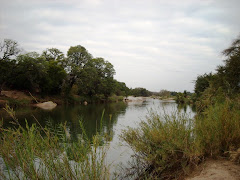
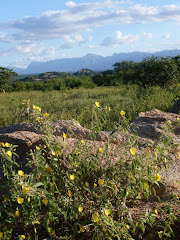
The parched colours of the dry season.
Photo by Kim Reijs.


When I venture into the field these days it's like I've somehow slipped into a Disney animated classic.

All I need is a ballooning skirt and a tripping walk to make the illusion complete.

Why am I suffering these weird fantasies?

Well, the moment I set foot in the bush, I'm surrounded by clouds of little blue birds, all atwitter with excitement. And then the little animals come creeping out of the undergrowth to gather at my feet.
Magic?  Charisma?  Sadly no.
You see it's the height of the dry season here. With the bush seared, dusty and leafless, everyone could use a drink.

In an effort to curry favour with my study subjects (essential if I'm to ever find the little brutes), I reward them with a small bowl of water whenever I join a group. And of course it doesn't take long for the other locals to catch on too.

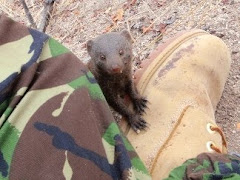
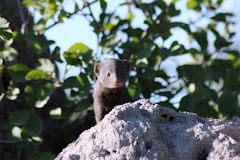
The mongooses crowd around the bowl, some delicately lapping with pink tongues while others dip in their paws and lick the moisture from their toes. Meanwhile a menagerie congregates around us.
Four-footed or two, feathered, scaled or furred, no one can resist the lure of free drink.


Tamarind (HF047) enjoying a tipple.


The tree squirrels (Paraxerus cepapi) aren't backward in coming forward.


Rough-scaled plated lizards (Gerrhosaurus major) disdain rules of etiquette.


Rainbow skinks (Mabuya quinquetaeniata) tentatively seeking that elusive pot of gold water.


"... and then I told that great brute of a mongoose to just clear off..."


The blue waxbills (Uraeginthus angolensis; pictured above) are the most persistent (and impatient). They accompany me as I search for the mongooses, flitting through the bare twiggy undergrowth, peeping vociferously. We collect more and more followers as we go, with everyone complaining loudly about having to wait to wet their whistle. I find this entourage a bit irritating because it drowns out the subtle, tell-tale peeps of my mongooses.

But if the waxbills are annoying, there's one avian devotee that drives me insane. Dressed in humdrum colours, it flutters from branch to branch above my head, ruffling its wings, wriggling its white-edged tail and bobbing about like a creature possessed. It also feels compelled to squawk non-stop. One of my bird books likens its raucous call to the sound of a shaken box of matches, which is pretty accurate if you pump up the volume about 100-fold.

This irksome devotee will dog my steps for hours (OK, for the purposes of scientific accuracy, I'll admit that this is a slight exaggeration). It certainly doesn't retire once I find the mongooses (and they dislike it as much as I do). You see it's not after a mere sip of water. It wants wax.

Yep, you read right: the greater honeyguide is one of only a handful of critters who's able to dine on, and digest, wax (thanks to special microbes in its gut).

But before you start imagining some ghastly Hitchcockian scene, let me make it clear that it isn't after earwax.
This feathered stalker hungers for beeswax.

Its fervent taunting is designed to persuade me to follow it to a likely bee hive. Once there, it expects me to smoke out the bees and heroically retrieve the honeycomb so it can gorge itself on bee larvae and wax (it doesn't eat honey). I've never felt tempted to accept this offer (opening a jar of jam seems safer), but if I'm unwise enough to move or speak in the bird's presence, it gets super excited and zooms off, in a sweeping, undulating flight, toward the nearest hive.


Although greater honeyguides (Indicator indicator) are only about 20 cm (8 in) long, they vex the inhabitants of woodlands and savannahs throughout sub-Saharan Africa. When not guzzling wax or terrorising baby bees, they make do with flying insects.
Photo by Carol Foil.

Now as a zoologist who studies partnerships between species (see an example here), I know I should revere this bird. Collaboration between beasts of feather and fur is rare, and the greater honeyguide is the poster child for such complicity.
But God it's annoying!
And the creature's not easily deterred; honeyguides will invade villages and gardens in search of someone with a sweet tooth, and they even pursue cars and boats.

You see the honeyguide has had the dubious pleasure of sharing its habitat with humans for millions of years, and that's plenty of time to notice a mutual fondness for bee by-products. But what's really impressive about the alliance that's evolved, is how well human and bird communicate.

For example, when the Boran people of northern Kenya decide to do a spot of honey pilfering they inform the birds by whistling piercingly through clasped fists (this doubles their chances of bumping into a honeyguide, who then reduces the time they spend searching for a hive by two-thirds). Of course the bird has reason to come running flying: only 6% of the hives (of Apis mellifira) in its territory are accessible to beak and claw alone.

Upon arrival, the honeyguide gives its annoying come-hither call, zips off for a moment (presumably to identify landmarks along its proposed route) and then leads the honey gathers in a beeline for the closest hive. (A three-year study found that the birds monitored all the hives in their area, routinely stopping by for a minute or so to check they were active).
Intentionally or otherwise, the honeyguide also informs its followers how far they'll have to walk. The further away the hive, the longer the bird is gone on its initial reconnaissance mission, and the nearer the allies gets to the booty, the shorter the bird's perch-to-perch flights become. When the team finally rocks up at the hive, the bird gives a special 'here it is' call, perches close to the nest and then keeps mum.

If you haven't already seen footage of a greater honeyguide doing its thing, you can view one (and David Attenborough imperilled by bees) here (courtesy of the BBC's Trials of Life).

The weirdness of greater honeyguides is not limited to their dietary habits. These birds are territorial and each male has a special 'song post' where he sits from dawn 'til dusk throughout the breeding season vociferously boasting of his macho charms. Interested lady honeyguides simply drop by for a bit of fun every now and again.
But once knocked up, female honeyguides appear to go to pieces, abandoning the fruit of their passion at the earliest opportunity. They cunningly slip their egg into the nest of unsuspecting hole-nesting birds (such as barbets and woodpeckers). When their little darling hatches, it dispatches its nest mates with a wicked billhook designed for the purpose.
Serendipitously, you can see wonderful photos of this villainous behaviour here.


The adoptive parent (a meves starling) of a greater honeyguide chick bringing home the bacon frogs legs.
Photo by Johann du Preev.

But all is not well in the land of honey procurement.
When I first started working on the dwarf mongooses six years ago, I was constantly beset by these irritating birds; now it's a rarity. I hadn't really given this much thought: sure, the resident birds had learnt I was a no-show and had given up on me (sigh of relief). But after researching this post I began to realise how bad this is.

You see in many places greater honeyguides don't indulge in guiding at all. It's believed that this is the result of humans, at some time in the past, welshing on the deal. And increasingly local people are abandoning traditional food gathering techniques (hey, sugar's dirt cheap at the supermarket), leaving the birds high and dry.
Similarly, human activities such as honey gathering are banned in national parks and other protected areas, exacerbating the problem.

So this amazing alliance between bird and mammal - rightly lauded as the world's most impressive example of interspecies mutualism - is rapidly disappearing.

And I'm hastening its loss!


Honeyguides and Honey Gatherers: Interspecific Communication in a Symbiotic Relationship. H. A. Isack & H. U. Reyer. 1989. Science, 243: 1343-1346.

The Fallacy, Fact, and Fate of Guiding Behavior in the Greater Honeyguide. W. R. J. Dean, W. Roy Siegfried & I. A. W. MacDonald. 1990. Conservation Biology, 4: 99-101.

Thursday, April 22, 2010

A smelly favourite

Today while searching for Bugbears, I stumbled upon my favourite animal.
Nocturnal, solitary and rare, this creature has influenced human culture for thousands of years.

At first I just glimpsed movement, and then - barely visible in a tangle of leaves - a patch of soft grey fur, patterned with spots of black. I froze, as did the animal, and we both waited. Eventually, with head lowered, the creature crept slowly from the bushes.
It was an African civet.

African civets (Civettictis civetta) look like huge soft toys. Their thick fur is decorated with black splodges, bars and stripes, and their faces are masked just like a racoon's. When alarmed, civets raise a crest of black and white hair that grows along their backs, making them look one third larger. They also give deep, menacing growls which are quite unnerving.
But today's civet was peacefully snooping about for food. This species doesn't only share the racoon's facial markings, it also shares its omnivorous diet, munching on fruit, bugs, small vertebrates and carrion. Unlike the raccoon, however, civets are designed for life on the ground, and their small paws are dog-like and not at all dexterous.

Civets, along with mongooses and genets, are viverrids. They closely resemble the ancestors of all of today's carnivores. Their teeth and skeletons have barely changed during the last 30-40 million years.
Photo by Neil Roux and borrowed from here.

Like mongooses, civets mark their territories with secretions from their anal glands. Reversing up to trees or rocks, they smear on a vile-smelling, thick, yellowish grease that remains detectable for at least four months. Now you might be thinking 'ooh yuk', but are you wearing perfume? Expensive perfume? If so, you probably have a little bit of civet goo on you right now.

The anal gland secretion of African civets ('civet musk') has been traded commercially for thousands of years. Originally used medicinally, it was valued more highly than gold, ivory or myrrh, and was employed as currency in ancient Ethiopia. For many centuries it's been integral to perfume-making because the refined product, civetone, 'fixes' other fragrances and – when highly diluted (1 kg of civet musk makes 3000 litres of perfume) – has a pleasant musky scent. It also seems to be a natural attractant (e.g. field biologists in Central America report that the civetone in Calvin Klein's Obsession is great for attracting jaguars).

Although artificially synthesised civetone has been available since the 1940s, many of the 'exclusive' perfume manufacturers continue to use animal-derived civetone. This is where it gets ugly. Ethiopia produces 90% of the world's civet musk, exporting 1000 kg annually; 85% of which goes to France. The musk is obtained from about 3000 captive civets held on 200 civet farms. A large male civet (who has his anal glands scraped out weekly) produces about 30 g of musk monthly. In 1999, the WSPA (World Society for Protection of Animals) undertook surveys in Ethiopia and reported widespread animal cruelty, with many civet-farmers failing to meet even the most basic husbandry needs, and animals living out their lives in crates too small for them to turn around. At that time, three major perfume manufacturers - Chanel, Lancome and Cartier - admitted to using animal-derived civetone.

I guess what I find most shocking, is that although civiculture has been practiced in Ethiopia for centuries, they've never succeeded in breeding an African civet in captivity! (Apparently Jersey Zoo has done it.) All farmed civets are captured from the wild, and up to 40% die from stress within the first three weeks. With the rampant deforestation that has occurred in Ethiopia over the last couple of decades, I can't imagine how the country's dwindling civet population can possibly sustain this onslaught.


Photo by Maureen Jarratt and borrowed from here.

If you want to read more:
Sustainable Utilisation of the African Civet (Civettictis civetta) in Ethiopia, by Yilma D. Abebe. 2000.
Scent-marking by the African Civet Civettictis civetta in the Menageha-Suba State Forest, Ethiopia. B. Tsegaye, A. Bekele & M. Balakrishnan. 2008.

Related Posts Plugin for WordPress, Blogger...