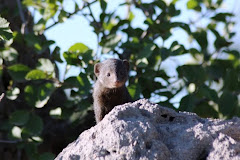
Nocturnal, solitary and rare, this creature has influenced human culture for thousands of years.
At first I just glimpsed movement, and then - barely visible in a tangle of leaves - a patch of soft grey fur, patterned with spots of black. I froze, as did the animal, and we both waited. Eventually, with head lowered, the creature crept slowly from the bushes.
It was an African civet.
African civets (Civettictis civetta) look like huge soft toys. Their thick fur is decorated with black splodges, bars and stripes, and their faces are masked just like a racoon's. When alarmed, civets raise a crest of black and white hair that grows along their backs, making them look one third larger. They also give deep, menacing growls which are quite unnerving.
But today's civet was peacefully snooping about for food. This species doesn't only share the racoon's facial markings, it also shares its omnivorous diet, munching on fruit, bugs, small vertebrates and carrion. Unlike the raccoon, however, civets are designed for life on the ground, and their small paws are dog-like and not at all dexterous.
Civets, along with mongooses and genets, are viverrids. They closely resemble the ancestors of all of today's carnivores. Their teeth and skeletons have barely changed during the last 30-40 million years.
Photo by Neil Roux and borrowed from here.
Like mongooses, civets mark their territories with secretions from their anal glands. Reversing up to trees or rocks, they smear on a vile-smelling, thick, yellowish grease that remains detectable for at least four months. Now you might be thinking 'ooh yuk', but are you wearing perfume? Expensive perfume? If so, you probably have a little bit of civet goo on you right now.
Although artificially synthesised civetone has been available since the 1940s, many of the 'exclusive' perfume manufacturers continue to use animal-derived civetone. This is where it gets ugly. Ethiopia produces 90% of the world's civet musk, exporting 1000 kg annually; 85% of which goes to France. The musk is obtained from about 3000 captive civets held on 200 civet farms. A large male civet (who has his anal glands scraped out weekly) produces about 30 g of musk monthly. In 1999, the WSPA (World Society for Protection of Animals) undertook surveys in Ethiopia and reported widespread animal cruelty, with many civet-farmers failing to meet even the most basic husbandry needs, and animals living out their lives in crates too small for them to turn around. At that time, three major perfume manufacturers - Chanel, Lancome and Cartier - admitted to using animal-derived civetone.
I guess what I find most shocking, is that although civiculture has been practiced in Ethiopia for centuries, they've never succeeded in breeding an African civet in captivity! (Apparently Jersey Zoo has done it.) All farmed civets are captured from the wild, and up to 40% die from stress within the first three weeks. With the rampant deforestation that has occurred in Ethiopia over the last couple of decades, I can't imagine how the country's dwindling civet population can possibly sustain this onslaught.

Photo by Maureen Jarratt and borrowed from here.
If you want to read more:
Sustainable Utilisation of the African Civet (Civettictis civetta) in Ethiopia, by Yilma D. Abebe. 2000.
Scent-marking by the African Civet Civettictis civetta in the Menageha-Suba State Forest, Ethiopia. B. Tsegaye, A. Bekele & M. Balakrishnan. 2008.