Showing posts with label crocodile. Show all posts

Saturday, January 12, 2013

Scarred for life (or what's left of it)

‘Well, it’s going to leave a scar’, the doctor said as we stared at the gaping wound on my lower leg.
He wanted to stitch it.
I was trying to avoid having needles poked through my flesh.
‘I can cope with that’, I said calmly (secretly thinking: Ah ha. Now I can impress people who ask about my scars).

But that was five years ago and NO ONE HAS EVER ASKED.

Now this sad state of affairs is a product of my age.
Have you noticed that when you’re young, people are forever asking you how you acquired this blemish or that. And as a callow youth, all you can do is confess, ‘Okay, I’m a complete klutz’. Yes, I did mishandle a breadknife; yes, I did trip on the stairs.
But as you edge into middle-age, scars shift allegiance, traitorously teaming up with wrinkles, saggy skin and liver spots to become harbingers of age. And, goodness me, no one wants to mention them!

Of course, the phenomenon isn’t limited to bodily blemishes and I’m the first to rejoice in this unexpected benefit of aging. No longer must I endure prolonged and incredulous discussions about why I don’t want children (Oh God, she’s one of those unfortunate women who can’t have kids...) or hours of nonsensical harassment over imbibing distasteful beverages (don’t say anything; she’s obviously on the wagon...).
But I’m digressing shamelessly here (probably senility).
Since no one has ever enquired about the impressive scar on my right calf, I’m going to tell you about it here. And it serves you right for being so polite!

It was a dark and stormy night...
Well it was dark at least. Oh, and it was hot (I was wearing shorts).
Suddenly my dogs shot out the backdoor, barking wildly. Something stirred in the bushes beyond the garden and Magic (my husky cross) clambered straight up and over my dog-proof fence.
Aha, I thought, this isn’t one of our normal passersby.
You see, like all well-brought-up carnivores, my dogs detest other meat-eating beasts. When a porcupine, hippo or waterbuck tippy-toes past the garden they respond with a bark or two, but only a carnivorous creature can arouse them to such athleticism.

Envisaging the potential annihilation of some innocent little furbearer, I girded my loins for a rescue mission (scuffed my feet into thongs/flipflops and grabbed up my semi-flat torch/flashlight).
As I hurried through the thigh-high forbes below the garden, I could see Magic circling a large tree stump, barking frantically. Oh dear, some inoffensive critter must be hiding among the broken roots. A fur-fluffed genet maybe? Or a striped polecat, big-eyed and cowering? Shining my wavering torch beam carefully on the stump, I hastened toward Magic.
Then CRUNCH!
Something had sunk its teeth into my lower leg.
And let me tell you, this was no little mustelid.
With my mind still fixed on nocturnal mammals, I bewilderedly ran through the possibilities. A civet? A honey badger?
But even the most vicious honey badger couldn’t feel like this! Warm wetness was flowing down my leg and pooling stickily in my sandal. As I lowered the torch beam toward my leg, my mysterious attacker gave a head-shake, thrashing the vegetation wildly and almost flinging me off my feet. Then it let go. And I finally managed to get the light focused at my feet.
Oh God!
Right before me was the wide, tooth-filled gape of a crocodile.


What you don’t want to see two inches in front of you.

Now this was a shock. This is NOT what you expect to find at the bottom of your garden! Well sure, I live beside the Oliphants River, but the water’s edge is at least 250m/yards from my house.
The reptile, poised threateningly in a patch of flattened vegetation, was relatively small (for a crocodile) being about the same size as me (1.7 m / 5’6” long). And it was fixing me with a piercing death stare. Without thinking, I immediately stepped backward and the creature lunged toward me, it's mouth still agape. However, this time it kept its teeth to itself and I was able to slowly back away. As I hobbled squelchily back to the house, I found I was shaking head to foot.


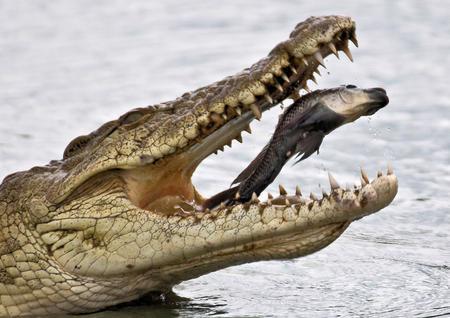
Fortunately the teeth of the Nile crocodile (Crocodylus nilotus) are designed to grab and hold, rather than slice and dice. On the downside, crocodiles have the most powerful bite known for any living creature.
Photo by Silvain de Munck.

Now I don’t blame the crocodile for this assault. Clearly I’d blundered straight into it, and who doesn’t bite when stepped upon? I’m just profoundly grateful that it let go! A few years ago I read an article in the local paper about a crocodile that got into a swimming pool at a local game lodge. It grabbed a child (by a limb) and hung on. The girl’s grandfather managed to keep her above water, but it was half an hour before he could persuade the beast to open its maw. Unfortunately, the crocodile had to be put down afterwards because Granddad had had to gouge its eyes right out of their sockets before the crocodile would let go.

Now if you’ve ever lain awake at night worrying about how hard a crocodile can bite (and who hasn’t), a recent study by Gregory Erickson and his colleges in Florida will put your mind at rest. These intrepid researchers persuaded 83 crocodilians to sink their fangs into a waterproof, leather-encased bathroom scale (ain’t science grand). They measured the bite force of all 23 living species, from diminutive little fish-eaters to bloody great wildebeest-snatchers. And what they found was unexpected.


The toothy schnoz of the Indian gharial (Gavialis gangeticus) is a perfect fish-processing tool.
Photo by Josh More.

The Chinese alligator’s (Alligator sinensis) Walt-Disneyesque snub nose is custom-made for crushing mollusc shells.
Photo by Roger Smith.

It didn’t matter what a crocodile ate, or how its snout or teeth were shaped, the force of its bite was the same. What was important was the size of the beast; the bigger the croc (regardless of its species) the worse the chomp (note to self: don’t step on a large crocodile). The most powerful bite the researchers measured was inflicted by a whopping (5.3 m/17 ft long) saltwater crocodile whose teeth crunched down with a force of 3,700 pounds per sq inch (psi) or 16,400 newtons. Compare this to a human’s best bite (150-200 psi or 4,450 newtons) or that of a lion or spotted hyena (1,000 psi or 4,450 newtons) and you can see why crocodiles really are best avoided.

Using the measurements from this study, and scaling down to a 1.7 m crocodile, I figure that my scar was produced by teeth pressing into my flesh at a force of about 335 psi (or 1,500 newtons). This isn’t too bad really (it’s certainly better than a lion). I guess you can stop feeling sympathetic (you were feeling sympathy, weren’t you?).


The little raised black spots on the scales of crocodilians are touch-receptors, ten-times more sensitive than our finger tips. You can read about them here. Nile crocodiles, such as this one, have them sprinkled all over, but in alligators they’re restricted to the snout. Photo by Silvain de Munck.

Now you may be wondering what‘s brought on my current bout of crocobilia. Well I’m currently staying (temporarily I’m afraid) in a beautiful lodge perched on an outcrop above the river. And it has a swimming pool (oh, the luxury). Unfortunately my dogs - who presumably read the local rag - believe the pool is crocodile-infested and won’t set paw anywhere near it. Whenever I take a dip they look at me with tragic reproof, utterly convinced that this folly will cost me my life. And Magic’s paranoia doesn’t stop there; she’s sure we’re facing an invasion. With great heroism, she sits guard, day and night, on the verandah overlooking the pool and barks ferociously each time the floating bottle of pool chemicals drifts in the direction of the house. Sigh.

Magic on sentry duty.


Friday, April 22, 2011

Running scared

Running just isn't my thing.

I've never understood what people gain from jogging (apart from joint problems) or why any sane biped would want to run a marathon.

Of course I did do cross-country running for PE back in high school (we jogged out the school gates, sauntered to a friend's house, drank coffee for two hours and then jogged back in through the gates). I guess that doesn't count.

However, since coming to Africa, I've discovered that there are times when I'm happy to run with the best of them.

And yesterday was one of them.


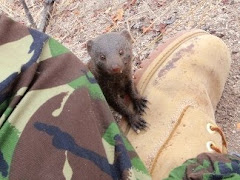
The occupational hazards of a mongoose researcher: I've taken to my heels to avoid ostriches, bulls, poachers, rhinos, elephants and a hand-raised ground squirrel. Said demonic ground squirrel (sporting HUGE teeth and an ankle-biting fetish) shown above.


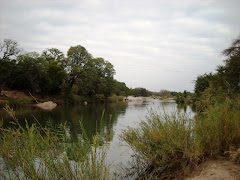
When I first moved into this house (located right on the banks of the Oliphants River) I was very cautious about walking by the water's edge. You see this river is home to a multitude of Nile crocodiles: little cute teeny ones – goggle-eyed and stripy in black, yellow and green - who high-tail it for the water the moment they see you, up to massive behemoths 5 m (16.5 ft) long who just lie there and watch as you pass. They bask on the beaches, waddle along the roads between river and dams, and creep out at night to drag away anything unwise enough to die within 500m of the river.


A Nile crocodile (Crocodylus niloticus) paddling in the dam near my house. When I stopped to photograph his grisly prize (an ill-starred waterbuck the size of a large horse), he hastily towed it further off shore.

So when it came to walking with my dogs in the river bed, I was initially very wary about getting too close to the water. After all, I'd seen those scary wildlife documentaries where the crocodiles leap out of the water to snatch milling wildebeests off the bank. And let's not forget killer whales, beaching themselves on the sand for a mouthful of unsuspecting seal pup.
You simply can't trust aquatic predators to stay in their rightful element.

Yet after three years of riverbank rambles, free of anyone trying to eat me, I've become a little blasé.

Well yesterday I got a shock.

The dogs and I were wending our way along the river bed, ploughing through the drifted sand and clambering over rocks, when I spotted a huge crocodile basking on the beach of a mid-stream island. It was one of the really massive ones, close to 4 m (13 ft) long and it looked more like a felled rainforest tree than an actual animal. I cannot describe to you how awesome these creatures are. It's not so much their length as their immense bulk; they can weigh up to 1000 kg (2200 lbs). I can never look at them without shivering inside and feeling that reptiles simply should NOT get this big. And they've effectively cured me of a lifelong desire to meet a dinosaur.


The world's worst photograph of a mammoth crocodile (sorry!). Crocs have all sorts of spiffy adaptations, like a palatial valve (a fleshy flap at the back of the tongue) which seals their throat when below water. Normally crocs dive for up to 15-20 minutes but, when harassed, they can stay below for 2 hours, reducing their heart rate to 2-3 beats a minute and closing their heart valves to redirect blood to only essential organs.


The dogs and I picked our way across the sandy beach toward the creature, stopping about 3 m (10 ft) from the water's edge. I'd been a bit hesitant about approaching it so directly as I didn't want to disturb it, but these big guys tend to be very confident and there was about 25 m (82 ft) of fast-flowing river swirling between us. The dogs, of course, simply didn't see it (they never see crocodiles unless they move) and I was keen for them to do so, so they'd understand why I keep insisting the water is dangerous.

While we were standing on the beach, enjoying the vicarious thrill of gazing at such an awesome predator, the awesome predator lurched to its feet - standing up on fully straightened legs (called a 'high-walk' in crocodile parlance) which made it waist-height - swung round to face us and plunged into the river. It came surging toward us through the water at full speed (about 15 kph/10 mph according to the books), and it took me a moment or two to realise, 'hey, it's coming straight at us!'

Coincidence, surely.

I walked a few steps downstream and it immediately altered its path so its trajectory would intercept us.

Oh God!

By now it was half way across the river and I felt a rush of alarm, disbelief and dismay as I realised we were now on the menu. I envisioned the beast hurtling out of the water in front of us; a creature at least ten times my own body mass.

It was at this point that I turned and ran.

Fast.

I'm afraid I cannot tell you whether the crocodile actually emerged on to our beach, as I didn't stop to look back.
And neither did the dogs.
We just ran.

And from now on, I'm going be to very cautious again!


I thought you should see what these big guys are capable of. If you go here you can view a series of eight photos showing what happened during this horrible interaction.
Photo by Martin Nyfeler/Barcroft Media, and posted on Flickr by Arno Meintjes.


Wednesday, April 14, 2010

Telltale footprints

While searching for Bugbears today, I came across these tracks.

They followed the road for about 200m before veering off into the bush towards the dam.

At first I was completely baffled. They look like crocodile tracks but something isn't right. The curving line you can see on the left was made by the crocodile's tail, swinging back and forth as the animal walked. And on either side of the tail line you can make out the reptile's foot prints. But why are there two gouged lines?

A crocodile with two tails? Two crocodiles walking in single file?

It took me a while to figure it out, and then I felt stupid for not realising immediately: the crocodile was carrying something which was scraping along the ground.
It's not unusual to find crocodile tracks here, because the animals use the roads to move between rivers and dams. They can travel long distances, especially to exploit to temporary water bodies.

This dam in Bugbears' territory is about 2 km from the nearest water, and it dries up completely each winter. But within 24 hours of it refilling (at the start of the wet season), a large crocodile always moves in.

If disturbed far from water, crocodiles pursue the strategy beloved by tortoises and chameleons everywhere: they freeze and try to blend into their surroundings. Their camouflage is surprisingly effective out in the bush (and I've got the scars to prove it) but less so on the road. Several times I've come across large crocodiles stretched motionless across the highway. I think, 'Oh my God, it's been run over!' and start madly worrying how on earth I can get an injured crocodile to the vet. But as soon as the traffic is gone, the croc just gets up and marches off. And you'll be amazed the length to which motorists will go, NOT to run over a 3 m crocodile!

I don't know what today's crocodile was carrying at Bugbears, and I don't really want to think about it. The photos below will help your imagination conjure up images as vivid as my own. These pictures were taken by visitors to Kruger National Park (which is just next door) and posted on the Public Sightings Gallery at the South African National Parks' website. Check it out: it's amazing what people get to witness.

Baby hippo. Photo by Yolande Oelsen.


Fish. Photo by Peter Winnan.


Warthog. Photo by Bernard Steele.
Related Posts Plugin for WordPress, Blogger...