Monday, January 3, 2011

New Year’s resolution?

Pitter patter,  pitter patter,  pitterSQUEEEEE...!

Silence.

I lie wide-eyed staring into the dark. Apprehension edges through me as I strain to catch a tell-tale sound.

Directly over my head an innocent rodent has just met its doom.
And I don't know why (or more precisely, whom).

For the last couple of months my nights have been haunted by the slaughter in my ceiling. The piercing shrieks of dying bats, mice and geckos shatter my dreams.
Somewhere in my roof lurks a Large Predatory Beast. And, so far, I've been too cowardly to find out what it is.


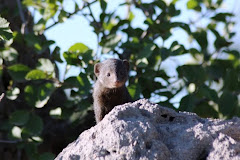
Tomorrow's supper? An Egyptian slit-faced bat (Nycteris thebaica) hides out in my bathroom.

While everyone's busy making New Year resolutions, I'm debating whether I should resolve to clamber up on my kitchen bench, clear away the cobwebs and poke my head up into the ceiling.

To look or not to look...

I know that as a wildlife enthusiast I should be bursting with curiosity and as a zoologist my scientific zeal should outweigh all other considerations. But I'm fairly certain The Beast is limb-free. And I do NOT like snakes. The tiny feet of mice and geckos hammer a noisy tattoo on my ceiling, and even visiting birds (shopping for nest sites) sound as if they're attending a tap-dance festival.
But when The Beast prowls, I hear nary a footfall.
Only one sound is detectable: a heavy, sliding slither. It's the sort of sound that, in the dead of night, conjures images of a hooded hunchback dragging his withered leg or a silent assassin gently shifting his kitbag.

I know you think I'm being paranoid. I'm mean lots of people have wildlife (even legless wildlife) living in the cosy space between ceiling and roof. But the problem is, only half my house has a proper ceiling. My lounge and kitchen are roofed with sagging sheets of thickened bubble-wrap, and each swayback strip - draped precariously over dangling wires – is bordered by big yawning gaps.
Call me wimpy, but I'm convinced that sooner or later - intentionally or otherwise – The Beast is going to drop down into my house.

Is it better, or worse, to know what's destined to land on your head?

The possible contenders are not encouraging. There are three nocturnal mammal-killers with a penchant for climbing: the snouted cobra, the African rock python and the brown house snake.


What I'm afraid I'll see if I poke my head through a gap in the ceiling. The snouted cobra (Naja annulifera) was once considered a variant of the Egyptian cobra (aka Cleopatra's downfall) but has now been granted taxonomic independence. Photo by Michael Randsburg.


Snouted cobras scare the Hell out of me. They're the thugs of the cobra family. It isn't enough for them to tote a highly lethal neurotoxin, or to inject enough of it to kill ten humans. No, they also have to indulge in body-building. Why any cobra feels the need to attain boa-like proportions is beyond me, but when you're battling a snake phobia, it's just not nice.

As with most muscle-bound heavies, snouted cobras are active at night. Occasionally I meet one at dusk while walking my dogs at the local mine. Last time, the dogs were too busy haring after a duiker to notice the snake coiled by the track, but as I approached it reared up threateningly and spread its hood. Although quite reasonable in length (about 2 metres/6 feet), its yellowish body (banded here and there with grey) was as thick through as my thigh (the part toward the knee; I can't vouch for the rest after Xmas indulgences). The creature stood poised with its head at waist-height (I hate the way South African snakes do this; isn't there some biblical stricture about 'slithering on thy belly') and its massive hood was a scary 25 cm ( 10") across. I felt queasy. Hissing threateningly, it glared at me for a few moments before correctly concluding I was not a threat and gliding smoothly up into the canopy.


A captive snouted cobra showing off its glorious physique.
Photo posted on Flickr by KBugler.


To find out whether I was alone in my feelings towards the snouted cobra, I turned to the internet. The herpetological forums are a source of endless fascination for me. A snouted cobra photo that sends shivers down my spine elicits a volley of appreciative comments:
"I love this beautiful snake".
"One of my favourite species..."
"A stunning specimen of a gorgeous snake. I still miss Paul."
Huh?
The next comment, after a paragraph of snake-directed superlatives, concludes:
"Paul was a really great guy."
Yep, you guessed it. After a short search I find that Paul died several years ago after a snouted cobra nipped him on the wrist.

I do NOT understand snake-enthusiasts!

Of course, The Beast in my ceiling may turn out to be a non-venomous python. Unfortunately, the pythons around here grow a trifle large; husky-eating large. My neighbour, about 1.5 km downriver, recently found one 5.2 metres (17 feet) long showing a heart-warming interest in his Weimaraner dogs. Encountering one on my bed at 2 am has taught me that - venom or no venom - I do not want one of these falling on my head.


My guest room with guest. African rock python (Python sebae).


There is no doubt, that the diminutive brown house snake (Lamprophis fuliginosus) is my one shining hope. It's small (about 1 m/3 ft) and its teeth are entirely venom-free. It even sounds reassuringly friendly; like a house cat.
Of course I've never actually seen one around here...
But maybe that's just evidence of its discrete and humble disposition.

Currently I remain unresolved.
Would you look?


Sunday, December 26, 2010

A slew of new gnu


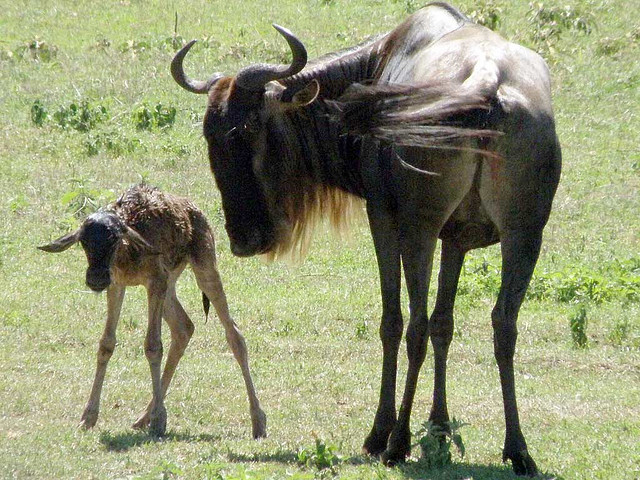
Common (or brindled) wildebeests (Connochaetes taurinus). Photo by Dom Cram.


The 'miracle of birth' is one of those tired clichés that slide past us without making the slightest impact.

(Don't panic this is NOT a schmaltzy Christmas post.)

And it's not just the phrase that's world-weary; it's the concept too.
Oh yeah, another birth, another miracle... ho hum.
Unless you're involved personally, unless a small, mewling being is actually placed in your own hands, the creation of a new life - where none existed before - is something we bizarrely take for granted.

Well this week I encountered an antidote to this blasé approach to natural miracles.
It was brought to me by my local wildebeest herd.

Wildebeests (or gnus) are the itchy-hoofed members of the antelope family. They're dedicated believers in the old 'grass is always greener...' adage. Let them perceive the distant rumbles of a far-flung thunderstorm and off they'll go, happily trudging 50 km (31 miles) in search of that greener grass. And of course you'll have seen footage of wildebeest herds - a thousand strong - trekking through East Africa on their annual migratory romp.


A new gnu. Gnu is the Hottentot name for the species. To produce a convincing imitation of the male's territorial call, pinch your nose and say 'g-noo' in a deep voice. Photo posted on Flickr by naddel.


But not all wildebeests migrate. Give a wildebeest a generous supply of short, green grass and a drinking fountain and he'll hunker down with all the gusto of a limpet (surely limpets have gusto). Alternatively you can just build a fence. This may, of course, have dire consequences, as demonstrated by the 50,000 wildebeests that met their maker along Botswana's veterinary fences during the mid-1980s' drought. But I'm getting sidetracked here. The point is that many wildebeests (including the ones living around here) enjoy a happy and fulfilling sedentary life.

But regardless of whether they're nomads or couch potatoes, wildebeests are built to roam. Unlike every other antelope, they don't hide their calves away during the first days or months of life; that would be a sure-fire way of getting left behind. The newborns must find their feet immediately, and they can totter after Mum within - on average - six minutes of birth. But such tiny calves, moving openly with the herd, are dreadfully vulnerable to anything with big teeth. So what's to be done?


Mastering stilt-galloping. Notice that the legs of this newborn are almost as long as his mum's. Wildebeest calves are born during the morning to maximize their practice time before the nightly predators rock up. Photo posted on Flickr by Kibuyu.


I witnessed the solution to this problem firsthand this week. You see I usually pass a herd of wildebeests on my way to the mongooses each day. Black-coated with large, heavy heads topped with devil horns, they remind me of those medieval depictions of demons. The well-grown yearlings cavort and prance, tossing their bearded heads, while the females - bellies rounded and taut - pause in their grazing to gaze at me through long black lashes. Patrolling the herd is a macho territory-owner, bigger and darker than the rest. He stands regally side-on, striving to show off his majestic physique.

Now I can't say I haven't been expecting it; it happens just before Xmas every year. But it's always a shock, anticipated or not. You see when I passed the herd on Tuesday, it had almost doubled in size. Tottering by the side of every female was a wobbly-legged calf. The sudden, miraculous appearance of a whole herd full of little tan calves is utterly awe-inspiring and, of course, a real joy.

To outfox predators, wildebeests opt for the old predator satiation strategy, flooding the market with all their yummy calves at once. And when I say 'at once' that's exactly what I mean. Expectant mums congregate (hundreds at a time in the large migratory herds) at special calving grounds (normally open, short-grassed areas) dropping their calves together. This en masse calf-production begins very abruptly because no one can afford to be early; a calf arriving even one day ahead of its peers is destined for consumption. And any latecomers, being littler than the rest, are also prone to be munched.

I defy anyone to experience this sudden magical conjuring of wildebeest calves without feeling awe, wonder and a renewed appreciation for the 'miracle of birth'.

Built for speed, a calf tests his legs. Wildebeests begin to lose their tan coats at two months old. Photo posted on Flickr by Picture Taker 2.

Saturday, December 25, 2010

Tuesday, December 21, 2010

The stink of Paradise

My house reeks of something VERY dead.
And for once my poor housekeeping skills are not to blame.

At night the sweet, cloying stench is so powerful it makes my head throb. No, one of Silver's post-prandial snacks didn't escape to expire behind the refrigerator. And Magic hasn't been dragging carrion home again.
In fact, the odour isn't even seeping from the roof, home to a Large Predatory Beast. I hear this ogre devouring rodents and bats regularly, but I haven't had the courage to poke my head through one of the (scarily numerous) gaps in the ceiling to see what it is. Ignorance is bliss, or so I tell myself.


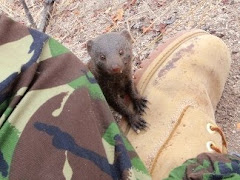
Baby animal: a very dwarf dwarf mongoose.
This is Galadan from Ecthelion.
So why the smell?

Because it's a jungle out there.
Literally.

Since the rains have come, the bush has turned into a lush, verdant tangle, vibrant with birdsong and flitting butterflies. It's the closest thing to Paradise I can imagine. Baby animals of every kind peek wide-eyed from the undergrowth, and the trees and shrubs are scrambling to send their come-hither signals to potential pollinators.
Here are some of their efforts.


The buffalo thorn (Ziziphus mucronata) is popular with the religious: Christ's crown of thorns was woven from a species of Ziziphus, and the local Zulu and Swazi people traditionally believe that the twigs can attract, and carry, the spirit of a deceased person.


The silver raisin bush (Grewia monticola) will be covered in small, orange berries come February. Although dry and current-like, these fruits are scoffed by almost everyone (jackals, baboons, guinea-fowl, vervets, peckish zoologists).


Seasonally appropriate, the sickle bush (Dichrostachys cinerea) is decked out like a Christmas tree.


My first encounter with a sickle bush occurred in Melbourne when I was a mere teenager. I blush to admit that I was filching sprigs of labelled plants from the Botanic Gardens to fraudulently fulfil a Botany assignment on plant identification (oh come on, my abiding passion was Zoology!). Accustomed to the flowers of the ubiquitous Aussie wattles (golden fluff, creamy fluff, yellow fluff... ) I was blown away by this plant. Of course, here in its native land, the sickle bush is considered an invasive weed because it enthusiastically transforms disturbed ground into impenetrable thickets.


The weeping wattle (Peltophorum africanum) is not for the squeamish. It's named after the constant mist of pee which rains down from its foliage. Who does the peeing? Tiny, sap-sucking 'cuckoo-spit' insects (Ptyelus grossus).


With all these plants madly competing for pollinators, it pays to stand out. And the lowveld cluster-leaf certainly does that. This tree isn't content to just lay on copious amounts of nectar. In the evenings it widens its client-base by pumping out perfume: a sickening odour of decay. Unfortunately my front yard is ringed by these trees.


The stinky culprit: the lowveld cluster-leaf (Terminalia pruniodes).


Whom is it hoping to attract?  Hyenas?


Wednesday, December 15, 2010

The plenitude of Mwanzamala

I'm writing this post in celebration of Mwanzamala.

What is it?

It's the Shangaan name for the present month.

Unlike us, the local Shangaan people don't go about commemorating megalomaniacs, obsolete gods or erroneous numbering systems. Traditionally they divvy up their year using a lunar calendar, naming each cycle of the moon after notable natural events.
Wouldn't you love to exchange 'December' for 'first snow' (if you're unlucky enough to live in the Northern Hemisphere)?

Well here, right now, it's Mwanzamala.

Yes, yes, I'll tell you what it means in a moment. First let me share with you an experience I had during Mwanzamala some years ago.
I was diligently working at my laptop (honest) at a picnic area in Kruger National Park (Pretoriuskop camp) when I was distracted (oh no, not easily done) by a movement in the hedge that divided the sprawling lawns. The hedge was about chin-height, very dense and neatly clipped, and some small animal had just popped out of the top, only to immediately disappear again.

There it was again. Furred in soft reddish brown, it sprang up, almost like a jack-in-the-box, before diving back into the foliage. And again! It certainly wasn't a squirrel or a hyrax (dassie) but for the life of me I couldn't make out what it was. I sat staring at the hedge mystified as the creature kept popping in and out. Once I was certain I glimpsed the edge of a long, hare-like ear. And look, a tuft of fuzzy white, like a rabbit's scut.

What was even more strange, was that the creature didn't always appear at the same spot, but was popping out at different places along the top of the hedge. Was it dashing about within the foliage? Or was there a whole colony of the beasts? Could someone at Pretoriuskop be surreptitiously breeding rufous, tree-dwelling rabbits?

Utterly baffled, I crept closer, only to realise that the animal wasn't actually in the hedge at all, but was popping up from behind it. But what on earth was it? I quickly back-tracked along the line of the hedge and - feeling a certain amount of trepidation – tiptoed around the end to see what lurked behind.

Boy did I feel stupid!

On the lawn before me was a crèche of a dozen capering impala fawns. They were playing follow-the-leader: galloping and pronking around the lawn in a large circle, like a roundabout come to life. As the string of fawns raced along beside the hedge, each one gave a prodigious leap, soaring through the air for several meters. It was the noses, ears and tails of these airborne antelope (the only bits to protrude above the top of the hedge) that I'd seen from the far side. Oh the embarrassment!


Photo by Melanie Lukesh.


Adult impalas (Aepyceros melampus) demonstrating the manoeuvre (notice everyone is at least a metre off the ground).
Photo by Martin Heigan.

Experiences such as this are common place during Mwanzamala, the month of 'more impalas'.

In the space of just 2 or 3 weeks, all the impalas in southern Africa (and there's well over a million) give birth to their wobbly-legged lambs. Skittish with huge ears and eyes, the fawns gather in large nursery herds and crèches. The idea is to glut the market; even the most voracious predator can't scoff everyone. But of course they give it their best shot, and everywhere you see predators lying snoozing contentedly with bellies grossly bulging.


Impala mums usually give birth around midday, leaving the newborn concealed in cover for its first couple of days.
Photo by Arno & Louise Meintjes.


Dinner. As well as the usual carnivores, impala lambs are munched by pythons, baboons and martial eagles.
Photo by Arno & Louise Meintjes.


But it's not just the carnivores that revel in Mwanzamala; it's holiday time for everyone.
Zebras, wildebeest and waterbuck all suddenly adopt an insouciant, relaxed manner; you can almost see them laying out their beach towels and slapping on the sunscreen. Predators? Who needs to concern themselves with those indolent, overindulged gluttons?

This year, I've joined the rank and file, and am also relying on the plenitude of Mwanzamala. You see my study site is currently the domicile of a large male lion who's wandered in from Kruger; may he wander off again soon!

Photo by Arno & Louise Meintjes.

Photo by Arno & Louise Meintjes.

Saturday, December 11, 2010

Unplugged


Sorry I haven't posted for so long but I was disempowered.
Literally.
One of my charming, well-furred neighbours unplugged me.


Who me?
Chacma baboon, Papio ursinus. Photo by Arno & Louise Meintjes.

An electricity cable that's been tugged from its socket by mischievous paws should be simple to fix, or so you'd think. Unfortunately, the furry culprit executed this fell deed at the very apex of the power-pole outside my house.

Handymen gathered from far and wide to stand and stare at the pole and shake their heads.
"No way to get up there."
"You need a trained monkey" someone quipped (grrr!).

So I've just had to wait - electricity-free - until a team of electricians could come out from town with their whizz-bang pole-climbing equipment (i.e. a VERY long ladder).

And let me tell you, the wait has not been pretty. I've no idea how people coped before the advent of electricity: thawing pet meat, sour milk, first-degree burns, candle wax dribbled everywhere, singed eyebrows (my camping stove is frighteningly unpredictable) and bruised limbs (from tripping over cats who refuse to believe they're invisible in candle-lit gloom).

Still, I do enjoy having the baboons around, and they're normally well-behaved. We did have a couple of tense weeks when I first moved in. The baboons lounged on the garden fence taunting my madly barking dogs, and every now and again a swaggering adolescent male would leap down and dash across the yard; dogs in frenzied pursuit. I didn't witness the denouement of this saga (thankfully), but I suspect it was painful for both parties: the baboons now stay well clear of the fence and my dogs pointedly ignore them, refusing to chase any baboon, even when we're out walking.

Of course I know baboons can be problematic. The youngsters love to play on roofs for example. On my iron shed roof, they beat out a rackety tattoo as they leap and wrestle, but on my landlord's roof of thatch, they clasp fistfuls of straw as they race up and down the steep pitch, tearing out great tufts of roofing as they go.
Still, others have it worse.


Hmm, I've never driven an automatic before... Photo by Tim Ellis.

The driver of this car pulled over to photograph the view on the scenic drive to Cape Point (the peninsula south of Cape Town). Unfortunately, the car doors weren't locked, and the baboon opened a rear door and hopped in. This photograph was taken after the driver and passenger had fled out the front doors, leaving their car to the baboon.
Related Posts Plugin for WordPress, Blogger...