Sunday, September 23, 2012

Male nannies get the girls

One of the advantages of living above the river is the endless aeronautics display.

Step outside my door and you're treated to fork-tailed drongos fluttering and plunging, little bee-eaters, adorned in cinnamon and gold, effortlessly looping the looping and, way up above, tiny swifts floating like calligraphy bewitched from the page.

But among these master aviators, there’s one creature that surpasses them all.

Dressed like an accountant and encumbered by a massive ice-pick bill, it seems an unlikely candidate for aerial supremacy, but the pied kingfisher is utterly mesmerising.

Zooming along just inches above the water, it suddenly rockets upward 10m (33ft) into the air, and there it stalls. Completely. With its torso held almost vertically and its huge black bill pointing straight down, it hovers motionless; not just for a few moments, but on and on and on.


Pied kingfishers (Ceryle rudis) are the second largest of South Africa’s ten kingfisher species. This one’s double necklace of black reveals that it’s male; females are more demur, sporting only a single band. Photo posted on Flickr by Tarique Sani.

It’s at this point that I start feeling anxious. I know I should be excited at the prospect of the hunt, and I’ve seen other people clutch one another eagerly and cry, “Oh look, it’s about to dive!”
But as the bird just hangs there, flouting gravity, I find myself glancing at the pool below and wondering how anything can plunge at breakneck speed into one foot of water without suffering... er, neck-breaking consequences. As the bird continues to hover (for the next 5 to 10 seconds), pictures drift into my mind: murky underwater images of kingfishers stuck bill-first in the muddy pond floor.

Of course this never happens. Down the bird plummets, plunging below the surface and immediately surging back up - almost at the same speed (how does it do this?) - amid a glittering cowl of water droplets.


Pied kingfishers plunge-dive in waters throughout Africa, India, Myanmar and southern China. While African birds dine exclusively on fish, those living in Asia are less fussy, enjoying side dishes of aquatic insects and crabs.
Photo by Arno Meintjes.

But if the way pied kingfishers acquire lunch is bizarre, it’s nothing to the way they produce more little kingfishers.

Defying all kingfisherly conventions, this bird thumbs its nose wings its beak at the concept of territoriality.
And nuclear families? Well, who needs ‘em?

You see unlike other kingfishers, pieds gather together in busy breeding colonies. Using nothing but beak and claw, they gouge out 2 m (6.6 ft) long nesting tunnels in a communal bank, sometimes crowding their homes to within 0.5 m (1.6 ft) of one another.
And as if this isn’t social enough, loving couples also share their underground hideaways with up to six male nannies!


Born to burrow. The pied kingfisher's second and third toes are partly fused together; this is thought to help them shovel dirt.
Photo posted on Flickr by skuarua.

So how does all this come about?
Well, young pied kingfishers leave the family home normally at about four months of age, but if the guys don’t find themselves a girl (and 95% bomb out), they move back home with Mum and Dad. Now this isn’t as bad as it sounds because they do help out about the house. In fact, they put as much effort into their chores (guarding the chicks from marauding mongooses, monitors and rivals, and ferrying fish to them) as do Mum and Dad. Of course this is sensible (and so isn't the kind of behaviour you expect from young males): if you can’t have kids of your own, at least you can give your genes a push-start by helping your little brothers and sisters.

However, in some pied kingfisher colonies, pairs also take on unrelated childcare workers.

But why do these males want to hand over good fish to strangers?
And if there’s free help available, why don’t all colonies take advantage of it?
To get to the bottom of this fishy behaviour (sorry), Uli Reyer undertook a long-term study in Kenya, comparing kingfishers that lived on the windy shores of Lake Victoria (where non-related home-help is all the go) with those dwelling at flamingo-rimmed Lake Naivasha (where it’s unheard of).

He found that if you’re a pied kingfisher, Lake Naivasha is the place to be. Here the birds live a cushy life, feasting on plump native cichlids. Even without any help, pairs are able to successfully rear four healthy chicks.
But things are very different at Lake Victoria. The kingfishers here dine on slim, deep-water sardines which only come up to the surface at dawn and dusk. The birds must fly long distances over open water to reach their feeding ground water and the wind-whipped ripples reduce visibility. Only 24% of the birds’ dives snare a fish (compared with 79% at Naivasha), and pairs working alone can raise only 1.9 chicks. Half their hatchlings simply starve to death. So Lake Victoria kingfishers needed all the help they can get.


A juvenile pied kingfisher (and groups normally rear four) gulps down 35 g (1.2 oz) of fish daily and is fed for at least six weeks. But the fish the kingfishers catch average only 1-2 g (0.04-0.07 oz). Even without a calculator, that’s an awful lot of work!
Photo posted on Flickr by Lip Kee.

Just to make certain that it was the need to put food on the table that led to the recruitment of helpers, the researchers sneakily increased the workload of Lake Navaisha pairs by doubling their clutch to 8 to 10 chicks. Sure enough, these beleaguered parents happily accepted non-related nannies into their homes, even though this was not the done thing in their neighbourhood. In contrast, when families at Lake Victoria were reduced to just one or two chicks, the unburdened parents steadfastly rejected the approaches of potential helpers.

But all this doesn’t explain why unrelated males want to help.
If they don’t have younger siblings to care for, why don’t they just loaf about, marshalling their resources so they’re super sleek and sexy for the next breeding season?

Well Reyer discovered that 91% of these unrelated, live-in childcare workers landed themselves a girl the following year (compared with only 60% of the stay-at-home sons and 33% of the loafers).
What was their secret?
Well, almost half of these successful Lotharios teamed up with the female they’d helped the previous year!
You see fathering baby kingfishers really takes it out of you, and only about half of dads survive to breed the following year. And when hubby passes on, who’s right there, offering a consoling fish to the grieving widow? The live-in help, of course.

Unlike sons stuck at home (whose testes don’t even bother to produce sperm), unrelated helpers are all primed up for sex. This explains why Dad only accepts them into his family after his chicks hatch out and there's no chance of a bit of hanky-panky with Mum.
Photo by Andy Li. 


In fact, it looks as if the pied kingfishers’ unique nesting colonies actually serve as old time hiring fairs. Here, amid all the hustle and bustle, youths seeking childcare work can check out prospective families and advertise their availability (by presenting Dad with a gift of fish), and overworked parents can pick and choose whom they’d like to have help with the kids.


Looking smug? Traditionally kingfishers are associated with good luck. Photo by Martin Heigan.


Monday, September 10, 2012

Flipping uncertainties

Yesterday was International Rock Flipping Day.

No, it wasn’t a day of wild celebration for stone-skimming enthusiasts, nor a day of reckoning for designers of rockeries.

On this auspicious day stout-hearted folk from around the globe head out into the wilds to turn over boulders and see what weird and wonderful critters are loitering underneath.

Now each time the event rolls around I’m faced with a quandary. I like the idea of all this collective rock-flipping but quail at the prospect of actually shoving my fingers into the murky haunts of venom-toting beasts.
OK, you may think I’m being overcautious, but the rocks around here harbour 3m (9.5 ft) long black mambas, bad-tempered puff adders and at least two species of cobra (one of whom spits venom with llama-like gusto). It’s a constant fight to keep these creatures out of my home without voluntarily invading theirs!

In the past I’ve deviously circumvented this dilemma (see here and here), but this year my ingenuity failed me and I decided to give Rock Flipping Day a miss. So averting my eyes from all rocks, and trying to ignore the skinks and flat lizards skittering about on every outcrop, I set off to find my mongooses. After one and half hours trudging through the heat, scouring the length and breadth of Koppiekats’ range, I finally found the group sprawled in the shade right beside my car.

And they were lying under rocks.
Hmm...

Although I only had my old point-and-shoot camera with me, I dutifully lay in the dirt on my stomach and tried to take some (bad) under-rock photos.


Whatta you lookin at?

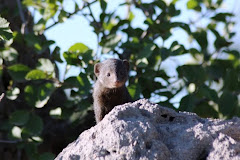
What dwarf mongooses (Helogale parvula) do under rocks.

'There are older and fouler things than orcs in the deep places of the world.'

Rock crevices are ever popular when jackals, honey badgers or dogs pay a call.

OK, I admit I didn’t flip anything. But I also didn’t die a slow and painful death by envenomation.
And I defy anyone to find something cuter under a rock.

To discover what the world's other (genuine) rock-flippers found beneath their rocks, check out Wanderin' Weeta blog.


Saturday, August 25, 2012

Homesickness

The ornament of a house is the friends who frequent it.
                                                 Society & Solitude.
                                                   Emerson. 1870.


I’m missing my ornaments!

Oh for the pitter-patter of little gerbil feet; the sonorous yap of geckos brawling over my mealworms; the reproachful glower of an almost-stepped-upon toad!

Where have all my wild friends gone, you’re wondering?
Taken to the hills in a spine-tingling, pre-tsunami exodus? Marched off by the porcupines to mount a decisive strike on Hoedspruit? Driven away by my heinous BO?

No (well I can’t be totally sure about the BO).
The disappearance is not of the wildlife, but of me!

You see I had to MOVE OUT of my lovely house.
Alright, maybe the house itself wasn’t exactly lovely (rather more of a dilapidated garden shed really). But the location – on the pilgrim-route for a billion thirsty beasts – was wonderful.
This, of course, explains why my landlord wants to demolish the place (gasp!) and replace it with a spiffy upmarket unit.


My dear old ISOLATED hovel. Photo by Amy Hill.

But after four years cohabiting with birds and beasts of every kind, I’ve built up many special relationships. I miss the vervet monkeys peering in the windows, the waterbucks napping in the garden and the baby baboons enjoying roof-top gumboot races.

I thought CSI was on on Tuesdays...


A paisley shirt with a striped pull-over? Oh come on.
Photo by Amy Hill.


Home alone. Once they munch their way through the two-week supply of apples and sweet potatoes I hid under the stove (oh yes, I’m the tenant from Hell), my bushveld gerbils will be back on bush tucker.

Now considering that I’ve only moved 1 km/0.6 miles away (as the crocodile paddles), and I’m still malingering by the Oliphants River, you might think I’m being melodramatic.

But I’m now on the OTHER SIDE.

No, no, I don’t mean dead (well not literally anyway). I’m referring to the dark side: the FAR bank of the river.
You see this is the posh side.
This is the side of resorts and lodges, manicured lawns and private airstrips (so you can pop in for Sunday brunch). Behind every shrub lurks a gardener toting nail-scissors, and brightly-garbed cleaning ladies bellow the latest gossip up and down the road. There’s even an occasional passing car!

For a deeply committed recluse, with years of anchoritic experience, this is a nightmare!

Here I’m met with aghast stares if I fail to change into non-holey clothes or brush my hair before walking my dogs, and I have to hide my rubbish bin so the local garbage wallah wont sniff it out (metaphorically speaking, I’m sure) and whisk it off to be emptied (hey, they charge for this service!).

How - you might ask - have I sunken to such depths?

Well after months begging and cajoling every landowner within a 15 km radius of my study site, and struggling vainly to portray my blood-thirsty hounds as innocuous and loveable tenants, I finally stumbled upon a place that would allow dogs.

But if I was dwelling in a semi-derelict house before, I’m now living in a total ruin.


My new home as viewed from the road (derelict car included for additional authenticity).

Burnt to the ground after being zapped by lightning, the house is a mere husk of its former self, but the owners have built a small bedsit underneath the ruin. Unfortunately, since this little concrete bunker is tucked below the old house, it’s perilously close to the river. In fact, based on water levels over the last 7 years, I figure I’ve got a 50% chance of surviving summer uninundated.


My hobbit-hole viewed from the wild side (of the river). The creamy bit is my bedsit with the burnt-out ruin above.
Lightning never strikes in the same place twice, right...
Photo by Amy Hill.

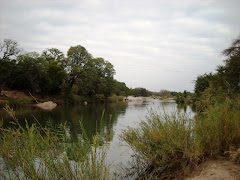
Now before you start feeling too much sympathy, let me mention that I do have an utterly breathtaking view of the river.

Oh and I’m not totally bereft of all my house ornaments.
Two of my old friends inadvertently accompanied me on my trans-river crossing, stowed away discretely in their hidey-hole behind the fridge. Already obscenely fat, these two are now enjoying uncontested mealworm rights and have become morbidly obese. Fortunately Wobbly Cat executed emergency liposuction (or something similar) and the two, no longer encumbered by their grossly bloated tails, are now acting like ‘new geckos’. I should probably sell their 'before and after' photos to a weight-loss program.


I actually prefer to think of myself as chubby. Turner’s geckos (Pachydactylus turnerii) are highly prone to self deception.


The view downriver from my patio. (Yes, I know the fence posts aren’t straight but I was cradle-cursed to transform into Mr Bean at the merest whiff of DIY.)

The view upriver. The strip of tiny pinky-grey slugs (near the centre of the photo) are sunbathing hippos.


Perhaps the worst aspect of living over here is that the food scraps I toss out on the compost heap just sit there... and, well, turn into compost!
I did wonder about floating little food parcels across the water, and I’ve been watching for surreptitious raft-building activities by the wildlife on the far bank, but so far there’s been nothing. I hope they’re all doing OK.


NEWS FLASH: My first ‘posh-side’ porcupine (a weedy, undernourished creature) showed up at my compost heap last night. Of course, Magic immediately scrambled over my homespun fence and chased it off, but tomorrow’s a new day night...

Sunday, July 29, 2012

A prickly situation

I am besieged.
Outside my door is a gang of heavily armed assailants. They’re stamping their feet, rattling their weapons and chanting war songs.
Five are picketed outside the window, but I know they’ve reinforcements waiting in the shrubbery.

They’ve come for provender, and they won’t go until they get some.

Alright, I admit it, they’re only rodents.
But they’re SERIOUSLY scary rodents.

You can forget all that tremulous, big-eyed, be-whiskered stuff.
There aint no wee cowrin, tim’rous beasties here.
The creatures patrolling my garden weigh in at 12-18 kgs (26-40 lbs) and stand waist-high when agitated.
Their endlessly-growing incisors are the very least of my concerns.


What I face nightly when I venture out my door.
The troops at my compost heap, noshing on their ill-gotten gains.

Disconcertingly, Cape porcupines (Hystrix australis) hang out in mobs. Big mobs.
You see, like many African beasts, they’ve gone cooperative.
Mum and Dad are so profoundly dedicated to one another that their progeny can’t bear to leave the family home, and they stay on, year after year, with everyone pitching in to help rear their little brothers or sisters. Now you might consider this laudable (and I’m the first to applaud it in darling mongooses), but something’s gone horribly awry in porcupine society.


Cape porcupines are a romantic lot. Couples are sexually active all year round even though Mrs Porcupine can only conceive for 2-3 days annually (and she won’t even do that unless she’s enjoyed the attentions of her spouse for at least 3 months). Her hubby’s penis (which sports small prickles!) is equipped with a baculum (shovel-shaped bone) and a backward-facing opening (no, I don’t know why). And despite the couple’s devotion, he doesn't take risks: his semen quickly sets into a jelly plug: a chastity-belt porcupine-style.

You see the beneficiary of all this praiseworthy cooperation is just one solitary little porcupette (yes, that is the official name for a baby porcupine). Cape porcupine groups (comprised of up to 12 adults) normally rear only one porcupette annually (average litter size is 1.5), so I guess it’s not surprising that the family’s ‘baby’ is as spoiled, precocious and demanding as only an only child can be.

This one-week-old porcupette raises Hell at Basil Zoo in Switzerland.
Photo borrowed from the ever-beguiling Zooborns blog (click here to see more porcupettes of various species).


More gratuitous cuteness.
Photo borrowed from here (copyright conditions unknown, but just too irresistable not to include).

So when I venture outside at night, clutching the household scraps to my chest and stumbling toward the compost heap, I blame the porcupines’ social system for what happens next.
Out of nowhere an almost full-grown porcupette comes hurtling; galloping straight at me with head lowered and quills erect in a rattling dazzle of spikes. There’s something quite unnerving about being charged by a porcupine; it’s reminiscent of the fabled avenging aardvarks, only with more spiky bits.

While the adults will peaceably trundle along beside me to the compost heap, their quills lowered companionably along their backs, Junior – bristling like a giant sea urchin - repeatedly sidles up to my legs or races in front of me to lunge backwards, weaponry aimed mercilessly at my shins. At first I thought that all this belligerent sashaying was due to nervousness. But no, I’ve realised that tantrum-throwing is how charming little porcupettes scrounge victuals from their betters.
Tooth-gnashing, foot-stamping, hip-slamming, twirling and quill-clashing all seem to be an integral part of persuading big bro to relinquish his supper. To Junior, I’m just another member of the clan.


A standoff between me and the porcupette. I’ve now become a proficient porcupine mutterer (like a whisperer only with more expletives). Photo by Amy Hill.
 
African porcupines (unlike their Yankee cousins) are earth-bound creatures, retreating by day down massive, multi-roomed burrows. Cape porcupine (Hystrix africaeaustralis) groups normally have 1 to 3 of these palatial bunkers within their 100-300 ha (250-740 acre) territory.

 
Is that an apple I see before me?
When not scoffing household refuse, Cape porcupines dine on bulbs, roots, fruit, tree bark and carrion. A leash-walking study (!) revealed that they mark important feeding sites with scent.


I’d just resigned myself to this nightly trauma, when things got appreciably worse.
You see the porcupines aren’t the only critters snooping around my compost heap.


African civets (Civettictus civetta) – my all time favourite beasts – are also very partial to leftovers.

Now, as in the classic scenario of birds and worms, the early scavenger gets the yummiest scraps, and this has led to an escalating race between the civets and porcupines. Who can arrive first? As a consequence (and much to my dismay), the porcupette now comes trundling in a full half-hour before sunset, whiling away his/her time by patrolling the garden and violently molesting anyone (dog, cat or human) unwise enough to venture out.
I’m wondering whether I shouldn’t start trading in ‘guard porcupines’.


An anxious competitor in the apple-eating race.
Photo by Amy Hill.

Desperate to escape the attentions of impatient, marauding porcupettes, I decided to try offering a distraction.
Porcupines, you see, have an unusual fondness for bone-gnawing (presumably quill-growing is a mineral hungry business) and they gather up any bones they find lying about, stockpiling them at their burrows. This bone-stashing tendency has proven a boon for researchers studying bygone eras. Unlike nasty old carnivores (whose bone caches are biased toward the yummiest or most easily captured prey), porcupines are completely non-discriminatory bone-collectors. Their hoards accurately reflect what’s living (or dying) out there, so their fossilised caches (recognisable by the extensive gnawing) reveal the abundance of different species, providing information about habitat and climate.

With a feckless disregard for the palaeobiologists of the future, I tossed all my dogs’ old, gnawed, beef bones over the fence. Would this keep the porcupette occupied? To some degree the experiment’s been successful (atrocious grinding/gnawing sounds now accompany all the foot-stamping and quill-rattling outside my door), but it’s also brought its own problems.
Spotted hyenas.
Yes, that’s right, I’m now responsible for the colonisation of my garden by hyenas.
Up until now, I’ve only ever heard these guys whooping in the distance, or seen the occasional paw print after they’ve padded through. But it appears they’ve now moved right in.

OK, I know that many of you out there are shaking your heads sagaciously and thinking,
‘This is what comes of feeding wild animals...”
And of course you’re right.

But it’s mighty cool to have hyenas in your garden.

Except perhaps when they whoop right outside your front door (heart-stoppingly, chest-thrummingly LOUD).
 
I just hope they don’t eat the civets or the porcupines.
Or, um... me.


Did someone mention ‘bones’?
I admit that I took this in Kruger. The locals are far too fleet-of-foot for my blundering photographic skills.
 

NB: I wrote this post about six weeks ago but didn’t get around to posting it (sorry). I’m telling you this, not because I want to draw attention to my ineptitude, but because my circumstances have changed, and I’m now suffering SERIOUS porcupine/civet withdrawal. Oh the misery...


Monday, April 23, 2012

Lust to dust

Shall two knights never tilt for me
And let their blood be spilt for me?
Where are the simple joys of maidenhood?

                                      The simple joys of maidenhood,
                                                                         Camelot.


OK, I admit that I’m too old to indulge in these girlish yearnings but, somewhere out there, a fetching young antelope must be clapping her hooves together in maidenly glee.

Why?
Well to answer that question I have to go back a month or so (oh, how I procrastinate blog posts).

I was tootling along to my study site, oblivious to the world (you know how it is driving to work), when suddenly I was dragged from my reverie by a horrible stench. Slamming on the brakes and reversing back, I discovered a mob of 40 white-backed vultures milling about on the roadside. Jostled together in a dense clump, the massive birds strutted back and forth, making snake-necked lunges at one another and uttering threatening hiss-growls (the cries of excited orcs).

At first I couldn’t see what they were all quarrelling over.
Then I glimpsed a massive grey rump.
Oh no! Another poached rhino!
(Now that’s a blog post I’m SERIOUSLY procrastinating about).
But then one of the birds leapt into the air – to hurtle with outstretched talons at its rival - and I got a proper glimpse of the carcass.
No, not a rhino.
The huge grey body was, in fact, the last mortal remains of an eland bull. Embarrassingly, the carcass looked at least two days old. Had I really sailed on past twice already?

White-backed vultures (Gyps africanus) squabbling over their breakfast of eland venison.


The dearly departed eland. I didn’t snap this photo until the following day, after the vultures had made tracks (literally and metaphorically); if they see a person at a carcass they won’t come back (legacy of centuries of poisoning).


Now elands go to a lot of trouble to prevent this sort of thing from happening.


Being thick-skinned (15 mm/0.6” on the neck)
and well-armed (those horns are 65cm/26” long)
didn’t save this Romeo from death by stabbing
(or should that be Mercutio?).
Tipping the scales at around 600 kg (1320 lbs), they’re too big to feature on the wish-lists of Africa’s many carnivores; in fact, as the world’s largest antelope, they flee from no one but man. So how did this one go astray?

If you hold your nose (figuratively) and take a closer look, you’ll detect the cause of death. Yep, a stab wound to the throat (he’s got another – presumably non-fatal - to his shoulder; enlarged, in the first photo, by peckish vultures).
This lad died for love.

Unlike most male antelopes, who bicker over their real estate holdings, elands are a romantic lot. They fight only for the attentions of a lady love. Although they swagger about in massive, mixed-sex herds (sometimes 500 beasts or more), the bulls maintain a stringent pecking order, and only the biggest and best chats up the girls. I’ve written before about the devious ways they figure out who trumps whom (without having to go head to head); heck, they don’t even have to lay eyes on one another!

But when two adversaries are perfectly matched, well, what can you do?
Maybe they’d had a bit much to drink, or some young buck had been getting up their noses, but whatever the reason, our very ex-eland and his nemesis came to blows.

Now fights between eland bulls are a rarity. This may be because - when things start heating up - elands resort to flaunting their hairdos. Like rockers slicking on the Brylcream or punks gelling up their mohawks, rival eland bulls smear their woolly quiffs with their own pungent cologne. Peeing ostentatiously, an agitated bull will then step backward and press the locks on his forehead and nose into the dampened earth. Rubbing gets so spirited, he’ll often pivot round and round in a circle, lifting his hind quarters right up off the ground. To complete the effect, he’ll add some pretentious headgear (a cool eland is an accessorized eland), violently thrashing with his horns at aromatic shrubs or weeds until he prizes out a pungent headdress of tattered leaves. Maybe a crown of thorns, or a beehive of grass, will give him that competitive edge.


An eland bull (Tragelaphus oryx) in slightly better health; note the luxuriant quiff. Like bull elephants, male elands go through periods of musth (called ukali) when their machismo (and testosterone levels) soar. Photo by Carol Foil.

But if a bull’s coiffure fails to intimidate his rival, it’s all out war. Clashes are brief and violent. The prize-fighters charge one another from 1 or 2 m/yards, ramming skulls and entangling horns. Using their massive neck muscles, they push and wrestle, striving viciously to lift and overbalance their opponent.
Now before some innocent reader comments, ‘Oh how exciting, seeing elands fight’, let me come clean. I haven’t. This is all hearsay. But don’t imagine it’s for want of trying. The problem is, elands are ridiculously shy of humans; they turn tail and flee at a distance of 300-500 m/yards.
Of course we humans only have ourselves to blame. Transform an animal into a deity and what can you expect?
You see elands feature big in San bushman mythology. San lads must skewer an eland to attain manhood, young girls are ushered into womanhood with an eland mating dance, and eland fat is both the drug of choice for shamanic trances and the favoured currency for procuring a bride. Now, this is all very flattering for your average eland, but not at all conducive to harmonious eland/human relations.


This bull’s from East Africa (southern African elands outgrow their stripes). He can go indefinitely without knocking back a drink, letting his temperature soar 7C (13F) on hot days, to save 5 litres/1.3 gallons of sweat (according to the best calculations of scientists). Photo by Carol Foil.


What’s worse, elands taste yummy. Even die-hard pastoralists - such as the Masai - who eschew dining on game, happily feast on eland. The beef-like qualities of this species didn’t escape European notice either. The 19thC English anatomist Sir Richard Owen (who coined the name dinosaur) was so delighted with eland steak he wanted the species introduced to the UK. In a letter to the Times in the 1860s he wrote, “...we might one day see troops of elands gracefully galloping over our green swards’’.

But attempts to domesticate elands (such as that at the Askania Nova reserve in the Ukraine) have met with limited success, not least because the beasts happily hurdle 3 m (10 ft) fences from a standing start. And despite their ox-like appearance, elands steadfastly refuse to hybridize with cattle (although crosses with their closest rellies - kudus, bushbucks, nyalas - have yielded a few perplexed calves).

Ahh, no wonder eland maidens are so smitten by their handsome knights.


Lady elands lack the males’ quadruple chin and bouffant hairdo. They also sport longer, thinner horns; perfect for lion-skewering. Mums team up to defend their sprogs from heartless felines.
 Photo by Lip Kee.


Friday, April 20, 2012

Not so Good Friday

BRRRR... BRRRRR... BRRRRRRRRR!!
This was the sound of my wheels spinning.

It was fast approaching midnight, and I was lying on my stomach on
a precipice struggling to manipulate a tyre jack into an impossible position.
I’d been at it for more than three hours and I was on the edge of despair.

How did this happen?
Well to explain, I need to wind back a bit.

“No... I don't smell bacon.”
Good Friday started out strangely. I guess one should expect this of a religious holiday.

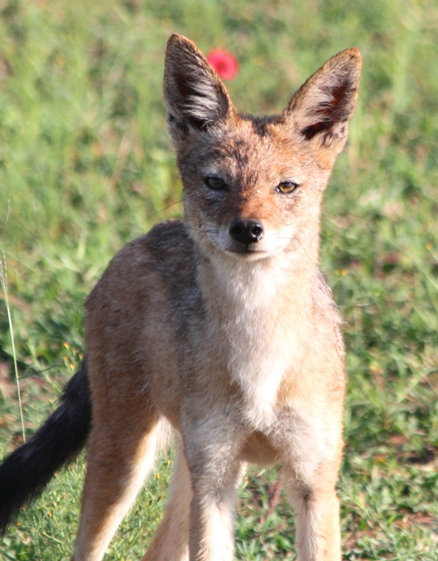
Driving to my study site I’d met two black-backed jackals accompanied by a small warthog piglet (the lion lies down with the lamb?). All members of the threesome seemed remarkably relaxed, so I guess the piglet was too big to eat. Presumably she’d misplaced her sounder and wanted for company.
Still, two big jackals, one small piglet...

Now, perhaps unwisely, I didn’t perceive this transposition from the Lion King as an omen of ill luck, so I wasn’t prepared for what was to happen that afternoon.
Since it was a holiday, I decided to walk my dogs at the local mine where mica is gouged from a 300 ha (740 acre) patch of jungle. Of course under the tangle of lush greenery lurks a century’s worth of mine shafts, tailing dumps and sharp, rusty implements. Oh yes, and the place is also peppered with brand new snares (the handiwork of peckish miners).
But, in a realm of game farms and private reserves, it’s the only place my dogs can romp off-leash without incurring major collateral damage.

 
Situated on an outcrop of ancient rock (4 billion years old), the local mica mine enjoys lots of thunderstorms and a spiffy view.


If – like me - you thought mica consists of glinting flecks in river sand, think again. Here it loiters in massive chunks made up of many layered sheets, rather like an overflowing in-tray.


Mica is the secret ingredient in metallic paints, glittery make-up and soaps that ‘leave your skin sparkling’ (for wannabe vampires?).


Leaves of mica are transparent,
and the chunks sop up water
to become black and rubbery.
Half way along our walk I noticed that Magic had disappeared.
But this was nothing unusual.
She’s compulsive obsessive about hunting, racing off into the bush after the merest whiff of antelope or blissfully engrossed for hours trying to excavate some hapless creature from the rocks.

When Wizard and I returned to the car, Magic wasn’t there to meet us (as she usually is). So we sat down to wait.
And wait...
And wait...
My irritation rose to fury and then gradually metamorphosed into alarm.
By nightfall I was imagining the worst: Magic choking in a wire noose or lying crumpled at the foot of a mine shaft.


My dogs (Magic and Wizard) gallivanting at the local mine.
 

The mine's resident baboons keep a wary eye on anything that gallivants.
 
As a massive full moon rose, transforming the bush to silver, Wizard and I set out to search. Without a torch and wearing shorts and sandals, I was ill-equipped for bush-bashing; thank Heavens for the moon!
Now ever since I foolishly calculated (in a moment of middle-aged angst) how many full-moons I’m likely to live to enjoy, I’ve greeted the waxing of the moon with a certain anxiety.
Time is precious!
I should be out there doing something to appreciate the spectacle.
But this was not what I’d had in mind.

To the accompaniment of roaring lions (the mine nestles on the border of the Greater Kruger Park), Wizard and I scrambled through the thorny undergrowth, stumbling over boulders and peering blindly into plant-choked mine shafts. I tried not to contemplate the many nocturnal biting beasts (cobras, puff adders, boomslangs) and struggled valiantly against the hopelessness that engulfed me each time a passing cloud plunged us into darkness.

After a couple of futile hours - calling and straining to hear a muffled whimper - I decided to give driving a try. But it was while negotiating the rough, overgrown tracks that I became ensnared.

Without warning my car suddenly lurched sideways and the rear wheels began to spin. Leaping out, I discovered that I’d driven into a large sinkhole (where the track passed over some old mine workings that had been covered with gravel and dirt). Beneath the deceptive covering of grass, the sunken earth - broken by huge cracks - fell away abruptly to my left, where rocks and pebbles were still merrily cascading down into a half-filled mine shaft. It was over this shaft that my left front wheel was dangling.
Oh f#*@!!
Of course - at Easter - the mine was deserted.
I was going to have to get myself out.

Over and over, I jacked up my car and heaved and shoved boulders beneath the front wheel. Unfortunately, this involved crawling about on the very edge of the crumbling mine shaft; each insecure foothold creating a landslide of gravel. Time and again I tried moving the car. No go. So then I painstakingly did the same with the rear wheels (to give them more traction). But all the while the ground around us was continuing to subside, and my car was listing further and further to the left. I envisioned it slip-sliding down into the maw of the tunnel until only its rear bumper stuck out, like in those improbable car insurance ads. Meanwhile, Wizard just lay on my bakkie/ute/truck's bench seat; head on paws, softly whimpering as if his world had come to an end.

By midnight I finally concluded that I’d never get out alone; I needed to be towed.

And that meant waiting for morning. Either I could sleep (??) the night on a small seat with a large husky, or I could hike 12 km/7.5 miles home (mostly along the main road which – in South Africa – is not a safe venue for a solitary, midnight stroll).
Of course there was another option.
One I’d been steadfastly refusing to consider for the last three hours.

Up until now I’d been trying to reverse my vehicle out of the sinkhole; but I could try driving forward.
Yes, this did mean going further down into the depression and would almost inevitably result in the vehicle sliding left, down into the actual mine shaft.
But if I could just keep the rear wheel on the disintegrating edge of the shaft, there was a flicker of a chance I’d gain enough momentum to scale the far side of the sinkhole.
And heck, I was going to have to be towed out anyway...
One might as well be hanged for a sheep as a lamb, right?

Ordering Wizard out of the car (so we both didn’t end up underground), I put the car in gear. Slamming on the accelerator, the car lurched forward. With a whomp and a judder and a loud susurration (as large quantities of earth and stones poured own the mine shaft) we managed to crawl to the far edge of the sink hole.
Oh my God!
We were OUT.

Now trembling from head to foot, I couldn’t face resuming the search for Magic.
Wherever she was – dead or alive – she was going to have to wait until morning.

Driving back along the rough, broken tracks, through the on-again, off-again moonlight, we met Magic at the mine’s front gate.
She was standing in the middle of the road, wagging furiously.
I’ve no idea where she’d been or what she’d been doing.

But all’s well that ends well, I guess...
Hmm...


Magic: the source of my woes.

Related Posts Plugin for WordPress, Blogger...