Showing posts with label Phacochoerus aethiopicus. Show all posts

Saturday, July 2, 2011

Ware warthogs!

Photo by Arno Meintjes.


I’m writing this post for people, like myself, who felt irritated when the Lion King portrayed Pumbaa (the insouciant warthog) as living on bugs ('slimy... yet satisfying').

Alright, it was probably only me, but warthogs are grazers for Heaven’s sake!

Of the 16 pig species trotting about the world today, the warthog is the most deeply committed vegetarian.
And its veggie of choice is grass.

Look inside a warthog’s mouth and (if you can avoid losing a finger) you’ll discover a highly sophisticated grass processing plant. The incisors are designed for nipping shoots from closely cropped lawn, and behind the seriously off-putting canines (i.e. the tusks), the entire tooth row is given over to one mighty mother of a molar.
Young warthogs shed their normal piggy assemblage of premolars and molars so their third molar can grow to immense proportions. This behemoth, which is open-rooted and grows continuously, is designed to combat the gritty rasp of silica-rich grass. Even a warthog’s jaw hinges differently to that of other family members, allowing its chops to work up a good sideways swing for grass grinding.

Of course you may be wondering how such a specialised grass-muncher copes with the dry season when all the grass has withered away? Well hungry warthogs switch to rooting up the grass’s underground rhizomes and bulbs.

Now don’t get me wrong, although warthogs are connoisseurs of pasture they’ll also munch fruit and berries. But they have surprisingly conservative tastes; even when starving, they turn their snouts up at veggie scraps, apple peelings and bread (I’ll tell you about that fiasco some other time).


A warthog (Phacochoerus africanus) relishing a meal of marulas.
Photo by Brian Gratwicke.

But warthogs haven’t totally forgotten their omnivorous ancestry. This was brought home to me as I watched a large female warthog marching along a road in Kruger National Park. Up ahead, lying in the centre of the tarmac, was a road-killed squirrel.
‘Oh this will be interesting,’ I thought niavely, ‘I wonder if she’ll react?’
I imagined her pausing to give the little body a cursory sniff.

I was wrong.

As the warthog approached the body, she quickened her pace. And then, when she was still a meter away, she leapt. Yes, that’s right, leapt. It was a lightning fast strike and I gazed open-mouthed as she snatched up the dead squirrel and beat it viciously against the tarmac. I could hear the thwack, thwack, thwack from the car.
Moving at a frenzy, she hurled the squirrel high into the air and as it hit the ground she lunged forward and trampled on it, over and over, with her front trotters. It was like someone treading grapes, only ten times the speed. She repeated these manoeuvres like a creature possessed for some minutes and then, pinning the body with her front hoof, began tearing it apart.

I have to admit I was stunned. So much for darling little warthogs!


Cannibalism? No, a bit of hakuna matata; they’re grooming.
Photo by Arno & Louise Meintjes.


I was reminded of this illusion-shattering incident as I drove home from the mongooses earlier this week.
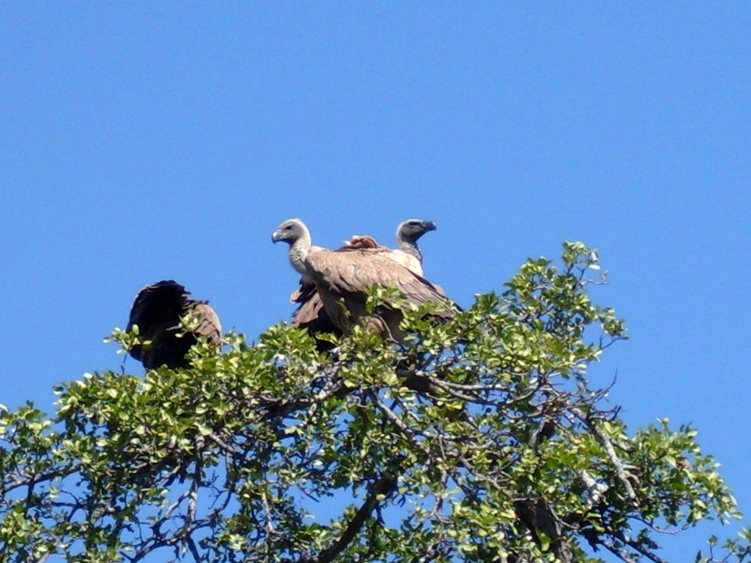
Now, I should explain that my landlord often sups on impala at his weekend braai (barbeque), and he tosses the less edible bits out for the delectation of the local vultures. So it’s not unusual for me to find myself engulfed in a flapping cloud of monstrous birds as I pass by on a Monday.

But this week the vultures weren’t enjoying their usual feast; they were all sitting waiting disconsolately in the trees.
Huh?
Was a leopard keeping them off?
A lion...?

As I got nearer I saw that a warthog family was gathered at the carcass. This sounder (comprised of two big mums and nine piglets) is one of my favourites because the little hogs are always gambolling and jousting with one another or trotting along decorously - tails raised - in single file. But this week I was a little dismayed to see them tucking in enthusiastically at the bloody remains of the impala's ribcage. Each charming little piglet - its face spattered with gore - was tugging with great vigour on the end of a rib!

With my usual aplomb as a wildlife photographer, I failed to capture the moment (although you can see a camera-trap image of warthogs munching carrion here, if you need proof of this perfidy), and the best I can offer you are ‘after shots’.

The culprits fleeing the scene of the crime.


Pissed-off vultures (white-backed) waiting for the swine to relinquish their lunch.

So next time you’re watching the Lion King, be thankful that grass-eating Pumbaa is dining on nothing worse than bugs!

Monday, February 7, 2011

Wee weird warthogs

Warthogs (Phacochoerus africanus).
Photo by Arno & Louise Meintjes.


I'm sorry I haven't posted recently; I've been going through a bit of a stressful patch.

However, outside in my front garden, there's a family that's clearly not stressed.
You could be forgiven for thinking they're feeling pious, because the two adults are down on their knees.

But they aren't facing Mecca.

Yes, you guessed it, they're warthogs.
Now I realise that you know all about warthogs. They trot past as non-speaking extras in every African wildlife documentary ever made.
Warthogs are passé.

But believe me, warthogs are weird. Pigs that live down burrows? Rabbits, wombats, prairie dogs – these are the critters that pop up out of holes. But pigs? And when tooth-and-claw threatens, warthogs don't just hurtle headlong down their holes like any self-respecting burrow-dweller. No, they skid to a halt at the tunnel mouth, whirl around (as much as anything pig-shaped can whirl) and reverse down backwards – now that's just perverse.  

When your the only pig bizarre enough to specialise in grazing, why not go the whole hog and gad about on your knees. This is said to give more leverage for snouting up grass roots, but I reckon they're trying to garner sympathy by looking obsequious. And it's premeditated: their gnarly knee calluses are present in the womb.
Photo by Brian Gratwicke.


But the reason I've been lured into writing about my common-or-garden warthogs is because, over the last couple of weeks, there's suddenly a whole lot more of them. Out in my garden - along with Mum and Aunt Mabel - are five little hoglets, currently leaping, spinning in the air and madly snout-jousting with one another. I've never figured out why warthog piglets are so appealing. I mean they're semi-bald and always look so... well, earnest. I guess it's partly because they're so tiny next to Mum (only 1% of her weight at birth), and they trot along in single file, tails stuck up and Mohican hairdos billowing in the breeze.

I first noticed something untoward in the world of hogs about two months ago. I pass several families (called sounders) on my way to the mongooses each day and, back then, all the mums suddenly disappeared. This set me in a panic because, around here, warthogs are popular guests at Saturday night's braai/barbie. But once I'd seen that last year's youngsters were pottering about normally, despite the lack of maternal care, I regained my composure and realised what was happening. You see when a mother-to-be's happy day arrives, she deserts her teenaged kids and retreats down a burrow. Here she'll stay, tending her tiny newborns, for at least a week. Even after she emerges, she'll still go hungry for several weeks, guarding her burrow-bound piglets and suckling them at 40 minute intervals.


Who wouldn't stay underground, if they looked like this? Warthog piglets don't leave their hole until 6-7 weeks old.
Photo by Martin Heigan.

Mother warthogs defend their piglets. That doesn't sound scary, does it. But then it fails to evoke the piglets' blood-curdling squeals, the dreadful roaring bellows and grunts of a charging sow or the hysterical yelping of an injured dog.

Maybe I need to go back a step. The summer before last I was letting my two huskies gallivant in the bush at the local mine when they flushed a young warthog. The little fellow took one look at the dogs and began hollering for Mum. His piercing 'I'm-being-torn-apart' screams were so shocking that Wizard and I stood transfixed, but Magic took off after the critter. Suddenly a large grey shape erupted from the bushes. Roaring and growling, Mother Warthog hurtled straight toward Wizard. I couldn't see what was happening because of the undergrowth but my heart contracted as a volley of dreadful yelping arose. Warthogs have a penchant for disembowelling dogs; their upper tusks can reach 60 cm (23") in length and the lower ones are razor-edged (honed by the upper tusks whenever the warthog chews).

Looking mean. The piglet's white cheek fur is thought to give an illusion of tusks (technically they're called tushes, not tusks, because they're canine teeth not incisors).
Photo posted on Flickr by Piglicker.

Straining to catch sight of Wizard, who - still yelping pitifully – was fleeing through the undergrowth, I suddenly realised that Mum was now charging straight at me. This didn't alarm me at first because warthogs often appear to be attacking you when they're actually just fleeing to a burrow behind you. I'd been fooled before. I was much more worried about Wizard. But as the massive creature hurtled down the hill toward me (mother warthogs weigh in at around 65 kg/143 lbs), I began to think, 'Surely she's not going to attack me too?' I'd never heard of warthogs disembowelling people. As she got closer and closer, I wondered, in a panicky sort of way, whether it was possible to play toreador with a pig. By that stage, of course, I really had no other option. Fortunately, when she was just one metre (3 ft) away from me, and I was getting ready to leap, she swerved sideways, dashing past in a flurry of dust.

Meanwhile, the piglet had given Magic the slip by squeezing under a fence, and both dogs were standing together on the track. Wizard, whimpering constantly, was trembling from head to foot, and his white fur was splashed liberally with scarlet. Heart in mouth, I rushed up to assess the damage. One of the warthog's tusks had speared his thigh, leaving behind a deep stab wound. But much worse, the other one had pierced into his groin and there was blood everywhere. Only after I'd flushed out the wound did I realise how lucky we'd been. The tusk had penetrated more than 20 cm (8"), but it had gouged up between the skin of his thigh and abdomen, slicing - but not actually penetrating - the abdomen wall. Although the wound was not life-threatening, it still took many painful weeks to heal.

Of course even as I write this, Wizard and Magic are racing up and down the fence, desperately eager to get out and chase those tempting little piglets. Oh, aren't dogs a blessing!


Pigging out. Unlike domestic pigs, warthog piglets don't own and defend a particular teat. They're so into sharing that females will suckle one another's kids. But milk-drinking is a frantic business: once flowing, the supply lasts only one minute.
Photo by Arno & Louise Meintjes.
Related Posts Plugin for WordPress, Blogger...