You know, when getting out of bed turns out to be a seriously bad decision?
Well Wednesday (18th Jan) was that kind of day for me.
Things actually started going pear-shaped on Tuesday afternoon, I just didn't notice.
That was when the rain started.
Now rain is good; we need rain.
I’m thoroughly sick of providing halfway housing for dispossessed tadpoles.
OK, I did spend much of Tuesday night emptying drip-buckets, mopping up indoor waterways and rearranging electrical appliances, but that’s only to be expected.
Yet perhaps if someone had mentioned the word ‘cyclone’ I may have been more wary.
Maybe I wouldn't have headed out into the downpour at 5am to collect an Australian friend who was flying into Nelspruit (200 km/124 miles south of here).
The 3 km (1.9 miles) slalom run to the front gate was an eye-opener. Skidding through sticky red mud, plunging into overflowing creeks, circumventing hitherto unknown lakes and careening into culverts was somewhat off-putting. When I finally crept onto the tarred road (with one headlight blearily water-filled and my fan-belt squealing in protest), I thought my troubles were over.
Hmm...
I can’t see anything in this torrential rain.
Did those oncoming cars have their hazard lights on? I wonder..?
Next minute I’m aquaplaning at 100 kph (60 mph) down a road that’s a river. The water is almost 18 inches (45cm) deep and bubbling along at a merry pace. When my tyres finally touchdown, I figure I’d better keep going, since I’m already in it (in every sense of the phrase). So on I chug... and on... and on... milk chocolate water churning against the windows. I’m getting nervous: how deep is this water going to get?
Then looming through my deluge-smeared windscreen are the rabbit-dazzling headlights of a massive truck.
In the centre of the bloody
The behemoth’s horn blares deafeningly and just as I’m thinking my end has come, the truck’s huge bow wave catches my car and swirls it sideways. Shit, shit, where does the tarmac end?? Once I regain steering, I manage to lurch back on to what could be the road.
Oh God!
Can I really reach the airport?
By the time I slew, skid and slosh my way into Hoedspruit (35 km/22 miles from home) I have the demeanour of a druggie in rehab.
I’ll just stop here, calm down and decide what to do, I think.
Oh.
The petrol station is hidden behind Lake Geneva. The supermarket’s car park is an ocean vista.
Maybe not.
But how is an aeroplane going to land in this??
Still unable to see more than a foot in front of my beleaguered windscreen wipers, I decide to flee for home before the road is cut entirely. So back I chug, through hell and high water.
Just as I reach my front gate, the deluge stops. My mood lightens with the sky. I phone the airline: oh yes, the flight touched down right on time. I envision my friend sitting, waiting...
Maybe I gave up too easily.
Maybe I’m just being a wimp.
After all, the water is probably no more than runoff from the actual downpour. Give it a few minutes and it’ll all flow away...
So round I go again and head back.
There’s more traffic about now and big 4-wheel-drives cluster nervously at the edge of the floodwaters, like bathers in winter. Their occupants stare open-mouthed as I zip past them in my little bakkie/ute/truck/van (a 1989, 2-wheel-drive, 1800 Hilux), plunging fearlessly into the swirling torrent (heck, I’ve forded it twice already!).
This time I’m determined not to give up. My grim resolve carries me through rushing, log-toting rivers, over-pouring dams and vast brown lakes. But 50 km (30 miles) from home I’m defeated. Up ahead a long line of motorists sit gazing in dismay at an endless expanse of water. In the middle a single car sits. Its tail lights still blaze defiantly although they’re submerged, and water's gently lapping over its bonnet/hood.
Ahh. Time to head back home.
But I don’t make it home. Just one kilometre (half a mile) from pay dirt I’m forced to abandon my
Now this should be the end of the tale, shouldn’t it?
I'd love to be able to describe how I snuggled up on the sofa with my dogs and a warm cup of cocoa and listened to the falling rain.
But I can’t. Or rather I couldn’t (hear the rain, or anything else for that matter). You see outside my backdoor a jumbo jet was taxiing. Or at least that’s how it sounded. In reality it was the Oliphants River and it was in FULL flood.
 |
| The view from my spare bedroom. The nice caramelly bit is raging floodwater. |
 |
| The caramelly bit up close. Not something you want to find on your doorstep. |
Now for those of you, like myself, who didn’t think South Africa suffered cyclones, let me introduce you to the wonders of climate change.
Cyclone Dando made landfall in Mozambique on Sunday the 15th and after successfully inundating 4000 homes decided to try its luck in South Africa. Fortunately its overland trek exhausted the 120 kph (75 mph) winds, but didn't prevent it from dumping 380 mm (15 inches) of rain in the Hoedspruit area (in about 36 hours). The town suffered its worst floods on record; every access road was cut and both the Blyde and Klaserie rivers broke their banks, destroying shops, businesses and homes. Floods swept through the nearby Kruger National Park where several camps had to be evacuated and stranded tourists airlifted to terra firma.
 |
| Kruger National Parks’ Sabie River (viewed from the Lower Sabie restaurant). Photo by Arno & Louise Meintjes. |
 |
| Not the best choice for a game drive (the Sabie River showing its teeth). Photo by Arno & Louise Meintjes. |
With the rain still bucketing down, I stood gazing at the river racing below my house. Huge waves and eddies churned the water and spume flew high into the air. Enormous tree trunks surfed by as fast as a car on the highway, and breakers crashed against the banks.
When you live on the banks of a major river you formulate plans for this sort of an eventuality. But mine did not involve being car-less.
And NO vehicle could breast the torrent that I’d just waded through.
I looked like I'd have to abandon all my possessions, and just trudge off into the hills with my pets, singing Climb every mountain.
Surveying my house, I was a bit disconcerted to find that I really didn’t mind losing most of its contents (is this one of the benefits of being a hoarder?). But there were my books; and the computer. And all my work equipment.
I spent several hours packing. The moment I opened the front door to move the boxes, my dogs hurtled out, disappearing off into the rain-soaked bush. Was this some eerie animal ‘presentiment’ thing, I wondered? Or just the irresistible lure of displaced cane rats? Sans dogs, I carted my books through the rain to an old shed (on slightly higher ground) and shoved and hauled my ‘valuables’ (in lidded plastic crates) up the slope into the bush.
As the river continued to rise during the afternoon, army helicopters zoomed back and forth overhead, presumably searching for hapless victims stranded by the flood. I stood outside hopefully, looking pathetic, but I guess I wasn’t hapless enough because they just whop-whopped on by. (I’ve since heard about an 80-year-old who sat up a tree for several hours awaiting rescue - OK, her need was greater than mine.)
 |
| The Oliphants River roaring past my house (at 3118 cubic metres/110,111 cubic feet per second). Just enough to fill my house - floor to ceiling - in one-twelfth of a second. |
 |
| My back garden. The little black blobs in the water are the uprights of a picnic table. The top is already scudding its way to Mozambique. |
The water continued to rise all evening and I kept dashing outside with my torch to check where the surf was breaking. If it rose another 2 m (6 ft), my house was a goner.
I wasn’t relishing the prospect of sitting out the night on a hilltop in the rain. The pets wandered about restlessly with widened eyes, and my head throbbed painfully from the constant roar. I’d intended to mount an all-night vigil (so as not to wake surrounded by swirling, crocodile-infested floodwater) but tiredness overcame anxiety and prudence. Huddled in a heap, the pets and I eventually fell asleep.
And lo and behold, at dawn the next day we were still there!
And the river was starting to fall.
Yay!
 |
| The aftermath. The riverbed below my house now looks ravaged. |
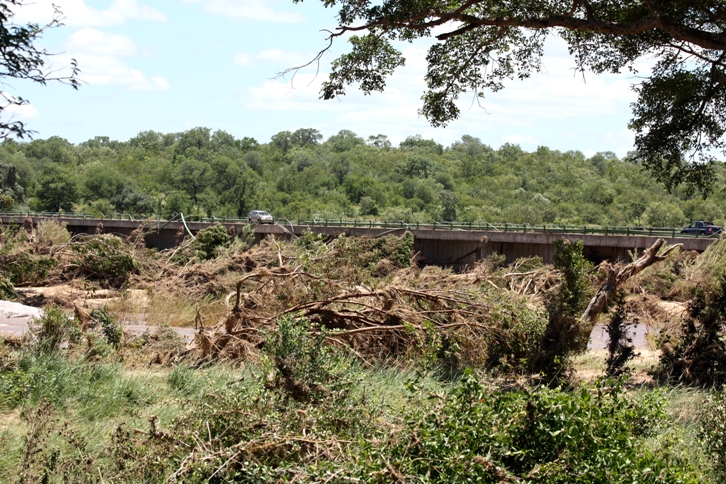 |
| The Sabie River a week after the flood. Check out the railings torn from the bridge (on second thoughts you’ll need a magnifying glass; see below instead). |
 |
| Flood-wracked railings. |