The one thing that most people know about mongooses is that they kill and eat snakes.
This is like knowing that humans eat lasagne.
Of course, there are snakes and there are snakes.
Big snakes are only too happy to kill and eat little mongooses.
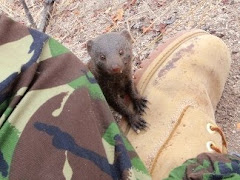
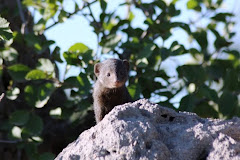
And my dwarf mongooses are the teeniest mongooses there are.
Being rat-sized and the weight of half a can of baked beans, they're ideal snack snake food.
But ONLY if they're caught unawares.
 |
| The spotted bush snake (Philothamnus semivariegatus) is about the largest snake my dwarfs can kill. It's a slick, zippy snake, about 1 m (3 ft) long and the thickness of my thumb. Sadly, only the group's oldest members can feast on the spoils because no one else's teeth are hefty enough to pierce the skin. |
When walking in the bush alone I rarely see a snake.
But 'see' is the critical word here. Add 15 mobile snake-detectors and it's a whole different story. Last Sunday I spent an hour pottering along with Ecthelion. In that time we met two large puff adders and a Mozambique spitting cobra.
When a mongoose meets a life-threatening snake, it hollers for the group using a special, high-pitched 'snake' call. Everyone immediately comes running. It's a moment I dread. All the mongooses cluster around the snake, flattening themselves down on their tummies, calling and spitting. The snake coils into the smallest possible bundle and assumes strike position. I bite my nails.
At this point, puff adders demonstrate why they're so named. They produce a loud, ominous noise: a deep whooshing hiss like a deflating football, which lasts around 3 seconds and is then repeated over and over. The mongooses are not deterred. Individually they try to dart in and nip the snake's body, leaping backward as it lunges for them. Some even cartwheel half a metre into the air to evade the striking snake. I stand well back, wincing and squirming, with my eyes screwed half shut.
 |
| This is an action shot. Unfortunately it features two cryptic species. Can you spot the puff adder (lower centre) and two mongooses (upper right and upper left beneath the grass tussock)? |
From my (wimpy) perspective, snake-mobbing is worst when - as now - the group has small pups. I've seen a puff adder (undetected by me or the group) snatch a mongoose pup almost at my feet. It's not an experience I wish to repeat.
But snake-baiting appears to be a learned behaviour in mongooses and the pups are totally clueless. On Sunday, Ecthelion's three smallest members came trotting over to see what all the fuss was about, wending in and out of the mobbing adults and blithely ignoring the huge puff adder poised inches above them. I actually stopped breathing when Hiccup marched right over the adder's coils. But no one else even noticed. The snake and the mobbing mongooses were focussed exclusively on one another; neither could afford a moment's distraction in the deadly exchange of bite and counter bite.
This whole awful scenario ends after about five minutes, when the mongooses lose interest and wander away. I know this is sounds like an anticlimax, but once the mongooses know the snake's presence, and the snake knows it has a whole group to contend with, the peril is over.
 |
| A puff adder (Bitis arietans) feeling put upon. Snakes breathe by moving their ribs (called a costal pump) and a puff adder uses the ribs along its entire trunk to 'puff'. Both the inhalation and exhalation are disturbingly loud (75 decibels - the same volume as a vacuum cleaner at 1 m/yard). |
Puff adders are the sluggards of the snake world. During the day they lie about cryptically in thickets or rocks, and at night they lie about cryptically on pathways waiting for edible things to stumble into them. Of course this indolent lifestyle has its consequences: although they only grow to about 1.2 m (4 ft) in length, they get embarrassingly rotund, weighing up to 7 kg (15 lbs). If given unlimited food in captivity, they'll literally eat themselves to death.
 |
| Puff adders are responsible for more than 60% of serious snake bites in southern Africa. Their long fangs (12-18mm/0.5-0.7") are capable of penetrating soft leather and they inject a potent cytotoxin that causes severe swelling, pain and necrosis. Around 10% of untreated bites prove fatal (due to kidney failure or complications from the swelling) but loss of an appendage is much more common. |
Despite the puff adder's reputation, this is the snake I've grown to feel most warmly towards. Why would someone who's snake-phobic feel warmly toward any legless beast? Gratitude, pure and simple.
You see, in my experience, puff adders behave with exemplary restraint. Once, when I was crawling about a termite mound, neatly piling up mongoose droppings (so I could tell if anyone subsequently visited the latrine), I suddenly realised that my scrabbling fingers were only 2" away from the nose of a very large puff adder. It lay perfectly still but its golden eyes were watching me intently. I'm not sure how it felt when a look of horrified recognition passed over my features, but it maintained its perfect immobility.
In a more testing situation, once (while walking the dogs) I glanced down to see a puff adder right beneath my feet. The snake's thickened body was coiled up beside the track, but its head and neck lay out across the path (presumably in wait for passing rodents). I'd actually passed over the snake before I saw it, but not so my dog, who was following along behind me. With horror, I watched as she lowered her hind paw directly down on to the snake's head. But to my amazement, at the very last moment, the adder flicked its head sideways, out of her way, and the dog marched on, quite oblivious. I think I lost a few years off my life, but I can't help but feel profound gratitude that it did not strike.
 |
| A coat of many colours. During spring, male puff adders trail females (who waft an alluring pheromone) and neck wrestle each other to win their regard. Mothers bear 20-40 mini adders in late summer. |