When you were a child, did you ever play
Red light/green light?
It's one of those backyard games where everybody lines up, except for 'it' who stands, back turned, at the far end of the yard. The players try to creep up and touch 'it' without being seen to move. 'It' can swing round at any time, and if he/she spots someone moving, that person must go back to the starting line.
Well, I've been playing
Red light/green light for several days.
And I'm always 'it'.
No, I haven't suddenly developed a passion for amusing small children; in fact, my playmates are considerably bigger than I am.
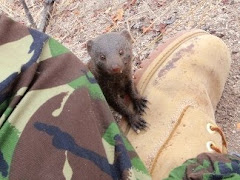
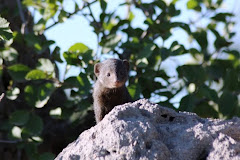
It all started when Bugbears decided to sleep for several nights at a termite mound located on an open, grassy knoll. With the chilly nights, the mongooses like to start their day slowly, lounging around the mound for several hours, soaking up the sun, grooming and playing. As a result, I've been spending quite a lot of time lounging around there too.

Now, open hilltops are the favoured haunt of mother giraffes; it's easier to spot someone sneaking up on your calf. But when you munch leaves, open grasslands are a bit of a bummer, so giraffe Mums deposit their young in a crèche - tended by just one or two adults – before stepping out for a bite to eat. One such crèche, of up to six gangly calves, has been whiling away its time near Bugbears' mound.
When I first arrive in the morning, and sit down to observe Bugbears, all the giraffes watch me from a distance. Within moments, the adults return to nibbling treetops, but the youngsters keep staring intently. Every time I glance back at them, they're all lined up gawking. Although they're always standing perfectly still, legs splayed out and necks very erect - clearly poised for flight - they're appreciably closer than the last time I looked. This goes on for around 20 minutes, and as they silently creep closer and closer, I begin to feel unnerved. They could be teleporting for all I know; I can almost hear the
Twilight Zone music.
Eventually, when they're only about 8 metres (25 ft) away from me, someone suddenly loses their nerve and they all whirl around and galumph away. Of course, this loss of courage is marked by an immense crashing and thundering, which makes both me and the mongooses jump in fright.
Once the young giraffes have recovered their composure (and I'm sure they're all giggling in a silent giraffey way), the whole game starts over again.
Three of the culprits.
I try to be tolerant. I figure giraffe calves deserve a certain amount of leeway: growing into a 4.5 metre stilt-walker isn't easy. By the time these guys reach adulthood, they'll have had to grow an immense heart (weighing 11 kilos, and measuring 0.6 m long) just to get blood up to their brain. And their gushingly high blood pressure (twice that of the most cholesterol-clogged human) is a constant peril; their brain only avoids damage by hiding behind a special bed of capillaries that diffuses the spurting flow. On top of this, giraffes need to grow lungs eight times bigger than our own, just to get a breath of fresh air. If we tried to use a two metre long windpipe, our lungs would draw in and exhale the same stale air, over and over, until we asphyxiated.

Apart from these logistical hassles, giraffes (like most of us) have inherited all sorts of design flaws from their forebears. Take their laryngeal nerve, which runs from the brain to the larynx (a distance of a couple of inches). In mammals, this nerve casually loops through the blood vessels near the heart before heading to the larynx. While this is a tenable route in 'normal' animals (including the giraffe's squat ancestors) when you add neck-extensions, it becomes absurd. The giraffe's laryngeal nerve zips two metres down its neck, loops around the heart and then zooms all the way back up again to the larynx. No wonder giraffes don't say much.
After an hour or so of
Red light/green light, the little giraffes at Bugbears grow weary and wander off to lie down in a cluster in the long grass. They usually sit with their necks erect and their horn-topped faces just showing above the grass. Giraffes are the only animal to get their horns in the womb. No, your concern for Mum is misplaced; the horns are made of cartilage and lie flattened against the calf's skull until after it's born. It's the newborn you should be sympathising with: mother giraffes stand up to drop their calves. Literally
drop. Can you imagine a ruder introduction to the world than plummeting two metres to the ground? It's enough to make anyone's horns stand on end.
Refuelling stop. Like all ruminants, giraffes have a four-chambered stomach for breaking down vegetation, but when a giraffe calf suckles it stimulates the opening of a special groove within its stomach which shunts the milk past the rumen (fermentation vat) so it's digested immediately.
I must admit that very young giraffe calves - although undoubtedly cute - give me the creeps. They remind me of plesiosaurs or strange sea monsters because their necks move with complete snake-like flexibility. A giraffe's neck is made up of only seven vertebrae (like yours), but (unlike yours) each one is linked to the next via a ball and socket joint (similar to your shoulder joint). This allows movement in almost every direction (like your arm). Although this wondrous flexibility isn't especially noticeable in adult giraffes, whose neck vertebrae are almost a foot long, in stumpy-necked calves it's utterly alarming!
Maybe tomorrow Bugbears will decide to sleep in a different termite mound, and the giraffe creche will have to find someone else to play with.
Recent research on captive giraffes has found that the species uses infrasound (very low frequency) calls that are entirely inaudible to humans.

 Now, open hilltops are the favoured haunt of mother giraffes; it's easier to spot someone sneaking up on your calf. But when you munch leaves, open grasslands are a bit of a bummer, so giraffe Mums deposit their young in a crèche - tended by just one or two adults – before stepping out for a bite to eat. One such crèche, of up to six gangly calves, has been whiling away its time near Bugbears' mound.


 The weather was cool and dreary, so I decided to stay in and analyse my daunting stockpile of mongoose video tapes. However, my highly playful cat, Silver, had other ideas. He was in a mischievous mood and spent the entire morning leaping at the TV to paw at the on-screen mongooses, wrestling my video camera, scuffing up my check sheets and batting my pen under the sofa. Eventually, in exasperation, I took a break outside. Silver came too, slipping under the back fence to race about wildly, tearing up and down the trunk of a large buffalo-thorn tree.
  There were about six monkeys and they were all youngsters. They came excitedly gathering around Silver (who was now sitting sedately on the garden wall), slithering down trunks or dangling precariously from drooping branches to get close to him. They completely ignored me, although I was standing quite close. I thought they must be curious about Silver's previous absurd behaviour. But then I looked more closely. They were lounging coyly on their backs, heads upside down and wiggling back and forth. And some of them had their eyes half shut and their mouths open in the classic primate 'play-face'.