Monday, August 29, 2011

The mysterious case of the missing mammals

It’s grim struggling out of bed on cold winter mornings but there are compensations.

For me, it’s watching the sunbathers.
Voyeurism, I know, but who can resist all those exposed fluffy tummies.

In the big nyala tree behind my house the vervet monkeys bob about like sailors in the rigging, waiting in the topmost foliage for the sun’s first rays. And when the light catches their coats, they blaze silver. Nearer at hand, dozens of tiny fire finches, blue waxbills and cut-throat finches squabble in the buffalo-thorn outside my bedroom. Lined up in the warming sun, they ruffle their feathers and shuffle their feet and complain non-stop in a cacophony of twittering.

But my favourite sun-worshippers sit about on the koppies (granite outcrops) I pass on route to my study site. Silhouetted against the sky on the giant ears of rock, they look like an infestation of ticks (OK, I’ve been working on small mammals for too long). But up close, they transform into pyjama-filled plush toys.


Rock hyraxes (Procavia capensis) are less adept than most of us at keeping their body temperature just so which makes their early morning sun-bathing session mandatory.

Now I’ve been spying on this unsuspecting colony of rock hyraxes (or dassies) every day for almost six years, so you can imagine my consternation a month or so ago when they all disappeared.

Was I passing by too early? Too late?
I often see eagles hovering about the rocks - clearly with evil intent - but they couldn’t have scoffed everyone. I rushed home to scour the hyrax literature to find what might have happened.
Apparently diseases like mange can wipe out whole colonies (yet no one’s looked moth-eaten) and a colony can include several widely-spaced koppies in their territory, so maybe they'd just changed residences (but they've never left before).

It was at this time too, that I noticed a new set of tracks on the road at the base of the koppies. Amid the usual mosaic of paw prints (laid down by genets and jackals, civets and porcupines) were prints I’d never seen before: the rear paw’s imprint always overlapped that of the fore paw.

Of course I didn’t put two and two together at first.
But then Koppiekats disappeared.

Koppiekats is the mongoose group who hangs out at the base of the koppies (hence their name). For days I scoured their territory (about 40 ha/100 acres of bush), searching every tussock, termite mound and cranny until I was quite certain they simply weren’t in it. But where were they?? A skiing holiday? A winter break in the Riviera? Victims of alien abduction?

Now when a mongoose is snatched by a ground predator, its group will desert that part of its range, sometimes for up to six months. But what could induce Koppiekats to vacate their entire territory? Dwarf mongooses are fiercely territorial critters and trespassing brings swift retribution. As I trudged about disconsolately seeking non-existent mongooses I kept stumbling upon macabre hints: the beak and piebald feathers of a late hornbill, random duiker legs, the half-consumed torso of a puff adder and a veritable fountain of francolin plumes. Hmm... Should I be checking over my shoulder?


Constant vigilance! Twenty-four species of raptor try to dine on my dwarf mongooses (Helogale parvula) and, on an average morning, the group suffers a predator scare once every 11 minutes. Unsurprisingly their repertoire of alarm squeaks is sophisticated. Their cries warn whether the peril is lurking in the grass or circling above and the degree of danger (from, ‘I spot trouble, but everything’s cool’ to ‘OH SH#@*T!!’).

It was at this point that I realised I’d better figure out who was making those weird paw prints. Now, for those without a foot fetish, deciphering the subtle disparities between the mitts of carnivores is wearying. I’ve spent many an hour crawling about in the dirt, clutching a grubby field guide and squinting in puzzlement at fuzzy-edged smudges. But these tracks turned out to be easy; there aren’t many carnivores with such distinctive pacing.
They were made by a caracal.


The caracal (Caracal caracal) may look like the lynx’s long-lost twin – complete with stumpy tail, untrimmed ear tufts and ginormous hind legs – but they’re not closely related. Molecular studies reveal that the caracal’s nearest and dearest is the African golden cat.
Photo posted on Flickr by e3000.

Now things made sense. These big-pawed, russet cats occasionally padded through our study site in the Kalahari Desert and when the meerkats got wind of one, they’d retreat down their burrow and refuse to emerge for 36 hours.
Why? Well caracals are weapons-grade predators. About the size of a small border collie, they’re dangerously opportunistic, slaying anything that's plentiful, from teeny bugs to antelope twice their own weight.
And they do it by ambush; lurking in wait to fell their victim with a single pounce.
And what a pounce!
A pet caracal, startled while sleeping, shot into the air, and measurements taken by the owner revealed that its forepaws only hit the wall at a height of 3.9 m (12ft 10”).

Such acrobatic feats have not gone unnoticed, and for millennia dignitaries in India and Persia (now Iran) kept tame caracals for hunting. In fact, caracals have given us that ever-handy expression, ‘put a cat among the pigeons’. The ancients - combining two favourite pastimes (bloodletting and gambling) - came up with a sport in which two caracals were set upon a flock of feeding pigeons, and wagers were laid on which of the cats would bring down the most birds. Hunting caracals can leap 4-5 metres (13-16 ft) into the air, and a skilled cat was able to snag up to ten birds before the flock escaped.

Dreaming of yummy mongooses? Back in the good ol’ days, caracals terrorised furred beasts throughout the deserts and dry savannahs of Africa, the Middle East and the Near East (as far as India and Russia). They’re now close to extinction in the northern hemisphere, and here in South Africa they’re classified as ‘vermin’ or ‘problem animals’ (depending on the PC-ness of the province) due to their taste for mutton, and are rigorously poisoned, trapped and shot.
Photo by Steve Jurvetson.
 
After a few weeks, the caracal prints stopped appearing on the track below the koppies (caracals have big territories) and, much to my relief, both the hyraxes and mongooses have now returned home. Unfortunately, two members of Koppiekats (Saturn and Shade) are missing, presumed consumed, and everyone else is pocked with bite-marks suggesting that their sojourn with the neighbours was not harmonious.
While I’m pleased that caracals live here (and I’d dearly love to see one), I do hope they don’t pay another visit soon.


Saturn (KM068). R.I.P.


Tuesday, July 12, 2011

Smelly little messages


A gratuitous mongoose piccy.


PLOP!

Something slipped from my thermos flask and splashed into my mug of tea.

I didn't see it happen. I was sitting on a boulder, with one eye on my mongooses, pouring a quick cuppa while they searched for bugs.
But I heard the plop.

What the...?
Oh god!
Bobbing in my tea was a sticky, black mongoose poop nestled in a small plastic bag.

How did this happen?
Well, when I'm out in the field I carry two thermos flasks. One contains my morning brew and the other is filled with ice to keep faecal samples fresh and perky. Unfortunately, the two flasks look very much alike. And sometimes I'm just not paying attention as I stuff a sample into a flask...

As I carefully fished out the neatly labelled bag, I could see that the tea had seeped inside. Presumably, worse things had seeped out. I didn't know which aggrieved me more, the loss of my tea or the sample. You see, after five years working with dwarf mongooses I've come to share many of their perceptions of the world (scary, I know). And for a dwarf mongoose, every poop is sacred.

Unlike other family members, dwarf mongooses don't just broadcast their droppings far and wide. In fact, regardless of the leg-crossing involved, they'll only poop at the group's special scent-marking sites or at latrines located by each of their sleeping mounds. Now you may think the early morning rush to use the bathroom is hectic at your house, but it's nothing to the jostling that goes on when a mongoose group gets out of bed. Tumbling out of hole, they scramble and dash across to the latrine, a dozen little furry bodies jockeying for position all at one time. Even mongooses that don't need to go make a huge effort to squeeze something out. And once the group has headed off to forage, it's not unusual for someone to realise they haven't completed their toilette and, all in a panic, they'll go racing back. But why do they go to all this trouble?


Does scat mean scat? Latrines were once seen as Keep Out signs but, in many species, they're really community notice boards, all aflutter with phone-number fringed personal ads.
Image borrowed from here.

We know from experiments with banded mongooses and meerkats that mongooses can discriminate between the poop of different individuals. And not just their nearest and dearest; they can also tell the droppings of neighbours from those of strangers. And banded mongooses act very edgy indeed if they encounter a neighbour's poop steaming on the wrong border.

But how do they do it? Well like all carnivores (including Fido and Puss) mongooses are blessed with anal glands that secrete a fatty substance. This goo sits about cosily inside an anal pouch where it's feasted on by hungry bacteria. The bugs leave behind an array of volatile carboxylic acids (which stink), and which ones you end up with (and how much of each sort) depends on which types of bacteria are lurking in your anal pouch. Since every individual has its own unique bacterial assortment, everyone's acid profile is unique, and thus so is their pong. (I do have to wonder how antibiotics affects all this, for example in zoo animals.)


Comet leaving a message.

And of course excrement is also chockfull of all the hormones coursing through the depositor's veins. So for those with a sensitive nose, the gen is endless. Is he stressed? Is he feeling mean? Is she willing?

With so much personal information being bandied about, it's not surprising that individuals sometimes indulge in a bit of self promotion.
At meerkat latrines, the ladies post alluring come-hither messages for the guys next door while their male group-mates dash about madly, trying to mask these billets-doux with stinky macho threats. The end result is an absurdly male-biased latrine whose shitty composition bears no resemblance to the actual group make up.


The take away message proffered by a meerkat latrine.
Image borrowed from here.

In contrast to meerkats, banded mongooses are far more narcissistic. They consider poop an in-house affair. Everyone is too interested in getting the low down – or putting one over - their sexual rivals (who come from inside the group, not out) to spare much of a sniff for the leavings of the opposite sex.

But what are the dwarf mongooses up to? Why do they – unlike other mongooses – religiously pile up huge middens outside their sleeping dens? It's not as if dens (i.e. termite mounds) are in short supply; there are 200 to 300 in each group's territory (I know because I've plotted every one) and the group sleeps - and latrines - at only about 30.

It's in an attempt to figure out why my mongooses don't waste their waste that I daily risk the integrity of my morning cuppa. The smelly little samples I spoon up are destined for use in taste sniff tests. The idea is to present a smorgasbord of poo to selected individuals and see exactly what takes their fancy. Are they more intrigued by the droppings of outsiders or group members; rivals or lovers?


A mobile perfume counter. On the right are a male and female poop from the sniffer's own group; on the left they're from a strange group. Don't panic! The one in the middle isn't from a mongoose on steroids; it's an antelope turd, just to be sure they aren't simply attracted to anything that pongs.

My first attempt at this experiment was not a success.
In fact, it was one of those ghastly moments when you see your research career evaporating before your eyes.
No one sniffed anything.
They totally ignored every single dropping.

In desperation, I grabbed up a poop and stuffed it right under Pleiades' nose. She screwed her eyes shut and turned her head away with such overt revulsion I was shocked. I couldn't have evoked a more negative reaction if I'd done this to a human! I could almost see her thinking, 'Who would leave that here!'

That was when it hit me.

Dwarf mongooses never leave their droppings lying about in the field, yet here I was presenting samples to animals as they trotted about foraging. It was like tossing post-it notes under the feet of busy shoppers and wondering why no one read them.

I tried again at one of the group's scent-marking sites.
And low and behold, they scratched and sniffed!
O frabjous day!
Of course this makes the whole procedure much more tedious because the samples must be kept frozen until just before they're presented. So I spend my days trailing after the mongooses, trying to anticipate when they're going to stop in at one of their toilet facilities. When I believe a lavatory stop is imminent, I have to madly thaw the samples down the front of my shirt (and, yes, it does feel as ghastly as it sounds).

I'm still undertaking these trials so I can't yet tell you what messages are encrypted in my mongooses' latrines. However, it looks as if the ladies (who are very status conscious) are most interested in getting the low down on one another, while the guys can't resist a lovely female poop, particularly if it's from someone they haven't met.


Bugbears enjoying themselves at the information exchange (i.e. scent-marking site).


Saturday, July 2, 2011

Ware warthogs!

Photo by Arno Meintjes.


I’m writing this post for people, like myself, who felt irritated when the Lion King portrayed Pumbaa (the insouciant warthog) as living on bugs ('slimy... yet satisfying').

Alright, it was probably only me, but warthogs are grazers for Heaven’s sake!

Of the 16 pig species trotting about the world today, the warthog is the most deeply committed vegetarian.
And its veggie of choice is grass.

Look inside a warthog’s mouth and (if you can avoid losing a finger) you’ll discover a highly sophisticated grass processing plant. The incisors are designed for nipping shoots from closely cropped lawn, and behind the seriously off-putting canines (i.e. the tusks), the entire tooth row is given over to one mighty mother of a molar.
Young warthogs shed their normal piggy assemblage of premolars and molars so their third molar can grow to immense proportions. This behemoth, which is open-rooted and grows continuously, is designed to combat the gritty rasp of silica-rich grass. Even a warthog’s jaw hinges differently to that of other family members, allowing its chops to work up a good sideways swing for grass grinding.

Of course you may be wondering how such a specialised grass-muncher copes with the dry season when all the grass has withered away? Well hungry warthogs switch to rooting up the grass’s underground rhizomes and bulbs.

Now don’t get me wrong, although warthogs are connoisseurs of pasture they’ll also munch fruit and berries. But they have surprisingly conservative tastes; even when starving, they turn their snouts up at veggie scraps, apple peelings and bread (I’ll tell you about that fiasco some other time).


A warthog (Phacochoerus africanus) relishing a meal of marulas.
Photo by Brian Gratwicke.

But warthogs haven’t totally forgotten their omnivorous ancestry. This was brought home to me as I watched a large female warthog marching along a road in Kruger National Park. Up ahead, lying in the centre of the tarmac, was a road-killed squirrel.
‘Oh this will be interesting,’ I thought niavely, ‘I wonder if she’ll react?’
I imagined her pausing to give the little body a cursory sniff.

I was wrong.

As the warthog approached the body, she quickened her pace. And then, when she was still a meter away, she leapt. Yes, that’s right, leapt. It was a lightning fast strike and I gazed open-mouthed as she snatched up the dead squirrel and beat it viciously against the tarmac. I could hear the thwack, thwack, thwack from the car.
Moving at a frenzy, she hurled the squirrel high into the air and as it hit the ground she lunged forward and trampled on it, over and over, with her front trotters. It was like someone treading grapes, only ten times the speed. She repeated these manoeuvres like a creature possessed for some minutes and then, pinning the body with her front hoof, began tearing it apart.

I have to admit I was stunned. So much for darling little warthogs!


Cannibalism? No, a bit of hakuna matata; they’re grooming.
Photo by Arno & Louise Meintjes.


I was reminded of this illusion-shattering incident as I drove home from the mongooses earlier this week.
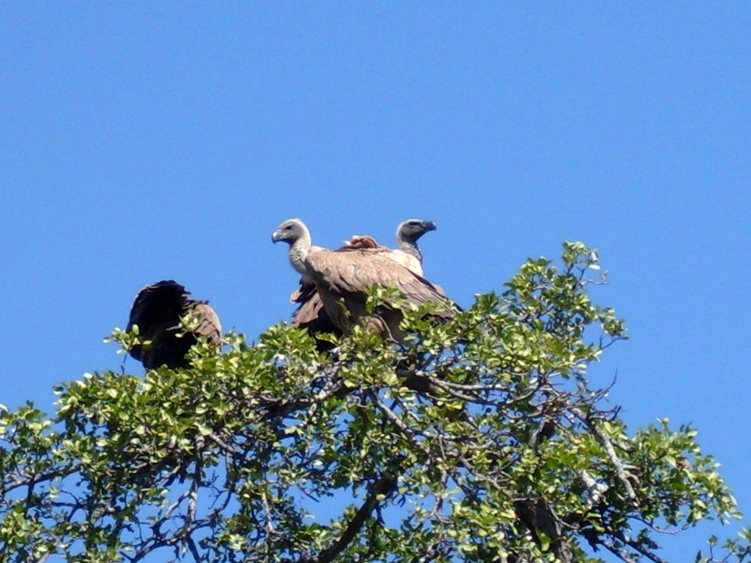
Now, I should explain that my landlord often sups on impala at his weekend braai (barbeque), and he tosses the less edible bits out for the delectation of the local vultures. So it’s not unusual for me to find myself engulfed in a flapping cloud of monstrous birds as I pass by on a Monday.

But this week the vultures weren’t enjoying their usual feast; they were all sitting waiting disconsolately in the trees.
Huh?
Was a leopard keeping them off?
A lion...?

As I got nearer I saw that a warthog family was gathered at the carcass. This sounder (comprised of two big mums and nine piglets) is one of my favourites because the little hogs are always gambolling and jousting with one another or trotting along decorously - tails raised - in single file. But this week I was a little dismayed to see them tucking in enthusiastically at the bloody remains of the impala's ribcage. Each charming little piglet - its face spattered with gore - was tugging with great vigour on the end of a rib!

With my usual aplomb as a wildlife photographer, I failed to capture the moment (although you can see a camera-trap image of warthogs munching carrion here, if you need proof of this perfidy), and the best I can offer you are ‘after shots’.

The culprits fleeing the scene of the crime.


Pissed-off vultures (white-backed) waiting for the swine to relinquish their lunch.

So next time you’re watching the Lion King, be thankful that grass-eating Pumbaa is dining on nothing worse than bugs!

Monday, June 20, 2011

Today a gerbil, tomorrow the world

The first time I saw mongooses out foraging I went into shock (well, that's a slight exaggeration).

It was back in 1995, and I was on holiday in Kruger National Park.
I'd stumbled on a group of about 25 banded mongooses and they were busily searching for dinner around my car. Each animal was scratching through the leaf litter, poking its nose into likely holes and raking around under fallen timber. Every now and again one would unearth a cricket or a juicy grub from a pile of dung or noisily crunch up a beetle.

Now this I was accustomed to.

I'd spent lots of time watching Australia's marsupial carnivores (e.g. quolls, dunnarts, antechinuses) and they obtain their takeaways in exactly the same way.

But what amazed me was that the mongooses totally ignored one another. Here they were trotting about, only a foot or two apart, burbling away companionably and moving along as a troop, but no one paid the slightest attention to what anyone else was eating!

Now if a family of quolls or a pair of dunnarts are out foraging and someone finds a tasty morsel, it's a free for all!
Everyone one dashes over and there's squeaking and brawling and utter fur-flying chaos. Heck, even dogs and cats will rush over to investigate if a companion makes a killing.

I guess, in retrospect, I shouldn't have been so shocked because flocks of birds hunt like this all the time, but mongooses have FUR for Heaven's sake!

An eastern quoll (Dasyurus viverrinus). Quolls are Australia's best attempt at a mongoose; regrettably they're solitary and nocturnal.
Photo posted on Flickr by Shuttergirl3.

Sociality doesn't come easily to mongooses. Of the 37 species snooping about the world today, only eight (all African) have mastered the art of living together. You see mongooses are descended from a Christmas eve checkout queue of solitary, skulking killers and their physiques have remained unchanged for 30 million years.

But as the African climate dried out and savannah replaced forest, the mongooses – now perilously gadding about in the open – banded together so they'd always have someone to watch for predators. So, unlike other pack-living carnivores (such as wolves, lions or dholes), the mongooses ganged up to outsmart the beasts that ate them, rather than to up-size the beasts that they ate.

So while my little dwarf mongooses are now among the planet's most sophisticated socialites, at mealtimes their ancestral proclivity for independence shows through: everybody does their own thing, together.

Now I've explained all this, I'm going to contradict myself by describing the hour I spent with Ecthelion yesterday morning.
They were gerbil hunting - cooperatively.

I've only seen my mongooses behave this way a couple of times before, but it's always disconcerting. Their quarry, the local bushveld gerbils (Gerbilliscus leucogaster; you can see a photo of one here), live in big colonial warrens which they dig in sandy soil.
And yesterday morning, Merlin sniffed out an occupied warren. He immediately hollered for the group with a special rodent-hunting call (a bubbling, staccato version of their usual 'follow me' squeak) and the group came running. While Merlin and one or two others dug madly at the warren's main burrow entrances, everyone else milled about excitedly, watching and sniffing, pushing their noses down the many minor entrance holes, and peering under logs or into clumps of grass. They were all searching, impatiently, for any gerbil foolish enough to flee its underground home.


Putting in the spade work.

'We seek him here, we seek him there...'

Now this cooperative effort isn't exactly egalitarian because the group's reigning monarchs will filch the spoils from anyone who manages to bag a rodent. However, gerbils are big (about one-third the size of a mongoose, which makes the kill protracted, noisy and traumatic for soft-hearted observers), so lesser group members are usually able to snatch up some bloody, dismembered bits.
At the last hunt I witnessed, Koppiekats (a group of 18) snagged three of the five fleeing gerbils, and eight mongooses scrounged a meal.


The Lazy Mongoose's Guide to Gerbil Hunting.

Ecthelion's hunt wasn't successful (to my secret relief) as the gerbils refused to be flushed, and after three-quarters of an hour the 15 milling mouse-hunters were getting frustrated. Widening their search area brought them over to where I was sitting, with my backpack on the ground beside me. I should have foreseen this, but they began eyeing my bag speculatively, and I could see them thinking, 'Well if we can't find them anywhere else, they must be hiding in there'.


'"They must be in that bag..."

Soon half the group was lined up in front of me, glaring accusingly, convinced that I was harbouring their missing rodents. (Do they know me better than I realise?). Since I could think of no conceivable way to convince a group of mongooses that my backpack was gerbil-free, I shouldered the offending article and withdrew. They immediately called off their hunt ('Well, she's pinched the booty!') and headed off to forage normally.


"Gimme the gerbils!"

Now I know that dwarf mongooses hunting gerbils is not on a par with chimpanzees killing monkeys, but there's something worrying about these little creatures teaming up to bring down prey.
Sure, today it's just a few pesky gerbils, but where will this lead?
How long before I come across a felled duiker or a warthog nibbled off at the knees?
Come to think of it, aren't hyenas supposed to be descended from ancestral mongooses?
THAT'S where it will lead!

Just don't say I didn't warn you...

Friday, June 17, 2011

Finding faerie fauna

There are fairies at the bottom of our garden!
It's not so very, very far away;
You pass the gard'ner's shed and you just keep straight ahead -
I do so hope they've really come to stay.                                    

                                               The Fairies.
                                               Rose Fyleman


These are the opening lines of a poem written in the 1920s after a series of fairy photographs had taken the world by storm.

The photos were snapped by two young cousins (Elsie Wright 16 and Frances Griffiths 10) at Cottingley, England. The girls borrowed Elsie's dad's camera and photographed cardboard cut-out fairies (copied from a children's book and fixed with pegs) to persuade Elsie's mum to let them play down by the creek (where the fairies lived).
Mr Wright was so annoyed at their prank he refused them further use of his camera, but his wife believed the girls' story and passed the pictures on to the Theosophical Society. Once the society had established that the photographic plates hadn't been tinkered with, a prominent society member – Sir Arthur Conan Doyle (creator of Sherlock Holmes) - declared the photos authentic, sparking fierce worldwide debate.


One of the purported fairy photos:
Frances Griffiths with the Leaping Fairy.
Image source: Wikipedia.

Elsie and Frances didn't come clean for more than 60 years.
In the 1980s Frances explained,
"I never even thought of it as being a fraud – it was just Elsie and I having a bit of fun, and I can't understand to this day why they were taken in – they wanted to be taken in."

This incident (dramatised in the 1997 film Fairy Tale: A True Story) illustrates our deep-seated need for magical entities. Whether they're dryads, fauns and sylphs, pixies and gnomes, or elves, ents and hobbits, we show an incredible determination to populate the natural world with mystical beings.
But why?
Do we really need nature spirits to feel the enchantment of Nature?

Living here has influenced my thoughts about this. You see it's almost impossible to venture outside without feeling like you've slipped into the world of The Magic Faraway Tree.

All around there are rustles and scurries; an eerie trembling in the grass, a twitch of foliage seen from the corner of the eye, the ever-present feeling of being watched... An eye glints from a rock crevice, a wizened face peers down from the leaves or a huge horned figure looms darkly against the twilit sky.


One of the nature spirits that live at the bottom of my garden: a grey duiker (Sylvicapra grimmia).

Of all the local nymphs, the bushbucks are the most impressive. Haunting leafy thickets, they tiptoe past with an uncanny staccato, high-stepping walk; placing each hind hoof precisely in the print of the forefoot. When alarmed they freeze, disappearing magically into the dappled underbrush. You can look straight at them and see nothing, and then, quite suddenly, there's a face! Right there, staring straight back at you. It's like those optical illusions that jump unexpectedly from vase to human silhouettes and back again, only it's a lot more startling.

A bushbuck sylph. The home-range it uses by day is completely separate from the one it haunts by night.

After experiencing the African bush, I can't help but think that it's the loss of this life-brimming habitat that's created our need for magical entities.
Maybe we conjured a panoply of nature spirits to replace the wild beasts we'd driven away, and to populate northern lands that lie bereft of fauna for half the year. Are we simply trying to recreate our ancestral home: the abundant environment in which we evolved for millions of years?

So what's prompted this reverie on the origins of faerie fauna?

Well a couple of days ago I encountered a little Elemental more adorable than any human mind could conjure.

The dogs and I were returning from our evening walk when we rounded a corner to find a newborn bushbuck lamb standing by the track. 'Standing' isn't entirely accurate; it was sort of teetering on weirdly propped legs. Only knee-high with fluffy dark fur, huge bat-ears and a puppy's wet nose, it gazed at us, all bright-eyed with curiosity. And then, to my horror, it came tottering straight toward us! Of course my dogs went berserk, straining violently at the leash in their attempt to reach it. While I wrestled wildly with the dogs, it wobbled closer and closer, stopping only a metre (3 ft) from their slathering jaws.

I didn't get a photo of this spell-binding creature (although it stood gazing at us in wonder for at least a minute) because I needed both hands to constrain the dogs. I'm sorry I didn't snap my fairy-encounter because images of day-old bushbucks are even rarer than genuine fairy photos.


An anal-retentive fairy? Baby bushbucks won't urinate or defecate unless licked by Mum, and she gulps down all predator-attracting trace evidence (nothing like maternal devotion!). This little cutie is a few days older (and much lighter) than the sprite I met.
The photo was borrowed from here.

Many of the local antelopes leave their newborns hidden in the bull-rushes shrubbery for their first few days or weeks, but bushbuck mums go to an extreme. Their ankle-biters spend four months lying out alone (I wonder if they have imaginary friends?). And they seem to have the gift of invisibility because I've never before glimpsed a bushbuck less than two months old.
So why was this little creature approaching us? In fact, why was it even tottering about at all; I was certain we hadn't flushed it from its hiding spot? Was it a starving orphan? Was it currently imprinting on my huskies, and would be scarred for life (in every sense of the phrase)?

Then the answer suddenly materialised.
Mum, who'd been standing invisibly right next to us (undoubtedly biting her nails hooves to the quick), could stand the tension no longer. She leapt away into the undergrowth, and Junior, realising that something was amiss, wobbled away after her.
I gave a huge sigh of relief.
We must have stumbled on the pair during one of Mum's twice daily visits and her little darling was so obsessed with the prospect of guzzling milk, it paid little heed to who provided it!

Now with encounters like that, who needs fairies?

Back in 1918, Frances Griffiths mailed one of her fairy photos to a friend in Cape Town (where Frances had spent much of her life). On the back of the photo she wrote,
"It is funny, I never used to see them in Africa. It must be too hot for them there."

I'd suggest that there's just too much competition.


Puck? No, a young male bushbuck (Tragelaphus scriptus). Unlike other solitary antelopes, bushbucks aren't territorial (except perhaps mature males) and they enjoy a bit of company. When two meet, they greet each other cordially and mosey about together for the next hour or two.
Photo posted on Flickr by bwana4711.

Tuesday, June 7, 2011

This morning I showered with a murderer

I did it yesterday too.

Now you mustn't imagine that I enter into such liaisons lightly.
But there's only so long that one can go unwashed in order to avoid unsavoury company.

Maybe I should start at the beginning...

About a week ago, I woke at 3 am to the sound of screaming.
Never a good sign.
The dogs, Wobbly Cat and I hurtled out of bed, in a tangle of blankets, flailing limbs and stepped-on paws, and blundered to the bathroom; source of the shrieks. What we found was grisly.

Now I want you to imagine the shower scene from Psycho. Not the bloody bit (which, by the way, was actually the chocolate saucy bit, because Hitchcock thought stage-blood looked wishy-washy in black and white) but the suspenseful build-up. OK, you need to tweak things a little; make the victim rather short and dumpy, and she's snoozing in the cubicle rather than actually showering, but otherwise everything is bona fide horror movie.
The assailant's stealthy approach, the victim blithely unaware... the weapon silently raised, ready to strike... And then AAAAHH!

Well we stumbled in at the AAAH part to find the killer dangling from the light fitting with the terrified victim struggling in his jaws. This was disturbing because the victim was a friend; she'd lived in my house for more than a year. OK, I admit she was a frog, but foam nest frogs are endearing creatures. Creamy coloured with huge jewel eyes and suction-pad toes, she'd munch any mealworm tossed her way, and - along with her gentlemen friend - had faithfully guarded the entry to my shower for the last two months; one atop each door post like a pair of animated gargoyles.

And now here she was scrabbling frantically in mid air, squawking in distress, with the killer's jaws clamped over her back and her huge hind feet wind-milling.


My dearly departed southern foam nest frog (Chiromantis xerampelina). R.I.P.
You can read about this critter's idiosyncrasies here.


And the perpetrator? Still only half-emerged from a small hole in the ceiling, the assassin was slicked out in glistening brown. He was, of course, legless (what else would a snake-phobic expect to find in their bathroom at 3 am). Not large enough to send me into a full-scale panic attack (at a bit less than a metre long (2' 6") and 2 cm (0.8'') thick), the murderer glared down at me with the eyes of a cat: bright gold with a vertical pupil.

'The Beast, I presume', I thought grimly.

Those of you imprudent enough to follow this blog will know I live in fear of The Predatory Beast that haunts my ceiling. Since I've never had the courage to climb up and identify The Beast (you can read of my ongoing cowardice here and here) I guess it's inevitable that he would eventually come to me. But at 3 am, identifying him was beyond me (actually that's an excuse; it's beyond me at anytime).
Was this snake venomous? Was it dangerous?

The frog's shrieks and cries were so heart-rending I considered launching a rescue mission. After all, how in Heaven was this snake going to gobble down an amphibian four times wider than his own head? Yet something in the snake's bitterly determined, clamp-jawed expression ("All I have to do is keep my mouth shut and wait") suggested my shower accessory was already doomed. The pets and I trudged sadly back to bed and lay trying not to hear the pitiful – and now weakening - shrieks.

By 6 am, I knew I had a problem. The snake was still hanging from the bathroom light, his head and throat bizarrely distended to accommodate the first inch of limp, dangling frog. And to me, it was appallingly clear that - like Pooh Bear after a honey binge – this snake, post breakfast, was not going to fit back through the hole from whence it came. Oh God!


The killer - a marbled tree snake (Dipsaloboa aulica) - was identified, from a mug shot, by the folk at SA Reptile Forum. (I guess I'm now honour-bound to stop suggesting they're a little bit barmy). The bulge on the perp's right side is my friend's hind feet, and the rest of her is contained within the swelling on the left.

I didn't photograph the whole frog-swallowing thing (sorry) for fear that any intervention by the paparazzi might induce vomiting, and my friend would then have died in vain. Marbled tree snakes hang out in lush riverside forest in the lowveld (a strip of low-altitude, bushy savannah edging South Africa's eastern border). They specialise in hunting tree frogs and geckos by night and, although venomous, they aren't considered dangerous to people (fingers crossed). I suppose it's fitting that my resident tree frog should die at the hands fangs of an arch nemesis.

By 7 am, breakfast was consumed (miraculously) and The Beast retreated to my shower cubicle, coiling up neatly in the grooves of the aluminium frame over the doorway.
He's been there ever since.


Ophidiophobia mutating into ablutophobia (fear of snakes, and bathing, respectively). This photo was taken from inside my (tiny) shower cubicle looking up at the lintel. When I'm showering, those coils are only 1 foot from my nose; genuine immersion therapy.

Initially I abstained from showering (hoping to wait out the digestion period), but the creature's shown no inclination to leave even now he's svelte. Bathing is tense for us both: he tightens up into a bundle, with just his snout peeping out over his coils, and I edge nervously into the cubicle and press myself against the far wall. We then try to avoid making eye contact more than, oh, forty times per shower. He's an awesome water saving device though.

Figuring that he was pretty harmless, I'd resigned myself to his winter-long presence (snakes have to hibernate somewhere I suppose), but then one of my resident toads came hopping into the bathroom. Instant serpent action! Arrgh! I didn't know snakes could move that fast. Fortunately, I managed to shove the toad out the door before tooth-contact was made, but my fumbling attempts at snake removal (unravelling coils from the light/toilet/tap/shower-head/sink using a broom handle) were laughable (yes, I know snakes don't laugh, but he was doing his best).


Making light of murder. My resident snake (I go cold just writing those words) enthusiastically making dinner plans.

So The Beast continues to squat in my shower cubicle believing my bathroom is a larder. And I'm getting neurotic trying to remember to keep the bathroom door closed to avert further carnage.

Ahh, don't you just love snakes...

My squatter expressing his feelings toward the landlord.
Related Posts Plugin for WordPress, Blogger...