Tuesday, October 12, 2010

Magic and the monitor

Outside my window, my dogs are currently leaping up and down at the fence, madly trying to attack a very large reptile.

It's two metres (6 ft) long, sway-backed and very nonchalant, thoroughly conversant with the dog-deterring properties of wire-mesh.

No, it's not a Nile crocodile; it's a Nile monitor (Varanus niloticus), Africa's biggest lizard.

Like all monitor lizards (called leguaans in South Africa and goannas in Australia), these guys are unnervingly opportunitistic predators. Although I like them pottering around (because they chomp the cobras), I'm a bit nervous that this one may munch the cats too. I'm also surprised the dogs are showing such zeal, as Magic's enthusiasm for monitor-hunting suffered a serious setback one day last summer.

It was a really hot day and I returned from the field to find Magic (my husky cross) missing. However, I could hear muffled barking: high-pitched yaps, sharpened by a note of panic. Bewildered, I followed the sound through the backyard to the small outside toilet. I never use this toilet, but I usually leave the cubicle door ajar. Today it was closed, and Magic was evidently shut inside.

But who would shut her in? When I tried the door, it wouldn't budge. Something heavy was blocking it on the inside. After a great deal of struggling (actually - I'm embarrassed to admit - I had to lie in the dirt, brace myself against a tree and use my feet to push the door in ... oh, my shameful lack of upper body strength), I finally managed to force a small gap. I squeezed through painfully, intending to then move whatever was lodged behind the door. Only once I was inside the tiny cubicle - in the warm, fetid darkness - did I realise that Magic and I were not alone.

Crouched halfway up one wall was an extremely large (2 m/6 ft) monitor lizard. It was eyeing me warily; it's blue forked tongue flicking in and out rapidly.


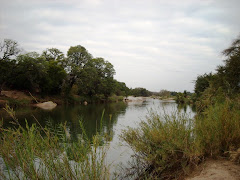
Nile monitors (Varanus niloticus) hang out near permanent water. They're gifted swimmers, taking to the water when threatened (hence my toilet?) and using their long muscular tails for propulsion.
Photo posted on Flickr by Hyper7pro.

Apparently Magic had pursued the fleeing monitor into the toilet cubicle and, in the resulting tussle, one of them had knocked over an old ceramic toilet bowl that was standing behind the door. I don't know how long the pair had been forced to room together (I'd been away about five hours) but judging by the smell – a vile mixture of dog and monitor excrement - it had been a while.

Moving the toilet fixture proved challenging. It was too heavy to drag, so I had to use my feet again. But sharing a tiny cubicle with a highly stressed and impressively armed lizard, along with a large and anxious dog, was unpleasant enough without having to sit on the floor with them. The monitor, now hissing and puffing ominously, responded to my movements by lurching across the cubicle in a long-clawed scramble. Magic, I noticed, leapt out of its way with great alacrity. The creature came to rest on top of the cistern, puffing threateningly and lashing its hefty tail back and forth, alarmingly close to my face. Despite these impediments I eventually managed to shove the toilet fixture a few inches further from the door, and Magic shot out. The monitor was equally keen to leave, although it was kind enough to let me to go first.


Nile monitors call much of sub-Saharan Africa home and also paddle down the Nile into Egypt (hence the name). However, their popularity with reptile fanciers has taken them further afield and a feral population is now enjoying life in SW Florida. Photo by A & L Meintjes.

Magic seemed a little traumatised after this encounter (to be honest, so was I) but, in retrospect, she may simply have been feeling ill. It's now known that monitor lizards have special, venom-producing glands in their mouths. An MRI scan of the world's largest monitor, the Komodo dragon, (don't ask how) revealed six venom glands in its lower jaw, each drained by a duct leading to between the teeth. Researchers have detected venom in at least three Aussie species, but I don't think anyone has yet looked at the African monitors.

Monitor venom is a heady cocktail of ten toxins, seven of which are also made by snakes. Mixed with copious saliva and administered by a bite, the poison prevents blood clotting and dilates blood vessels, lowering blood pressure and inducing shock. When researchers injected rats with monitor venom, they went completely still (the rats, not the researchers... although, thinking about it, the researchers probably deserved it more).

But don't panic! Monitor bites aren't life-threatening; they secrete only tiny quantities of toxin.

But perhaps what's more interesting, is that while the researchers were trying to figure out where and when venom-production first began, they did DNA tests that revealed that monitors and iguanas (a couple of whom are also venomous) are more closely related to snakes than to other kinds of lizards (such as skinks, chameleons and geckos). Monitors and snakes shared a common great granddaddy (who was, of course, toxic) about 200 million years ago.


Nile monitors are surprisingly sociable creatures. They sometimes team up to pinch crocodile eggs (one lures mum away while the other excavates the eggs) and they often spend the winter months snugged up together, hibernating communally within a large rock crevice in a riverside cliff or koppie. Photo by Michael Ransburg.

Saturday, October 9, 2010

Holiday snaps


...and here I am waving goodbye at the airport...

Only kidding.

I'm currently revelling in being back in Africa where the mammals gallivant in the sunshine, flaunting their garish stripes and spots and ornamental tufts.
In Australia, it's all soft-pawed, nocturnal creeping; silent and cryptic and drab of fur (alright, roof-dwelling possums don't seem silent and cryptic at 3am, but you get the idea). Still I guess I'd be cryptic too, in light of Australia's extinction record. The continent has lost 27 mammal species in the last 200 years, and the trend continues...

Despite this horrifying statistic, I very much enjoyed my sojourn in Oz.
I'd like to tell you about all the exciting things I learned at the conference, but I can't. Scientific journals won't accept material that's already published, and posting stuff on a website counts as publication. So unless I want to be lynched, I can't write about anyone's research results. A bit frustrating.

However, I can write about the day trip. When the conference delegates began swooning from information-overload, the organisers packed us up and bussed us out to Paruna Wildlife Sanctuary, a woodland reserve east of Perth. It's owned by the Australian Wildlife Conservancy who assiduously lay out poisoned baits for those arch villains, the red fox and feral cat, and then reintroduce the region's small (sorry, medium in Australia) endangered mammals (e.g. black-flanked rock wallaby, southern brown bandicoot, brush-tailed bettong and tammar wallaby).

Of course, the stomping feet of 200 behavioural ecologists would put the wind up any self respecting animal (including your average hermit) so we didn't actually see any of the aforesaid rarities. Nevertheless, we had a jolly time pottering about peering at whatever oddities interested us. You could see the ant specialists lying on their stomachs beside obscure-looking holes, the spider aficionados craning their necks beneath wisps of web, and the ever-present birders hotly debating the identity of something small, brown and very far away.
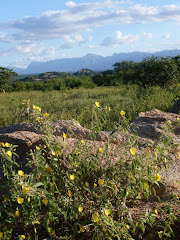
I breathed the eucalyptus-scented air, tried not to look for hippos in the dam and snapped poor-quality photos of the many wildflowers (which I'll now inflict on you).


The Paruna Wildlife Sanctuary forms a 2000 ha corridor linking two national parks.


This little sundew digests ensnared bugs to get the nutrients which are unprocurable from the ancient leached soils.


Like all kangaroos, the western grey (Macropus fuliginosus) is a master at milk manufacturing. Because the needs of a growing joey change with age, mother roos fine tune the chemical composition of their milk to fit the bill. But what's really amazing is that roo mums produce two different kinds of milk at one time.  One teat secretes milk suitable for the big joey hopping at foot, while the other caters for the smaller youngster who's still fixed within the pouch.


The Australian ringnecked parrot (Barnardius zonarius) is the most common parrot species in Perth. I have to admit that, living in Africa, I miss the ubiquitous presence of parrots: the colourful squabbling, the brilliant flashes as they clamber and dangle in the foliage, the fluting whistles of lorikeets and the wide-horizon shrieks of cockatoos.


Tuesday, October 5, 2010

When spring comes unsprung


Spring is here!
In theory.

It's just that spring here isn't like spring in Other Places.

You can forget the rising sap, unfurling leaves and frolicking bunnies and chicks (alright, I admit I've never actually experienced a Northern Hemisphere spring, but I've seen the Easter cards...)

Here spring is more like an intense bout of schizophrenia.
At night winter has a monopoly, with temperatures dropping to 8 C
(46 F), but as soon as the sun sneaks over the horizon, summer leaps in and the mercury rockets to the mid 30s C (95 F).
And the weather's not the only one refusing to take its meds.
After five months without rain, the bush is leafless, parched and grey. As you'd expect. Then whoosh (that's a figurative whoosh, not an audible whoosh), all the knob thorns burst into flower.


Knob thorns (Acacia nigrescens) are the dominant tree species here, so if they decide to bloom prolifically, when everyone else is playing dead, it's rather startling.


The knob thorn gets its name from its... er... knobs, which grow on the trunk and branches of young trees. Each knob is tipped with a single thorn, presumably to spike large herbivores.
 

In Africa, acacias are called thorn trees (rather than wattles) because of their weaponry. My tree guide (South African) puts it bluntly: 'Australian acacias are always spineless'. Even I feel that this is a trifle harsh.

All the local browsers (giraffe, kudu, bushbuck and impala) enjoy munching knob thorns, but I hadn't realised how sought-after the species was until I tried to take a close-up photo of its flowers. No go. Despite an exhaustive search, I couldn't find a single branch growing within my reach (kudus are considerably taller than me!). I trust you appreciate my dedication to blogging, as I had to dodge speeding traffic to snap an un-nibbled, highway-side specimen.


Hard-won knob thorn flowers.


With such a profusion of blossom, the local giraffes are looking rotund and smug. During the brief (2-3 week) flowering period, knob thorn flowers make up 25% of their diet, and they're currently swanning around dusted in golden pollen, and sometimes wreathed with creamy blooms. It's been suggested that giraffes may act as pollinators for the knob thorn, since the trees produce many more flowers than they need for seed production. However, research undertaken in Kruger National Park found that knob thorns growing in giraffe-free localities produced more seed than their giraffe-nibbled counterparts. And within trees munched by giraffes, seed-production was far greater in branches located above the giraffe's reach than in the branches they could access.


Munching knob thorn flowers isn't as pleasant as you'd think. They contain three times more tannin than the leaves. Tannins (which have that awful drying, astringent effect in your mouth) bind with the plant's proteins, making them indigestible.

Are giraffes pollinators or flower predators of Acacia nigrescens in Kruger National Park, South Africa? P.A. Fleming, S.D. Hofmeyr, S.W. Nicolson and J.T. du Toit. Journal of Tropical Ecology (2006) 22:247–253.

 
NB: I wrote this post a couple of weeks ago, but I was so busy emulating decapitated poultry (during the lead up to my overseas trip) that I didn't get around to posting it. Sorry!

Friday, September 24, 2010

Bugbears' own bugbear

Oh no, they're back AGAIN. I guess we'd better hide...


Come on!  I saw those little legless brown things again.


I know they were here somewhere...


I could've sworn it...


Sorry I haven't posted for a while but I'm currently suffering homesickness pangs in Australia. I'm here to attend a conference in Perth (International Society of Behavioural Ecologists) - and I haven't written my talk yet (arrgh!) - and to visit family and friends in Melbourne.
I should be back on line again in a week or so when I'm happily back on African soil.


Sunday, September 12, 2010

Flipless rock flipping


Today is international rock flipping day.

Nature bloggers from around the world are out there vigorously overturning boulders and stones, and recording all the grisly details of what's underneath.

Unfortunately, my intention to take part in this global event began to waiver as the big day approached. A little nagging voice kept whispering, 'Don't you encounter enough life-threatening beasties without going looking for them?'
My resolve was further eroded by today's cool, blustery weather – perfect for cobras, mambas and puff adders to be hiding snugly in subterranean crevices.

Maybe if I flipped only little rocks...

Of course, there were still the scorpions. But only two of the thirteen species that live around here are actually lethal to adults... If only I didn't have to stick my fingers under the to-be-flipped rock before I knew what was underneath!

Then this rock saved the day.


Alright, I admit I didn't flip it.
Herculean strength (like courage) is not one of my blessings.
To be totally honest, I wasn't even thinking about flipping rocks; I was crawling about in search of a trace of Koppiekats. As I peered into this crevice, diligently hunting for mongoose poop, I was startled to see an eye.

Can you see it?


Of course, the eye was equally startled to see me.
We gazed at each other for a bit, before I dashed to the car for my camera. I was jubilant. After all, I'd definitely found this creature under a rock - so it must qualify - yet I'd managed to evade 'death-by-venomous-beast'.

Appropriately, my saviour was a rock monitor (Varanus exanthematicus).


These heavy, thickset lizards grow to more than a metre (3 - 4 ft) and like to loiter in rock crevices, disused mammal burrows or hollow trees. This one was pressed as far back into its crevice as its bulk would allow. It had even folded its stumpy forelegs back along the side of its body for a better fit. Of course, you can't blame it for shyness; I wouldn't be forthcoming either if my scientific name meant 'skin eruptions' in Greek.

Impressive claws: all the better to scratch you with.

Of the 30 species of monitor that stalk the earth, only three live in Africa, and only two hang out here. I could see this one wasn't a Nile monitor (V. niloticus) because of its stubby, bulbous snout, and the weird placement of its nostrils (nearer its eyes than nose tip). Monitors (called leguaans in South Africa) have long forked tongues that they flick in and out as a snake does. Unlike most lizards, their tongues have no taste-buds, and are designed solely to pick up molecules and insert them - for chemical analysis - into the double opening of the vomeronasal organ on the roof of the mouth. However my prone monitor was clearly playing the cryptic card and appeared to be concentrating very hard on flicking nothing (maybe I just smell appalling).

This rock monitor (also called savannah monitor) was photographed on a previous occasion.

September is the season of love for rock monitors, but I'm not up on how to sex non-furred critters; particularly ones that defend themselves by lashing a hefty tail, biting and holding with bulldog-like tenacity, and squirting out the nauseating contents of from their cloacae. Of course, if all else fails, they sham death. I could probably handle that.

If this one was female, she'll bury her 10 to 40 eggs (soft-shelled and the size of small hens' eggs) in a deep pit dug in the rain-softened soil. Although the eggs take four months to hatch in captivity, out here it's usually twelve. Why? Well there's no point in leaving your egg if the soil above you is rock hard because of the dry season. Does this mean - that at this very moment - there are hundreds of little monitor lizards sitting inside their eggs, drumming their toes and waiting for the rain? Well I never.

Although rock monitors mostly dine on millipedes, beetles and land snails, they're also very fond of carrion and any animal small enough to scoff down (including mongoose pups). Do you recognise the crevice in the photo below? Yep, it's the same one; only here it's sheltering a little Koppiekat pup.


 To discover what other exciting creatures the world's (much braver) rock-flippers have found, visit the compilation at Wanderin Weeta.

Sunday, September 5, 2010

Castanets at 50 paces


When you're out in the bush on your own, miles from anywhere, bumping into people is seldom a good thing.

So when I heard the sounds of someone hammering in stakes I was worried.
Clonk, clonk, clonk... pause.
Clonk, clonk, clonk, clonk....
The sound was rhythmic, and quite close by, but the bush was just too thick for me to see what was happening.

Who could it be? I knew the park staff weren't working in the area. And it wasn't a bird (although admittedly some of them make some pretty weird clicks and thunks).
Didn't poachers knock in stakes when setting snares?
I stood listening anxiously to the intermittent hammering until I realised that the source of the sound was moving. It shifted slowly, in fits and starts, in a wide arc around me, as if the perpetrator knew exactly where I was. That freaked me out. I hurriedly packed up my gear and headed home. I didn't know who was knocking in pegs, and I didn't want to find out!

This incident occurred during my first months working with the mongooses, and the mystery of my phantom stake-basher remained unsolved. Once or twice a year, I'd catch a momentary hint of the same noise again, but it was always fleeting and very far off.

It wasn't until last February, when my old Toyota bakkie/ute/pick-up/van (depending on which continent you call home) uttered its terminal splutter, that I finally learnt the truth.
While my car enjoyed a rejuvenating overhaul, the university lent me a rental car: a tiny, three-door hatchback that was incapable of passing over an apple without creating pulp. Trying to coax this thing along the rough, rocky tracks at my study site was a nightmare. It took me hours to reach the groups, inching around boulders and over culverts, sliding across sand-filled creek-beds and braving the paint-scratching embrace of overhanging thorn bushes. Oh, and did I mention it was black? In February. Who would purchase a black car in a region where midday temperatures play cat and mouse with 40C for nine months of the year?
Anyway, it was while I was edging along in my sweaty little black box - fervently cursing all car manufacturers and university administrators - that I met a herd of eland.


Eland (Tragelaphus oryx) are incredibly shy of people, avoiding all signs of human activity. They've the longest flight distance of all African game (300-500m), presumably thanks to thousands of years of human carnivory. Photo borrowed from here.

Although eland are common here, I very rarely see them so I stopped my travesty of a car to watch as they fled into the bush. Only they didn't. They just stood staring at me. Then they started walking toward me. As they inched closer, I suddenly realised I was an utter novelty; no one had ever been insane enough to drive a tiny hatchback out here.
Eland are massive, hefty animals, air-brushed in salmon-pink and equipped with tall, erect horns embellished with a candy-cane twist. Being the world's largest antelope, they towered over my car, crowding around cautiously to peer and snuffle at this strange new animal. I gazed back in awe, stunned by the amazing privilege (it's an ill wind...).

Then it happened.
I heard the clonk, clonk, clonk of my phantom stake-basher.
It took a while, but I eventually figured out that it was emanating from a large eland bull. What was wrong with him? Was he suffering some ghastly form of arthritis?

Once I (eventually) made it home, I trawled the literature. Sure enough, there it was: mature eland bulls make a castanet-like clicking when they walk. It's audible for several hundred metres. But why? Surely it's a 'come and get me' invitation to predators?

This is where it gets interesting. Eland are nomadic creatures who congregate in loose herds, often hundreds of animals strong. Although the herds are constantly changing composition, the bulls maintain a strict hierarchy, with only those at the top wooing the females. But how does a randy eland bull, joining a herd of strangers, figure out where he fits in? He clearly can't test out everyone, yet he needs to know how strong each male is (i.e. how big), how experienced he is (how old) and how aggro he's feeling (because eland bulls aren't all equal in the testosterone stakes; like elephants in musth, they go through periods of heightened aggression, called 'ukali'). The answer? He looks and listens.

A macho eland bull parading his signals. Photo by Blake Matheson.

Research by Jakob Bro-Jørgensen, in the Masai Mara Game Reserve in Kenya, found that a bull's dark face, his woolly forehead tufts (normally smeared with urine for added effect) and his grey colour (due to balding) are all features induced by testosterone, the hormone that also promotes aggression. By checking out these traits, a strange bull will get a pretty good idea of how antsy a rival is likely to be. (Note to self: steer clear of dark grey eland bulls). In contrast, the bull's goitre-like dewlap grows bigger over time, regardless of his size or hormone levels, so accurately reveals his age (and hence experience).

But the most ingenious of an eland bull's signals, is their weird knee-clicking. This clonking sound is generated by the leg tendon slipping over the carpal bone. And it works just like a plucked guitar string, with the pitch (or frequency) of the click varying precisely depending on the length and thickness of the tendon. Hence, the bigger the bull, the deeper his knee-click. Bro-Jorgensen found that the pitch of the knee-click didn't just reflect skeletal size but muscle mass too. When one of his study bulls lost body condition, his knee-click got higher, as the thickness of his leg tendon shrank in response to the dwindling muscles.
So canny eland bulls can figure out the size of a potential rival from a distance and - if the 'stake-basher' is threateningly big - skedaddle before he arrives.


 Fighting in eland bulls is extremely rare, testament to the efficiency of their 'look and listen' signalling system. Photo posted on Flickr by kibuyu.

Bro-Jørgensen J. and Dabelsteen T. 2008. Knee-clicks and visual traits indicate fighting ability in eland antelopes: multiple messages and back-up signals. BMC Biology, 6:47.
Related Posts Plugin for WordPress, Blogger...