Saturday, November 13, 2010

Look before you leap


When I was fourteen I met the love of my life.

Alright, I admit it, he wasn't human.

He was a small Arab gelding. Dark chestnut and flaunting a blonde mane and tail, he danced along with all the grace and elegance of his breed.
And for me - during my fraught teenage years - he epitomised everything joyous and good.

Of course being highly strung (the horse not me), he also had his foibles. For example, he refused to set hoof in puddles (not an issue in the Arabian desert but endlessly problematic during Melbournian winters). But his most distressing eccentricity related to jumping.

Without fail, we'd come galloping boldly up to a hurdle, only to have him slither to an abrupt stop with his chest almost against the bar. He'd then carefully inspect the far side of the obstacle and, once he'd ascertained a lack of large, fanged beasts lying in wait, he'd rear up on his hind legs and leap the obstacle from a standstill. As you can imagine, this was miserably uncomfortable for me, and utterly heart-stopping to watch. Nevertheless it seemed to work, and the dire predictions of everyone who'd seen us in the jumping ring (that sooner or later he'd kill us both) never materialised; he remained my dearest companion for almost 25 years.

Why am I telling you this? Because since coming here, I've realised that my horse's idiosyncratic approach to show jumping wasn't that idiosyncratic at all.

Take yesterday for example. While out on our evening stroll, the dogs and I met a kudu. Now kudus are my all-time favourite antelope. They're regal and stately, and they stand 1.4 m (4 ft 8") at the shoulder. They remind me of those computer-enhanced images of lingerie models, where the elegant legs just go on and on. Clothed in soft fawn or dove grey, kudus are drizzled with trickles of white, to break up their outline and help them blend in. And their faces are simply gorgeous: huge ears, an irresistible bambi nose and big dark eyes.

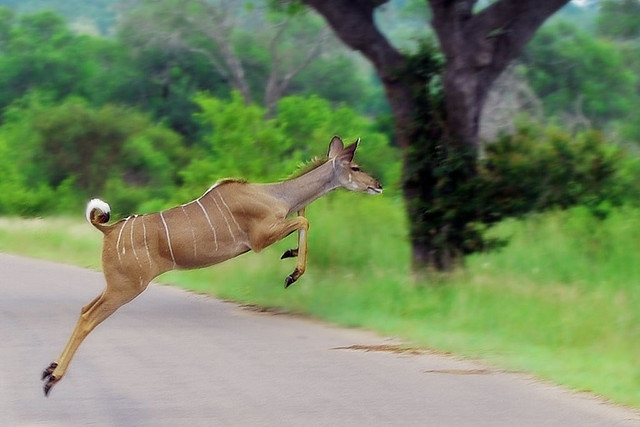
The horns of the greater kudu (Tragelaphus scriptus) are the longest of any antelope, reaching 1.8 m (6 ft) in length. When making a getaway through the dense thickets in which they live, kudu bulls raise their chins like haughty aristocrats, so their horns lie harmlessly along their backs. Photo by Arno & Louise Meintjes.

Yesterday, as we ambled along a track that follows a game fence, the dogs heard something in a thicket on the fence line. Trembling with eagerness, the pair dragged me forward. I couldn't see what was hiding there (kudus put their camouflaged coats to good use, freezing in the face of danger) until we were about 12 m (40 ft) away. Then a huge kudu bull leapt out. Much to my surprise he didn't gallop away from the fence, he just gave one massive leap (from a standing start) up and over the 2.3 m (7 ft 6") fence. There was a ricocheting boing as his forelegs rapped the top wire and the fence swayed precariously, but the knock didn't slow his flight and within seconds he was gone.
With my usual photographic ineptitude, I failed to capture the event but I did snap a dreary photo of the kudu-less fence, once all the excitement was over.

The fence the kudu leapt. Grubby husky included for scale.


Careening kudu. Renowned for their jumping ability, greater kudus can easily clear 2.5 m (8 ft). Photo by Arno & Louise Meintjes.
 
Thanks to this impressive disregard for fences, kudus are free to indulge in seasonal pilgrimages. I don't see hide nor hair of them in the wet season (because they're off roaming far and wide) but once food gets short, they all come trooping back, to hang out near the koppies and the river. Kudus dine almost exclusively on foliage and, because of their size, they need plenty of it; especially the males (who are 50% heftier). Late in the dry season, I often come across emaciated bulls tottering about, and many starve if the rains are late to arrive. A study in Kruger found that a six-year-old kudu bull (who's just attained adult size) has only a 50% chance of reaching his seventh birthday. In contrast, svelte lady kudus often live to fifteen.


Crown of thorns. Cryptic and stealthy, greater kudus are able to survive outside protected areas and are gradually infiltrating much of their former range (after rinderpest epidemics almost annihilated them early last century). Photo by Arno & Louise Meintjes.

 
Fortunately, all the kudus I've met this year are looking OK (thanks to the heavy rain last April) so I don't have to feel guilty about chasing them over fences. But the prodigious leap I witnessed was by no means unique. I've also seen impala, bushbuck, duiker and eland leap over large obstacles from a stationary start. And, thinking about it, both my dogs and cats jump from a standstill. Maybe my darling horse was just behaving naturally??


When love is in the air (around May), kudu bulls slap on the neck muscles. Why? Because rival males lock horns and neck-wrestle to win the hoof of lady kudus.
 Photo by Arno & Louise Meintjes (who clearly share my love of kudus).

Saturday, November 6, 2010

Rain


Last night we received our first good dowsing of rain.

Although the runoff seeped in to flood my kitchen, and the pets took fright at the golf-ball sized ice-chunks crashing on the roof, we're now all celebrating (a doubling of chocolate consumption).
  
Well, perhaps all isn't strictly accurate, since the composition of my household has undergone a change.
 
Last night all my resident red toads (eight, it turned out) lined up at the door to be let outside. As they hopped off into the rain to do their froggy thing, I felt I should be waving a handkerchief or something. But as they say, 'Nature abhors a vacuum', and I now have several foam nest frogs calling the place home.
 

A foam nest frog (Chiromantis xerampelina) enjoying the view from my curtain rail.


After one light shower of rain last week, the bush is already edging its way toward green. Its absolute faith in the coming of rain terrifies me. I guess I spent too long in the Kalahari where all the plants lie doggo until there's been enough rainfall for them to sprout, bloom and set seed all in one hit.

With everything breaking out in leaf and the air scented with flowers, the first summer migrants are starting to wing in. I heard a red-chested cuckoo calling for the first time this morning (cause for nervousness, no doubt, in all hairy caterpillars, thrushes and robin-chats).

Red-chested cuckoo (Cuculus solitaries). Photo by Johann du Preez.

I'm now going to inflict on you photos of some of the flowers that are currently burgeoning (sorry, I can't resist them).


The mopane pomegranate (Rhigozum zambesiacum) pins its sweet-scented flowers on a stark thicket of bare twigs.


The weeping boer-bean (Schotia brachypetala) literally drips nectar, attracting a deafening buzz of insects. Around here, these trees grow almost exclusively on termite mounds, sucking up the moisture generated by these little control freaks (a mound is not a home unless it's humidity-controlled!). Every man and his dog (well maybe not his dog) eats this tree: starlings, monkeys and baboons scoff the flowers, antelope nibble the leaves, and both monkeys and people chomp the carb-rich beans (apparently you roast the pods). Oh, and black rhinos (who've presumably been partying) like to gnaw the bark, which is said to cure heartburn and hangovers.


The red bushwillow (Combretum apiculatum) is a handy plant for practical jokers. The seeds, although consumed by birds, are poisonous to humans, causing prolonged hiccupping.


Natal plane (Ochna natalitia). These lovely perfumed flowers last only a day or so. Then they fall to create drifts of golden petals.


The blood flower or fireball lily (Scadoxus multiflorus) is utterly bizarre. Once a year it sprouts a single flower head (26cm/10" across) comprised of about 200 individual flowers. Laden with alkaloids, the plant snuffs out livestock, and is used to coat poison arrows in Cameroon and Gabon, and as a fishing poison in Guinea and Nigeria.


Another species of plane (Ochna spp.) that I've yet to identify.


The migratory yellow-billed kites (Milvus aegyptius) began to rock up last week. Each morning at dawn, as I drive to the study site, I follow one skimming along the road – kilometre after kilometre - searching for beasties that were flattened in the night.
Photo by Matt MacGillivray.

Friday, November 5, 2010

Monkey see, monkey do (well, sometimes)


Do you ever feel unappreciated?
As if others just aren't noticing the effort you put in?

The feeling's not uncommon. And not only in people.
Male vervet monkeys also have cause to feel this way.

Even as I write, a small troop of vervets are sitting nibbling bushwillow flowers in the trees outside my window. Mostly I only glimpse some soft, smoky fur beneath the foliage, but now and again there's a quiet churring call or a small sooty face pops out from the leaves to peer down at me. Some of the group are now heading off; they shinny down the tree's lower branches, dangling from the sagging twigs and dropping into the soft river-sand below. One little youngster, dancing after its Mum, executes the manoeuvre as a cartwheeling back-flip, landing with all the aplomb of an Olympic gymnast's finale. I feel a bit ashamed that I've made no effort to get to know the individuals in this troop, and I can't tell you which ones are male.

Vervets monkeys (Chlorocebus aethiops) are highly sophisticated critters. They converse by means of 36 distinct calls and more than 60 gestures. And they can recognise every monkey in their troop, as well as members of their neighbouring troops, simply by voice.
Photo by John Tolva.


Like most monkeys, vervets are intelligent, inquisitive and opportunistic (as you're likely to discover, to your cost, at picnic and camp grounds throughout their range). Their remarkable talent for exploiting new opportunities is at least partly due to a willingness to learn new things from one another. However, recent research - by Erica van de Waal from the University of Neuchatal, Switzerland – shows that not all monkeys are equal when it comes to passing on new skills.


Up to new tricks. Photo by Martin Heigan.

Erica presented natty little fruit boxes to six wild vervet troops at Loskop Dam Nature Reserve. Each box housed a slice of apple that was accessible via two different doors. She taught one monkey (either the dominant male or the dominant female) in each troop how to open just one of these doors, and then she presented the snack boxes to the whole troop. The vervets quickly learnt how to pilfer the apple, but the troops differed in the technique they used. In troops with a trained matriarch, almost all the monkeys used the same door as she did (suggesting they'd learnt the skill from her), but in groups where the dominant male had been trained, the monkeys were just as likely to use either door, suggesting they'd learnt by trial and error.

But why the difference? It seems that although the troop's leading man monkey fathers most of the troop's infants, he doesn't actually rate much notice with his group mates. Erica found that the vervets simply didn't bother looking at the dominant male, so they didn't see how he opened fruit boxes. In contrast, the group's first lady was the centre of the group's attention for much of the time.


Restoring self-esteem. Male vervet monkeys perform the, so called, 'red, white and blue display' to intimidate male group mates. (Warning: do not try this at home, even if you are feeling overlooked.) Photo by Louise and Arno Meintjes.


You see, in vervet society, females believe in hearth and home. They spend their entire lives in the troop in which they were born, and so they develop very strong bonds with their sisters, aunts and nieces. Which, of course, translates into paying lots of attention to 'the girls'. In contrast, young males must pack their bags (metaphorically speaking) at around five years old. Most choose to sign on with a troop that includes someone they know (e.g. an elder brother) but they usually change groups several times during their lifetime. Thus their ties - and importance - to the group are not so deep.
Interestingly, this set up means that new innovations are slow to spread through the vervet world (since incoming males are unlikely to pass on their bag of tricks) and – over time - cultural differences will burgeon between different vervet troops.

So if you're feeling unnoticed and unappreciated, at least you can be pretty sure that no one's going to steal your innovative ideas (or, for that matter, your fruit box).


Keeping it in the family. Vervet territories are passed down from mother to daughter; generation after generation. It horrifies me that people shoot encroaching vervets (so the troop will 'go away') when their house is built on land that's belonged to a vervet family for many hundreds of years. Where is the troop supposed to go?
Photo by William Warby.

E. van de Waal, N. Renevey, C. Monique Favre, R. Bshary. 2010. Selective attention to philopatric models causes directed social learning in wild vervet monkeys. Proc. R. Soc B.


Monday, November 1, 2010

Beasts for the bedridden


"The universe contains any amount of horrible ways to be woken up...

A dog's wet nose is not strictly speaking the worst of the bunch, but it has its own peculiar dreadfulness which connoisseurs of the ghastly and dog owners everywhere have come to know and dread. It's like having a small piece of defrosting liver pressed lovingly against you."

Terry Pratchett (Moving Pictures)


This quote holds particular significance for me this week because I spent the better part of it in bed, fighting off the horrible ravages of malaria (you're allowed to use phrases like 'horrible ravages' when you've got a bona fide tropical illness).

It's only been 'the better part' because of the regular intervention of the aforesaid noses. Oh, and don't let's forget cats' whiskers; equally unnerving when pressed into the face of a sleeper.

Of course their eyes are reproachful:  you know it's time to let us out...  feed us breakfast...  refill our water bowl...  turn on the air conditioner...  clean out the litter tray...  take us walking...  prepare our dinners...  shut the leopards out...

They've watched with deep concern as I trembled and shook, coughed and spluttered and fed-the-fishes (a phrase that's not as euphemistic as I'd like, given the state of the house's plumbing). Being cynical (a consequence of the illness, I'm sure), I couldn't decide whether they were genuinely worried about me or simply monitoring symptoms indicative of their continued neglect. But on Friday I decided it WAS true love. When I ate my first meal for four days, I had an utterly transfixed and joyous audience; and no one tried to beg a thing!

Being bedridden restricts one's wildlife encounters, so I thought I'd write a nice gentle post about the vervet monkeys who hang out in the trees beside my bedroom window. I love these little guys, silvery-furred and lithe, they're like wood sprites or dryads as they dance through the foliage. But my contemplative mammal post was not to be. The local wildlife came inside.

On Thursday night I was just drifting off to sleep - in a semi-drugged daze - when I felt something brush against my thigh. Magic's tail, I wondered? Tentatively I reached down and felt about a bit: no tail. Magic was lying too far away. Since our recent serpent-visitations, we've all been a little paranoid (Wobbly Cat still hasn't placed a paw outside and Magic won't sleep there), so I decided miserably I'd better wake up and check it out. I groped sleepily for my torch and shone the wavering beam toward my feet.

Within seconds I was out of bed.

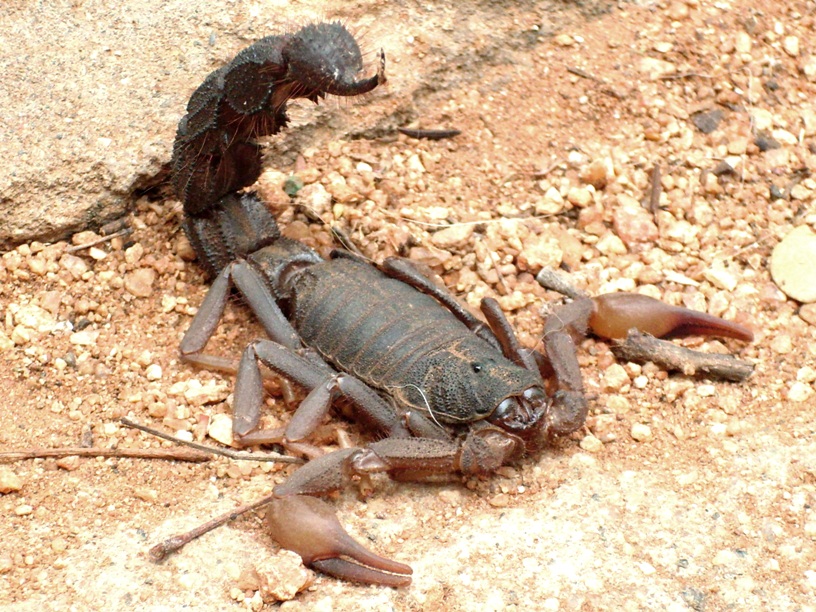
There was a large black scorpion crouched among the sheets.
It was about 12 cm (5") long with a huge armoured tail upraised threateningly over its back.

Oh, S#%*T!

It wasn't just any scorpion, it was a Parabuthus transvaalicus, one of the most lethal scorpions in southern Africa.

ISN'T MALARIA ENOUGH? I thought in anguish.

Parabuthus transvaalicus grows to 15 cm (6") long. But size isn't what counts. As a rule of thumb (although it's best to keep them out of the way), your scorpion-related panic can be accurately tuned by examining the beasty's body bits. Scorpions with whopping pincers live hand to mouth, so to speak, crushing their prey to death, and so they have wimpy tails and weak venom. But scorpions (like this one) with petite little pincers kill with their sting (both prey and those that piss them off) so they have hefty tails that produce lots of lethal venom.


Trying to ignore my throbbing headache, I began bundling the pets out of the room.
Fleetingly I considered taking a photo, but thought 'To hell with the blog'. (Forgive me, dear reader, but I'm sure it was the wicked malady speaking, and I also remembered I'd taken a few shots of a dead specimen in the garden last August.)

Wielding a plastic drinking cup, I rumpled the sheets behind the scorpion and it obligingly trundled into the cup. Then, while stuffing a blanket over the beaker, I fumbled it and the scorpion scuttled out again. Not good. I should probably point out, at this stage, that this species doesn't just sting like normal scorpions, it can also spray it's venom for distances of about one metre/yard. Thankfully, it didn't. My second attempt was more successful, and despite a few nervous moments, trying to keep the lid on the cup with my chin while unlocking the back door, the release went smoothly.

While I'm not keen on scorpions, I have to admit their interesting little guys; especially when it comes to romance.
After following the trail of his true love's pheromones, the smitten male performs a little tap dance, juddering his body, tapping his pincers or wagging his tail (depending on his species). His lady detects these 'love vibes' through highly sensitive hairs on her feet and body, and sensibly curbs her predatory inclinations. Next the couple embrace, lovingly locking pincers or - more intimately - mouth parts. The male then whisks his sweetheart into a waltz (lasting 5 to 30 minutes), fanning out his pectines (fluffy sensory combs on his stomach that feel the ground) in search of the ideal place to consummate their love. The dance only halts when he finds a smooth hard surface. Here he deposits his spermataphore: a little package of sperm that's sticky on the bottom and hooked at the top. Once it's stuck firm, he helps his paramour move above it; they have to get the position just so, because the hook on the spermataphore must catch and pull open the covering of her genital opening. Ain't Nature grand!

While this is the end of the story for the male, the female's destined to a 2 to 18 month pregnancy (depending on her species). She then gives birth to live young, a feat virtually unheard of among arachnids. Withdrawing to the safety of a burrow or shelter, she arches her tail over her back and places her front two pairs of legs beneath her genital opening to create a birth basket for the emerging babies. She then helps the newborns (tiny, but pale and soft, versions of the adult) clamber up on to her back. Here they remain, safe and snug, (while she forgoes foraging) for their first 9-14 days.


Parabuthus transvaalicus' monstrous tail churns out large quantities of neurotoxin (drop for drop as potent as any snake's). It causes severe pain, muscular cramps, uncontrolled limb movements, numbness, difficulty breathing and swallowing and death by respiratory failure (depending on the victim's body size and health- yikes!). To be fair, the species also uses its tail to excavate burrows, and to sing. Metaphorically. It emits a 'chick-chick' sound by rubbing its sting against the roughened surface of its second tail segment. Oh, and those spiffy hairs detect the air vibrations generated by hapless prey.


Sharing a bed with a scorpion is not my idea of fun, especially when I'm already feeling under the weather. But my sense of persecution evaporated instantly when I read the latest blog post by the hyena researchers  in the Masai Mara Reserve in Kenya. Oh my! I urge you to check out  what intruded on their sleep this week. Your life will suddenly seem so much better!

Sunday, October 24, 2010

Uninvited house guests


Last Wednesday was an evening for unexpected visitors.

And unwelcome ones.

I was alerted to my first caller by the dogs. I could tell that they weren't just indulging in their usual nightly spat with the porcupine: they sounded threatened.

Dashing outside, to drag them away from whoever might be about to do them in, I wondered whether I'd run headlong into a leopard (they're forever leaving their paw prints round about). But what I discovered was the back half of a very large African rock python (Python sebae) disappearing into my outside bathroom. The dogs were too afraid to attack (ahh, thank goodness for the salutary effects of an eyeful of cobra venom), but were creeping after it, hackles raised and necks outstretched. Wobbly Cat was standing nearby looking like a feather duster who'd suffered electric shock therapy.

The python, hissing stridently (I've never heard a snake actually hiss before), slithered in among the boxes and paraphernalia I store in this unused bathroom, before wrapping itself around the sink plumbing. At around 2.5 - 3 metres (7-9 ft), it wasn't as big as the one that plagued us last summer, but it'd still see my cats as nothing more than appetite-piquing hors d'oeuvres.


I quickly bundled the pets into the house, to prevent any mishaps, and left the snake to entertain itself amongst my worldly goods.


I'd no sooner got all the animals safely shut in the house, than I turned round to see Wobbly staring transfixed at something under the dining table.

Oh God, another snake!

After a scuffle, I managed to drag, shove or carry everyone (except the snake) into my bedroom and squeeze shut the door. Step one complete. I then fetched my tried-and-true snake removal equipment: the kitchen broom and a poster mailing tube.

Well, at least this one was small. In fact, it was only around 0.5 metres (1.5 ft) long, strangely two-toned (glistening black above and white below) and entirely new to me. With great presence of mind (something I tend to relinquish in the presence of snakes), I snapped a couple of blurry photos as it coiled and uncoiled nervously on the concrete floor. Actually, it looked pretty innocuous; after all, it wasn't hissing or puffing, spitting or threatening to strike. In fact, when I got a bit closer I realised that what I'd assumed was its head, upraised and ready in defence, was actually its stumpy tail (as you can see in the photo). It had tucked its head safely away undercover. Aww, the poor little creature; I could almost see it covering its eyes with its hands and trying to be invisible.

Bibron's burrowing asp (Atractaspis bibronii) also labours under the names of southern stilleto snake, mole viper and side-stabbing snake. Living underground, they like to dine on burrowing reptiles, frogs and little baby rodents. When they encounter a nest of these little cuties, they slither about incapacitating several before indulging in their feast.

Any normal person, I told myself, would just pick it up and carry it outside. But I'm not a normal person. I'm the product of a childhood of indoctrination (by a mother determined to keep her animal-loving offspring alive in a land where almost all snakes are lethal). As a concession, I put aside my poster tube and gently shoved the little creature toward the open door with the broom. It writhed about with weird jerky movements, its head flicking sideways, so rapidly and frequently, it looked as if it had some awful nervous palsy. I'd never seen any snake behave like this.

After I'd persuaded it out the door (and had released the jostling pets), I sat down to identify it.

Oh. It wasn't harmless after all.

In fact, it was quite extraordinary.

It was a Bibron's (or southern) burrowing asp and - I was startled to learn - it and its kin (other burrowing asps) have the longest fangs, relative to skull size, of any venomous snake.
Their huge venom glands (which extend for up to 20% of their bodies) churn out a highly toxic brew that zaps your heart and blood pressure, and induces arterial spasms (now there's a symptom you don't see every day). North African species regularly kill people, but the bite of my common, under-the-table variety just leads to pain, severe swelling, blistering, necrosis, nausea, dryness of the throat and vertigo. You can read, here, the stressful story of someone (sans snake phobia) who made the same mistake as me. But read it LATER, because the really interesting bit is still to come!

You see, what's fascinating is that the impressive fangs of these little snakes are designed for underground use. And you can't rise up and strike in the tight confines of a burrow. So how do they prepare dinner? They've opted for the method favoured by street thugs the world over: they sidle up beside their victim and, without so much as opening their mouths, stab them in the ribs.

Their long fangs, located in the front of their upper jaw, actually lie horizontally in the mouth, pointing back toward the corner of their lips. To make room for this weird arrangement, they've had to sacrifice virtually all their other choppers (making swallowing food a pain - well, actually, a series of wriggles – in the neck). Their fangs have a hollow central tube (like a hypodermic syringe) and the tips are keeled for slicing flesh (all the better to get the venom in). When they want to stab a victim, they only have to shift their jaw a bit to one side, so a fang protrudes from their lips, and then jerk their heads down and sideways: POW!
So when my little house guest appeared to be suffering dreadful trembling palsies, it was actually biting the Hell out of the fluffy nylon bristles of the broom. Just shows, you never can tell.

These snakes are particularly problematic because you can't hold them safely behind the head; they just stab you out of the corner of their mouths. You can see a photo of one stabbing a baby mouse here. The Bibron's burrowing asp is also unusual because it has a sharp spine sticking out of the end of its tail (actually a continuation of its... well, spine). Browsing herpetological websites (oh, the shame), it seems that this anatomical feature further complicates things because care-givers of captive beasts (the species is popular for venom studies) often can't be sure whether they've been spiked by a tail or a tooth!


I included these photos, just in case you don't believe that African rock pythons can kill and eat large beasts (such as heedless huskies). This one has constricted to death an imprudent impala.
Photo by Arno and Louise Meintjes.

And this one is just finishing off a tasty steenbok.
Photo by Alex Griffiths.


Sunday, October 17, 2010

House of Herps No. 11

Welcome to the October edition of the House of Herps blog carnival.

Before I go further, just let me clarify that ‘herps’ are reptiles and amphibians (as in herpetologist), NOT unpleasant, sexually-transmitted diseases.

It’s late in the dry season here.

With no rain for six months, the ground is parched and bare, the trees are leafless, and the wildlife, bony and gaunt.
Temperatures rise into the 40s C (104 F), sapping the last moisture from everything, living and dead.

But the rains may come any day.
Or not.

Almost palpable, spoken silently by plant and animal alike, is the question: can I survive until it comes?

Watching this saga, day after day, as the rainclouds build up and then drift away again, I’ve come to appreciate why humans - in every culture and on every continent - turn to superstition and ritual in a bid to influence Nature.

With so many of the ancient rain-making rituals focussing on reptiles and amphibians, hosting House of Herps seemed a great opportunity to enlist a bit of help in my very non-scientific endeavour to bring-on the rain.

So grab your umbrella and come join our rain-making festivities.


RAIN-DANCING
Get ready to rock!
For millennia, people have been boogying for rain.

To call up rain, the Karen people of Thailand and Burma, sway to the beat of 'frog drums', whose bronze tympanum is adorned with rain-inducing amphibians.

Bronze frog drum (2nd century AD). The little lumps are frogs.
Photo by IAMCP30 (Flickr).

In China, it's the dragons (surely up there with dinosaurs as the ultimate herp) who fly up to the clouds for rain, so extravagant dragon-dances are the go. The one you see at Chinese New Year began life as a rain-making ceremony.


Photo by Christopher Chan.

 
Photo by Marion Doss.

But if you can't snare yourself a dragon, don't worry, a snake will do. To conjure rain, the Zuni and Hopi tribes, of south western USA, hold a live venomous snake in their mouths as they bop. The snakes, released at the end of the performance, act as emissaries, carrying the peoples' prayers to the Gods. The ill-starred Hopi rattlesnake (Crotalus viridus nuntius) is even named after its occasional participation in this shindig.
 
So today, join Cindy at Dipper Ranch, who - in this grand festive tradition - takes her serpent emissary to a party. How do her neighbours react when their small guest shows its stripes (well, spots actually)? Will they dance?? Find out here.

If you’re having trouble carrying your rattlesnake in your mouth, help is on hand. Join Elizabeth, at Yips and Howls, as she dabbles in the art of rattlesnake transportation and demonstrates a practical alternative. Please bring your own aluminium pail.

But before you get too complacent, thinking that we’ve got rain-production in the bag, pay a visit to Explore Missouri. There’s a problem, you see: the susurration of rattlesnakes is disappearing. Why are our divine messengers growing mute? Shelley explains here.


GIFT-GIVING
There's nothing like a bit of bribery to get things done.
And it's a time honoured tradition when it comes to rain-making.

To break a drought, the Nguni Zulu of southern Africa bribe a large python (hugely potent in watery affairs) by slaughtering a pure black goat and laying out its skin; the python slithers in after dark to lick up the fat. Meanwhile, in Sudan, the Lafofa people (whose shaman transforms into a red snake) spill milk on a hilltop for rain-begetting serpents, and, in Nigeria, the Bubbure people dress in sackcloth and ashes and offer munchies to the Rulers of Deep Pools: the crocodile, python and water monitor.

So join me here, at Mainly Mongoose, as I strive to give the gift of freedom to one of these sacred monitors. Unfortunately, it proves a little difficult (toilets and Water Gods just don't mix).

Across at Philly Herping, Bernard contemplates sacrificing chipmunks to placate his missing rattlesnakes. But despite injury, disappointment and obscenities, what he conjures in the end is just as alluring. Check it out here.
 
The Aztec god Xolotl was allied to death,
fire & lightening. Photo by Pablo Necochea.


Then drop by Beetles in the Bush to gawk at the dazzling creature Ted finds while in pursuit of beetles. Although these critters suffered some seriously bad press at the hands of the Aztecs, the Huichol people of Mexico believed they were agents of the Rain Mother, stirring the clouds for rain. Join Ted as he plans a smorgasbord of delicious offerings for his new family member.


RITUALS
If partying and bribery don't work, why not try rituals.

To save their withering crops, Bangladeshi villagers host a lavish wedding ceremony: for two live frogs. The happy couple - their foreheads daubed with red - are paraded through town in a special basket. After the ceremony (staged on a banana leaf) and plenty of feasting, the villagers release the newlyweds into the village pond.

The ground agama (Agama aculeata) defies its
name by sitting about in trees. Photo by Johann du Preez.
The rain-making rituals of the San bushmen of southern Africa are much more practical: they shoot arrows into the thorn trees. Why? Because the Agama lizard is associated with !Khwa, the Rain. "The lizard lies up on the thorn tree; it keeps its head toward the place where the north wind blows and bewitches the clouds". Only when the lizard is persuaded to get down (by the sound of arrows whistling past its ears) will the rain come.

Join Amber at Birders Lounge as - armed only with a camera – she tries valiantly to disturb some laidback lizards. Of course, there's good reason why these jaunty little guys wouldn't hear the whoosh of a passing arrow...

But perhaps the most innovative ritual is performed by JSK at Anybody Seen my Focus. She enlists the help of a charming anole to enact the miraculous transformation that the bush undergoes after rain. Don't miss it.


WORSHIP
It takes time, it takes resources, it takes commitment; but deifying a herp has its payoffs.

Can millions of ancient Egyptians be wrong? (rhetorical question).

The Egyptian crocodile god, Sobeka, was as dangerous and unpredictable as his carnate representatives paddling in the Nile. He engendered fear and awe in his followers, who built him huge temples that housed dozens of bejewelled crocodiles, lazing by their pools. The beasts' remains were even mummified and entombed, with all the care given to family members.
Why go to all this trouble?
Because Sobeka controlled the waters of the Nile. It was He that brought the seasonal inundation, essential to the nation's crops and fisheries.

Sobeka's temple at Kom Ombo. Photo by Colin Goh.

So join Olivia, at Beasts in a Populous City, as she makes a pilgrimage through the hallowed halls of the Reptile House. Share her sense of reverence, and discover why the world's reptiles and amphibians deserve our veneration and awe.

And I'll be watching the sky!


THIS MONTH'S CONTRIBUTORS:
Anybody Seen My Focus
Beasts in a Populous City
Beetles in the Bush
Birders Lounge
Dipper Ranch
Explore Missouri
Mainly Mongoose
Philly Herping
Yips and Howls
 
Related Posts Plugin for WordPress, Blogger...