Friday, September 24, 2010

Bugbears' own bugbear

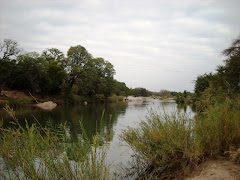
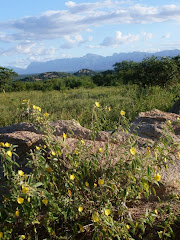
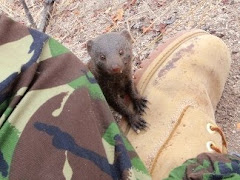
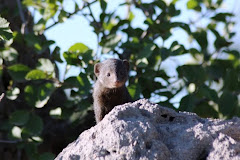
Oh no, they're back AGAIN. I guess we'd better hide...


Come on!  I saw those little legless brown things again.


I know they were here somewhere...


I could've sworn it...


Sorry I haven't posted for a while but I'm currently suffering homesickness pangs in Australia. I'm here to attend a conference in Perth (International Society of Behavioural Ecologists) - and I haven't written my talk yet (arrgh!) - and to visit family and friends in Melbourne.
I should be back on line again in a week or so when I'm happily back on African soil.


Sunday, September 12, 2010

Flipless rock flipping


Today is international rock flipping day.

Nature bloggers from around the world are out there vigorously overturning boulders and stones, and recording all the grisly details of what's underneath.

Unfortunately, my intention to take part in this global event began to waiver as the big day approached. A little nagging voice kept whispering, 'Don't you encounter enough life-threatening beasties without going looking for them?'
My resolve was further eroded by today's cool, blustery weather – perfect for cobras, mambas and puff adders to be hiding snugly in subterranean crevices.

Maybe if I flipped only little rocks...

Of course, there were still the scorpions. But only two of the thirteen species that live around here are actually lethal to adults... If only I didn't have to stick my fingers under the to-be-flipped rock before I knew what was underneath!

Then this rock saved the day.


Alright, I admit I didn't flip it.
Herculean strength (like courage) is not one of my blessings.
To be totally honest, I wasn't even thinking about flipping rocks; I was crawling about in search of a trace of Koppiekats. As I peered into this crevice, diligently hunting for mongoose poop, I was startled to see an eye.

Can you see it?


Of course, the eye was equally startled to see me.
We gazed at each other for a bit, before I dashed to the car for my camera. I was jubilant. After all, I'd definitely found this creature under a rock - so it must qualify - yet I'd managed to evade 'death-by-venomous-beast'.

Appropriately, my saviour was a rock monitor (Varanus exanthematicus).


These heavy, thickset lizards grow to more than a metre (3 - 4 ft) and like to loiter in rock crevices, disused mammal burrows or hollow trees. This one was pressed as far back into its crevice as its bulk would allow. It had even folded its stumpy forelegs back along the side of its body for a better fit. Of course, you can't blame it for shyness; I wouldn't be forthcoming either if my scientific name meant 'skin eruptions' in Greek.

Impressive claws: all the better to scratch you with.

Of the 30 species of monitor that stalk the earth, only three live in Africa, and only two hang out here. I could see this one wasn't a Nile monitor (V. niloticus) because of its stubby, bulbous snout, and the weird placement of its nostrils (nearer its eyes than nose tip). Monitors (called leguaans in South Africa) have long forked tongues that they flick in and out as a snake does. Unlike most lizards, their tongues have no taste-buds, and are designed solely to pick up molecules and insert them - for chemical analysis - into the double opening of the vomeronasal organ on the roof of the mouth. However my prone monitor was clearly playing the cryptic card and appeared to be concentrating very hard on flicking nothing (maybe I just smell appalling).

This rock monitor (also called savannah monitor) was photographed on a previous occasion.

September is the season of love for rock monitors, but I'm not up on how to sex non-furred critters; particularly ones that defend themselves by lashing a hefty tail, biting and holding with bulldog-like tenacity, and squirting out the nauseating contents of from their cloacae. Of course, if all else fails, they sham death. I could probably handle that.

If this one was female, she'll bury her 10 to 40 eggs (soft-shelled and the size of small hens' eggs) in a deep pit dug in the rain-softened soil. Although the eggs take four months to hatch in captivity, out here it's usually twelve. Why? Well there's no point in leaving your egg if the soil above you is rock hard because of the dry season. Does this mean - that at this very moment - there are hundreds of little monitor lizards sitting inside their eggs, drumming their toes and waiting for the rain? Well I never.

Although rock monitors mostly dine on millipedes, beetles and land snails, they're also very fond of carrion and any animal small enough to scoff down (including mongoose pups). Do you recognise the crevice in the photo below? Yep, it's the same one; only here it's sheltering a little Koppiekat pup.


 To discover what other exciting creatures the world's (much braver) rock-flippers have found, visit the compilation at Wanderin Weeta.

Sunday, September 5, 2010

Castanets at 50 paces


When you're out in the bush on your own, miles from anywhere, bumping into people is seldom a good thing.

So when I heard the sounds of someone hammering in stakes I was worried.
Clonk, clonk, clonk... pause.
Clonk, clonk, clonk, clonk....
The sound was rhythmic, and quite close by, but the bush was just too thick for me to see what was happening.

Who could it be? I knew the park staff weren't working in the area. And it wasn't a bird (although admittedly some of them make some pretty weird clicks and thunks).
Didn't poachers knock in stakes when setting snares?
I stood listening anxiously to the intermittent hammering until I realised that the source of the sound was moving. It shifted slowly, in fits and starts, in a wide arc around me, as if the perpetrator knew exactly where I was. That freaked me out. I hurriedly packed up my gear and headed home. I didn't know who was knocking in pegs, and I didn't want to find out!

This incident occurred during my first months working with the mongooses, and the mystery of my phantom stake-basher remained unsolved. Once or twice a year, I'd catch a momentary hint of the same noise again, but it was always fleeting and very far off.

It wasn't until last February, when my old Toyota bakkie/ute/pick-up/van (depending on which continent you call home) uttered its terminal splutter, that I finally learnt the truth.
While my car enjoyed a rejuvenating overhaul, the university lent me a rental car: a tiny, three-door hatchback that was incapable of passing over an apple without creating pulp. Trying to coax this thing along the rough, rocky tracks at my study site was a nightmare. It took me hours to reach the groups, inching around boulders and over culverts, sliding across sand-filled creek-beds and braving the paint-scratching embrace of overhanging thorn bushes. Oh, and did I mention it was black? In February. Who would purchase a black car in a region where midday temperatures play cat and mouse with 40C for nine months of the year?
Anyway, it was while I was edging along in my sweaty little black box - fervently cursing all car manufacturers and university administrators - that I met a herd of eland.


Eland (Tragelaphus oryx) are incredibly shy of people, avoiding all signs of human activity. They've the longest flight distance of all African game (300-500m), presumably thanks to thousands of years of human carnivory. Photo borrowed from here.

Although eland are common here, I very rarely see them so I stopped my travesty of a car to watch as they fled into the bush. Only they didn't. They just stood staring at me. Then they started walking toward me. As they inched closer, I suddenly realised I was an utter novelty; no one had ever been insane enough to drive a tiny hatchback out here.
Eland are massive, hefty animals, air-brushed in salmon-pink and equipped with tall, erect horns embellished with a candy-cane twist. Being the world's largest antelope, they towered over my car, crowding around cautiously to peer and snuffle at this strange new animal. I gazed back in awe, stunned by the amazing privilege (it's an ill wind...).

Then it happened.
I heard the clonk, clonk, clonk of my phantom stake-basher.
It took a while, but I eventually figured out that it was emanating from a large eland bull. What was wrong with him? Was he suffering some ghastly form of arthritis?

Once I (eventually) made it home, I trawled the literature. Sure enough, there it was: mature eland bulls make a castanet-like clicking when they walk. It's audible for several hundred metres. But why? Surely it's a 'come and get me' invitation to predators?

This is where it gets interesting. Eland are nomadic creatures who congregate in loose herds, often hundreds of animals strong. Although the herds are constantly changing composition, the bulls maintain a strict hierarchy, with only those at the top wooing the females. But how does a randy eland bull, joining a herd of strangers, figure out where he fits in? He clearly can't test out everyone, yet he needs to know how strong each male is (i.e. how big), how experienced he is (how old) and how aggro he's feeling (because eland bulls aren't all equal in the testosterone stakes; like elephants in musth, they go through periods of heightened aggression, called 'ukali'). The answer? He looks and listens.

A macho eland bull parading his signals. Photo by Blake Matheson.

Research by Jakob Bro-Jørgensen, in the Masai Mara Game Reserve in Kenya, found that a bull's dark face, his woolly forehead tufts (normally smeared with urine for added effect) and his grey colour (due to balding) are all features induced by testosterone, the hormone that also promotes aggression. By checking out these traits, a strange bull will get a pretty good idea of how antsy a rival is likely to be. (Note to self: steer clear of dark grey eland bulls). In contrast, the bull's goitre-like dewlap grows bigger over time, regardless of his size or hormone levels, so accurately reveals his age (and hence experience).

But the most ingenious of an eland bull's signals, is their weird knee-clicking. This clonking sound is generated by the leg tendon slipping over the carpal bone. And it works just like a plucked guitar string, with the pitch (or frequency) of the click varying precisely depending on the length and thickness of the tendon. Hence, the bigger the bull, the deeper his knee-click. Bro-Jorgensen found that the pitch of the knee-click didn't just reflect skeletal size but muscle mass too. When one of his study bulls lost body condition, his knee-click got higher, as the thickness of his leg tendon shrank in response to the dwindling muscles.
So canny eland bulls can figure out the size of a potential rival from a distance and - if the 'stake-basher' is threateningly big - skedaddle before he arrives.


 Fighting in eland bulls is extremely rare, testament to the efficiency of their 'look and listen' signalling system. Photo posted on Flickr by kibuyu.

Bro-Jørgensen J. and Dabelsteen T. 2008. Knee-clicks and visual traits indicate fighting ability in eland antelopes: multiple messages and back-up signals. BMC Biology, 6:47.

Tuesday, August 31, 2010

The heat is on


Spring is in the air (well, maybe it's the pollen from the knob thorns), and the mongooses are abuzz with romance.

Achren - the alpha female in Ecthelion - is in oestrus.

How do I know? From the panic in the alpha male's eyes.

You think I'm kidding? I'm not. You see, dwarf mongooses are not fair and equitable when it comes to love. Only the group's upper echelons have a chance of scoring, and the alpha pair monopolises most of the action. Old Merriman (Ecthelion's battle-scarred alpha) will sire around 80% of all baby Ecthelions. But it's not an easy job.

During the 3-4 days that Achren is in heat, Merriman will guard her constantly. He trots along, just inches from her side, obsessively scanning the group for rivals while she calmly forages. If any male dares to venture within a couple of feet, Merriman lunges viciously, sending the intruder fleeing amid a chorus of submissive squeaking. Of course supremacy comes at a price. Each time Merriman tries to dig up a bug, Achren (named after a beautiful but wicked enchantress in Lloyd Alexander's Prydain series) casually strolls on. Merriman's torment is obvious as he momentarily vacillates between pursuing the juicy larvae and escorting his true love. Love wins every time.

Merriman (named after the Old One, Great Uncle Merry, in Susan Cooper's 'The Dark is Rising' series) enjoying the fruits of his diligence.

But despite Merriman's best efforts, every ten minutes or so, he loses sight of Achren entirely. I feel like shouting "Don't panic", but it's to no avail. Merriman races about the group frantically, peering over and around group members, searching behind bushes and rocks, and calling with rising hysteria. Achren completely ignores this show of ardour and continues to forage unperturbed. Although it seems absurd, Merriman's panic is not without cause: he's not the only one tracking Achren's movement. The moment she's unattended, Merlin (the deputy alpha) comes racing from across the group to hurl himself on top of her. She just glances irritably at him over her shoulder and goes on scratching through the leaf litter. If she's interested in mating, she'll slink quietly away from the group, trailing him behind, his nose glued to her tail.

As you can imagine, by the end of the oestrus period, alpha males look gaunt and haggard. Their fur stares and you can almost see the dark rings under their eyes. Perhaps this is why they throw in the towel. On about the fourth day, they simply let the second-in-charge male take over. By the fifth day, it's the third male that's escorting her, and so on down the hierarchy. Even the little nine-month-old males will eventually indulge in a bit of hanky-panky with Mum. Is this how she guarantees that everyone helps raise her pups? 'This one is yours, dear.' Lucky they haven't figured out how to do DNA testing...

Alpha females are not backward in coming forward. Jasmine, Halycon's reigning monarch, invites passersby to sniff the goods.

Thursday, August 26, 2010

Mother’s milk... and Dad’s too


This post is not about elephants. Or lions.

I am NOT going to talk about yesterday's dawn-chorus of roaring, or being woken this morning by the excited, come-hither calls of spotted hyenas.

In fact, today's post is about the very epitome of peace: the dove (well actually a pigeon, but who's splitting hairs).

You see, I've been spending the last few days with Ecthelion, whose favourite termite mound is shaded by a fruiting rock fig.


The roots of the large-leaved rock fig (Ficus abutiliflora) can split rocks and plummet down 60 metres/yards to tap underground water sources.


I arrive each morning to a festival of birds: hornbills, starlings, louries and pigeons, all hopping about among the leaves, gorging themselves on the tiny figs. With squawks of protest, most of the revellers flee as I approach, but the African green pigeons (Treron calva) are made of sterner stuff. They simply shuffle sideways or crane their necks to peer down at me from between the leaves. Dressed smoothly in soft greens, and decorated with epaulettes of lavender, they're designed to blend into the foliage. To aid the disguise, they've developed a preternatural stillness. I find it disconcerting. Their persona is not improved by their unnerving, ice-blue eyes, or a bill – blood red and sharply hooked – that hints of deeds far more sinister than fruit-munching. And when viewed from below, they reveal a hitherto unsuspected brazenness: brilliant yellow leggings and scarlet toes.

Would you trust this bird? Photo by Johann du Preez.

After a while the pigeons tire of glowering down at me and go back to clambering silently about the branches. When I'm not looking, they'll even hang upside down, parrot-like, to pluck the small spherical figs from the branch tips. If I move suddenly, they burst from the foliage in a clamour of wing clapping, and fly - swift and straight - to a nearby dead tree. Here they line up on a sun-drenched branch to soak up the warmth and delicately preen one another's feathers.

Like all pigeons, African green pigeons have some weird habits. Not the least of which is feeding their chicks on milk. No they don't steal it, they brew the stuff themselves.

Midway through incubating their eggs, something strange begins to happen to both Mum and Dad. A rush of the pituitary hormone prolactin (the same hormone that prompts milk production in mammals) makes the walls of their crop thicken up and blood vessels invade the area. By time the first chick scrambles from its shell, the adults' crops have trebled in weight and are sloughing off cells to form a cottage-cheese-like goo, called 'crop milk' or 'pigeon milk'. The newly hatched squabs (the in-house term for pigeon chicks; personally I'd go back into my egg if someone called me a squab) feast exclusively on this for the first few days, thrusting their heads right inside the parents' beaks to gobble down the goodies.
Pigeon milk compares well with mammal milk; it's very rich in protein, moisture and fat, but contains no carbs. And it's more effective at promoting rapid growth than the milk in your refrigerator. Parent pigeons, however, only produce the stuff for the first week or so, and then they wean their little ones on to solids.

Enjoying the morning sun. I try not to identify with this species' plump shape... I'm sure I'll lose weight once the summer comes... Photo by Arno and Louise Meintjes.

But why do pigeons go to all this trouble? The only other birds known to feed their kids on throat secretions are flamingos, who cough up a mixture of blood and fat. But flamingo chicks need to grow fast if they're to avoid being left high and dry when their shallow breeding pools dry out. Baby pigeons face no such deadlines.

The answer seems to be two-fold. Firstly, pigeon eggs are unusually small (relative to the size of Mum) and secondly, little pigeons are very well developed when they eventually hatch. As a result, pigeon chicks have squandered their entire food store (the egg's yolk) by the time they hatch. This is not normal. Most baby birds emerge with up to a third of their yolk intact. With this rich source of fat and protein embedded in their tummies, the chicks of other species don't eat for their first few days, giving their gut a chance to adapt to solid food. It's thought that pigeon parents cover this 'down-time' for their hungry chicks by coughing up pigeon milk.


 Figs are the favourite food of African green pigeons (Treron calva) who dine almost exclusively on fruit. I was going to call them fruitarians but apparently strict fruitarians (and some vegans) boycott figs because they contain insects! NB: figs are pollinated internally by a symbiotic wasp who ultimately dies inside the fruit.
Photo by J. Muchaxo.

Wednesday, August 18, 2010

Arrgh! More megafauna...


Today I meant to write about a small, innocuous bird, but circumstances have overtaken me.

By this I mean I'm feeling too jittery to sit and think about anything with feathers (no offense to any ornithologists out there).

You see, this afternoon the dogs and I inadvertently strolled into the middle of a herd of elephants.

This has never happened to me before. Although I've met elephants on foot in the past, I've always been on 'elephant alert' (i.e. hyper-anxious and wary due to obvious elephant occupation) and have spotted the creatures before we were actually nose to... trunk.

Not today. Unfortunately, I'd been lulled into believing the wanderers had gone home. On Saturday, the main road leading back toward Kruger had been generously festooned with elephant droppings, and I'd made the obvious (erroneous) assumption.

It's easy to know where elephants have been by the massive, circular foot prints, broken branches, felled trees, lakes of urine, prodigious heaps of dung (100 kg or 220 lbs daily), overturned vehicles and trampled dog-walkers. They also pong (the elephants, and - come to think of it - trampled dog-walkers). It's much harder to know where they're going. Photo by Arno Meintjes.

So today, as the dogs and I ambled along the track beside the riverbed and I was wondering what kind of soup to make for dinner, we rounded a corner to meet three large elephants marching along the track toward us. They were walking closely in single file and were only 15 meters/yards ahead. We all stopped dead and stared at each other in amazement. The two elephants at the rear stuck their heads out to gawk at me around the lead animal, and they all flared out their ears. My field of view became entirely elephant-filled. I immediately swivelled around and began walking quickly back the way we'd come; a decision the dogs seemed more than happy to comply with. Glancing over my shoulder, I was hoping to see the elephants reacting in the same way. They weren't. They were still striding along the track and were rapidly closing the (very small) distance between us. At this point I thought, 'F*#! the don't-run policy', irrationally shouted "Run!" (a command unknown to my bewildered dogs) and took off down the track. Of course, I had a snowflake's chance in Hell of out running them if they gave chase, but I was praying they'd not had a bad day. Fortunately I think my shout startled them, because - risking a fleeting look back - I saw them swing off the track and stride away up the hill.


What you don't want to meet while walking the dogs.


I was just slowing down to catch my breath (running is NOT my forte), and the dogs were gazing at me incredulously (they'd never seen me take flight before), when an elephant clambered up the bank on our left, and lumbered on to the track eight metres/yards ahead of us. We stopped running. We all stared. I thought, 'There's nothing I can do'. I didn't think about the trusty pepper spray in my pocket (which wouldn't reach an elephant's eyes; maybe its trunk-tip? On second thoughts, getting up the nose of an enraged elephant probably wouldn't help matters).

The elephant looked disgruntled, swinging back and forth as it shifted its weight from one foreleg to the other. It flapped its ears and then jogged across the track, tail curled in anxiety, to retreated up the hill to our right. It wasn't very big (as elephants go); in fact, it was only a youngster. A youngster with a Mum? Where was she?? I was starting to panic again, trying to check every nearby bush and boulder for rampaging matriarchs. The youngster was now walking parallel to the track but less than ten metres away from it. Figuring that he, at least, didn't appear belligerent, and fearing that his (highly protective?) Mum could burst forth at any moment, I dragged the dogs back into a run, hurtled down the track past the young elephant and raced on towards home.

Quite a workout and NOT something I want to do every day!


What you NEVER want to meet. Photo by Jussi Mononen who's a braver soul than I.
NB: in-focus images of charging elephants are as rare as hen's teeth.
Related Posts Plugin for WordPress, Blogger...