Do you ever feel unappreciated?
As if others just aren't noticing the effort you put in?
The feeling's not uncommon. And not only in people.
Male vervet monkeys also have cause to feel this way.
Even as I write, a small troop of vervets are sitting nibbling bushwillow flowers in the trees outside my window. Mostly I only glimpse some soft, smoky fur beneath the foliage, but now and again there's a quiet churring call or a small sooty face pops out from the leaves to peer down at me. Some of the group are now heading off; they shinny down the tree's lower branches, dangling from the sagging twigs and dropping into the soft river-sand below. One little youngster, dancing after its Mum, executes the manoeuvre as a cartwheeling back-flip, landing with all the aplomb of an Olympic gymnast's finale. I feel a bit ashamed that I've made no effort to get to know the individuals in this troop, and I can't tell you which ones are male.
 |
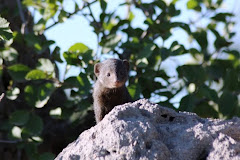
| Vervets monkeys (Chlorocebus aethiops) are highly sophisticated critters. They converse by means of 36 distinct calls and more than 60 gestures. And they can recognise every monkey in their troop, as well as members of their neighbouring troops, simply by voice. Photo by John Tolva. |
Like most monkeys, vervets are intelligent, inquisitive and opportunistic (as you're likely to discover, to your cost, at picnic and camp grounds throughout their range). Their remarkable talent for exploiting new opportunities is at least partly due to a willingness to learn new things from one another. However, recent research - by Erica van de Waal from the University of Neuchatal, Switzerland – shows that not all monkeys are equal when it comes to passing on new skills.
 |
| Up to new tricks. Photo by Martin Heigan. |
Erica presented natty little fruit boxes to six wild vervet troops at Loskop Dam Nature Reserve. Each box housed a slice of apple that was accessible via two different doors. She taught one monkey (either the dominant male or the dominant female) in each troop how to open just one of these doors, and then she presented the snack boxes to the whole troop. The vervets quickly learnt how to pilfer the apple, but the troops differed in the technique they used. In troops with a trained matriarch, almost all the monkeys used the same door as she did (suggesting they'd learnt the skill from her), but in groups where the dominant male had been trained, the monkeys were just as likely to use either door, suggesting they'd learnt by trial and error.
But why the difference? It seems that although the troop's leading man monkey fathers most of the troop's infants, he doesn't actually rate much notice with his group mates. Erica found that the vervets simply didn't bother looking at the dominant male, so they didn't see how he opened fruit boxes. In contrast, the group's first lady was the centre of the group's attention for much of the time.
 |
| Restoring self-esteem. Male vervet monkeys perform the, so called, 'red, white and blue display' to intimidate male group mates. (Warning: do not try this at home, even if you are feeling overlooked.) Photo by Louise and Arno Meintjes. |
You see, in vervet society, females believe in hearth and home. They spend their entire lives in the troop in which they were born, and so they develop very strong bonds with their sisters, aunts and nieces. Which, of course, translates into paying lots of attention to 'the girls'. In contrast, young males must pack their bags (metaphorically speaking) at around five years old. Most choose to sign on with a troop that includes someone they know (e.g. an elder brother) but they usually change groups several times during their lifetime. Thus their ties - and importance - to the group are not so deep.
Interestingly, this set up means that new innovations are slow to spread through the vervet world (since incoming males are unlikely to pass on their bag of tricks) and – over time - cultural differences will burgeon between different vervet troops.
So if you're feeling unnoticed and unappreciated, at least you can be pretty sure that no one's going to steal your innovative ideas (or, for that matter, your fruit box).
 |
| Keeping it in the family. Vervet territories are passed down from mother to daughter; generation after generation. It horrifies me that people shoot encroaching vervets (so the troop will 'go away') when their house is built on land that's belonged to a vervet family for many hundreds of years. Where is the troop supposed to go? Photo by William Warby. |
E. van de Waal, N. Renevey, C. Monique Favre, R. Bshary. 2010. Selective attention to philopatric models causes directed social learning in wild vervet monkeys. Proc. R. Soc B.