Monday, April 23, 2012

Lust to dust

Shall two knights never tilt for me
And let their blood be spilt for me?
Where are the simple joys of maidenhood?

                                      The simple joys of maidenhood,
                                                                         Camelot.


OK, I admit that I’m too old to indulge in these girlish yearnings but, somewhere out there, a fetching young antelope must be clapping her hooves together in maidenly glee.

Why?
Well to answer that question I have to go back a month or so (oh, how I procrastinate blog posts).

I was tootling along to my study site, oblivious to the world (you know how it is driving to work), when suddenly I was dragged from my reverie by a horrible stench. Slamming on the brakes and reversing back, I discovered a mob of 40 white-backed vultures milling about on the roadside. Jostled together in a dense clump, the massive birds strutted back and forth, making snake-necked lunges at one another and uttering threatening hiss-growls (the cries of excited orcs).

At first I couldn’t see what they were all quarrelling over.
Then I glimpsed a massive grey rump.
Oh no! Another poached rhino!
(Now that’s a blog post I’m SERIOUSLY procrastinating about).
But then one of the birds leapt into the air – to hurtle with outstretched talons at its rival - and I got a proper glimpse of the carcass.
No, not a rhino.
The huge grey body was, in fact, the last mortal remains of an eland bull. Embarrassingly, the carcass looked at least two days old. Had I really sailed on past twice already?

White-backed vultures (Gyps africanus) squabbling over their breakfast of eland venison.


The dearly departed eland. I didn’t snap this photo until the following day, after the vultures had made tracks (literally and metaphorically); if they see a person at a carcass they won’t come back (legacy of centuries of poisoning).


Now elands go to a lot of trouble to prevent this sort of thing from happening.


Being thick-skinned (15 mm/0.6” on the neck)
and well-armed (those horns are 65cm/26” long)
didn’t save this Romeo from death by stabbing
(or should that be Mercutio?).
Tipping the scales at around 600 kg (1320 lbs), they’re too big to feature on the wish-lists of Africa’s many carnivores; in fact, as the world’s largest antelope, they flee from no one but man. So how did this one go astray?

If you hold your nose (figuratively) and take a closer look, you’ll detect the cause of death. Yep, a stab wound to the throat (he’s got another – presumably non-fatal - to his shoulder; enlarged, in the first photo, by peckish vultures).
This lad died for love.

Unlike most male antelopes, who bicker over their real estate holdings, elands are a romantic lot. They fight only for the attentions of a lady love. Although they swagger about in massive, mixed-sex herds (sometimes 500 beasts or more), the bulls maintain a stringent pecking order, and only the biggest and best chats up the girls. I’ve written before about the devious ways they figure out who trumps whom (without having to go head to head); heck, they don’t even have to lay eyes on one another!

But when two adversaries are perfectly matched, well, what can you do?
Maybe they’d had a bit much to drink, or some young buck had been getting up their noses, but whatever the reason, our very ex-eland and his nemesis came to blows.

Now fights between eland bulls are a rarity. This may be because - when things start heating up - elands resort to flaunting their hairdos. Like rockers slicking on the Brylcream or punks gelling up their mohawks, rival eland bulls smear their woolly quiffs with their own pungent cologne. Peeing ostentatiously, an agitated bull will then step backward and press the locks on his forehead and nose into the dampened earth. Rubbing gets so spirited, he’ll often pivot round and round in a circle, lifting his hind quarters right up off the ground. To complete the effect, he’ll add some pretentious headgear (a cool eland is an accessorized eland), violently thrashing with his horns at aromatic shrubs or weeds until he prizes out a pungent headdress of tattered leaves. Maybe a crown of thorns, or a beehive of grass, will give him that competitive edge.


An eland bull (Tragelaphus oryx) in slightly better health; note the luxuriant quiff. Like bull elephants, male elands go through periods of musth (called ukali) when their machismo (and testosterone levels) soar. Photo by Carol Foil.

But if a bull’s coiffure fails to intimidate his rival, it’s all out war. Clashes are brief and violent. The prize-fighters charge one another from 1 or 2 m/yards, ramming skulls and entangling horns. Using their massive neck muscles, they push and wrestle, striving viciously to lift and overbalance their opponent.
Now before some innocent reader comments, ‘Oh how exciting, seeing elands fight’, let me come clean. I haven’t. This is all hearsay. But don’t imagine it’s for want of trying. The problem is, elands are ridiculously shy of humans; they turn tail and flee at a distance of 300-500 m/yards.
Of course we humans only have ourselves to blame. Transform an animal into a deity and what can you expect?
You see elands feature big in San bushman mythology. San lads must skewer an eland to attain manhood, young girls are ushered into womanhood with an eland mating dance, and eland fat is both the drug of choice for shamanic trances and the favoured currency for procuring a bride. Now, this is all very flattering for your average eland, but not at all conducive to harmonious eland/human relations.


This bull’s from East Africa (southern African elands outgrow their stripes). He can go indefinitely without knocking back a drink, letting his temperature soar 7C (13F) on hot days, to save 5 litres/1.3 gallons of sweat (according to the best calculations of scientists). Photo by Carol Foil.


What’s worse, elands taste yummy. Even die-hard pastoralists - such as the Masai - who eschew dining on game, happily feast on eland. The beef-like qualities of this species didn’t escape European notice either. The 19thC English anatomist Sir Richard Owen (who coined the name dinosaur) was so delighted with eland steak he wanted the species introduced to the UK. In a letter to the Times in the 1860s he wrote, “...we might one day see troops of elands gracefully galloping over our green swards’’.

But attempts to domesticate elands (such as that at the Askania Nova reserve in the Ukraine) have met with limited success, not least because the beasts happily hurdle 3 m (10 ft) fences from a standing start. And despite their ox-like appearance, elands steadfastly refuse to hybridize with cattle (although crosses with their closest rellies - kudus, bushbucks, nyalas - have yielded a few perplexed calves).

Ahh, no wonder eland maidens are so smitten by their handsome knights.


Lady elands lack the males’ quadruple chin and bouffant hairdo. They also sport longer, thinner horns; perfect for lion-skewering. Mums team up to defend their sprogs from heartless felines.
 Photo by Lip Kee.


Friday, April 20, 2012

Not so Good Friday

BRRRR... BRRRRR... BRRRRRRRRR!!
This was the sound of my wheels spinning.

It was fast approaching midnight, and I was lying on my stomach on
a precipice struggling to manipulate a tyre jack into an impossible position.
I’d been at it for more than three hours and I was on the edge of despair.

How did this happen?
Well to explain, I need to wind back a bit.

“No... I don't smell bacon.”
Good Friday started out strangely. I guess one should expect this of a religious holiday.

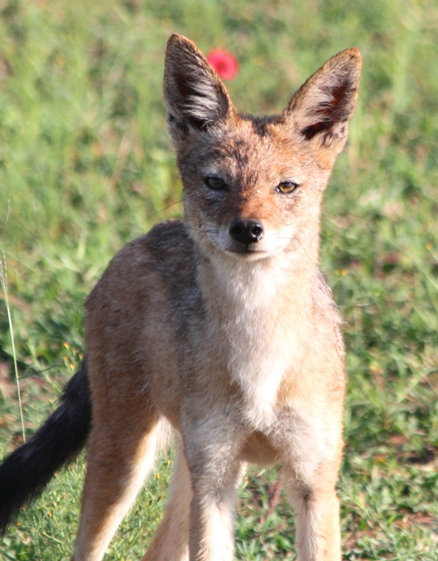
Driving to my study site I’d met two black-backed jackals accompanied by a small warthog piglet (the lion lies down with the lamb?). All members of the threesome seemed remarkably relaxed, so I guess the piglet was too big to eat. Presumably she’d misplaced her sounder and wanted for company.
Still, two big jackals, one small piglet...

Now, perhaps unwisely, I didn’t perceive this transposition from the Lion King as an omen of ill luck, so I wasn’t prepared for what was to happen that afternoon.
Since it was a holiday, I decided to walk my dogs at the local mine where mica is gouged from a 300 ha (740 acre) patch of jungle. Of course under the tangle of lush greenery lurks a century’s worth of mine shafts, tailing dumps and sharp, rusty implements. Oh yes, and the place is also peppered with brand new snares (the handiwork of peckish miners).
But, in a realm of game farms and private reserves, it’s the only place my dogs can romp off-leash without incurring major collateral damage.

 
Situated on an outcrop of ancient rock (4 billion years old), the local mica mine enjoys lots of thunderstorms and a spiffy view.


If – like me - you thought mica consists of glinting flecks in river sand, think again. Here it loiters in massive chunks made up of many layered sheets, rather like an overflowing in-tray.


Mica is the secret ingredient in metallic paints, glittery make-up and soaps that ‘leave your skin sparkling’ (for wannabe vampires?).


Leaves of mica are transparent,
and the chunks sop up water
to become black and rubbery.
Half way along our walk I noticed that Magic had disappeared.
But this was nothing unusual.
She’s compulsive obsessive about hunting, racing off into the bush after the merest whiff of antelope or blissfully engrossed for hours trying to excavate some hapless creature from the rocks.

When Wizard and I returned to the car, Magic wasn’t there to meet us (as she usually is). So we sat down to wait.
And wait...
And wait...
My irritation rose to fury and then gradually metamorphosed into alarm.
By nightfall I was imagining the worst: Magic choking in a wire noose or lying crumpled at the foot of a mine shaft.


My dogs (Magic and Wizard) gallivanting at the local mine.
 

The mine's resident baboons keep a wary eye on anything that gallivants.
 
As a massive full moon rose, transforming the bush to silver, Wizard and I set out to search. Without a torch and wearing shorts and sandals, I was ill-equipped for bush-bashing; thank Heavens for the moon!
Now ever since I foolishly calculated (in a moment of middle-aged angst) how many full-moons I’m likely to live to enjoy, I’ve greeted the waxing of the moon with a certain anxiety.
Time is precious!
I should be out there doing something to appreciate the spectacle.
But this was not what I’d had in mind.

To the accompaniment of roaring lions (the mine nestles on the border of the Greater Kruger Park), Wizard and I scrambled through the thorny undergrowth, stumbling over boulders and peering blindly into plant-choked mine shafts. I tried not to contemplate the many nocturnal biting beasts (cobras, puff adders, boomslangs) and struggled valiantly against the hopelessness that engulfed me each time a passing cloud plunged us into darkness.

After a couple of futile hours - calling and straining to hear a muffled whimper - I decided to give driving a try. But it was while negotiating the rough, overgrown tracks that I became ensnared.

Without warning my car suddenly lurched sideways and the rear wheels began to spin. Leaping out, I discovered that I’d driven into a large sinkhole (where the track passed over some old mine workings that had been covered with gravel and dirt). Beneath the deceptive covering of grass, the sunken earth - broken by huge cracks - fell away abruptly to my left, where rocks and pebbles were still merrily cascading down into a half-filled mine shaft. It was over this shaft that my left front wheel was dangling.
Oh f#*@!!
Of course - at Easter - the mine was deserted.
I was going to have to get myself out.

Over and over, I jacked up my car and heaved and shoved boulders beneath the front wheel. Unfortunately, this involved crawling about on the very edge of the crumbling mine shaft; each insecure foothold creating a landslide of gravel. Time and again I tried moving the car. No go. So then I painstakingly did the same with the rear wheels (to give them more traction). But all the while the ground around us was continuing to subside, and my car was listing further and further to the left. I envisioned it slip-sliding down into the maw of the tunnel until only its rear bumper stuck out, like in those improbable car insurance ads. Meanwhile, Wizard just lay on my bakkie/ute/truck's bench seat; head on paws, softly whimpering as if his world had come to an end.

By midnight I finally concluded that I’d never get out alone; I needed to be towed.

And that meant waiting for morning. Either I could sleep (??) the night on a small seat with a large husky, or I could hike 12 km/7.5 miles home (mostly along the main road which – in South Africa – is not a safe venue for a solitary, midnight stroll).
Of course there was another option.
One I’d been steadfastly refusing to consider for the last three hours.

Up until now I’d been trying to reverse my vehicle out of the sinkhole; but I could try driving forward.
Yes, this did mean going further down into the depression and would almost inevitably result in the vehicle sliding left, down into the actual mine shaft.
But if I could just keep the rear wheel on the disintegrating edge of the shaft, there was a flicker of a chance I’d gain enough momentum to scale the far side of the sinkhole.
And heck, I was going to have to be towed out anyway...
One might as well be hanged for a sheep as a lamb, right?

Ordering Wizard out of the car (so we both didn’t end up underground), I put the car in gear. Slamming on the accelerator, the car lurched forward. With a whomp and a judder and a loud susurration (as large quantities of earth and stones poured own the mine shaft) we managed to crawl to the far edge of the sink hole.
Oh my God!
We were OUT.

Now trembling from head to foot, I couldn’t face resuming the search for Magic.
Wherever she was – dead or alive – she was going to have to wait until morning.

Driving back along the rough, broken tracks, through the on-again, off-again moonlight, we met Magic at the mine’s front gate.
She was standing in the middle of the road, wagging furiously.
I’ve no idea where she’d been or what she’d been doing.

But all’s well that ends well, I guess...
Hmm...


Magic: the source of my woes.


Wednesday, April 11, 2012

Off air


SORRY


Sorry I haven’t blogged for a while.

Unfortunately some vile evil doer has hacked into my internet connection, making it so sluggish that it’s basically unworkable.

I’m struggling to put this wrong right, but in the meantime I’m pretty much off air.

I apologise for any inconvenience!

Saturday, February 18, 2012

An embarrassing confession...

We all make mistakes, right?
There’s no call for embarrassment.
But some mistakes make you feel sillier than others...

Now I’m not talking about those absent-minded slip ups that everyone makes (they do, don’t they?).
You know, like realising in the supermarket that your shirt’s on inside out or that you’ve forgotten to change out of your mismatched trainers (the red pair’s left shoe is raggedy and the blue pair’s right shoe... Well, the mongooses don’t mind!).

No, the kind of blunder I’m talking about springs from ignorance, pure and simple uncouth and ugly.

I remember my sister discovering that her rural high-school pupils didn’t believe dinosaurs ever existed. They thought that these prehistoric beasts – along with King Kong, Godzilla and the Muppets – were creations of the media.
Well that’s the sort of mistake that I’m guilty of.

It all started when I was pottering about the local newsagent and noticed a stack of glossy, movie-spinoff booklets.
A sweat-streaked Harry Potter glared up from the cover of the top one, below that peeped the earnest blue face of a Na’vi from Avatar, and on a third, two CGI aliens stared nonchalantly off into space. They were lankily humanoid but clothed in a stylised uniform of fur: pure white with chocolate brown insets on their arms, chest and thighs. Disconcertingly golden eyes stared from their smooth black faces, and black elf-like ears peeped from the fur on their heads.
‘What will they come up with next’, I wondered before sauntering on.

But that image kept haunting me; there was something disquieting about it. They were so humanlike, but...
It was as if the artist had melded human facial features with those of a llama or guanaco. It was uncanny. And unnerving.

So you can imagine my shock - on my very first day in Madagascar – when I rounded a bend on a forest trail and found myself face to face with just such an alien. In fact, two real, living, breathing aliens.
Oh, and did I mention the excruciating embarrassment?


Extraterrestrials assessing the chemical composition of Earth’s flora? No, Coquerel’s sifakas (Propithecus coquereli) contemplating lunch. But you can see how one could be mistaken, can’t you? Oh sure you can.  Please...
 
When not impersonating computer-generated aliens, Coquerel’s sifakas hang out in groups of 2-10, in the dry forests of NW Madagascar. Like all sifakas, they're strictly vegan and the ladies rule the roost.

Named after their explosive, hissing alarm call (shee-fark!), sifakas are the bounders of the lemur world. I’m not being judgemental here; I mean it literally. They’re made to hop. With legs 35% lankier than their arms (the figure for people is 65%), these lemurs leap frog-like from tree trunk to tree trunk, and cling there vertically with their knees pressed against their chests. They’ve artistically long fingers, and utterly outrageous big toes, to clamp vice-like around tree trunks.


A toe of note.

Now if my first encounter with sifakas made me feel like Bridget Jones at the launch of Kafka’s Motorbike, my second interaction was almost as disquieting.

We’d just arrived at Berenty Private Reserve in southern Madagascar after a long, hot morning jolting over crumbling tarmac (last road mending, the 1950s). Trudging through the heat and dust towards the promise of lunch, I glanced up into a huge tamarind tree that overhung the tourist cabins.
There, almost within arm’s reach, was a fluffy white tangle of Verreaux’s sifakas. Pristine white, apart from a Santa’s cap of chestnut brown, they lounged along the tree’s massive branches or hung languidly upside down from the branch tips like an angelic manifestation of spider monkeys. As I gasped, they gazed down at me interestedly, golden eyes bright in their intelligent sooty faces. I can’t begin to describe the emotional impact of their unexpected and incongruous appearance; try to imagine the warmth invoked by fluffy white bath-towels coupled with the enchantment of snow.
Needless to say, I was very late for lunch.


Of the nine sifaka species bouncing around Madagascar, only the Verreaux’s sifaka (Propithecus verreaux) is not endangered (it’s considered vulnerable). It’s also my favourite (why court heartbreak?).

The Verreaux's sifaka groups at Berenty hold territories of only 2-3 ha (5-7 acres); that means 15 groups of sifaka could ricochet around happily within the territory of one dwarf mongoose group! 


Hanging loose. Verreaux's sifakas live in mixed-sex groups where love is free. However, the reigning honcho fathers most of the kids because he dogs the steps of any female on heat.
  
Now if, like me, your enthusiasm for wildlife is tainted by vices (laziness, for example, or voyeurism), Berenty Reserve is the place to be.
Protected since 1936, this tiny pocket (250 ha /620 acres) of gallery forest is set within a vast sisal plantation (the spiky aloe used to make ‘green’ shopping bags) and is chockfull of lemurs. Alison Jolly began studying ring-tailed lemurs here in 1963, so the furred inhabitants are enchantingly blasé about non-furred primates. You can lounge on your veranda and happily spy on three species of lemur as they blithely scent-mark, squabble or snooze. And of course you can also potter at leisure in the forest, blissfully unchivvied by zealous park guides.
It was certainly a highlight of my trip. 

No, not a sifaka, but a typical Berenty scene. Ring-tailed lemurs (Lemur catta) and red-fronted brown lemurs also smooch around camp.

High density living is the norm for sifakas. Groups of crowned sifaka (Propithecus coronatus) claim ownership to just 1.5 ha (3.7 acres) of dry deciduous forest (in NW Madagascar) and they advertise possession by smearing around goo from their chest and anal glands.

Sifakas, of course, are famous for another trait. Designed to leap, tree to tree, they aren’t well equipped to negotiate flat land. Bizarrely, they stand up on their lanky hind legs and skip along sideways, twisting their torsos back and forth and holding their arms up effeminately for balance. If you haven’t seen footage of these guys ‘dancing’, treat yourself by clicking here or here.
 
Leaping lemurs!
 

'No, I've never heard of the Ministry of Funny Walks.
Why do you ask?'


Let's move it, move it, move it!
 
Strutting their stuff by day, sifakas kip in the tree tops after dark. But despite this safety measure, being eaten is still a serious problem for them (well for anyone, I guess). Fosas, who specialise in chomping mammals, cunningly clamber up and nab them in the night. Raptors also won't say no to an occassional lemur. 
In an effort to evade these lemur-eaters, sifakas employ the usual arsenal of ‘functionally referential’ alarm calls (i.e. they shriek ‘Run!’ or ‘Hide!’ or ‘Get down!’ rather than ‘Harrier-at-10 o’clock!’ or ‘Bloody fosa!’).

What’s interesting is that different populations use the standard calls in different ways. While everyone seems to know that roaring barks warn of raptors (the lemurs look up and climb down), researchers found that playbacks of the iconic shee-fark cry invoked mixed responses.
Coquerel’s sifakas, and Verreaux’s sifakas who lived within fosa territory, believed it warned of ground predators (they looked down and climbed up), but Verreaux’s sifakas living in a fosa-free local just ran away. Growls were even more personalised. Coquerel's sifakas living in places with many birds of prey interpreted a growl as warning of aerial predators, while Verreaux's sifakas residing in fosa-rich habitat thought a growl meant prowling carnivores. The other populations, of both species, associated growls with minor disturbances.
Now this shows that the sifakas learn the meaning of their calls from others, and it lets them adapt calls to meet local needs. But what happens when we come along and translocate animals from one population to another?
 
'What? He's growling?! It's all Greek to me.'
The diademed sifakas (Propithecus diadema) living in Analamazoatra Special Reserve (aka Perinet) were translocated into the park in 2006 from three different sites (the original inhabitants were hunted to extinction in 1973). They appear to be prospering despite any language barriers.   

Like all the larger lemurs, Milne Edward's sifakas (Propithecus edwardsi) are hunted by humans as well as fosas. Although 'fady' (taboo) prevents certain tribes from consuming particular species, it often doesn't prohibit them from catching and selling the animals to people who do. Lemur is a delicacy in city restuarants.


Fossa snack food. Milne Edward’s sifakas bear only a single sprog every second year. 40% of their ankle-biters don’t make it to their first birthday, and only a third reach puberty.


A Milne Edward's sifaka (in Ranomafana National Park) awaiting the arrival of a Hollywood talent scout.

Friday, February 3, 2012

Masked weavers revealed

If you’ve come here expecting an exposé on the criminal activities of textile workers, you’re in for a disappointment.

This post is about something much less exciting: SEX.

Now I don’t know how you choose your sexual partners, and I wouldn’t dare suggest that anything is inappropriate... But whatever traits turn you on, you can be certain that somewhere out there someone with feathers is already doing it.

Regardless of whether your interest is sparked by a lover’s apparel, their talent in the performing arts, their real-estate holdings, the colour of their footwear (you’d have to be a real booby to go for this), their artistry or – let’s get down to it – the size of their gender-specific endowments (excuse me, I was referring to tail plumes), your tastes don’t differ from millions of birds.

But there’s one group of feathered critters whose predilections are genuinely perverse.
For them, sweaty singlets and wolf-whistles are all the go.
That’s right; construction workers rule the roost in weaver society.

Now if DIY skills were the currency of ardour in humans, I’d be destined for barren spinsterhood (hey, wait a minute, I am a barren spinster...). Although home-building skills may seem a tepid way to woo a lover, it hasn't held back weavers. Around 62 species (all in the genus Ploceus) are out there busily knocking up their edifices, mostly in Africa but also in southern Asia too.
And with all the recent rain, a large proportion of these creatures seem to be doing it right here.


A macho lesser masked weaver (Ploceus intermedius) kitted out for love. He only dons his mask - in bad-boy warning colours - when the talent weather is hot.

Gathering in rowdy hordes in trees overhanging water, the local lesser masked weavers are in a state of frenzy.
Males dash back and forth with long grass stems trailing from their bills, and there’s a constant buzz of chirping and squawking, which swells periodically into a goal-score roar when a flirtatious chick drops by.

Before a weaver on the make can fabricate an alluring boudoir, he must first stake out his own patch within the colony. This involves lunging at intruders and grappling tooth and nail beak and talon with any persistent rivals. Once he's scored an exclusive building site, Romeo gets to work weaving a collection of finely-laced, retort-shaped homes (if you're not a closet alchemist, a retort is a glass flask with a spherical base and a long tapering neck that's bent downward; it’s designed for distilling things). The male’s goal is to distil a harem of lady tenants who’ll considerately raise his chicks for him.

Using only fresh green grass, plucked straight from the clump, he twists and pokes and pulls, entwining the strips intricately, while emanating an air of intense and bad-tempered concentration. As the grass strands dry, they shrink, tightening up the weave and strengthening the structure. But with nest sites at a premium, a male can’t afford to keep any untenanted premises on his books, so pissed-off males demolish nests that have proven unpopular.

In the quest for the most beguiling nest, males also indulge in a bit of landscape gardening, clipping the leaves from all branches near their homespun abodes. This - along with the nest’s funnel entrance - is thought to make things tricky for those iniquitous nest robbers, the harrier hawk and the boomslang.


‘These damn things just keep growing BACK!’


‘Well, that’s an improvement anyway.’


When a lady weaver approaches, all the males get very excited, snatching up a grass stem and dashing to their best construction. Hanging from the base, a hopeful male flutters his wings enticingly, sticks his tail out horizontally and points his beak suggestively into his nest. He also chirps in a frenzied manner (precise translation unavailable, but I daresay you know all the usual pick up lines...).


‘If you come in here, you can see the playroom has a northerly aspect...’


‘I think someone should really tell George that the can-can is so yesterday.’


For any inept handymen out there, consoling themselves that bird's nest-building skills are hardwired anyhow, let me disabuse you. Male weavers must learn their trade.

While yearling females rush headlong into motherhood, their brothers eschew sex for a year or two. These young bloods get together in colonies of their own where they can work on their erections without censure. Experiments show that if adolescent males are deprived of this early practice (by denying them building materials), their DIY skills are seriously retarded. However, just like riding a bicycle (which you may be please to know male weavers cannot do), building prowess - once learned - is never forgotten; even if callous researchers blockade building supplies for years on end.


Slipshod workmanship will not escape the eye of a lady lesser masked weaver. However, the landlord's only responsible for creating the nest’s outer walls; all soft furnishings must be provided by the tenant.

But what does today’s lady weaver seek in a family residence?

Researchers working with village weavers (Ploceus cucullata) found that mothers-to-be aren’t swayed by outward appearances; neatness and closeness of weave are, after all, mere superficialities. What counts is the strength of the materials and the newness of construction. The girls will have no brook with old, browned off nests and, like master chefs, they’re canny at detecting what’s fresh and what’s not. Merely painting a good nest brown will not fool them, although the same cannot be said for males, who are three-times more like to demolish a nest if it’s been artificially dyed brown.


‘Hmm, I do like a Paspalum veneer; it gives a much fresher ambience than the traditional Poa finish...’


‘Yes Martha, I’ll join you in a mo’. That little minx Estella is looking real interested in Number 3.’


Saturday, January 28, 2012

Hey, I ain't drowned yet!

Do you ever have one of those days?
You know, when getting out of bed turns out to be a seriously bad decision?

Well Wednesday (18th Jan) was that kind of day for me.
Things actually started going pear-shaped on Tuesday afternoon, I just didn't notice.
That was when the rain started.

Now rain is good; we need rain.
I’m thoroughly sick of providing halfway housing for dispossessed tadpoles.
OK, I did spend much of Tuesday night emptying drip-buckets, mopping up indoor waterways and rearranging electrical appliances, but that’s only to be expected.
Yet perhaps if someone had mentioned the word ‘cyclone’ I may have been more wary.
Maybe I wouldn't have headed out into the downpour at 5am to collect an Australian friend who was flying into Nelspruit (200 km/124 miles south of here).

The 3 km (1.9 miles) slalom run to the front gate was an eye-opener. Skidding through sticky red mud, plunging into overflowing creeks, circumventing hitherto unknown lakes and careening into culverts was somewhat off-putting. When I finally crept onto the tarred road (with one headlight blearily water-filled and my fan-belt squealing in protest), I thought my troubles were over.

Hmm...
I can’t see anything in this torrential rain.
Did those oncoming cars have their hazard lights on? I wonder..?

Next minute I’m aquaplaning at 100 kph (60 mph) down a road that’s a river. The water is almost 18 inches (45cm) deep and bubbling along at a merry pace. When my tyres finally touchdown, I figure I’d better keep going, since I’m already in it (in every sense of the phrase). So on I chug... and on... and on... milk chocolate water churning against the windows. I’m getting nervous: how deep is this water going to get?
Then looming through my deluge-smeared windscreen are the rabbit-dazzling headlights of a massive truck.
In the centre of the bloody river road!
The behemoth’s horn blares deafeningly and just as I’m thinking my end has come, the truck’s huge bow wave catches my car and swirls it sideways. Shit, shit, where does the tarmac end?? Once I regain steering, I manage to lurch back on to what could be the road.
Oh God!
Can I really reach the airport?

By the time I slew, skid and slosh my way into Hoedspruit (35 km/22 miles from home) I have the demeanour of a druggie in rehab.

I’ll just stop here, calm down and decide what to do, I think.
Oh.
The petrol station is hidden behind Lake Geneva. The supermarket’s car park is an ocean vista.
Maybe not.

But how is an aeroplane going to land in this??

Still unable to see more than a foot in front of my beleaguered windscreen wipers, I decide to flee for home before the road is cut entirely. So back I chug, through hell and high water.

Just as I reach my front gate, the deluge stops. My mood lightens with the sky. I phone the airline: oh yes, the flight touched down right on time. I envision my friend sitting, waiting...
Maybe I gave up too easily.
Maybe I’m just being a wimp.
After all, the water is probably no more than runoff from the actual downpour. Give it a few minutes and it’ll all flow away...
So round I go again and head back.

There’s more traffic about now and big 4-wheel-drives cluster nervously at the edge of the floodwaters, like bathers in winter. Their occupants stare open-mouthed as I zip past them in my little bakkie/ute/truck/van (a 1989, 2-wheel-drive, 1800 Hilux), plunging fearlessly into the swirling torrent (heck, I’ve forded it twice already!).

This time I’m determined not to give up. My grim resolve carries me through rushing, log-toting rivers, over-pouring dams and vast brown lakes. But 50 km (30 miles) from home I’m defeated. Up ahead a long line of motorists sit gazing in dismay at an endless expanse of water. In the middle a single car sits. Its tail lights still blaze defiantly although they’re submerged, and water's gently lapping over its bonnet/hood.

Ahh. Time to head back home.

But I don’t make it home. Just one kilometre (half a mile) from pay dirt I’m forced to abandon my waterlogged trusty car on the edge of a waist-deep beck. After wading through, I squelch home on foot.

Now this should be the end of the tale, shouldn’t it?

I'd love to be able to describe how I snuggled up on the sofa with my dogs and a warm cup of cocoa and listened to the falling rain.

But I can’t. Or rather I couldn’t (hear the rain, or anything else for that matter). You see outside my backdoor a jumbo jet was taxiing. Or at least that’s how it sounded. In reality it was the Oliphants River and it was in FULL flood. 


The view from my spare bedroom.
The nice caramelly bit is raging floodwater.

The caramelly bit up close.
Not something you want to find on your doorstep.

Now for those of you, like myself, who didn’t think South Africa suffered cyclones, let me introduce you to the wonders of climate change.
Cyclone Dando made landfall in Mozambique on Sunday the 15th and after successfully inundating 4000 homes decided to try its luck in South Africa. Fortunately its overland trek exhausted the 120 kph (75 mph) winds, but didn't prevent it from dumping 380 mm (15 inches) of rain in the Hoedspruit area (in about 36 hours). The town suffered its worst floods on record; every access road was cut and both the Blyde and Klaserie rivers broke their banks, destroying shops, businesses and homes. Floods swept through the nearby Kruger National Park where several camps had to be evacuated and stranded tourists airlifted to terra firma.


Kruger National Parks’ Sabie River (viewed from the Lower Sabie restaurant). Photo by Arno & Louise Meintjes.
 

Not the best choice for a game drive (the Sabie River showing its teeth). Photo by Arno & Louise Meintjes.


With the rain still bucketing down, I stood gazing at the river racing below my house. Huge waves and eddies churned the water and spume flew high into the air. Enormous tree trunks surfed by as fast as a car on the highway, and breakers crashed against the banks.

When you live on the banks of a major river you formulate plans for this sort of an eventuality. But mine did not involve being car-less.
And NO vehicle could breast the torrent that I’d just waded through.

I looked like I'd have to abandon all my possessions, and just trudge off into the hills with my pets, singing Climb every mountain.

Surveying my house, I was a bit disconcerted to find that I really didn’t mind losing most of its contents (is this one of the benefits of being a hoarder?). But there were my books; and the computer. And all my work equipment.

I spent several hours packing. The moment I opened the front door to move the boxes, my dogs hurtled out, disappearing off into the rain-soaked bush. Was this some eerie animal ‘presentiment’ thing, I wondered? Or just the irresistible lure of displaced cane rats? Sans dogs, I carted my books through the rain to an old shed (on slightly higher ground) and shoved and hauled my ‘valuables’ (in lidded plastic crates) up the slope into the bush.

As the river continued to rise during the afternoon, army helicopters zoomed back and forth overhead, presumably searching for hapless victims stranded by the flood. I stood outside hopefully, looking pathetic, but I guess I wasn’t hapless enough because they just whop-whopped on by. (I’ve since heard about an 80-year-old who sat up a tree for several hours awaiting rescue - OK, her need was greater than mine.)


The Oliphants River roaring past my house (at 3118 cubic metres/110,111 cubic feet per second). Just enough to fill my house - floor to ceiling - in one-twelfth of a second.


My back garden. The little black blobs in the water are the uprights of a picnic table. The top is already scudding its way to Mozambique.
 
The water continued to rise all evening and I kept dashing outside with my torch to check where the surf was breaking. If it rose another 2 m (6 ft), my house was a goner.

I wasn’t relishing the prospect of sitting out the night on a hilltop in the rain. The pets wandered about restlessly with widened eyes, and my head throbbed painfully from the constant roar. I’d intended to mount an all-night vigil (so as not to wake surrounded by swirling, crocodile-infested floodwater) but tiredness overcame anxiety and prudence. Huddled in a heap, the pets and I eventually fell asleep.

And lo and behold, at dawn the next day we were still there!
And the river was starting to fall.

Yay!


The aftermath. The riverbed below my house now looks ravaged.


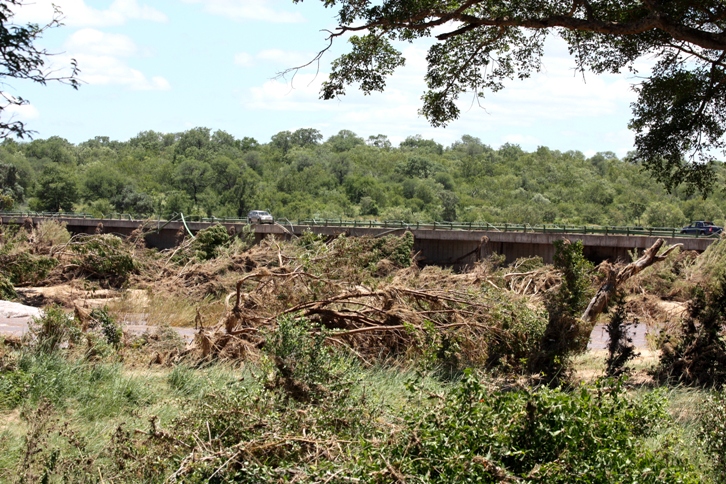
The Sabie River a week after the flood. Check out the railings torn from the bridge (on second thoughts you’ll need a magnifying glass; see below instead).


Flood-wracked railings.


Related Posts Plugin for WordPress, Blogger...