Friday, July 19, 2013

Dwarf mongooses: warts and all

 
After seven and a half years working with dwarf mongooses (Helogale parvula), today I discovered the meaning of their scientific name.
And I’m outraged!

Their dreadful scientific moniker was bestowed upon them back in 1847 by Carl Jacob Sundevall. Dr Sundevall was a Swedish ornithologist (yes, that’s right, ornithologist) who was working as curator of the Natural History Museum of Stockholm at the time of his ghastly misjudgement.


The culprit. Image from Wikipedia.

Now let’s be clear. I have nothing against Sundevall’s choice of a species name, parvula.

In Latin parv means little, and ula is a diminutive form; so that’s little, little.
And there’s no question that dwarf mongooses are wee. Even at the height of summer when they’re at their chubbiest, adults clock in at only 270-300g (10 oz). They’re not only the teeniest of the globe’s 31 mongoose species (they’re only one-third the size of meerkats, for example), they’re also Africa’s most petite carnivore.
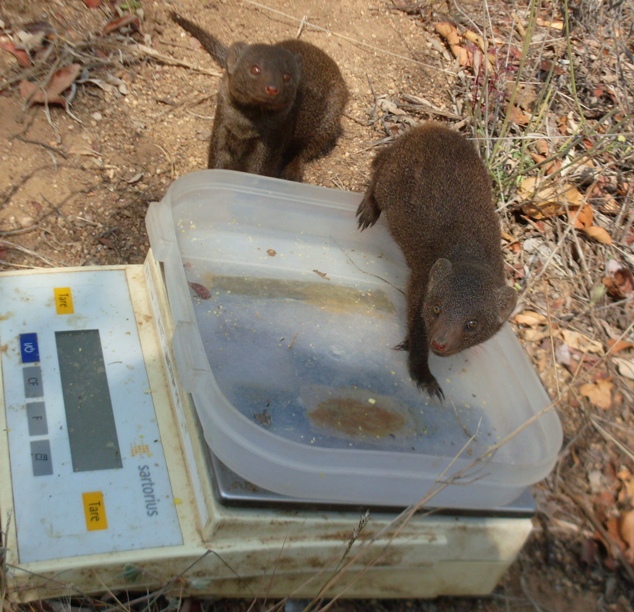

Chimera (EM061) and Doxy (EM066) helping me to document their littleness.

No, no, it’s the genus name, Helogale, that I have problems with.
In Latin gale means weasel.
Mongooses are NOT weasels.
Mongooses do not even belong to the weasel family (the pesky mustelids).
Heck, they don’t even like weasels!

If the mongooses held a family reunion, you’d see genets and aardwolves, linsangs and banded palm civets. There’d be hyenas, overseeing the braai (BBQ), and civets griping endlessly about the perfume industry. The binturong would be annoying everyone by picking up party nibbles with its tail, and the toddy cat, who’s had too much to drink (again), would be delighting the kids with unsavoury re-enactments of kopi luwak manufacture. Even the Madagascan contingent would be there: the falanouc pontificating about earthworms with the white-tailed mongoose, and the fossas and meerkats locked in heated debate over media bias.

BUT THERE WOULD BE NO WEASELS!

Even when the distant cousins rocked up (oh you know, those weirdoes who lost touch eons ago), you wouldn’t see a single weasel. Oh yes, amid the fake smiles and cries of ‘pull up a pew’, you’d spy tigers and ocelots, jaguarondis and cheetahs, clouded leopards and (oh my god) a very obese Persian.

BUT THERE WOULD BE NO WEASELS!

This is the only weasel to sully the lands south of the Sahara. When threatened, striped weasels (Poecilogale albinucha ) squirt stinking anal-gland secretions for a distance of 1 metre/yard. This is one of the many traits they do NOT share with mongooses.
Photo from Wikipedia.  

Nevertheless.
I’m willing to concede that weasels and mongooses do show some (superficial) likenesses. I can understand that a person who spends all their days mulling over dead bodies (and probably has seasonal affective disorder too) could consider these similarities noteworthy.
Yes - if I must - I can cope with gale.

But I cannot accept Helo.
Carl Sundervall what were you thinking??

So what does the dwarf mongooses’ scientific name actually mean?

LITTLE WART WEASEL.


Does this look like a LITTLE WART WEASEL to you?
(This is a rhetorical question. Any reader veering toward the affirmative is strongly advised not to leave a comment.)

 Now Carl Sundervall didn’t actually see a living, breathing (and biting) dwarf mongoose. He described the species from a cadaver sent to him by another Swede, Johan August Wahlberg. Back in the 1840s, Johan Wahlberg toured the length and breadth of South Africa shooting things collecting specimens. Dwarf mongooses were just in the wrong place at the wrong time. A vast mountain of carcasses (of mammal, bird and reptile species) were then shipped back to lucky old Stockholm.
So could it have been gun-happy Johan who was responsible for this dreadful naming travesty? Did he fail to treat the limp little body with sufficent reverence (and preservative)? Was the scrap of lifeless fur that Carl Sundervall lifted from the packing crate pocked with wart-like decay?

Is there an excuse for the inexcusable?


Another victim of Johan Wahlberg’s shooting spree. To add insult to (mortal) injury, this victim got landed with the perpetrator’s name: Wahlberg’s eagle (Aquilla wahlbergi). I guess things can always be worse. Photo by Arno Meintjes.

Now I realise that once a species is officially described and named, its scientific moniker cannot be changed. But surely Anagalligale parvula (delightful little weasel) or Dulcigale parvula (sweet little weasel) or even Maxigale parvula (greatest little weasel), would have been preferable.

Maybe I can just sneak in a different name as a typo...

Dwarf mongooses (Calligale parvula) enjoying a family moment. Ah, beautiful little weasels...

 P.S. Johan Wahlberg was ultimately killed by an elephant. Hee hee.


Monday, July 15, 2013

Intruder rampant


Last night I was victim to a ‘break and enter’.
Although (to be honest) ‘enter and break’ would be more apt.

It was 2 am when I was flung from sleep by a loud, tinkling crash coming from the kitchen. A quick head count revealed that all my pets – now struggling groggily to their paws – were with me in the bedroom.
There was an intruder in the house.

Snatching up my bedside torch, I and the pets (two huskies and a cat) stumbled drowsily toward the noise.
Now call me unwise, but it never occurred to me that the intruder might be human. From the china-shattering sound effects, I knew someone had knocked over the dishes I’d left teetering on the sink (for security purposes only, of course). This suggested an arboreal offender, and my sleep-clogged brain was shuffling inefficiently through alternatives... a bush baby, maybe?
Hopefully, NOT a leopard.

I snapped on the kitchen light and all Hell broke loose.
Instantly a slim, cat-sized creature was hurtling around the room, bouncing off the walls, the fridge-top, the sink, the cupboard. Every gargantuan leap was accompanied by a cacophony of breakages as jars, pans, egg cartons, canisters and plates crashed to the floor (not that my kitchen is untidy, of course). My dog Magic leapt after the frightened animal, knocking over the garbage can and bounding through the broken crockery and glass. Over and above this chaos there arose a burgeoning stench: acrid, sweet and musky.
With everything happening so quickly, and the animal moving so fast, I couldn’t get a good look at it. My only impression was of a long, ringed tail.
Ahh, a genet.

Now genets are very special animals. Of all the carnivores pussyfooting about the globe today, genets are the ones most closely resembling the ancient grand-pappy of the whole toothy mob (a little miacid who hunted 50 million years ago). In fact, the genet’s teeth and skeleton have barely changed since way back then. This isn’t to say that genets are primitive; they’re simply traditionalists who like to do things the way their mammies’ did.
They’re also amazingly beautiful.
Clothed in the softest, pale silver fur, they’re brushed with delicate streaks of inky droplets. A trim of silky black fur crests along their spines, and their long, long tails - the ultimate accessory - are shockingly aposematic, ringed spectacularly in white and black.


The small spotted genet (Genetta felina) is one of ten species that haunt the African night. Their nearest and dearest are the civets, linsangs and mongooses (so how could they not be charming?).
Photo by Fredric Salein.


My intruder hurtled through the kitchen doorway and circumnavigated the lounge room in seconds by ricocheting off the walls. Leaping at the French windows, it slid spread-eagled down the glass, Sylvester-like, its claws screeching all the way. Magic (who’s mania for hunting ratchets into insanity in the presence of a small carnivore) saw this as her big chance and plunged across the room. I pelted after her in a valiant attempt to avert certain carnage. But I’d underestimated the genet. Touching ground, it instantly sprang again, bouncing off the top of Wizard’s head and disappearing into the bedroom.


Genets, like cats, have sharp, retractile claws that let them climb and snare small beasts efficiently. Their paws also have 5 toes (cats and dogs have 4).
Photo by David Bygot.


By this stage the musky fetor was almost making my eyes water. You see genets are masters in the art of perfumery. As professional serial killers, they favour a solitary lifestyle and operate only under the cover of darkness. This makes conversing with lovers and rivals challenging. Yet with typical mammalian ingenuity, they’ve hit on a solution: they leave little aromatic messages that convey their identity, sexual orientation and level of libido.
While most carnivores make do with bog-standard anal glands - brimful with pungent bacteria - (this, by the way, includes your sweet little cat and dog), genets brandish a perineal gland too (a little slit located between their anus and their naughty bits). When marking is imminent, muscles pull open this innocuous looking slit to expose an inbuilt paintbrush of fine white hairs oozing a clear oily emulsion. As if this isn’t scary enough, the animal then uses acrobatics to apply the malodorous stuff. Backing up to an object, it flings its hind legs up over its back and teeters around on its forepaws (in a perfect handstand) to smear the goo, back and forth, as high as genetly possible. (Okay, my dwarf mongooses also indulge in handstanding, but I’m sure they’re much more mannerly).

Oh, and I forgot to mention that when genets get anxious they release every possible excretion.
Urgh!


Genets munch any small critters they can lay their paws on, from bugs to duiker lambs. They’re also partial to fruit and nectar.
Photo by Isidro Martinez.

When I followed the procession of animals into the bedroom, I found Magic trampolining on the bed in an attempt to reach the genet, who was scrabbling up the wardrobe. Launching a flying tackle, I pinned the dog to the mattress with my body, and everything fell still. Panting quietly, we all took stock. The genet stood frozen on top of the dresser, one forepaw raised and nose uplifted like a wondrous heraldic beast (argent genet passant).

Unfortunately, I was so busy devising an escape plan for the frightened creature, I forgot to check out its tail. Now this may seem an understandable oversight but two genet species lurk around here, and they’re not easy to tell apart. The tail of the large spotted genet (Genetta tigrina) sports a black tip, while the small spotted genet’s (Genetta felina) tail usually concludes in white (I’m sure you’ve noticed the flaw in this masterly technique). Unfortunately, the whole ‘large’ and ‘small’ business is a red herring (to confuse newbies); it refers to the spots not the beasts.

Large spotted genets (Genetta tigrina) are found in the moister bits of southern Africa. Their spots are rust-coloured and ringed in black rather than being charcoal (hmm, a bit subtle...).
Photo posted on Flickr by West Chester Dumonts.

Common or European genets (Genetta genetta) are the only species to venture beyond Africa (they also prowl the Middle East and southern Europe). However, it’s uncertain whether they were introduced to Europe (by the Moors to Spain) as they were routinely kept as mousers throughout the Middle Ages (before cats got popular). Photo by Ricardo Sanchez.


After careful thought, I concluded the best way to help my nameless genet was to neutralise Magic. I wasn’t worried about Wizard: he’s not much of a hunter and he was still recovering from the whole head-bouncing incident. While I dragged a whimpering Magic off to the bathroom, the genet quietly slipped back into the lounge room and escaped out the window. 
Phew!

Now I’m just left with a complete ruin of a kitchen and an overpowering stench.
It’s not entirely unpleasant, but... er... very animally!

This image is for those of us who secretly suffer tail-envy. Presumably it’s of Mum and the kids (but there seem too many). Maybe - like other solitary mammals - small spotted genets are willing to bend the rules when food is bounteous.
Photo by David Bygott.

Saturday, July 6, 2013

Communiqué from a hermit

I’M SORRY!

That’s an apology for my appalling lack of posts.

Yes relatives, I am still alive.
 

The problem is (okay, one of the problems is) I’m now living in a spot unsullied by modern communications.
Yet hope’s recently arrived in the form of a laptop. If I drive half a dozen kilometres, clamber to the top of a wind-whipped kopje and sit numb-bottomed and squint-eyed (playing spot the cursor), I can communicate with the outside world.
But not very much.
You see my funding ran out last year so I’m trying to survive on... well, nothing at all really. And petrol and internet access are costly. Nevertheless, despite these adversities, I bring you a blog post! 

   
My latest domicile is tucked away beside the river in the reserve in which I potter with mongooses work. I moved in last March and have fallen in love with the place because my neighbours are all non-human.

    
Uninhabited (theoretically) for the last seven years, the house harbours an impressive assemblage of fauna. Fortunately the hippos and hyenas - whose dawn chorus ushers in my days - tend to stay outside, but others are less reticent. Jealously I guard my dogs from the leopards who stamp their pugmarks on my driveway nightly, and struggle (vainly) to oust the bloom-devouring porcupines from the garden. Ah, bliss...


Chez Mongoose (mainly)

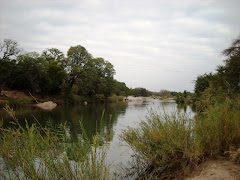
The charming Oliphants River as viewed from my veranda.

Of course, adjusting to the idiosyncrasies of new housemates can be challenging. And some are far from pleased to see me. The incumbent geckos, for example, are the least friendly I’ve ever encountered. They lurk furtively in crevices and crannies, secretly plotting my downfall. Only if I arrive home after nightfall and unexpectedly snap on the light, do I get to see them, frozen guiltily and bristling with insurgency, up there on the walls.

The most welcoming of my new roomies spends much of her time in the kitchen (and sadly has a figure to match). You can usually find her lounging on the bench top beneath the window. Dressed with classic elegance in umber, bistre and pearl, she emanates a proprietorial air but graciously lets me share the facilities. Admittedly she’s only six inches (15 cm) long, but for a striped skink (Tachylepsis striata) this is not to be sniffed at. I have presumptuously christened her Algernon. (I should point out at this stage that although my zoological expertise is profound (naturally), it does not extend to sexing small lizards (well, any lizards at all really); hence the gender-related ambiguity.) 


Embarking on a staring contest with a striped skink (Trachylepis striata) is ill advised. Okay, unlike some reptiles, they do actually blink. But their lower eye lids have a transparent window so that glare never falters.

As might be expected, there was a little friction between us at first. Algernon’s insistence on spending the night tucked up in the egg carton led to heart-stopping encounters every morning. After ten days I finally realised that – in my early morning daze - I was incapable of remembering she was there, and so I hid the eggs away in a cupboard. She ruefully shifted into the washing machine. Of course now I can’t launder my clothes before 11 am (she’s a late riser on these chilly mornings) but we all have to make compromises.

As a striped skink (Trachylepis striata), Algernon is meant to live in trees. The soles of her feet have built-in cleats (special spiny scales) and each absurdly elongated toe sports a bark-catching keel. Unfortunately, these nifty adaptations are less well suited to kitchen fly screens. You see striped skinks are active hunters and - according to the books – they seize their insect prey after a short, fast dash. However, when Algernon is hunting flies on the window screen, her dashes - back and forth, up and down, round and round - are annoyingly protracted. With each step, her impressive grappling-iron toes snare the mesh, so she has to fling her limbs into the air like she’s practising semaphore. As inconvenient as this may be for Algernon, it’s worse for me: each unplucked toe produces a dreadful reverberating clatter that’s audible throughout the house.
Still a girl has to eat; I show forbearance.


Algernon showing off her fine toes and svelte figure.

Our relationship has grown considerably more cordial since Algernon discovered the delights of mealworms. Each day she greets me upon my return from the field, skittering across the counter top to stand gazing up at me in the hopes of cadging any leftover worms. (Yes, that soft susurrus was a gasp of outrage by my mongooses.) After hours basking on the window sill, Algernon moves quicker than the eye can see. I find this unexpectedly disturbing. I mean we’re all used to small critters flitting out of sight in the blink of an eye, but when one flits AT you, it’s a different story entirely. One moment she’s sitting peaceably on the counter top and the next she’s crouched on my wrist, glaring at me fiercely for failing to unhand the mealworm. As far as I’m concerned, teleporting lizards should stay firmly in the realm of science fiction.

I was wondering whether to teach Algernon tricks (is this demeaning?). But what’s the point of a lizard that jumps through a hoop if you can’t see it do it??

Now the advantage of living on the window sill (apart from the whole fly-catching business) is that Algernon can zip back and forth through the gap in the screen whenever danger threatens. The down side - at least from my perspective - is that those with an appetite for striped skinks sometimes pursue her right into the house. So far I’ve discovered a brown-headed kingfisher lurking behind the stove and a little sparrow hawk circling the light fitting in my bedroom. Considering that the hole in the screen is only the size of my fist (or, more accurately, the fist of a bygone burglar), this is impressive.
 

Striped skinks are modern, up-to-date lizards who have no time for all that primitive egg-laying stuff. Mums heroically bear a litter of 3 to 9 mini-skinks each summer (something to look forward to...  hmm).

Now if you’re reading this post, it means:
(a) I still have at least one gallant and faithful reader (I'll add you to my Xmas card list);
(b) I can upload posts despite my wonky internet connection.
Taken together, these suggest that I have no excuse for not resuming blogging. 
Of course, I do have a wide selection of half-written posts on my computer...
Hmm, all I need now is to overcome my self-loathing.... 
Please stay tuned!


Saturday, January 12, 2013

Scarred for life (or what's left of it)

‘Well, it’s going to leave a scar’, the doctor said as we stared at the gaping wound on my lower leg.
He wanted to stitch it.
I was trying to avoid having needles poked through my flesh.
‘I can cope with that’, I said calmly (secretly thinking: Ah ha. Now I can impress people who ask about my scars).

But that was five years ago and NO ONE HAS EVER ASKED.

Now this sad state of affairs is a product of my age.
Have you noticed that when you’re young, people are forever asking you how you acquired this blemish or that. And as a callow youth, all you can do is confess, ‘Okay, I’m a complete klutz’. Yes, I did mishandle a breadknife; yes, I did trip on the stairs.
But as you edge into middle-age, scars shift allegiance, traitorously teaming up with wrinkles, saggy skin and liver spots to become harbingers of age. And, goodness me, no one wants to mention them!

Of course, the phenomenon isn’t limited to bodily blemishes and I’m the first to rejoice in this unexpected benefit of aging. No longer must I endure prolonged and incredulous discussions about why I don’t want children (Oh God, she’s one of those unfortunate women who can’t have kids...) or hours of nonsensical harassment over imbibing distasteful beverages (don’t say anything; she’s obviously on the wagon...).
But I’m digressing shamelessly here (probably senility).
Since no one has ever enquired about the impressive scar on my right calf, I’m going to tell you about it here. And it serves you right for being so polite!

It was a dark and stormy night...
Well it was dark at least. Oh, and it was hot (I was wearing shorts).
Suddenly my dogs shot out the backdoor, barking wildly. Something stirred in the bushes beyond the garden and Magic (my husky cross) clambered straight up and over my dog-proof fence.
Aha, I thought, this isn’t one of our normal passersby.
You see, like all well-brought-up carnivores, my dogs detest other meat-eating beasts. When a porcupine, hippo or waterbuck tippy-toes past the garden they respond with a bark or two, but only a carnivorous creature can arouse them to such athleticism.

Envisaging the potential annihilation of some innocent little furbearer, I girded my loins for a rescue mission (scuffed my feet into thongs/flipflops and grabbed up my semi-flat torch/flashlight).
As I hurried through the thigh-high forbes below the garden, I could see Magic circling a large tree stump, barking frantically. Oh dear, some inoffensive critter must be hiding among the broken roots. A fur-fluffed genet maybe? Or a striped polecat, big-eyed and cowering? Shining my wavering torch beam carefully on the stump, I hastened toward Magic.
Then CRUNCH!
Something had sunk its teeth into my lower leg.
And let me tell you, this was no little mustelid.
With my mind still fixed on nocturnal mammals, I bewilderedly ran through the possibilities. A civet? A honey badger?
But even the most vicious honey badger couldn’t feel like this! Warm wetness was flowing down my leg and pooling stickily in my sandal. As I lowered the torch beam toward my leg, my mysterious attacker gave a head-shake, thrashing the vegetation wildly and almost flinging me off my feet. Then it let go. And I finally managed to get the light focused at my feet.
Oh God!
Right before me was the wide, tooth-filled gape of a crocodile.


What you don’t want to see two inches in front of you.

Now this was a shock. This is NOT what you expect to find at the bottom of your garden! Well sure, I live beside the Oliphants River, but the water’s edge is at least 250m/yards from my house.
The reptile, poised threateningly in a patch of flattened vegetation, was relatively small (for a crocodile) being about the same size as me (1.7 m / 5’6” long). And it was fixing me with a piercing death stare. Without thinking, I immediately stepped backward and the creature lunged toward me, it's mouth still agape. However, this time it kept its teeth to itself and I was able to slowly back away. As I hobbled squelchily back to the house, I found I was shaking head to foot.


Fortunately the teeth of the Nile crocodile (Crocodylus nilotus) are designed to grab and hold, rather than slice and dice. On the downside, crocodiles have the most powerful bite known for any living creature.
Photo by Silvain de Munck.

Now I don’t blame the crocodile for this assault. Clearly I’d blundered straight into it, and who doesn’t bite when stepped upon? I’m just profoundly grateful that it let go! A few years ago I read an article in the local paper about a crocodile that got into a swimming pool at a local game lodge. It grabbed a child (by a limb) and hung on. The girl’s grandfather managed to keep her above water, but it was half an hour before he could persuade the beast to open its maw. Unfortunately, the crocodile had to be put down afterwards because Granddad had had to gouge its eyes right out of their sockets before the crocodile would let go.

Now if you’ve ever lain awake at night worrying about how hard a crocodile can bite (and who hasn’t), a recent study by Gregory Erickson and his colleges in Florida will put your mind at rest. These intrepid researchers persuaded 83 crocodilians to sink their fangs into a waterproof, leather-encased bathroom scale (ain’t science grand). They measured the bite force of all 23 living species, from diminutive little fish-eaters to bloody great wildebeest-snatchers. And what they found was unexpected.


The toothy schnoz of the Indian gharial (Gavialis gangeticus) is a perfect fish-processing tool.
Photo by Josh More.

The Chinese alligator’s (Alligator sinensis) Walt-Disneyesque snub nose is custom-made for crushing mollusc shells.
Photo by Roger Smith.

It didn’t matter what a crocodile ate, or how its snout or teeth were shaped, the force of its bite was the same. What was important was the size of the beast; the bigger the croc (regardless of its species) the worse the chomp (note to self: don’t step on a large crocodile). The most powerful bite the researchers measured was inflicted by a whopping (5.3 m/17 ft long) saltwater crocodile whose teeth crunched down with a force of 3,700 pounds per sq inch (psi) or 16,400 newtons. Compare this to a human’s best bite (150-200 psi or 4,450 newtons) or that of a lion or spotted hyena (1,000 psi or 4,450 newtons) and you can see why crocodiles really are best avoided.

Using the measurements from this study, and scaling down to a 1.7 m crocodile, I figure that my scar was produced by teeth pressing into my flesh at a force of about 335 psi (or 1,500 newtons). This isn’t too bad really (it’s certainly better than a lion). I guess you can stop feeling sympathetic (you were feeling sympathy, weren’t you?).


The little raised black spots on the scales of crocodilians are touch-receptors, ten-times more sensitive than our finger tips. You can read about them here. Nile crocodiles, such as this one, have them sprinkled all over, but in alligators they’re restricted to the snout. Photo by Silvain de Munck.

Now you may be wondering what‘s brought on my current bout of crocobilia. Well I’m currently staying (temporarily I’m afraid) in a beautiful lodge perched on an outcrop above the river. And it has a swimming pool (oh, the luxury). Unfortunately my dogs - who presumably read the local rag - believe the pool is crocodile-infested and won’t set paw anywhere near it. Whenever I take a dip they look at me with tragic reproof, utterly convinced that this folly will cost me my life. And Magic’s paranoia doesn’t stop there; she’s sure we’re facing an invasion. With great heroism, she sits guard, day and night, on the verandah overlooking the pool and barks ferociously each time the floating bottle of pool chemicals drifts in the direction of the house. Sigh.

Magic on sentry duty.


Tuesday, December 25, 2012

A festivity of pups

One.... two, three....
Crouched in the dappled shade of a marula tree, I was counting pups.
Not pups of the canine persuasion; mongoose pups.
Now this was no easy feat because they were passing me at speed, curled into walnut-sized balls within the mouths of their caregivers.

Four... five...
Number five was having a rough ride, dragged along enthusiastically by nine-month-old Echo. Despite pointing his nose skyward and waddling on tiptoes, he simply wasn’t tall enough to lift his cargo clear of snags.
Six...
Oh, wait a minute, there’s one being carried back again...
Back to five...

Koppiekats group was shifting its week-old pups to a new termite mound and it was my one chance to figure out how many there were.
Frenzied excitement gripped the group as mongooses dashed back and forth; some carrying pups, some not. Calling anxiously to one another, and with agitation-fluffed fur, some individuals raced ahead to check the safety of the new mound while others ran helter-skelter back to huddle the last nest-bound pups. Meanwhile the pup-carriers hurried on past, self-importantly announcing their passage with uninterrupted, high-pitched peeps (‘clear the way, pup coming through’). And the little ones - although tiny, black-fuzzed and blind - gave ear-piercing squawks whenever they were unceremoniously dumped beneath tussock or log.

Six... seven...
Eight!

No wonder the group was so excited.
Four is the normal size of a dwarf mongoose litter.
So how did Koppiekats end up with eight?


Koppiekats’ most recent progeny, venturing out at four weeks old. Pups stay snugged away inside a termite mound for their first three weeks of life, coddled and guarded by babysitters. With so many little ones, Koppiekats felt the responsibility keenly, usually leaving behind two or three minders.

As you probably know, dwarf mongooses - like their celebrated cousins the meerkats – are the living embodiment of the Musketeers’ motto. Dedicated to the ‘all-for-one and one-for-all’ maxim, group members team up to harry snakes, evict trespassers and warn one another of incoming raptors. With heroic selflessness, they forfeit their own romantic aspirations to devotedly care for the offspring of their group’s sovereigns. It’s all heart-warmingly altruistic.
In theory.
In reality, the Queen’s ladies-in-waiting are not quite so chaste. These heirs apparent (sisters and grown daughters of the Queen) are not above indulging in a little hanky-panky. And when the inevitable happens, they try to hush it up by smuggling the consequences into the royal nursery.

To help perpetuate the hoax, they give birth on the same day as the monarch. I don’t know how they manage this because the courtiers normally mate a day or two after the Queen. But when royalty decrees, loyal subjects follow, ready or not. It looks as if the illegitimate pups are simply borne a little premature (they’re smaller and have shorter fur). Even courtiers who are only ‘a bit pregnant’ honour the auspicious day, aborting their litters and discreetly nibbling up the tiny pink foetuses.


When spring is in the air, the ladies of the court don’t seem to be able to say ‘No’, and the sovereign is rarely alone when she delivers the first litter of the summer. This is Cricket, an errant Princess in Bugbears, awaiting the big day.


So what’s the fate of these illegitimate ankle-biters?
Well that’s in the paws of the Queen.
Normally they’re doomed.
Her Majesty swiftly transforms them into a restorative post-partum snack and the bereaved mums then act as wet-nurses for the rightful heirs. Fortunately (from my perspective) dwarf mongooses don’t believe in airing their dirty laundry in public so all I see of the nefarious deed is a bulging tummy and blood-smeared chin. Not so meerkats, who enact a horrifying spectacle in which the whole group tussles over the gory remains.

However, occasionally, if food is plentiful, the Queen grants a stay of execution. A genetic study of Serengeti’s dwarf mongooses found that 18% of pups reared by the group are the progeny of lesser females. Although the rulers of my other study groups were merciless this year, Pleiades, the sovereign of Koppiekats, opted for clemency. So some of the pups that just passed me are actually Pleiades’ nieces, nephews or grandkids.


The brood at six weeks. Notice the size difference between the legitimate pups (on the left) and the little interloper on the right. Yes, there is a question mark over his head: I don’t know who his mum is (because three courtiers - Spark, Helium and Mercury – were in the family way).

But even if they escape the death sentence at birth, illegitimate pups aren’t out of the woods. They face a second test. And it is this that has made me apprehensive every time I've visited Koppiekats.

You see at one month old, mongoose pups begin tagging along on the group’s daily foraging jaunts. Chivvied, cajoled and carried, the little ones are tended constantly. Carefully lodged under a log or boulder, the pups are then presented with half-chewed creepy-crawlies by doting group members.
But when the pups hit five weeks old, this mollycoddling stops. Although everyone still feeds them (and will do so for another five weeks), the youngsters are expected to look out for themselves. If the group runs, so must they. It doesn’t matter how far, or how fast; they must keep up. So if any pup is below par (debilitated from want of food, illness or underdevelopment), they’re simply left behind.

Although I loathe this phase of mongoose-rearing, it serves the mongooses well, ensuring that they channel their efforts only into the healthiest pups.
And I’m very relieved to report that all but one of the little Koppiekats pups managed to pass this trial. Aided and abetted by a timely glut of beetle lava, seven of the roly-poly little creatures live to tell the tale. In fact they’re doing so well, they spend most of their time playing rather than trying to cadge food from their betters.


Shell games.

Leaf games.

Bite-brother games.

If you were wondering, no-one left these pups out in the rain. The rusty patches on their fur are from daubs of ‘Camomile’ blonde hair dye (so I can tell who’s who).

Born on 31 Oct, the Koppiekat pups remain unnamed. I’m trying to come up with Halloween-appropriate monikers, but they also need to be associated with minerals (as in Twenty Questions). Darkness, maybe? Sulphur? Or Silver (for the bullets needed to pot vampires)? Any suggestions gratefully received!

I almost forgot.
HAPPY CHRISTMAS!!


Sunday, December 9, 2012

Fraternizing with the locals


WHOOOOP... WHOOOOOP... WHOOOOP...

The deep, resonant calls - each ascending smoothly in pitch - were spine-tinglingly loud.
I dashed outside into the cool, river-scented darkness. The night reverberated with the machinery-clatter of toads, cicadas and crickets, yet the eerie, other-worldly whoops were loud enough to thrum within my chest.

Somewhere, down below me in the riverbed, a spotted hyena was calling to his/her clan.

Now even if you’ve never been to Africa (and if you’re into wildlife, WHY NOT?); even if you’ve never seen a hyena in the fur, you’ll recognise these calls. Beyond any other sight or sound, the hyena’s whoops epitomize the African night (and feature in virtually every wildlife documentary ever made on this continent).
And of all the wild places in the world, Africa - at night - is probably the scariest. It's also our ancestral home. For millions of years our forebears stared out into the dark, shivering at the sound of the hyena’s call. It’s no surprise then, that the eerie whoops stir a deep, atavistic trepidation. Grinning insanely into the dark, I stood revelling in the trills of fear that fluttered up and down my spine.

[You can listen to a spotted hyena whooping here (button no 2)].


Hyena-kind evolved from mongooses and civets about 10 million years ago. The spotted hyena (Crocuta crocuta) has haunted the African savanna for as long as humankind's existed. It can also digest teeth (I just thought you’d like to know that).

Now I don’t want you to start thinking that hyenas whoop simply for our titillation. This long-distance call (audible up to 5 km/3 miles) is the SMS of the hyena-world. Roaming clan-members use it to keep in touch and call for assistance when uninvited visitors rock up for dinner.

Whoop-studying researchers - plotting the calls of different hyenas on spectrograms - found that each hyena has its own distinctive whoop; something I guess the hyenas already knew.
Although an individual’s voice gets deeper as it ages, the unique pattern of its whoops remain consistent year after year; so hyenas can recognise one another from whoop alone.

When researchers played back recordings of cubs (who start whooping at 3-4 weeks), the whooper’s mum (but not other mothers) rushed to the speaker (oh, that is unless Mum was dining, in which case she just glowered in the right direction – hey, you gotta get your priorities right). Close family members also responded, and the amount of time they spent eyeing the speaker was directly proportional to how closely related they were to the little whooper. In fact, hyenas seem to use whoops to flaunt their identity during brawls (and no one scraps as well as spotted hyenas).

Now I have to admit I wasn’t thinking about any of this as I stood at the bottom of my garden the other night. I was peering into the darkness, straining to pinpoint the exact location of the caller.
Umm, exactly which side of the river was the creature prowling?
Then my heart-stopped.
Directly behind me (and I’m talking one or two metres/yards) an answering call rose up. Fear clutched my chest as the eerie, resonant wail swelled upwards. But after a few moments I realised that the call was not a hyena’s. Although almost as loud, and with the same deep, tonal qualities, it continued to rise, and then undulate, in pitch. It was probably the most desolate sound I’ve ever heard. Still barely able to breathe, I crept toward the uncanny, penetrating wail.
What could make such a call?
And there it was; lying on my door mat.
My husky, Wizard.


‘You won’t believe the riffraff you meet around here these days’.
 
Now in truth, I couldn’t have been more shocked if I’d stumbled upon the cat reciting Shakespeare. This was like no dog’s howl I’d ever heard. It was a blood-curdling keening, evocative of wildness, primal instinct and vast empty lands. It was NOT something that should be emanating from a household pet! In the seven years that Wizard has companionably shared the humdrum domesticity of my life, I’ve never heard him utter such a sound.


Wizard, pining for the tundra?

I guess the whole incident made me realise that, just as our own hearts and minds were honed by millions of years on the African savanna, so too our domestic animals carry within them the legacy of their ancestors’ lives. It’s so easy to overlook our pets, to somehow believe they’re creations of our own (like TV or motor cars or computers). But our companion animals are profoundly wild beings, gifted to us with just the flimsiest wrappings of domesticity.
And what an utterly amazing privilege it is to share so intimately in the life of a wholly different species.

Related Posts Plugin for WordPress, Blogger...