Saturday, April 2, 2011

Rewind (unwind?)


With another birthday (and large quantities of celebratory chocolate mousse) under my belt, I feel it's time for a (slightly queasy) rethink.

I began this blog about a year ago because I wanted to tell someone about the small everyday adventures of living here.
Working and living alone, I've no one to share the tingle of apprehension at a snake encounter, the jump of pleasure as monkeys dangle upside-down to peer in my window or the small frission of excitement at seeing an unexpected beast or weird behaviour (hopefully not my own).

Gradually, as time's passed, I've moved away from this original purpose; my posts have grown twice as long and much less frequent. And now, when I'm beset by feelings of ineptitude (common) and everything I write seems clumsy, disjointed and just plain dull, I lack the motivation to continue.

In an effort to resolve this difficulty, I've decided to revisit my original intention.
So come, gird your loins for boredom!
Day to day happenings it is!

Starting appropriately (considering this blog's inaugural post) with last night's midnight intruder.

I was woken at the witching hour by the dogs barking hysterically in the lounge room. Stumbling out to investigate (I don't remember deciding to do this), I came-to abruptly. My wavering torch beam revealed a large python, sinuously entwined around the burglar-bars of the window and draped, like a Christmas garland, along the curtain rail. This was bad news. Outside, under that particular window, is where my deaf cat (Fatcat) habitually sleeps the night. But a hasty scan of the snake (about 2.5 m/8 ft long) revealed no cat-sized lumps, and a quick head count confirmed that all my pets were alive and kicking (or barking). Actually - in truth - Fatcat was curled up, totally oblivious, under the toilet.


Curtains for my cat? Not this time. Southern African rock pythons (Python natalensis) routinely grow to 5 m (16 ft) during their 30-year lifespan, so this one's only a young'n.

But how to get it out? With great determination it kept trying to nose its way up into the ceiling, and I was equally determined not to let it. Shoving its movable end back out the window with a broom had no effect beyond eliciting much loud and emphatic hissing, which seriously freaked out my cats. OK, I know that a normal person would've just grabbed the thing, but the salutatory effects of immersion-therapy have only reduced, not eliminated, my ophiophobia. Anyway, I couldn't see how I'd be able to unwind all its twists and turns, even if I was brave enough to handle the creature. And African rock pythons are renowned for being antsy.
My reptile field guide says,
 "They lunge and bite readily in defence. The teeth are very large and can inflict painful ripping wounds."
And of course they've got more than 100 of those teeth, backward curving and blade-like...

Or how about this testimony from the ever redoubtable reptile forums:
"I kept an adult (rescue) and it's the most evil and one of the most dangerous species I have ever come across, would never trust it or get complacent. Are they common in the US? Rare in the UK, would love another."


Snake removal, a knotty problem, tale tail.

And let's not forget that large African rock pythons do occasionally eat people. If Wikipedia is to be believed, they show a strange penchant for 13-year-old boys. However, thinking about it, this mightn't be so surprising, if the victims aren't entirely blameless. A recent, non-fatal attack in Kenya occurred after an adult man accidentally stepped on the snake. In this case, the python dragged him, encoiled, up into a tree, but the guy managed to ring for help on his cell phone (I knew they had to be useful for something).

But of course this is mere sensationalism. The specimen dangling off my curtain rail had a heck of lot of growing to do before adding annoying adolescents to its menu.


Going off the rails (me, not the python). Notice the cobwebs festooned on its nose (oh, the shame).

Deciding to play it safe, I dragged, carried or chased all edible fauna into my bedroom and closed the door on them. Then, in the silence and the dark, the snake and I waited... and waited... and waited. Pythons are big on the whole cryptic bit. Eventually, after an hour or so, it finally began seeking a way out, and with some judicious poking (using the broom of course) when it headed the wrong way, it eventually slide back out the window. Once it touched ground, it glided off into the bush as fast as its legs leglessness would carry it.


Despite a fearsome reputation, African rock pythons are caring mums. Within a termite mound or aardvark burrow, they coil around their 30-50 orange-sized eggs, protecting and warming them for the 2- 3 months until they hatch. Even then, they guard and shepherd the little ones until they find their feet (so to speak) at around two weeks of age. Photo by Arno & Louise Meintjes.

Friday, March 18, 2011

A blessing of bee-eaters


When I first learned what bee-eaters ate I was shocked.

I mean common names are almost always wrong, right?

You don't see honeyeaters plundering bee hives or oystercatchers diving for pearls. An antbird wouldn't be seen dead consuming ants, miners don't venture underground and blacksmith plovers show no interest in metalwork. And as for goatsuckers (nightjars), well...

Anyway, who in their right mind would want to eat bees?

Well, swooping and gliding in the airspace outside my house is a flock of around 10 birds that do precisely that.

They're white-fronted bee-eaters and they just love noshing on stinging things.


White-fronted bee-eaters (Merops bullockoides) always remind me of an Australian aboriginal creation myth that says birds arose when a rainbow shattered and the falling fragments took flight.
Now that's nicer than descending from dinosaurs, isn't it.
Photo by Nathan Rupert.


Looping the loop on slick wings, bee-eaters will snap up other flying critters too (no airborne grasshopper, wasp, cicada or termite is safe) but they actually prefer to feast on bees. Calling to each other with noisy enthusiasm and settling in gregarious clusters on the overhead power lines, they sit scanning the sky for quarry, whimsically tilting their heads to one side and then the other and staring intently straight up into the blue. In Malaysia, olive bee-eaters can spot a 1 cm (0.4") wasp from 80-95 m (260-310 ft) away, and I'm sure my locals are just as astute. Once they detect a victim they dash out in aerial pursuit. Their long curved bill – so like a nectar feeder's – allows them to keep their eye on the ball bee right up to the moment of capture (which is marked with an audible snap). They then zoom back to their perch for a bit of bug-processing.

I love the way my resident clan constantly narrates their activities. They have appealing upward-inflected calls; a tasteful combination of squeaking-door and balloon-rub (I know that doesn't sound pleasant but it is).


Assault and battery. Bee-eaters use violence to de-venom their prey. First they beat the hapless victim senseless and then carefully rub its nether parts against the perch (as you'd move an eraser) to tear away the noxious bits. Photo by Arno & Louise Meintjes.

When I first moved here I was startled to come across what looked like a pile of used Christmas wrappings strewn on the sandy track by the river. As I got closer I realised it was actually a gathering of white-fronted bee-eaters. But 'Oh my God', they'd been massacred!

They were lying perfectly still in a tumbled heap, their wings outspread and their heads, with eyes closed, kinked at horrible neck-broken angles. I stared aghast. Who was responsible for this dreadful carnage? Only when I came within a couple of metres (6 ft) did an eye open, and then another. I could almost hear the exasperated sighs as the sleeping birds slowly struggled to their feet, ruffled their feathers back into place and glared up at me. Oh, they'd been sunning.

But bee-eater weirdness isn't limited to a taste for venom-toting bugs and melodramatic basking behaviour. They burrow too. Yep, they use that constantly-growing beak to gouge out a one metre (3 ft) long tunnel from a cliff face. Their short-legs and tiny feet are specially designed (I'm sounding very creationist today) for earthmoving, with two toes fused partway along their length for improved shovelling power.


Nesting in large colonies, white-fronted bee-eaters can pepper a cliff face with ten burrows per square metre. Their tunnels slope upward - presumably to avoid runoff - but the egg chamber is rimmed with a lip to prevent accidents. Photo by Sander Kuulkers.


My local bee-eaters used to nest in the river bank near my house but they've abandoned the site. You can see why here. The little holes are the original nest tunnels and the big ones are nests excavated by predators. Prime suspects (based on claw-mark size): Nile monitors and honey badgers.


I you haven't already guessed, White-fronted bee-eaters are special. They possess one of the most complex social systems in the avian world. They're like those large, jolly southern European families that feature in Hollywood movies. Pairs team up for life, but they're often helped in their chick-rearing duties by one or two other birds (usually kids who've chosen to loiter at home). While this sort of cooperative breeding is fairly common in birds, white-fronted bee-eaters go even further. Each family unit joins forces with two or three other units to create a big sociable clan (of up to 12 adults). Clan members happily visit one another's nests and forage together, and if one family loses its brood, it will switch to helping raise its neighbour's. But just like feuding Capulets and Montagues, bee-eater clans are intolerant of one another.

Although breeding colonies normally house three to six clans, each one chases rival clan members away from its nests and fiercely defends its own exclusive feeding territory. Since the clan's feeding territory is normally located around 1 km (0.4 miles) from the nesting site, the birds must wing it all the way back each time they want to feed the kids. And this is no mean feat, considering that a bee-eater nestling munches around 50 insects a day (all individually delivered). Phew!

There are currently two other species of bee-eater helping to keep my garden bee-free. The European bee-eaters are migrants, winging in at the start of December for four months of bee-filled R & R. This species is a bit schizophrenic in South Africa. While the ones around here are holidaying after the stress of chick-rearing in southern Europe or the Middle East, those further south are busy stuffing bees into fledglings in preparation for their winter vacation to central Africa.
My third species, the little bee-eater, resides here fulltime. Each year a vociferous pair raises its family in the roof of an old aardvark hole inside one of the mongooses' favourite termite mounds. We've all got used to the scolding.


Bringing home the bacon bee. When breeding a European bee-eater (Merops apiaster) needs to catch around 225 bee-sized insects daily to maintain itself and its chicks. Photo by Joaquim Coelho.


Of the 24 bee-eater species that grace our world, the little bee-eater (Merops pusillus) is the teeniest. It's about the size of a sparrow. Photo posted on Flickr by Lip Kee.

Friday, February 18, 2011

Crying out loud


Have you ever lain awake in the night listening to the terrible shrieks, yowls and screams of something unknown?

Inevitably it happens when you're out camping, and all that separates you and the night is a thin smear of nylon.

Of course you know it's only some animal. Right?

I mean, there's no way it's a banshee, a victim of torture or that second-grade teacher you knew was a witch.
And while you're rationally thinking this, your body is preparing for the worst. Your palms grow sweaty, your breathing quickens and you leap neurotically at the smallest noise. Meanwhile your mind, consciously refusing houseroom to thoughts of ghouls, ghosts and gremlins, merrily conjures images of maimed animals; innocent creatures twisting in the agony of trap or snare, desperately gnawing at their own mangled legs.

What's prompted me to reminisce about such fun experiences?
Well I recently came across an entertaining article ('5 lovable animals you didn't know are secretly terrifying') and one of the critters it lists is the red fox. In an amusing transcript, the article describes - with quite uncanny accuracy - my own first reaction to red fox calls (although I hasten to add I wasn't stoned at the time). If you're not familiar with the dreadful noises a red fox can make, there's video clip in the article. But be warned: humans aren't alone in responding badly. An innocent click on the play button launched a large husky into my lap as she lunged head first into my computer screen, and the cats' fur took more than an hour to resume normal orientation.


Black-backed jackals are up there with the best when it comes to weird calls. Listen to them here (by clicking the website's speaker icon) if you doubt me.
Photo by Johann du Preez.

Of course animal calls are usually only harrowing because you don't know who's doing the shrieking. And like a good crime novel, it's always the most unlikely suspect. A top contender for the 'shock-value' award must surely be the hyrax (or dassie). These innocuous little creatures look like those fabric-covered brick doorstops (complete with button eyes and nose) that kids make at school in the lead up to Father's Day. Rock hyraxes have no appreciable legs, and spend most of their time sitting about in clusters atop boulders, soaking up the sun. Sometimes they'll scamper down the rocks to munch grass or totter about - with endearing ineptitude – in the branches, snacking on leaves. A colony hangs out on the koppies at my study site, and although I see them daily, nary a squeak do they make. But on bright moonlit nights, when you're least expecting it, male hyraxes let rip. Their shocking, maniacal cries (please listen to one here) terrify rivals and humans alike. Tree hyraxes have gone even further to perfect their cover, secreting themselves away by day in tree hollows so they can creep out at night and horrify unsuspecting bystanders.


A rock hyrax (Procavia capensis) trying to look innocent although clearly it's just mugged a picnicker. Hyraxes have changed little during the last 45 million years, apart from varying in size – one species grew lion-sized (urrgh!).
Photo by Arno & Louise Meintjes.

But my favourite alarming call comes from the Kalahari Desert. I worked for many years on the Kalahari Meerkat Project, and each year a new crop of volunteer field assistants arrived. They were mostly young graduates from urban UK, and, initially, they tended to be a bit unsettled by the isolation and wide, desolate landscapes. Now you need to understand that these young people hadn't spent their childhood playing cowboys and Indians; this was the generation that duelled with light sabres, rescued Princess Leia and verbs at the end of their sentences put, hmmm. Now as it happens, the Sand People in Star Wars (those scary hooded entities that ambush Luke Skywalker in the desert of his home planet) communicated with eerie calls virtually indistinguishable from the braying of mules (used for transport by our farm workers). So for me at least, it was a wonderful moment when - trekking with a new volunteer across the dunes in the middle of nowhere - the brays of the Sand People reverberated around us. I loved the look of utter shock and consternation as - just for one moment - they were plunged within their childhood fantasies.

I've heard that the bugling calls of wapiti (North American elk) are very similar to the cries of the Nazgul in the Lord of the Rings movies, so perhaps a whole new generation will experience this same heart-stopping magic. I wonder where the calls of the Dementors in Harry Potter came from...


Impala aglow. This antelope's grunts and roars (hear them here) routinely send my new field assistants scuttling for home.
Photo by Arno & Louise Meintjes.

But the most alarming animal noise that I've ever experienced was made by creatures that potter around my garden nightly. And no, it's not the hippos.

It happened one night a couple of years ago. I was just getting ready for bed when the roaring growl of heavy machinery began emanating from my front garden. Above the steady roar of engines was a very loud pulsing whirr that had that ululating, come-and-go quality of an ambulance siren. The combined noise was so deafening that the student staying here at the time was convinced a helicopter had landed in the garden. To me, it sounded exactly like a UFO (or what a special effects team would conjure up as a scary, unearthly spaceship sound). Since my garden seemed to be free of luridly flashing green light, helicopters or earth-moving equipment, I decided I'd better go out and find out what was happening. Admittedly I did feel a touch of apprehension but, hang it, if a UFO was landing on my doorstep I wanted to know about it.

What I found couldn't have surprised me more, even if it had been a delegation of little green aliens.

Clumped around my compost heap were three highly agitated porcupines and one small honey badger. The honey badger (a species renowned for its 'nothing's too fearsome' approach to life) had clearly been trying it on, and the porcupines were rallying in defence. Now, when my dogs harass the porcupines (a nightly occurrence), the creatures respond by stamping their hind feet (like petulant children), coughing out a growl, and rattling their spines. Their tail quills are hollow so when the porcupine shivers its tail (as a horse shivers its skin to dislodge a fly) they do make quite a dramatic clashing sound (which you can hear here). But I'd no idea that, when seriously pressed, porcupines combined their cacophony of noises into such an amazing and other-worldly din.

If you know of a potential contender for 'Most Alarming Animal Noise', please, please nominate it in a comment.


Never underestimate a rodent. One of the Cape, or southern African, porcupines (Hystrix africaeaustralis) that visits my garden nightly.

Monday, February 7, 2011

Wee weird warthogs

Warthogs (Phacochoerus africanus).
Photo by Arno & Louise Meintjes.


I'm sorry I haven't posted recently; I've been going through a bit of a stressful patch.

However, outside in my front garden, there's a family that's clearly not stressed.
You could be forgiven for thinking they're feeling pious, because the two adults are down on their knees.

But they aren't facing Mecca.

Yes, you guessed it, they're warthogs.
Now I realise that you know all about warthogs. They trot past as non-speaking extras in every African wildlife documentary ever made.
Warthogs are passé.

But believe me, warthogs are weird. Pigs that live down burrows? Rabbits, wombats, prairie dogs – these are the critters that pop up out of holes. But pigs? And when tooth-and-claw threatens, warthogs don't just hurtle headlong down their holes like any self-respecting burrow-dweller. No, they skid to a halt at the tunnel mouth, whirl around (as much as anything pig-shaped can whirl) and reverse down backwards – now that's just perverse.  

When your the only pig bizarre enough to specialise in grazing, why not go the whole hog and gad about on your knees. This is said to give more leverage for snouting up grass roots, but I reckon they're trying to garner sympathy by looking obsequious. And it's premeditated: their gnarly knee calluses are present in the womb.
Photo by Brian Gratwicke.


But the reason I've been lured into writing about my common-or-garden warthogs is because, over the last couple of weeks, there's suddenly a whole lot more of them. Out in my garden - along with Mum and Aunt Mabel - are five little hoglets, currently leaping, spinning in the air and madly snout-jousting with one another. I've never figured out why warthog piglets are so appealing. I mean they're semi-bald and always look so... well, earnest. I guess it's partly because they're so tiny next to Mum (only 1% of her weight at birth), and they trot along in single file, tails stuck up and Mohican hairdos billowing in the breeze.

I first noticed something untoward in the world of hogs about two months ago. I pass several families (called sounders) on my way to the mongooses each day and, back then, all the mums suddenly disappeared. This set me in a panic because, around here, warthogs are popular guests at Saturday night's braai/barbie. But once I'd seen that last year's youngsters were pottering about normally, despite the lack of maternal care, I regained my composure and realised what was happening. You see when a mother-to-be's happy day arrives, she deserts her teenaged kids and retreats down a burrow. Here she'll stay, tending her tiny newborns, for at least a week. Even after she emerges, she'll still go hungry for several weeks, guarding her burrow-bound piglets and suckling them at 40 minute intervals.


Who wouldn't stay underground, if they looked like this? Warthog piglets don't leave their hole until 6-7 weeks old.
Photo by Martin Heigan.

Mother warthogs defend their piglets. That doesn't sound scary, does it. But then it fails to evoke the piglets' blood-curdling squeals, the dreadful roaring bellows and grunts of a charging sow or the hysterical yelping of an injured dog.

Maybe I need to go back a step. The summer before last I was letting my two huskies gallivant in the bush at the local mine when they flushed a young warthog. The little fellow took one look at the dogs and began hollering for Mum. His piercing 'I'm-being-torn-apart' screams were so shocking that Wizard and I stood transfixed, but Magic took off after the critter. Suddenly a large grey shape erupted from the bushes. Roaring and growling, Mother Warthog hurtled straight toward Wizard. I couldn't see what was happening because of the undergrowth but my heart contracted as a volley of dreadful yelping arose. Warthogs have a penchant for disembowelling dogs; their upper tusks can reach 60 cm (23") in length and the lower ones are razor-edged (honed by the upper tusks whenever the warthog chews).

Looking mean. The piglet's white cheek fur is thought to give an illusion of tusks (technically they're called tushes, not tusks, because they're canine teeth not incisors).
Photo posted on Flickr by Piglicker.

Straining to catch sight of Wizard, who - still yelping pitifully – was fleeing through the undergrowth, I suddenly realised that Mum was now charging straight at me. This didn't alarm me at first because warthogs often appear to be attacking you when they're actually just fleeing to a burrow behind you. I'd been fooled before. I was much more worried about Wizard. But as the massive creature hurtled down the hill toward me (mother warthogs weigh in at around 65 kg/143 lbs), I began to think, 'Surely she's not going to attack me too?' I'd never heard of warthogs disembowelling people. As she got closer and closer, I wondered, in a panicky sort of way, whether it was possible to play toreador with a pig. By that stage, of course, I really had no other option. Fortunately, when she was just one metre (3 ft) away from me, and I was getting ready to leap, she swerved sideways, dashing past in a flurry of dust.

Meanwhile, the piglet had given Magic the slip by squeezing under a fence, and both dogs were standing together on the track. Wizard, whimpering constantly, was trembling from head to foot, and his white fur was splashed liberally with scarlet. Heart in mouth, I rushed up to assess the damage. One of the warthog's tusks had speared his thigh, leaving behind a deep stab wound. But much worse, the other one had pierced into his groin and there was blood everywhere. Only after I'd flushed out the wound did I realise how lucky we'd been. The tusk had penetrated more than 20 cm (8"), but it had gouged up between the skin of his thigh and abdomen, slicing - but not actually penetrating - the abdomen wall. Although the wound was not life-threatening, it still took many painful weeks to heal.

Of course even as I write this, Wizard and Magic are racing up and down the fence, desperately eager to get out and chase those tempting little piglets. Oh, aren't dogs a blessing!


Pigging out. Unlike domestic pigs, warthog piglets don't own and defend a particular teat. They're so into sharing that females will suckle one another's kids. But milk-drinking is a frantic business: once flowing, the supply lasts only one minute.
Photo by Arno & Louise Meintjes.

Friday, January 21, 2011

Wet and soggy


At 3 am last Saturday, while wading ankle-deep through my lounge room, I realised I may have been a bit hasty saying that I'd escaped the floods.

Fortunately, the water merrily gushing in under my front door was just runoff – clean and blessedly crocodile-free; a consequence of the night-long deluge. As I sloshed about trying to divert the flow away from essential appliances, and reclaiming sodden groceries and clothing (well, I sometimes leave them on the floor), the pets watched with great interest, sitting, dry-footed, on the furniture.

Outside, the swollen Oliphants River was making a deafening roar, but didn't appear to be rising.
That would come later.

By morning, the rain had stopped and I began mopping (much to the irritation of my resident toads who were delighted to be able to orgy in the comfort of their own home). I kept dashing outside to check the river, and at around 8.00 it started to rise.

By 8.15, I was madly packing boxes.

In the space of 15 minutes it had halved the distance between me and it, and the swirling water was still creeping closer. If it continued at this pace, I was going to have very little time to evacuate. Fortunately, by about 8.25, the encroachment slowed, and then the water level stabilised, with the torrent rushing by closer than I've ever seen before.

But I'm still not sure whether to unpack my possessions or not!

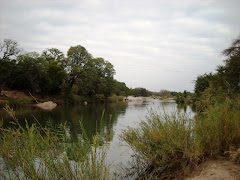
The Makhutsi river. This small tributary is dry eleven months a year and, even when flowing, is normally only a few meters across. Thankfully it joins the Oliphants downstream of my house.

If the heavy rain caused me a few tense moments, it's been a bonanza for the local wildlife. With all the temporary pans brimful, the frogs are going berserk. Every now and again they send an emissary into the house just so I know how much fun they're having.

And the frogs aren't the only ones. While searching for Halcyon, I was crossing a granite outcrop when I noticed movement in a shallow pool of rainwater. Looking closer, I was amazed to see several baby terrapins madly scuttling toward the deepest part of the pool. They lay cryptically on the bottom among the debris for a while, but soon one paddled up to cautiously poke its nose above the surface, and eventually a whole flotilla of the little creatures was drifting on the surface. They were only about an inch long (25 mm) and unspeakably cute (for mere reptiles), reminding me uncannily of the baby turtles in Finding Nemo.

But how on earth did they get there?


The terrapins' ephemeral home. The rock pool is only a couple of inches deep and situated up on a koppie, many kilometres from the nearest creek or waterhole.


 A newly-hatched marsh or helmeted terrapin (Pelomedusa subrufa). It's probably male given our wimpy summer. Terrapins (concerned about sex-appeal) let temperature determine the gender of their kids, producing hot females and cool males.


Now chelonians (that's turtles, tortoises and terrapins, not residents of Chelonia) have done very well out of their protective-shell racket, in fact they've been trundling about under cover since before the dinosaurs were a twinkle in a reptilian eye (210 million years in total). Yet a shell has to be mighty tough to withstand the jaws of a crocodile, and the relatively thin covering of marsh terrapins make them tempting snacks, especially when small. So while you'll see adult terrapins basking nonchalantly on logs (or hippos) in croc-infested waters, you won't spot a baby one. When it comes time to raise a family, marsh terrapins trek off into the bush in search of crocodile-free accommodation. I've been utterly shocked, on several occasions, to find one shuffling about in a rocky cleft of stagnant water at least 4 km (2.5 miles) from the nearest water.


Marsh terrapins belong to an ancient dynasty (side-necked terrapins) restricted to the southern continents. Their most famous ancestor - Stupendemys geographicus from Venezuela - was the world's largest chelonian, growing more than 2.5 m (8 ft) long and weighing 2,000 kg (4400 lbs). Photo posted on Flikr by pimgmx.

The love life of marsh terrapins can only be described as kinky. When a male's consumed with passion, he trails his lady love, suggestively touching his snout against her hind legs and tail. If she reciprocates his feelings, he'll teeter up on top of her, hooking the claws of all four feet under the rim of her shell. With neck fully extended, he rubs his chin back and forth on the back of her head, tickling her with two short chin tentacles. And just to keep her in the mood, he squirts a stream of water over her face from his nostrils. Now tell me, can your lover do that?


Nudge, nudge, wink, wink.
If size matters, terrapins have a right to look smug.

Like mammals, chelonians have erectile phalluses, but - unlike mammals -they're BIG, often extending more than half the length of their shell. Males fold these impressive appendages up neatly inside their cloacae when not in the throes of love, but some species are not above flashing to intimidate their rivals.
As Ogden Nash so aptly put it:
'The turtle lives twixt plated decks
That practically conceal its sex.
I think it clever of the turtle
In such a fix to be so fertile.'

The end product of all this hanky-panky is a clutch of 10 to 30 soft-shelled eggs buried in a pit that Mum scrapes in the soil with her hind feet. Ground too hard? No problem: Mum just wees on it.
Heavy rain triggers hatching, about 90-110 days later, and the little terrapins must head out, often climbing many meters of rock, to find the water that Mum intended.


This little guy may look harmless but marsh terrapins are not to be crossed. As expected, they polish off insects, frogs, carrion and waterweed. But it doesn't stop there. They also ambush, drown and devour doves drinking at the water's edge, nibble ticks off wallowing rhinos and even team up to drag down swimming waterfowl.

Friday, January 14, 2011

Wearisome wildlife?


Everywhere is flooding, except here.
Miraculous!

Admittedly, the river at the bottom of my garden (the Oliphants) sounds like an express train, and is tossing up great waves and spume of muddy brown water. But so far the torrent is only just brushing the twisted roots of the fig trees. Walking the dogs along the bank as the water rose, I was amazed by the yellow-billed kites, zooming along the shoreline in search of animals fleeing the flooded reed beds. My dogs nearly went berserk at the tempting scent of displaced cane rats and, down on the water's edge, pairs of blacksmith plovers dashed back and forth snapping up bedraggled insects.


Summer treat. The view of the Oliphants River from my house; normally I only get to see swathes of sand.


Thanks to the rain, everything here is resplendent and green; the grass is waist high and the bush a dense tangle of spiders' webs and foliage. Hidden in the depths of the greenery, the mongooses are busy raising their second litters and the pups from the first round are rushing about self-importantly chivvying and cuddling the new arrivals.

I couldn't imagine a lovelier place to live.
But...
Well sometimes, the wildlife encounters get just a little bit wearisome.

Earlier in the week Magic (my husky-cross) was skewered in the nose by a rapidly reversing porcupine that she was hassling through the mesh fence (blood everywhere). The following day I was startled to find her crunching up and eating the quills. Since she's never shown the slightest interest in quill-consumption before, I can only assume she's desperate to erase all evidence of being bested by a rodent.


An apple a day keeps the dogs at bay
(well, maybe you need some prickles too...)


Last night my wildlife encounters deteriorated further when I accidentally squished a reed frog in the front door (worse for him than me, I know, but it still left me feeling awful). And now I'm eating pasta again - for the fifth day running - because the mouse living in my kitchen (I think it fled the roof) keeps nibbling holes in packets of premade sauce. I've been intending to live trap this bolognaise-mad fiend (since my cats are failing in their only conceivable function) but during the last couple of days my kitchen's rung with the small squeaks of sibling rivalry. So now I can't relocate Mum without inflicting mass death and destruction.

Of course my mouse isn't your ordinary sort of house mouse (I got suspicious when she preferred sultanas and sweet potato to bird seed and peanuts). She is, in fact, a multimammate mouse (Mastomys natalensis); so named for - you guessed it – her extraordinary endowment of mammae (nipples).

To quote the mammal field guide,
"The multimammate mouse is the most fecund of all southern African mammals, 22 foetuses having been recorded in a single female."

Oh good. I wonder if they'll all like pasta sauce.


Staying abreast of the future. Lady multimammate mice are equipped with 8 to 12 pairs of nipples.
Photo posted on Flickr by Batwrangler.

Forthcoming snake-attractant.
These diminuitive multimammate mouselets are 3 days old.
Photo posted on Flickr by Batwrangler.

Since achieving global notoriety, the Large Predatory Beast dwelling in my roof has been lying low. I've taken no proactive steps, apart from shaking my fist at suspicious ceiling noises and shouting 'Stay up there, you bastard!' (ah, the joys of living alone). So I guess I can only blame myself for what took place a couple of days ago.

I was innocently curled up on the sofa reading a book when the dreaded happened.
Something fell out of the ceiling and landed on my head.
It was not small, and it was alive.

Heart-pounding and breath coming in gasps, I forced myself to stay still as the animal slid/slithered down my hair and on to my right shoulder. Not daring to turn my head to see what it was, I sat frozen, fervently hoping I'd be mistaken for an inanimate substrate. I could tell from the feel of it that whatever was poised on my shoulder was reptilian; you know, yielding on the outside but firm beneath (the texture that rubber snakes replicate so scarily). But after about 10 seconds of sitting perfectly still, my apprehension grew too great to bear (imagination is a highly overrated attribute) and - although I knew I may be precipitating a strike (fangs in the neck, urrgh) - I screwed my eyes shut, gritted my teeth and gave a small shrug.

The creature started, and then sIithered rapidly down, onto the arm of the sofa. I was already on my feet by the time I caught a glimpse of it. Sitting staring at me anxiously from the armrest was a very large Turner's gecko!

Now I should have felt relieved. I mean I was relieved; there are many worse things it might have been. But I guess I had too much adrenalin pumping around my system to feel anything but gasping anxiety. The gecko and I stared at one another in mutual antipathy. Still shaking, I guided it up the wall to the shelter of the curtain.

Now I NORMALLY like geckos. The ones in my house achieve gargantuan size because they sneak in and feast on my mealworm colony every night. This one was about 22 cm (9") long and 5 cm (2") across the tummy (no doubt worm-filled). Surprisingly it was still sporting a tail; most of my residents lose this appendage at the paws of my cats (we're only playing...).

Of course geckos are fascinating creatures and I'll probably write a post about them at some point in the future. But right now, I don't even want to think about geckos.

I'm sincerely hoping that my wildlife encounters will take a turn for the better soon.


The culprit. Turner's geckos (Pachydactylus turnerii) are close relatives of Bibron's geckos.
Related Posts Plugin for WordPress, Blogger...