Saturday, January 28, 2012

Hey, I ain't drowned yet!

Do you ever have one of those days?
You know, when getting out of bed turns out to be a seriously bad decision?

Well Wednesday (18th Jan) was that kind of day for me.
Things actually started going pear-shaped on Tuesday afternoon, I just didn't notice.
That was when the rain started.

Now rain is good; we need rain.
I’m thoroughly sick of providing halfway housing for dispossessed tadpoles.
OK, I did spend much of Tuesday night emptying drip-buckets, mopping up indoor waterways and rearranging electrical appliances, but that’s only to be expected.
Yet perhaps if someone had mentioned the word ‘cyclone’ I may have been more wary.
Maybe I wouldn't have headed out into the downpour at 5am to collect an Australian friend who was flying into Nelspruit (200 km/124 miles south of here).

The 3 km (1.9 miles) slalom run to the front gate was an eye-opener. Skidding through sticky red mud, plunging into overflowing creeks, circumventing hitherto unknown lakes and careening into culverts was somewhat off-putting. When I finally crept onto the tarred road (with one headlight blearily water-filled and my fan-belt squealing in protest), I thought my troubles were over.

Hmm...
I can’t see anything in this torrential rain.
Did those oncoming cars have their hazard lights on? I wonder..?

Next minute I’m aquaplaning at 100 kph (60 mph) down a road that’s a river. The water is almost 18 inches (45cm) deep and bubbling along at a merry pace. When my tyres finally touchdown, I figure I’d better keep going, since I’m already in it (in every sense of the phrase). So on I chug... and on... and on... milk chocolate water churning against the windows. I’m getting nervous: how deep is this water going to get?
Then looming through my deluge-smeared windscreen are the rabbit-dazzling headlights of a massive truck.
In the centre of the bloody river road!
The behemoth’s horn blares deafeningly and just as I’m thinking my end has come, the truck’s huge bow wave catches my car and swirls it sideways. Shit, shit, where does the tarmac end?? Once I regain steering, I manage to lurch back on to what could be the road.
Oh God!
Can I really reach the airport?

By the time I slew, skid and slosh my way into Hoedspruit (35 km/22 miles from home) I have the demeanour of a druggie in rehab.

I’ll just stop here, calm down and decide what to do, I think.
Oh.
The petrol station is hidden behind Lake Geneva. The supermarket’s car park is an ocean vista.
Maybe not.

But how is an aeroplane going to land in this??

Still unable to see more than a foot in front of my beleaguered windscreen wipers, I decide to flee for home before the road is cut entirely. So back I chug, through hell and high water.

Just as I reach my front gate, the deluge stops. My mood lightens with the sky. I phone the airline: oh yes, the flight touched down right on time. I envision my friend sitting, waiting...
Maybe I gave up too easily.
Maybe I’m just being a wimp.
After all, the water is probably no more than runoff from the actual downpour. Give it a few minutes and it’ll all flow away...
So round I go again and head back.

There’s more traffic about now and big 4-wheel-drives cluster nervously at the edge of the floodwaters, like bathers in winter. Their occupants stare open-mouthed as I zip past them in my little bakkie/ute/truck/van (a 1989, 2-wheel-drive, 1800 Hilux), plunging fearlessly into the swirling torrent (heck, I’ve forded it twice already!).

This time I’m determined not to give up. My grim resolve carries me through rushing, log-toting rivers, over-pouring dams and vast brown lakes. But 50 km (30 miles) from home I’m defeated. Up ahead a long line of motorists sit gazing in dismay at an endless expanse of water. In the middle a single car sits. Its tail lights still blaze defiantly although they’re submerged, and water's gently lapping over its bonnet/hood.

Ahh. Time to head back home.

But I don’t make it home. Just one kilometre (half a mile) from pay dirt I’m forced to abandon my waterlogged trusty car on the edge of a waist-deep beck. After wading through, I squelch home on foot.

Now this should be the end of the tale, shouldn’t it?

I'd love to be able to describe how I snuggled up on the sofa with my dogs and a warm cup of cocoa and listened to the falling rain.

But I can’t. Or rather I couldn’t (hear the rain, or anything else for that matter). You see outside my backdoor a jumbo jet was taxiing. Or at least that’s how it sounded. In reality it was the Oliphants River and it was in FULL flood. 


The view from my spare bedroom.
The nice caramelly bit is raging floodwater.

The caramelly bit up close.
Not something you want to find on your doorstep.

Now for those of you, like myself, who didn’t think South Africa suffered cyclones, let me introduce you to the wonders of climate change.
Cyclone Dando made landfall in Mozambique on Sunday the 15th and after successfully inundating 4000 homes decided to try its luck in South Africa. Fortunately its overland trek exhausted the 120 kph (75 mph) winds, but didn't prevent it from dumping 380 mm (15 inches) of rain in the Hoedspruit area (in about 36 hours). The town suffered its worst floods on record; every access road was cut and both the Blyde and Klaserie rivers broke their banks, destroying shops, businesses and homes. Floods swept through the nearby Kruger National Park where several camps had to be evacuated and stranded tourists airlifted to terra firma.


Kruger National Parks’ Sabie River (viewed from the Lower Sabie restaurant). Photo by Arno & Louise Meintjes.
 

Not the best choice for a game drive (the Sabie River showing its teeth). Photo by Arno & Louise Meintjes.


With the rain still bucketing down, I stood gazing at the river racing below my house. Huge waves and eddies churned the water and spume flew high into the air. Enormous tree trunks surfed by as fast as a car on the highway, and breakers crashed against the banks.

When you live on the banks of a major river you formulate plans for this sort of an eventuality. But mine did not involve being car-less.
And NO vehicle could breast the torrent that I’d just waded through.

I looked like I'd have to abandon all my possessions, and just trudge off into the hills with my pets, singing Climb every mountain.

Surveying my house, I was a bit disconcerted to find that I really didn’t mind losing most of its contents (is this one of the benefits of being a hoarder?). But there were my books; and the computer. And all my work equipment.

I spent several hours packing. The moment I opened the front door to move the boxes, my dogs hurtled out, disappearing off into the rain-soaked bush. Was this some eerie animal ‘presentiment’ thing, I wondered? Or just the irresistible lure of displaced cane rats? Sans dogs, I carted my books through the rain to an old shed (on slightly higher ground) and shoved and hauled my ‘valuables’ (in lidded plastic crates) up the slope into the bush.

As the river continued to rise during the afternoon, army helicopters zoomed back and forth overhead, presumably searching for hapless victims stranded by the flood. I stood outside hopefully, looking pathetic, but I guess I wasn’t hapless enough because they just whop-whopped on by. (I’ve since heard about an 80-year-old who sat up a tree for several hours awaiting rescue - OK, her need was greater than mine.)


The Oliphants River roaring past my house (at 3118 cubic metres/110,111 cubic feet per second). Just enough to fill my house - floor to ceiling - in one-twelfth of a second.


My back garden. The little black blobs in the water are the uprights of a picnic table. The top is already scudding its way to Mozambique.
 
The water continued to rise all evening and I kept dashing outside with my torch to check where the surf was breaking. If it rose another 2 m (6 ft), my house was a goner.

I wasn’t relishing the prospect of sitting out the night on a hilltop in the rain. The pets wandered about restlessly with widened eyes, and my head throbbed painfully from the constant roar. I’d intended to mount an all-night vigil (so as not to wake surrounded by swirling, crocodile-infested floodwater) but tiredness overcame anxiety and prudence. Huddled in a heap, the pets and I eventually fell asleep.

And lo and behold, at dawn the next day we were still there!
And the river was starting to fall.

Yay!


The aftermath. The riverbed below my house now looks ravaged.


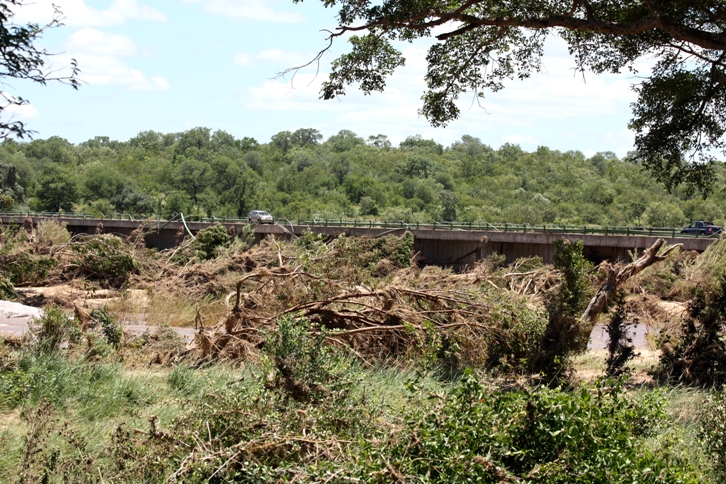
The Sabie River a week after the flood. Check out the railings torn from the bridge (on second thoughts you’ll need a magnifying glass; see below instead).


Flood-wracked railings.


Tuesday, January 10, 2012

Three's a crowd

‘twas the night before Thursday
And all through the house
Not a creature was stirring
Not even a mouse.

Huh?
THIS house??

Where bushbabies hold nightly gumboot races in the ceiling, cheered on by a squeakery of bats?
Where three species of gecko brawl raucously over the rights to my mealworm colony, and resident gerbils sharpen their teeth - without pause - on my electrical appliances?
Oh, and let’s not forget the live-in toads who are convinced that beetle-hunting is most lucrative deep within my store of recycled plastic shopping bags.

THAT house??
Yep.

Silent as the grave (and the simile wasn’t chosen idly).

What catastrophe has befallen us?
Did my housemates succumb to radio-active fallout from the gnawed microwave? Or maybe deadly spores wafted from the dishes mouldering in my sink? Was our water supply craftily poisoned by delinquent baboons?
No. We simply have a visitor come to stay.

In truth, we’ve had three visitors (all equally ostracized by my roommates) but I managed to persuade the other two to leave.

Now don’t imagine that these houseguests turned up unannounced.
It’s just that sometimes I have trouble understanding the local lingo.
Still, the first warning came through loud and clear.

I was beavering away on my computer on Tuesday afternoon when a large toad hopped by. Now this is nothing unusual as I share my domicile with at least four of the beasts.
Hey, but wait... It’s daytime!
I leapt to me feet in panic.
You see my toads are nocturnal beings, and there’s only one thing that will drag them from their beds before sundown: a professional toad-muncher.


A red toad (Schismaderma carens): snake-detector extraordinaire.


As the toad hurried out the back door, I cautiously crept into the kitchen (from whence the refugee had hopped). On route I passed a panic-stricken gecko, fleeing its daytime haunt behind the fridge.
Not a good sign.
A wary search of the kitchen’s nooks and crannies revealed the culprit: a Mozambique spitting cobra, lurking behind the stove.

Now I’ve written about spitting cobras before (here, here and here). With appalling manners (spitting in the faces of strangers) and a lethal overbite, they’re not the sort of guest you want loitering in your food preparation area. But, fortunately, the judicious application of a broom induced the creature to retreat into a poster tube (ah, one of life’s essentials), and in no time at all I was trudging off into the bush to liberate it.

The following day I was once again plugging away at my computer (see how diligent I am?) when Magic (my husky-cross) leapt up and rushed to the backdoor. We knew that something was loitering immediately outside because its shadow was moving in the strip of light under the door. I was gazing at this dark shape when, suddenly, a thin, black filament flicked, just for a moment, in under the door.
It’s a skink’s tail, I assumed erroneously.


Rainbow skinks (Trachylepsis quinquetaeniata) frequently skitter in and out of my house, hunting for any creepy-crawlies the toads may have missed (or maybe just to taunt the dogs).

Since the skinks are masters at evading canine pursuit, I opened the door to let Magic out.
Standing there on the doorstep was a two meter (6 ft) long rock monitor. Grey and gnarly-looking, it was bent forward with its stubby nose pressed to the crack below the door, and was flicking its long, forked tongue in underneath. I managed to grab Magic’s collar as she lunged for the reptile, and while I struggled to hold her, the monitor took off, racing in a claw-scritching, side-to-side, swayback sort of way for the back fence.

Once rational thought had returned, I sagely concluded that the monitor was hunting skinks, and nonchalantly went back to the computer.
Big mistake. It was not hunting skinks.


The rock monitor (Varanus albigularis) actively pursues its meals, licking up its victim’s scent with its forked tongue. The tongue’s prongs slot neatly into the paired opening of its vomeronasal organ, snugged away on the roof of its mouth.


Some hours later, when I lifted the lid from a mega carton of eggs sitting on my countertop (the carton, not me), I discovered what the monitor was hunting. A very large spitting cobra was coiled neatly among the eggs. The unexpectedness of this rendezvous sent me reeling backwards out of the kitchen, and the wily serpent slipped away beneath an immovable cupboard.

Oh dear.

Hence the complete exodus of my roomies.

Those of us brave enough to remain behind for the night (just myself and the pets) congregated by silent consent in my bed. As the kitchen has no door, we all hoped that a massed pile of big, warm furry mammals would be sufficient disincentive to a roving serpent.

MISSING
Mozambique spitting cobra (Naja mossambica).
Last seen wearing a smug expression,
in the vicinity of my saucepan cupboard.
Photo posted on Flickr by Jeppestown.

My hopes that our scaly tenant would do a moonlight flit were dashed when I went to feed the birds next morning. I discovered it curled up asleep in the spilled birdseed (clearly a strategic thinker). Once again, it exploited its shock-value to zip into hiding. My frantic efforts to find the beast failed, and the pets and I crept about the house on hyper alert, cringing from any object even remotely reminiscent of a snake.


Serpent induced chaos. Emptying all my kitchen cupboards did not reveal the felon.

My state of mind was not improved when I arrived home from my weekly shopping trip to discover my third caller, schlepping on the bed in my spare room.
What was this, a cobra convention??

As much as I wanted to believe that this creature was my overnight guest, its wholemeal-tinted sheen gave the game away (my kitchen resident was decidedly terracotta). Fortunately, this one zipped into the poster tube lickety-spit split, but I was still feeling shaken.
The prospect of immediately resuming a snake-hunt was more than I could face.

No, I thought, I’ll just take a wee break; let myself calm down a bit.
I know, I’ll treat myself and open the Christmas package I just picked up from the post office.
My mouth was already watering because it was from my sister (in Oregon USA) who normally sends me candy.

Now I don’t know whether you’ve noticed, but siblings – even those you rarely see – have an uncanny knack for ‘hitting the spot’; and not always in a good way. That day was no exception.

Ripping impatiently at the packaging, my heart suddenly stopped. Hidden within the torn wrapping paper - right beneath my fingers! - were the unmistakable coils of a snake!
Oh my God!
I let out a shriek and hurled the package across the room. My dozing pets, seeing a metre-long serpent uncoiling on the floor, careered away in all directions.

It took us all some time to regain our composure.

And there, lying in the middle of the lounge room floor, was a cellophane-wrapped, confectionary snake.
The label read, “The world’s largest gummy snake”.
“Almost 36 inches long” (almost?).
And then, just in case you were worried, “Artificially flavoured”.


While munching belligerently on this snake (delicious, by the way), I decided that this would be a symbolic gesture. No more would I be terrorized in my own home by a mere elongated reptile. As I devoured the snake, so I would annihilate my fear. After all, my houseguest clearly didn’t want to meet me (and was skilled at achieving this) and I didn’t want to meet it. All in all, I daresay we could get by.


POSTSCRIPT:
I didn’t meet our unwelcome tenant again, and you’ll be relieved to know (or at least I was) that all my wild acquaintances have now moved back in. I’m presuming this means that the cobra's made tracks.


Has it gone? I've never been so pleased to see a bushveld gerbil (Gerbilliscus leucogaster) peeping from my cupboard.


Saturday, December 31, 2011

Why raw bamboo shoots are a no no

I was sitting on a wet, slimy boardwalk watching tiny leeches inch their way up my mud-caked boots.
Huge trees loomed all around, their foliage heavy and dripping from a recent downpour. Dark clouds still pressed low, making the forest as gloomy as I was feeling.

The conversation didn’t help.

My companions were debating how long a species could remain unseen before it should be declared extinct.

There was good reason for both the topic and our despondency.

You see we were awaiting the impossible.


How did we get into this predicament? Well we’d clambered up this steep, slippery hillside, in the rainforest of Ranomafana National Park, in the hopes of glimpsing one of the world’s rarest primates. Critically endangered, the greater bamboo lemur (Prolemur simus) once frolicked across the entire island of Madagascar but today it clings on in just twelve isolated forest fragments. Fewer than 200 of the critters draw breath.


Ranomafana National Park is a 39,200 ha (96,900 acre) tuft of rainforest growing on the bald pate of eastern Madagascar. It was protected after a new species of lemur (the golden bamboo lemur) was discovered here in 1985.

We’d been shepherded up to this isolated spot by our park guide and his posse of ‘wildlife spotters’.
You see gawking at lemurs is big business in Madagascar and Ranomafana (home to 13 species) runs a tight ship.
When you rock up at the park you're allocated an (unexpectedly knowledgeable) guide, who specialises in visiting just one specific lemur group (of each of the common species). The guide's bevy of spotters race off into the forest to locate the beasts, while you saunter along the forest trails marvelling at minutia (bugs, frogs, chameleons, weird geckos, weirder tourists). Then a cell phone trills. ‘They’re found!’ With agitated hast the guide musters any stragglers and chivvies you off to do your gawking.


A minutia. The tree frog, Boophis viridis, or so I was told.
It could be a Martian for all I know.


Another rainforest skulker: a pitta-like ground roller (Atelornis pittoides). Ground rollers raise their families underground and are endemic to Madagascar.


Now I can’t deny that this system is efficient and lemur-friendly (any one lemur group is subjected to gawking for a limited time only). But it’s also surreal.
Lemur home ranges are small, so bands of gawkers are constantly drifting by, like ships in the night, and the forest echoes with excited cell phone conversations. And woe betide anyone who inadvertently stumbles across the wrong group of lemurs. You’re expected to avert your eyes shamefully and hurry on by.


The eastern grey bamboo lemur (Hapalemur griseus) is one of three species of bamboo lemur (also known as gentle lemurs) that call Ranomafana home.

So it was our guide who’d parked us beside a towering stand of giant bamboo while he and his posse sought our quarry. But before he left, he shared a few facts.

He told us that this group of greater bamboo lemurs was the ONLY ONE surviving in Ranomafana National Park.
‘You mean, it’s the only one tourists visit?,’ we suggested hopefully.
‘No, no. There is just one.’ 
We stared at him non-plussed.
He explained that the lemurs’ nearest neighbours lived 200 km (124 miles) away in a forest fragment on the slopes of the Andringitra massif.

Oh.

We asked how many lemurs were in the group.
‘There used to be eight, but when we last found them, there were only two left.’
‘When was that?’, a brave soul asked.
'Six weeks ago.'

Ahh.

We were still standing gob-smacked, mouths opening and closing like goldfish, when he and his team trooped off into the trees. Our dismay hadn't yet coalesced into cogent thought, so we didn't manage to holler,
‘Hey, why are we squandering our precious time in this park pursuing phantoms?!’

So we waited.
Miserably.


Now don’t get me wrong. Bamboo lemurs are worth investing time to see. They’re intriguing critters. With atypical accuracy, their common name really does reflect their tastes: they dine almost exclusively on bamboo, and giant bamboo (Cathariostachys madagascariensis) usually makes up 80-90% of their munchies.
The problem is, giant bamboo contains cyanide.

To thwart plant-nibblers big and small, many bamboo species stuff their tasty young shoots with taxiphyllin, a cyanogenic glycoside. When digested, taxiphyllin breaks down into deadly hydrogen cyanide. The bamboo’s branch shoots (which thrust up out of the ground like whopping asparagus spears) are the most heavily fortified; in giant bamboo they tote 15-40 mg of cyanide per 100g of shoot.
The lethal dose for humans is 0.5 to 3.5 mg per kilo of body weight.
Fortunately, cooking destroys the cyanide.
Unfortunately, lemurs don’t cook.


Lucky to be alive? If so, this eastern grey bamboo lemur is intending to waft the message to the world. It's smearing its tail with its own personal 'eau de lemur' from the scent glands on the inside of its wrists. 

No one knows how bamboo lemurs cope. They're the only primates to specialise on bamboo. Golden bamboo lemurs, who prefer to dine on the branch shoots, routinely guzzle 12 times the dose of cyanide needed to snuff out your average mammal. Researchers have found that the urine of all three of Ranamofana's bamboo lemur species is tainted with hydrogen cyanide (but their droppings aren't) showing that they really do digest and absorb the poison.
  

A golden bamboo lemur (Hapalemur aureus). Feeling a touch of indigestion?
    
Eastern grey bamboo lemurs sensibly favour bamboo leaves which are relatively low in cyanide. Tipping the scales at less than a kilogram (< 2.2 lbs), they're the smallest lemur to romp about by day.

For those of you fond of Asian cuisine, who might doubt the toxicity of the humble bamboo shoot, beware! Eight people keeled over in a well containing pickled bamboo shoots, blacking out instantly due to the hydrogen cyanide gas given off by the pickles. Two of the victims never recovered, their hearts having failed them entirely. Frustratingly, the research paper fails to address the most obvious question: what were eight people and a load of pickled vegetables doing down a well anyway? Although suspiciously mute about the veggies, the authors do allude to a ‘botched rescue attempt’.

But I digress distressingly.
Back to the rainforest.

We’d been sitting about despondently for around twenty minutes, and conversation had lapsed into a silent contemplation on the nature of loss (or the loss of Nature). We weren’t really listening to the surround-sound screech of frogs, cicadas and other unseen stridulators; in fact most of us were staring off – unseeing - into the eerie, primeval gloom. One of our group, glancing up at the huge bamboo thicket looming above us, said chirpily (in a transparent attempt to lighten the mood), ‘I keep expecting to see fairies or something suddenly pop out.’

And within a matter of minutes they did.

It started as a rustling overhead, and then a clump of bamboo canes swayed wildly as something dark clambered down among them. We snatched up our binoculars and jostled one another for the best view of the moving fronds.
OK, there was some fur...
Oh, and look a tail.
Yes, yes, they’re lemurs for sure... But what sort...?
Oh my God!

The impossible had happened.

Above our heads, the last two greater bamboo lemurs in Ranomafana National Park were nibbling bamboo!

About the size of small house cats and clothed in dark brown fur, they sinuously wound between the bamboo canes. One peered down at us, his bald nose and prominent grey ear tufts giving him a nutty professor look. As we watched, he began gnawing at the woody stem of a bamboo cane. Once he'd made a small hole, he clasped an edge of the wood in his teeth and pulled down a strip to reveal the soft pith inside. This he munched with enthusiasm. Greater bamboo lemurs are alone in using this part of bamboo plants.

Greater bamboo lemurs (Prolemur simus) specialise more exclusively on bamboo than any other lemur. This reliance makes them very vulnerable because bamboo is also coveted by humans. Used as scaffolding, it's often removed from forest remnants, even in protected areas.

Greater bamboo lemurs normally hang out in groups of 7-11 individuals. These two survivors are father and adolescent daughter.

About ten minutes after the lemurs had disappeared further up the mountainside our posse of lemur spotters trudged back. Sweaty and bedraggled, they shook their heads glumly, only to be greeted by an uproar of excited exclamations. As they peered at the images on our cameras, their eyes widened and smiles broke out all round; there was much back-slapping and laughter. I must admit that I was greatly heartened by their obvious delight and relief over the continued existence of their greater bamboo lemurs.

As we slipped and slithered back down the muddy track, we talked of our amazing good fortune in seeing these rarities. But somehow our elation and sense of privilege just wasn’t strong enough to lift the heavy, underlying despair. These creatures were almost certainly doomed.

I found myself wishing that I could give the good luck back; somehow pass the blessing over to the lemurs like a vial of golden Felix Felicis (Liquid Luck).
They were going to need every drop they could get.


Praying for a future?


Sunday, December 25, 2011

Holy infants?

It’s Christmas Day and I’m knee-deep in nativity scenes!

OK, maybe there's a dearth of straw-filled mangers, but angelic infants I’ve got aplenty.

As a kid, one of the highlights of Christmas was braving the crowds of harried shoppers to gawk in the windows of Melbourne’s largest department store.
With my nose snubbed against the plate-glass, I’d gaze open-mouthed at the archaic, creaky animatronics. Above the gum-nut babies, possums popped in and out of velvet tree hollows, owls blinked with glassy eyes and parrots flapped garish wings. Tiny dancing mice circled Cinderella on a barely concealed conveyer, each one twirling in frozen ecstasy.
And of course there was baby Jesus, hedged in by misshapen, nodding donkeys and smiling beatifically at a drummer boy suffering severe stomach cramps.

By today’s standards, this was primitive stuff indeed.
But even the newest of whizz-bang technology can’t begin to emulate what I can see through my windows today.


You see the bush around here knows how to do Christmas.
Decked out in the lushest greens, the foliage glitters and sparkles with a million fairy lights (thanks to yesterday’s rain), and mini Chinese lanterns dangle from every trackside sickle bush.

 
The sickle bush (Dichrostachys cinerea): Santa's own tree.
The Shona name for this species (mupangara) means 'tassels for the chief's hat'.


Even the tree ornaments are animate.

But it’s the nativity tableaus that are the real treat of the season.


Look beneath the tree here and you’re likely to find a wobbly-legged foal, gift-wrapped in stripes, or a lavishly decorated giraffe calf touching noses with its mother. My own favourites are the drifts of russet daffodils that, on closer inspection, become snoozing impala lambs; just their little faces and black-tipped ears poking above the dew-soaked grass.

Baby baboons ride by like prize-winning jockeys, and the first warthog piglets (who emerged jitteringly from their underground nests last week) trot along in single file with tails erect, and scatter like a flock of startled birds at the slightest threat. As usual, the little brown wildebeest calves arrived only just in time; their sudden entrance into the world as unnerving as the off loading of a school bus.

Now who’s to say whether these charmers have been fathered by Gods?


Like all youngsters, this one's itching for Christmas.

 
Christmas dinner? Impalas believe devoutly in safety in numbers. Bundled up in huge creches, the lambs move like schooling fish.


Who are you calling a fish?
 

Christmas is a time for pigging out but, for wee warthogs, speed is of the essence. Mum only turns on the milk for one minute bursts.

  
Hogging the limelight.

Now, as anyone who’s spent time appreciating the African bush knows, every day here is rather like Christmas.

You set out at first light to pay homage and in return you’re granted an armful of gifts. And to add to the excitement, you never know whether they’ll be socks or a new Lamborghini.

However, during the festive season the lowveld really ups the ante; in fact it's as if I’m living out the Twelve days of Christmas, with a special boon arriving daily.

The other night the porcupines trundled up to my compost heap with a brand new porcupette in tow (isn’t that a wonderful name?). This little blunt-nosed guy shuffled about shyly, pressing itself up against Mum (or Dad or older sibling, since the whole family helps with childcare). I assume he was embarrassed about his extravagant mohawk.

It was on the following day that I discovered two newly minted terrapins – their tiny shells less than an inch across - paddling about in a rock pool (actually more of a puddle) atop an isolated granite koppie.


The sprogs of marsh terrapins (Pelomedusa subrufa) favour teeny pools to avoid the jaws of crocodiles. 

Then on the third day, while walking with Bugbears, I accidently flushed a family of large-spotted genets. Springing lithely from their tree stump home, the three youngsters scrambled up a nearby marula tree. Crumple-eared and blinking myopically, they clung teetering by their claws, waiting for me to leave. These breathtaking (if sleep-interrupted) carnivores are softly furred in flamboyant polka-dots and sport luxuriously ringed tails. They're strict night owls and it's the first time I've glimpsed them by light of day. Of course, with my usual aplomb, I failed to capture them on film (or should that be on digit?).


A large-spotted genet (Genetta tigrina) masterfully photographed at Cincinnati Zoo.
Posted on Flickr by West Chester Dumonts. 


And then of course there are the four young silver-backed jackals who sit around outside their termite-mound den each morning, disconsolately scratching their fleas. Presumably Mum has hussled them outside to play so she can spend quality time with her new litter.


Do you think she'll let us back yet?

I can’t help but wonder what I'll find next?
Five gold rinkhal eggs?
Five baby unicorns?

Come to think of it Halcyon’s reigning monarch, Jasmine, has just produced five tiny pups...
But don’t let me get started on mongoose pups...


‘See Dad, I could be a tree-top angel!’
Keid, an ambitious dwarf mongoose (Helogale parvula) pup, chaperoned by his older bro, Flame.
Photo copyright Cleo Grieve.

All in all, there’s nowhere in the world that I’d rather spend Christmas.
And I wish upon you the same blessing.


Tuesday, December 13, 2011

I think I'm going cuckoo


Thrice welcome, darling of the Spring!
Even yet thou art to me
No bird, but an invisible thing
A voice, a mystery.

                     Wordsworth (who clearly didn't live around here)


Firstly, let me point out that this post is not about lemurs.
In fact it isn’t even about Madagascar.

I’m taking a break from my lemur litany to indulge in a bit of a gripe.

I need it.

You see my neighbourhood ‘invisible thing’ is driving me to distraction.


I’m sure you know how it feels to be assailed by an apparently innocuous sound, endlessly repeated.
Whether it’s the plink of a dripping tap or a tune circling in your mind, incessant repetition can push the sanest of us into madness. (And after eight years as a recluse, sanity is not my strong suit.)

My own personal bugbear comes feather-coated. He swept in about a month ago, all fresh and perky after a winter vacation in equatorial Africa. Dressed elegantly in soft grey, with a waistcoat of pinstripes and salmon cravat, he’s far too dapper for his slightly embarrassing moniker: the red-chested cuckoo (Cuculus solitarius).

 
Like other cuckoos, the red-chested (Cuculus solitarius) is dressed to impress. His slick hawk-like shape, raptorish eye-ring and sparrow-hawk chest stripes are no accident. Experiments show that the stripes alone are enough to intimidate potential cuckoo-rearers, allowing the wearer access to nests. Photo by Johann du Preez.

My red-chested cuckoo is out for a good time.
Having staked out a bachelor pad in the trees along the river, he dallies at special ‘song posts’ hidden in the foliage (essential, to avoid the shot-gun blasts of irate listeners) and sends forth his message. Repeatedly.

Now his descending, three-note call is not unpleasant per se (you can listen to it here).
But repeated stridently - at one second intervals – for hour after hour after hour, it’s simply soul destroying. And don’t imagine that nightfall brings relief. Mere darkness is no deterrent to a red-chested cuckoo on the make.

Tossing and turning sleeplessly, I’ve had plenty of time to ponder the purpose of his incessant advertising. Is he warning off rivals or serenading the ladies? At the risk of eroding your sympathy, I’ll admit (solely for scientific purposes) that he does occasionally take a break; sometimes for several days at a stretch (ah, blessed relief).
But this is weird behaviour for a bird that defends its territory with song. Does he only engage in operatics when he has an audience?
I’ve come to the conclusion that what he’s really shouting is,
“Have I got a nest for you!”

You see, in red-chested cuckoo society, it’s the male who screens prospective foster parents. When not driving innocent bystanders insane, he skulks about spying on the neighbours. Once he spots a happy couple preparing their nursery, he hurriedly leads (one of) his true loves to the spot and helpfully distracts the parents-to-be while she sneaks in and lays an egg. To make the crime scene less conspicuous, she then scoffs a resident egg (why waste a good egg?).


Like all his kind, this cute red-chested cuckoo chick won his spoiled, only-child status by murder (struggle, push, shove... ‘Oh look, chick/egg overboard. Now how did that happen?’).
Photo by Arno & Louise Meintjes.

As I’m sure you know, cuckoos produce eggs that look similar to those of their victims to assist them in their evil egg-switching.
This is all good and fine if you’re a cuckoo species that freeloads on only one type of bird. But my annoying red-chested cuckoos don’t put all their eggs in one basket (that way, they could become extinct... or so I fantasize).
No, my cuckoos foist their ankle-biters off on to 18 different species of sucker, all of whom produce very different looking eggs. So how do the cuckoos mix and match?

Well not all red-chested cuckoos are born equal. In any one place, you’ll find several different races (called gentes), each of which specialises in hoodwinking just one particular host, and produces the eggs to match.
But how do the cuckoos maintain this racial purity? What happens when a girl from the Cape robin gens (gens is the singular of gentes) is swept off her feet by a boy from the wagtail gens. Will the couple’s daughters ever find a suitable nest for their miscegenated eggs?
Alternatively if maiden cuckoos always abide by family tradition and only choose lovers from within their own gens (i.e. there’s no racial mixing), surely the races are really different species?

The answer is devious. Unlike mammals - where it’s the male who totes the whacky, sex-defining Y chromosome - birds do things the other way around. Macho birds carry two Z chromosomes while the ladies are ZW. Egg colour is craftily encoded on the W chromosome, so it’s always passed on – unadulterated - from mother to daughter regardless of what or whom Dad is (as he can only ever contribute a Z chromosome).

A recent study of greater honeyguides (OK, not a cuckoo but employing the same nefarious means of reproduction) found that their gentes are extremely ancient. When the researchers looked at the honeyguides’ mitochondrial DNA (which comes only from Mum) they found that the gentes had remained entirely separate and unsullied for millions of years. But when they looked at the chromosomal DNA (which comes from both Mum and Dad) they could find no difference between gentes (because everyone happily interbreeds).


The eye of the beholder. Some gentes of red-chested cuckoo lay eggs that don’t match those of their target species. So why do the victims accept them? Unlike us, birds are able to see near ultraviolet wavelengths. When researchers examined the eggs using ultraviolet-visible spectrophotometery, they found that they were similar. Oops.
Photo by Johann du Preez.


Among their other weird traits, cuckoos are renowned for their fondness for hairy caterpillars (they munch them, not keep them as pets). They develop this predilection only in adulthood because no sensible foster parent offers a chick such noxious fare. Furred caterpillars are eschewed by almost all birds thanks to their urticating hairs (I love that word; it means ‘stinging like a nettle’). The tips of these hairs are detachable and dispense irritating poison. Although cuckoos scrub their dinner thoroughly (you can see footage here), the lining of their gizzard still ends up bristling with cactus-like spines. To rid themselves of these, European cuckoos slough off and regurgitate bits of mucous membrane lining (a trick most of us employ only after dining on dodgy prawns).


Local cuckoo food.
Who wouldn't want one as a pet?

It was perhaps this ability to stomach noxious things that encouraged our ancestors to link cuckoos with wedlock. The sceptre of the ancient Greek goddess of marriage is normally topped by a cuckoo rampant, and folklaw stipulates that to hear a cuckoo is good luck for those about to tie the knot, and a portent of adultery for those already wed. Since I fall into neither category, I’ll opt for the alternative claim: the number of cuckoo calls you hear signifies the number of years until you marry or die (whichever comes first).

By my calculation, I should still be going strong in 9011.
How long my sanity will last is another question entirely.


Saturday, December 3, 2011

The world's cutest mammal?

There are surely many contenders for this title.
But up there with the best of them are mouse lemurs.

Now mouse lemurs don’t get much publicity. Compared to the hype dealt out for kittens, koalas, puppies or pandas, mouse lemurs suffer a media blackout. In fact, their only real public appearance was in the animated movie Madagascar, where Mort - the mouse lemur - was ‘Plan B’ should the lion Alex find sushi unpalatable.


Mort from Madagascar. Apart from his diminished dentition and propensity for bawling (oh such blatant exploitation of our nurturing instincts), he’s a reasonably accurate rendition of the mouse lemur genus (Microcebus).

As their name suggests, mouse lemurs are petite. They’re actually the world’s smallest primates. Pop them on balance (the scales-of-justice type) and you’ll need three of the little blighters to counterbalance one pygmy marmoset (and I know you thought they were teeny).

Being so eminently bite-sized (30-70g/1-2.5 oz depending on the species), mouse lemurs only come out under cover of darkness. So if you want to see one, you must venture out by torchlight.

My first encounter with a mouse lemur took place in a thicket of ‘spiny forest’ at Berenty Reserve in southern Madagascar. Now skulking about in the dark in a habitat that’s renowned for its thorniness isn’t actually as unpleasant as it sounds. In fact, for someone accustomed to the weapon-toting plants of Africa (designed to decorticate rhinos, elephants and giraffes), Madagascar’s thorny scrub is something of a cake walk. We’d only begun edging our way through the prickles when a searing flash of eye-shine leapt from the darkness. There, just at eye-height, crouched in the spiky shrubbery, was a stunning little animal.

A small piece of fluff with huge radar ears and large soulful eyes, it sat gazing at us, swivelling its ears back and forth (independently) as we appreciatively ‘ooohed’ and ‘ahhhed’. Its was a grey-brown mouse lemur (Microcebus griseorufus) and a ringer for a lesser bushbaby (although a third the size and more... well, mouse-shaped). As it sat there tremulously, looking at us with huge puss-in-boots eyes, it seemed so small and vulnerable I began to worry about our intrusion upon its life. Should we really be shining spotlights into those fathomless eyes?

It was at this moment that a moth fluttered down into the pool of light. With lightening speed, the little lemur reached out and snatched the insect from the air. Clasping its victim tightly in one fist, it bit off the head, and - still gazing at us - sat chomping away (very succulently) with its sharp little teeth.

Er, well maybe not quite so innocent and vulnerable...


My inept photograph of a grey-brown mouse lemur (Microcebus griseorufus). Fifteen species of mouse lemur haunt the forest (remnants) of Madagascar (ten of these were described since 2000).


Another of my out-of-focus photos of a grey-brown mouse lemur. Although quite svelte in October (after the cool dry season), mouse lemurs indulge in ‘opportunistic fattening’ (a concept I’m familiar with). They can double their body weight during the wet season, laying down fat in their tail (which I’m also familiar with).

Now this little mouse lemur was the first of about a dozen that we encountered on a one-hour night walk. I’m ashamed to say that we started greeting the flare of eye-reflected torchlight with,
“Oh, it’s another grey-brown mouse lemur.”
You see mouse lemurs favour high density living where conditions are good (up to 300 per sq km/780 per sq mile). Nevertheless, we only met singletons because they prefer to go a’hunting (mostly for bugs and fruit) alone.

But don’t you start imagining that they lead solitary lives. Mouse lemurs enjoy a social network that’d rival anything on Facebook. Like elephants, the girls stick together in big clans of grannies, daughters, aunts and nieces; all sleeping snuggled together by day (up to 16 per tree-hollow for grey mouse lemurs). Friends and rellies not only huddle and groom one another, they happily suckle each other’s sprogs. Even the guys, who head out to seek their fortune as adolescents, tend not to sleep alone. This saves on heating bills: mouse lemurs dozing in pairs use 20% less energy and trios enjoy an energy-saving of 40%.


When times are tough, grey mouse lemurs (Microcebus murinus) know how to wind down. Day or night, they can slip into torpor, dropping their body temperature to 12 C (54 F). These daily bouts of indolence (which last an average of 9.3 hours) reduce the lemur’s calorie needs by 38%. Of course, they can also opt for proper hibernation (and most females do).
Photo by Joshua Bousel.


The hazards of the night. Owls, like this white-browed owl (Ninox superciliaris), are very fond of mouse lemurs. In parts of southern Madagascar (e.g. Beza Mahfaly) they munch their way through a quarter of the population annually.

This is all well and good, but mouse lemurs kip in lots of different hidey holes, so how do potential bedfellows reunite after a night of solitary hunting?
They snoop and sniff.
Mouse lemurs don’t possess scent glands but they make the most of what’s on hand (literally). Saliva, faeces, urine and genital secretions are all smeared about strategically, to inform noses-in-the-know of each lemur’s identity, libido, property rights and level of alarm. Oh, and these fragrant little lemurs also like to urine-wash (the term says it all).

However, it’s acoustically that mouse lemurs really come into their own. Yodelling eight different types of call (plus a few ultrasonic ones that are beyond us), they coordinate group movements, importune lovers and warn of incoming owls. Studies have found that the ‘contact trill’ given by golden-brown mouse lemurs (Microcebus ravelobensis) seeking a dawn rendezvous is unique and consistent for each sleeping group (so no one ends up in the wrong bed). And the same is true for the seductive warbles performed by male grey mouse lemurs out on the prowl. What’s more, new guys on the block imitate the calls of resident dudes to hasten their acceptance in the neighbourhood!


The grey mouse lemur’s (Microcebus murinus) mating season is seriously hectic, and males prepare by increasing their testes size 5-10 times. The females are promiscuous but accept lovers for only one night. Enticed by a lady lemur’s lascivious trills, Romeos engage in ‘scramble competition’, and the successful ones knobble their successors by leaving behind sperm plugs.
Photo by A J Haverkamp.

I was blessed with another sighting of a mouse lemur in the rainforest of Ranomafana National Park. Here the local guides smear banana along the trunk of a roadside tree so three busloads of tourists can jostle one another for photographic opportunities. However, despite the less than inspiring circumstances, the resident brown mouse lemur (Microcebus rufus), who zipped in soon after nightfall, couldn’t fail to enchant.

Moving faster than the eye could follow, this tiny creature leapt and flitted from liana to branch to trunk to twig. It darted up and down in a fever of constant movement, pausing only for the briefest licks of banana paste. Of course photographing this amazing animal was way beyond my skill, so I’ve included a couple of images taken by more competent visitors so you can share in the experience.


A brown mouse lemur (Microcebus rufus) enjoying its offering of smeared banana. Photo by Leonora Enking.

Brown mouse lemurs (Microcebus rufus) at Ramonafana National Park are known to munch 69 different kinds of fruit (I’m unsure whether this includes the banana). The fat-rich mistletoe, Bakerella, is a mainstay of their diet.
Photo by Frank Vassen.
.

 So now you’ve met mouse lemurs, what do think?

Where would you place them on the mammalian-cuteness-scale?

Before deciding, please bear in mind that these little critters are full-grown adults, and it’s quite unjust to compare them to the bumbling, blunt-nosed infants of other species (i.e. all those nauseatingly saccharine kittens and bunnies).
Related Posts Plugin for WordPress, Blogger...