Thursday, January 23, 2014

Oh, the ingratitude

Everyone has days when they feel unappreciated.
You know how it is: those around you not only take your help for granted, they then go on to presume.
Well this is one of those days for me.

What’s caused this sad state of affairs?
Well, with the summer rain, my garden’s transformed into a jungle. The ‘lawn’ has reached head-height and the local avifauna have moved in.
This is not the problem.
I love watching the common waxbills clamber about the tussocks, scissoring off grass seeds with their redder than red bills. Down below the firefinches and blue waxbills hop about searching diligently for windfalls, and garrulous flocks of red-billed queleas swoop in to chatter and squabble among the trembling seed heads.


The joys of being lawn-mowerless
(Common waxbill, Estrilda astrild)

But these little seed eaters aren’t alone. In the wild mango, a pair of scarlet-chested sunbirds are canoodling, and tucked beneath my eaves, four families of white-rumped swifts noisily discuss the pleasures of the day.
But my grievances don’t rest with any of these critters.
It’s the garden’s tiniest feathered bug-eaters that have earned my ire.

Now tawny-flanked prinias aren’t a species you usually notice. They flit about in the undergrowth, pausing now again, with jauntily cocked tails, to peer around for ill-fated bugs. Only if something’s bothering them do you become aware of their loud and persistent complaints: przzt-przzt-przzt.


Tawny-flanked prinias (Prinia subflava) are Africa’s best attempt at a fairywren. However they’re traditionalists at heart, opting for monogamy and nuclear families. This juvenile was photographed by Neil Strickland.

Tawny-flanked prinias were once thought to flutter over much of Africa, India and east Asia (prinia is the Javan name for the species). However, the elegant inhabitants of the orient have recently gained taxonomic independence (becoming Prinia inornata) - presumably to their huge relief (my prinias could never look this refined).
Photo taken in Taiwan and posted on Flickr by John&Fish.

I was sitting on my veranda one morning, with my dogs and cat sprawled around me, when a prinia fluttered down to perch in a tangle of weeds almost at my elbow. Oh how charming, I thought, as I watched it throw out its chest excitedly and clarion its territorial przzts. It then zipped away, returning a moment or two later with a long, wavering grass stem.
Oh no, it couldn’t be...
Surely, not there...
But yes, it was determinedly twining the grass stem around a weed stalk.
I watched aghast: the creature was building a nest at perfect dog nose-height.

Now please bear in mind that while one of my dogs (Wizard) is a dyed-in-the-wool husky who sensibly eschews feathery aperitifs in favour of whale carcasses, the other is a husky-cross. I don’t know what her husky forebear coupled with, but it was certainly purpose-bred to exterminate rodents. Magic’s blood-lust for small defenceless critters is enough to turn even Wizard’s stomach.
I couldn’t decide whether the kamikaze homemakers, busily weaving a nursery just 1.2 m (4 ft) away from us, were the silliest birds to fly God’s airspace... or the most fiendishly cunning.
What snake, what monitor, what raptor would dare attack them there??

The pair dashed back and forth excitedly, hopping up and down on their toes and eagerly entwining leaf blades into their globe-shaped construction. Every now again one (the male?) would alight exuberantly on a weed top and przzt in triumph (just in case some predator hadn’t noticed them). I’m sure birds feel euphoric when they’re nest-building. These two just looked so, well... pleased with themselves.

Hmm, scissor truss joists here I think...

Both Ma and Pa prinia enjoy DIY but since they favour matching outfits (and both don their glad rags for the occasion (brighter with tail extensions)), I don’t know who this is.


The completed nursery.

I was convinced that sooner or later they’d realise the error of their ways and abandon the whole hare-brained scheme, but after a few days three tiny eggs – salmon-brown mottled with purple – appeared inside the rattan ball.

Having borne witness to this folly, I felt obliged to assist the venture. So, for the last month, I’ve been creeping about the garden, calling my dogs away dozens of times a day, dashing outside whenever a harrier hawk or coucal drops by and generally worrying over the hatchlings’ long-term prospects.

Now I do not expect accolades for this effort. I don’t expect the little creatures to sing my praises or bring me gifts (bugs?) or help with the housework. But their actual response left me speechless.

I was busily working on my computer (I do work sometimes) when I noticed a prinia hopping past the back door. I’d seen them flitting about there before and assumed they were hunting bugs. But this one was carrying something in its beak. It hopped on to the back door step, paused, examined the step with its head on one side, looking first to the left and then to the right, and then it carefully put down its burden – placing it meticulously, just so. It then flew off.

Curious, I went to see what it had been doing.
Bad move.
There, right before my door, was a little moist package of bird poop.
And when I looked closely I realised that the whole step was scattered with small white faecal sacs.They were using my door step as a waste dump for their nestlings’ poop!

Now I know that most birds remove (or swallow) their ankle-biters’ droppings so they don’t attract potential chick-munchers.
But why put the stuff on my doorstep?
Do they think my house stinks so badly it will mask the faeces’ odour?
Why not place the goo further along the veranda amid the piles of swift droppings? 
Why not put it, well... ANYWHERE else??

Sigh.
I’m just NOT appreciated.


Yeah, so?

Sunday, January 5, 2014

A festivity of stripes

Then the Ethiopian put his five fingers close together (there was plenty of black left on his new skin still) and pressed them all over the Leopard, and wherever the five fingers touched they left five little black marks, all close together. You can see them on any Leopard's skin...
How the Leopard got his spots’ from The Just So Stories.
Rudyard Kipling, 1902.


I’ve always disliked the Just So Stories.
As an animal-obsessed child I encountered them often but they inevitably left me feeling cheated and irritated. I really wanted to know why the leopard sported spots or how the elephant acquired its trunk and these silly tales could not enlighten me. (Maybe zoologists are born and not made??)
Fortunately neither Kipling, nor Aesop, tackled the tricky question of How the Zebra got its Stripes. A San (Bushman) legend, however, attributes the charcoal stripes to singe-marks...

But why am I pondering equine apparel?
Well, firstly it’s the festive season and what could be more festive than a zebra?
Romping, head-tossing and snorting, these roly-poly creatures are guaranteed to lift one’s spirit. They’re a dazzling chimera: part mythical beast, part fairground runaway, part my-first-pony.

Who can resist a zebra?

My second reason is that the local zebra mares are celebrating the season by dropping their foals. This has transformed my drive to work into a wonderful, ooh-ah experience. The new mums are cautious and they gallop off as I approach, their gangly-legged foals racing and weaving out ahead of them. The herd’s stallion trots a few paces before swinging around to confront me. Standing tall with nose lifted, ears pricked and nostrils flared, he paces forward a stride or two, doing his best to look fierce and intimidating. Once I’ve actually passed by, he wheels around and thunders off after his disappearing family.

Now before we start let’s get one thing straight: zebra is not a proper taxonomic term. In fact it’s a brazen act of colour discrimination.
Zebra simply means ‘striped horse’ and it’s like using one collective name for all spotted cats or all blue birds.


The great grandmamma of today’s six horse species galloped into existence on the North American plains about two million years ago, and then clip-clopped off to world domination. This equine granny is believed to have worn stripes and three of her great grand kids maintain traditional dress. However, these purists are no more related to one another than they are to the more individualistically attired horses and donkeys.
While the Grevy’s zebra (trotting about northern Kenya) is clearly an ass (no offense meant), the mountain zebra (counting down its days in the pointy bits of southern Africa) and the savannah-loving Burchell’s zebra are more closely allied to horses, enjoying the same free-wheeling lifestyle as mustangs and brumbies (i.e. itinerant harems).


The Grevy’s zebra (Equus grevyi) voices its dismay over its endangerment with a classic donkey’s ‘hee-haw’. As with the wild asses, stallions hold down real estate and then have their wicked way with mares that wander by. Photo by Steve Garvie.


The mountain zebra (Equus zebra) may look similar to the Burchell’s (give or take a dewlap and a bare tummy) but their differences run deep: the Burchell’s zebra boasts 44 chromosomes while the mountain zebra makes do with 32. Photo by Vince O’Sullivan.

The critically endangered Somali wild ass (Equus africanus) sired every donkey and mule on the planet; obviously a smart decision to hang on to those lewd stockings. Photo by Lisa Brown.

So why are some horses stripy?

I mean virtually every other grass-munching mammal favours demur browns or greys. What do zebra gain from sporting so much razzmatazz?
Well, sit back and enjoy some scientific just-so-stories.

Black and white stripes may dazzle and confuse leaping predators, or rouse in them a sense of danger (if skunks can do it...). Those stripes may deter blood-sucking flies, act as camouflage (at a distance) or break up a zebra’s outline. They may generate cooling air currents, enhance the wearer’s sex appeal or machismo, or allow individuals to recognise their nearest and dearest (every zebra is fingerprint-unique).

Of course ‘stories’ like these are the raw material of science. Whittled away by scientific endeavour, they’ll eventually yield a shabby effigy of reality. So I’m delighted that - after centuries of speculation - researchers are finally starting to test them.


The Burchell’s (or plains) zebra (Equus burchelli) looks like it’s been gift-wrapped by, er... someone like me. The stripes are aligned horizontally on the back half but vertically on the front.


The old razzle-dazzle, predator-befuddling fable has been given scientific credence by
Martin How and Johannes Zanker. Using piccies of Burchell’s zebras, they produced computer models which show that the zebra’s stripes create an optical illusion. Most animals (including you and me) have neural circuits in their brains that detect the direction an object is moving by monitoring how its contours appear. But when a zebra moves, its diagonal flank stripes, juxtaposed with the narrower vertical stripes on its neck and shoulders, produce confusing signals that flummox these motion detectors. Just like the classic barbers’ pole (whose spiral stripe appears to move upward when the pole spins), the zebra’s stripes make it appear as if the creature is moving in the wrong direction. In the pell-mell of a hunt, with multiple zebras leaping and jostling, these fickle signals may throw a lion off its stride.

Although it’s great to have this fable confirmed, it doesn’t fully explain why zebras are stripy. The problem is, not all species have the Burchell’s stripe pattern: Grevy’s zebras don’t have diagonal flank stripes, and the ill-starred quagga had no stripes at all on its back half (the bit most frequently viewed by blood-thirsty zebra-consumers).


Have I got them at the back too?


The brown quagga (a South African subspecies of the Burchell’s zebra) rashly lost many of its stripes. This sacrifice, however, failed to save it from being hunted to extinction for its skin during the 1800s. This scary spectre haunts a museum in Berlin (photo from Wikipedia).

The bug-proofing fable has also earned itself the scientific stamp of approval. In a horse paddock in distant Hungary, Adam Egric and a whole troop of researchers have been testing how colour influences the avarice of horseflies (tabanid flies). By leaving out coloured boards coated in sticky bug-glue, they’ve shown that dark colours (which reflect horizontally polarised light) are much more attractive to the little winged vampires than is white (which scatters light in all directions). Yet when the researchers put out a board with black and white stripes (which does both) they were startled to find that it lured fewer flies than just plain white. After trying various widths of stripe, they found that typical ‘zebra-width’ (i.e. Burchell’s) attracted the fewest flies of all. As a final confirmation, they created plastic horse models, smeared them with glue and left them outside for a two-week period. They then counted the number of ensnared horseflies and found that the black model harboured 562, the brown model 334, the white 22 and the zebra-striped model 8.


Sticky equids. Photo by Gabor Horvath (I’m unsure of the legality of using this image but I couldn’t resist it).
 

I must admit I’d be more convinced by this study if the researchers had done it with African bugs. Do the local tsetse flies show the same proclivities? Blood-thirsty insects can certainly pose a serious risk to their hoofed victims (because they transmit noxious illnesses) but if stripes are such an effective fly-repellent why don’t other succulent herbivores flaunt them too? And why is the Somali wild ass - who lives only a teeny bit further north than the very stripy Grevy’s zebra – unashamedly stripe-free?

Of course, the reason that ancestral horses opted for stripes in the first place may be different from the reason that stripes are a fashion item today. And different species may hang on to their stripes for different reasons... (oh, the trials of an evolutionary biologist).


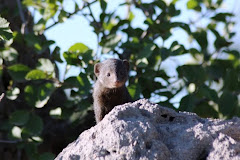
To be honest, I’d put my money on a social function being the primary one (but maybe my gregarious little mongooses have biased my thinking?). Although the stripe pattern on the rear half of zebras varies greatly (both between and within species), everyone looks remarkably similar up front (i.e. the bit spied by other zebras during social encounters). And we all know that transverse stripes make one look fat. Since prancing about on tippy-toe with an arched neck is standard protocol for equids out to impress, it seems very likely that stripes function to make the wearer look bigger and heftier.
But of course this is just one more just-so-story until some dedicated soul heads out there with a little pot of hair dye...


Friday, November 22, 2013

Halloween callers (er... belated)


Sorry I’ve taken such a ridiculous amount of time to upload this post...

Outside North America, the heart-warming tradition of extorting candy from strangers (trick or treating) is often met with less than enthusiasm. A survey in the UK, for example, found that more than half of British householders turn off their lights and pretend to be out, come All Hallows Eve.
But living as a hermit, tucked away in the African bush, I wasn’t expecting callers.
I was wrong.

Now trick or treating can trace its roots back to the Middle Ages, when the financially-challenged celebrated All Saints’ Day (or All Hallows’ Day) by dressing as demons and bartering prayers and songs (to help the wealthy’s departed mosey on through Purgatory) for cash and cakes. This jolly festivity was called souling and it was definitely a souler who visited my house on Halloween night.

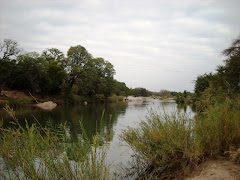
But I’m jumping ahead of myself here because my exchanges with soulers really started a few days earlier when I was walking my dogs down along the river. At this time of year (end of the dry season) the river is braided with sand and fringed by dense thickets of reeds. It was late afternoon and heavy clouds were leaching away the light when we heard a loud, rasping grunting coming from the far bank. The dogs and I crept upstream until we were directly opposite the hidden caller and hunkered down in a thicket of raisin-bushes in the hopes of catching a glimpse of the vocalist. With no more than 30m (100 ft) between us and the vociferous beast, its deep, grating calls were deafening, thrumming uncomfortably inside my chest.

Embarrassingly, it took me almost six years to figure out who utters this call. I’d always assumed it was a baboon expletive (something about one’s mother??) because it inevitably invoked a cacophony of outraged bellows from the local baboon troop. But it’s actually voiced by a much more impressive beast (my apologies to all Papiophiles). The books describe it as sounding ‘a lot like someone sawing wood’. I used to find this description unconvincing, but up close and personal, it’s spot on (in an age of chainsaws, perhaps I just don’t know what a distant wood-saw sounds like). The leopard utters its rasping ‘strokes’ while both inhaling and exhaling, and the result is shockingly loud. You can hear it here (click on leopard), but it's a recording of very distant animal (can't find anything better however).


Big cats (members of the genus Panthera) - unlike small cats (members of Felis) - can utter astoundingly loud roars because their hyoid bone (you know, the one that snaps during strangulation, as per CSI) has been replaced with cartilage.
Photo by Arno Meintjes.


Leopards (Panthera pardus) are the most cosmopolitan of the world’s cats (apart from our little domestic moggies, of course). They prowl almost every habitat in Africa and sneak about in Asia as far as China and Malaysia. They also sometimes munch people - mostly in India and Nepal - annually killing 1.9 Nepalese per million. Photo by Arno Meintjes.


The vocalist was hidden among the reeds by the water’s edge, and while we were trying to spot spots, I realised that the cat was actually dueting. Further upstream on our side of the river another leopard was answering. Fortuitously, we were downwind of both animals and it was clear that this second leopard was hot-footing its way downstream toward us. Were the two engaged in an acoustic border dispute? Or was one of them on the make?

I very much wanted to see what would happen when the two cats met. My dogs, however, weren’t too keen on the idea. I don’t know what’s changed their minds about leopards (they used to try to chase them) but these days the merest whiff of fresh leopard spoor makes them panic. They press up against each other and - glancing nervously over their shoulders - tow me away as rapidly as possible. They also now refuse to lie outside on moonless nights...
Thinking about it - maybe it’s better I don’t know...


Like almost all cats, leopards are solitary beasts. They stake claim to their territories using pee and song, and ferociously oust all members of their sex.
Photo by Steve Jurvetson.


She-leopards also use the species’ long-distance roar as a siren call for suitors. Like lions, leopards mate repeatedly for days at a time (he has to coax her into ovulation) but - unlike consorting lions - it’s very rare to catch them at it.
Photo (of captive Persian leopards) posted on Flickr by Tambako the jaguar.


As the leopard on our side of the river drew closer and closer, the dogs became more and more agitated, tugging frantically on their leashes. I began to wonder if I was acting prudently. I mean leopard fatalities are a rarity here in Africa but every few years the odd person gets chomped (and I’m certainly odd). In fact - I suddenly recalled as we sat hidden in our waterside thicket - a leopard attacked someone just a few weeks ago up near Pundia Maria (Kruger National Park). With the leopard on our bank no more than 50m (165 ft) off and closing fast, and the rasping roars of both cats now reverberating in our chests, Wizard’s nerve finally broke and he dragged me, sprawling, out of the shrubbery (let me tell you, huskies can pull). The leopard across the river immediately stopped roaring: our cover was blown. Although the cat on our bank continued to call, I figured that they wouldn’t interact normally, so I let the dogs haul me away inland.

Now I thought that this was the end of it.
But then the souler arrived on Halloween.

It was about 8pm and I was innocently watching TV when the roars began. Once again two leopards were dueting, with one far off and the other quite close. And getting closer... and closer... and CLOSER! Oh God, it’s roaring from the reeds just below my garden. Sitting no more than 15m (50 ft) from my back door, it gave its thunderous grating roars - one every three minutes or so - for more than an hour.

Now I don’t think this creature was seeking a treat (at least not from me) but I felt its performance would certainly hurry any passing spirits on their way, through Purgatory or otherwise. I mean leopards have harried our ancestors for millennia. Modern forensics show that at least one fossil hominid (who dwelt in South Africa 1.8 million years ago) fell victim to a leopard: the puncture wounds piercing the back of his/her skull perfectly match the bite impressions of a leopard’s lower canines. Researchers have even suggested that humans owe their intelligence to the leopard via an evolutionary arms race in which we combated stealth and might with cleverness. And I have to admit that while it was hugely exhilarating having a leopard at the bottom of my garden, it was also a little scary.
A leopard just isn’t something you want to stumble over when you pop out to move the sprinkler.
Would that be the trick I wonder?
Ah, spooky ol’ Halloween...


What better emissary to communicate with the dead than a professional killer? Photo by Arno Meintjes.

P.S. I always carry a nifty little pepper spray when I’m out dog-walking (I thought I’d mention that for the sake of nervous relatives).


Sunday, September 29, 2013

Avoiding the bathroom


Before I begin, I’d like to apologise if this blog post is a little... er... disjointed.
Or a touch confused.
Or just plain...  jittery.

You see I’m currently sitting hunched in front of my computer with my legs tightly crossed, jiggling. While half my brain ponders this blog post, the other half is quietly chanting, Sheldon-like,
‘I am the Master of my bladder...’
It’s not true of course. In any showdown, my gross bodily functions inevitably triumph.
So why don’t I just go and, er... relieve myself?

Because when I visit my toilet, I AM NOT ALONE.

No, the marbled tree snake has not moved back into my shower cubicle (actually I don’t even have a shower cubicle). The problem is smaller. But more numerous...

You see, dwelling within my toilet is a community of bubbling kassinas.
Now I know this probably won’t mean much to you.
It even sounds quite pleasant, doesn’t it? Drifts of tiny aquatic flowers maybe, garlanded with little silver bubbles?
Well you can forget that. Bubbling kassinas are frogs.
Little frogs; cute frogs; but FROGS!

Okay, I realise that when you live in the tropics, toilet-dwelling amphibians are humdrum and routine. But those are tree frogs. Those are frogs that hop about and clamber up the porcelain because it’s a cool place to chill. They aren’t aquatic frogs. They don’t come sculling in, underwater, from the dreadful lower reaches of the septic tank. They don’t circumnavigate the toilet bowl, in unhurried breaststroke – while you’re using it – and then dive deftly back down the outlet pipe.
Call me old fashioned, but I find that disconcerting.

Bubbling kassinas (Kassina senegalensis) are also known as running frogs (because they’re a bit anatomically-challenged). The critters trot about over much of sub-Saharan Africa but it’s still unclear whether they all belong to one big, happy family species.
Photo posted on Flickr by Vivi Bolin.

Look I’m not denying that bubbling kassinas are agreeable little frogs. Just 4 cm (1.6") long, they could have crept straight out of a Peanuts cartoon: their smiling, snub-nosed faces make up almost half their total being. They swim about wearing glossy wetsuits of yellow, cream or silver grey, flamboyantly adorned with black go-faster stripes. But most impressive of all are their massive eyes: burnished-gold with an inky black cat’s pupil.

Frog’s eyes, of course, don’t just look weird. Fitted out with rods and cones, they let the frog see in colour, but - unlike in a mammal's eye - the lens doesn’t flex to focus on objects at differing distances. Instead it trundles back and forth within the eyeball to adjust the focal length. Oh, and frogs’ eyes also aid in digestion. When a frog is scoffing down a bulky prey item, it retracts its eyeballs into its mouth cavity, giving the hapless victim an extra shove down the gullet.
Now that’s what I call gob smacking.


The skin cells of frogs are peppered with colourful chromatophores that can be corralled or dispersed within the cell to alter the frogs’ colour. One type, iridiophores, are silvery, reflecting light back through the other pigments to give the frog a vibrant ‘inner glow’. These kassinas are dressed for (left) the dark, chilly depths of the septic tank and (right) the warm, sunlit waters of the toilet bowl.

Sometimes I’m lulled into believing the toilet is ‘unoccupied’ only to find that the little beasts have crept up under the porcelain rim. When I press 'flush', they come whooshing down in a swirl of white-water, limbs akimbo like a granny in a waterslide. When I can, I fish the creatures out (NOT pleasant) and release them carefully into one of the water dishes I maintain (for no apparent reason) in the garden. But after repeated ‘rescue missions’, I began to wonder.
Was I translocating the same frog over and over?
Unwisely, I started photographing their back patterns...

Argh! There are hundreds of the creatures!

Kassina number 15. According to my frog book, bubbling kassinas hang out in temporary and permanent water bodies, including vleis, marshes, pans, ponds and dams. Please note the conspicuous absence of indoor plumbing. Is this an oversight or are my frogs eccentric?

The rains haven’t yet arrived this season, so the squatters in my bathroom are blessedly mute. Like most frogs, macho bubbling kassinas have two different croaks.
The first is a love song (a short, rising boip which you can listen to here) whose lyrics go: “I am WONDERFUL and I’m waiting here just for you” (okay, I can’t guarantee this is absolutely verbatim).
The other ditty, which has more of a punk rock feel, is sung to fellow choristers: “Piss off you mongrel, this is MY bloody podium!”

The problem with all this fine operatic communication is that the intended recipient may not be able to hear you above the racket. I mean when the rains come, there can be ten different species all bellowing out their serenades down by the water. But bubbling kassinas are wily. Firstly, they adhere to the early birds adage and begin calling in the late afternoon when everyone else is still abed. Secondly, they avoid the Idol's try-out scrum down at the poolside, secreting themselves in the shrubbery well back from the water. It’s out here, where it’s less noisy, that they rendezvous with potential lovers, and – if their song is sexy enough – then accompany their ladylove down to the water.

However, there’s a flaw in this plan. When one lusty kassina boips, his neighbours can’t resist doing it too, and while this creates a lovely rippling or bubbling effect (hence the frog’s name), it’s probably teeth-grindingly annoying to amorous gentlemen (yes, most frogs do have small teeth; some even have vomerine teeth that sprout from the roof of their mouth). In an effort to get a word in edgewise, male kassinas serenade antiphonally; that is, they carefully utter their boips in the space between the boips of their rivals. Begging meerkat pups use the same technique; in fact experiments show that adult meerkats bring more food to a speaker playing two pups begging antiphonally than to the same two begging simultaneously (I warned you I’d have trouble staying focussed tonight).

Now I don’t know what all this means for my effluent dwellers. Will the males position themselves around my lounge and kitchen, singing their hearts out from my bookshelves and stove? Will female kassinas come scratching at the windows like Cathy’s ghost? And will lovelorn couples then converge on my bathroom to indulge in hot amplexus in the toilet bowl? 
Hmm, something to look forward to I guess...

Female bubbling kassinas lay 100 to 500 eggs.  OH GOD!
Photo posted on Flickr by liesvanrompaey.

I was planning to tell you all about the kassinas’ ugly duckling tadpoles who look so similar to tiny fish that metamorphosis must come as a real shock to them. However, the prospect of a toilet bowl brimming with tadpoles (even spiffy goldfish-like ones) is too distressing to contemplate. Additionally, I couldn’t find a SINGLE image of the little creatures anywhere on the internet. I’ve resolved that when my resident kassinas do become parents, I’ll take a photo of their ankle-nibblers (come Hell or high water – oh yuk!) and post it – free for use – all over cyberspace.
 
Actually, the real reason I’m finishing up now is because I’m afraid I’m going succumb to major renal problems if I don’t IMMEDIATELY go and pollute my kassinas' home...


Monday, August 26, 2013

Archaeopteryx meets Priscilla

Ask people to name an iconic African bird and you’ll likely wind up with a whole lake-rim of flamingos and ostriches, plus maybe a ground hornbill or guineafowl thrown in for luck (ahhhhh... splosh).

But of all the myriad feathered critters cluttering the airspace of this continent, there are only two orders who flutter here and nowhere else: the mousebirds and the turacos.

I’ve already sung the praises of cute little mousebirds, so today I’ll take you down to the river to meet one of the weirdest birds I know.
A creature of the forest, around here it lives only in the verdant tangle of trees along the riverbank.  As you pass beneath the towering leadwoods, jackal berries and figs, you’ll hear its eerie kok-kok-kok-kok-kok call (which rises, in strength and pitch, to a deafening crescendo) reverberate through the gloom (you can also experience it here).
Carefully scan the smooth upper branches of that giant fig... but no...
Wait... there!
In that water berry, there’s movement.
A large ungainly bird suddenly lopes out along a branch, swaying slightly from side to side as it runs towards you. At first it looks to be black, its long wedge-shaped tail dark against the sky, but as it paces through a splash of sunlight you see its flamboyant plumage: iridescent purples and greens with a flush of rose rising on its breast. Without pausing stride, it leaps over a gap and halts abruptly on a branch directly above you. For a moment it shifts uncertainly from foot to foot, craning first left, then right, trying to catch sight of you. Then, cocking its head on one side, it peers down with one carmine-encircled eye, raising its raffish violet crest (a movement suggestive of arching an eyebrow) and fixes you with a fierce quizzical glower.

This is the purple-crested turaco.

If it decides you’re scary enough, you’re in for a real treat.
After a moment of dithering, running and hopping, it opens its stubby, rounded wings to unfurl a dazzling pageant of scarlet. It then launches into an elegant, balletic leap and glides away to a nearby tree. (I couldn’t find an ‘available-for-use’ image of the bird in flight - and of course snapping one is way beyond me - but please take a look at this one; it’s worth it.)


Running through the treetops, the purple-crested turaco (Gallirex porphyreolopha) bears a distressing resemblance to the world’s earliest feathered aviators.

Young turacos (this one’s an up-and-coming Ross’s turaco) even bear gnarly claws on their wing joints (used for pre-flight travel). They sensibly lose these primordial mementos in the embarrassment of adolescence. Photo posted on Flickr by SeaworldSA.
 
The turacos’ proficiency at tree-clambering is aided and abetted by a weird, reversible outer toe. This accessory normally sits at right angles to the axis of the foot, but can be swivelled fore or aft, depending on need. Photo by Vince Smith.
 
Turacos are members of an ancient order (Musophagiformes) and - since they keep themselves to themselves - no one really knows who their relatives are. The proteins in their eye-lenses (hey, the first place you’d look, really) hint at kinship with songbirds, their feather parasites are cousins to those on itchy fowls and their strange, swivel toes place cuckoos in their ancestry.
But as far as I’m concerned, they’re like no other. There’s something absurd and incongruous about their awkward, cumbersome shape coupled with such over-the-top plumage. They somehow remind me of avian drag queens, and I’m always half expecting them to break into an Abba dance routine.
Of course, it’s entirely inappropriate to question the purple-cresteds’ sexual predilections: they’re highly conventional birds. Living in old-school nuclear families, they’re unflinchingly monogamous and defend their home turf (very noisily) from anyone who may disrupt their conservative familial bliss.


I included these dreadful images (typical of my photographic prowess) because they show (in a blurry way) courtship feeding. It sounds so romantic, doesn’t it? Then you realise he’s hacking up regurgitated fruit pulp...
 
Nevertheless she seems grateful. Maybe it’s because she knows there’s worse to come. Parent turacos not only chomp their little darlings’ old eggshells, they gulp down their excrement too.

Now if turacos are the closet transvestites of the avian world, it’s the way they come up with their extravagant costumes that’s earned them global notoriety. You see turacos are the only feathered critters able to wear green. Lesser birds may look green but it’s all a con. While others achieve their verdant hues using yellow feathers (structured to refract sunlight and reflect blue wave lengths), turacos manufacture a genuine green pigment, turacoverd. This unique colorant is a copper uroporphyrin compound made up of 6% copper. The birds’ brilliant red wing feathers (found in most of the forest-dwelling species) are also designer-made, tinted with another exclusive copper-based stain, turacin. (The rest of the world’s birds must make do with carotenoids, for bright, orangey reds, and phaeomelanins, for rusty reds). But accumulating so much copper is challenging (so that’s who’s stealing the telephone cables...) and it takes young turacos twelve months to grow as gaudy as their parents (cable theft is slow work?). It’s even been suggested that turacos are only able to employ copper-based pigments because they dwell in one of the world’s richest copper belts.

 
The local copper Mecca: humans have been mining the stuff around here for more than 1200 years. This is the Phalaborwa copper mine, about 60 km (37 miles) up the road.
 Photo by Roman Betik.


Pride of the kingdom. The purple-crested turaco (Gallirex porphyreolopha) is Swaziland’s national bird. But fame and fortune come at a cost: the species’ dazzling flight feathers feature prominently in the ceremonial regalia of the Swazi and Zulu royal families.
Photo by Lip Kee.
 
Of course turacos are not alone in using copper to brighten up their world. Humans have been daubing this metal about ever since those old winos, the ancient Greeks, discovered how to cook up verdigris (expose copper plates to the fumes of fermenting grapes, then scrape off the crust of blue-green tarnish). Unfortunately humankind subsequently went astray (oh, that’s unusual) creating killer wallpaper throughout the 19thC using a copper-arsenic dye (Napoleon’s emerald walls probably hastened his demise: studies show his hair samples are chockfull of arsenic).
Sadly, this pigment was also used to tint clothing, sweets and deserts. A mass poisoning in Greennock, Scotland (where green confectionary was all the go during village celebrations) spawned a national aversion to green sweets (and I’ve indeed met a Sparkle-scoffing Scot who staunchly refused the green ones). Nevertheless, it’s all OK. Once our forebears figured out the perils of snacking on arsenic they converted their lovely green dye into an insecticide...


There are 23 species of turaco (all native to deepest, darkest Africa) and I couldn’t resist showing you how spiffy they are. This demur little one is a Knysna turaco (Tauraco corythax) from, well, Knysna in South Africa. Photo by Johann du Preez.
 

“What do you mean, you’ve never HEARD of turacos!”
Photo (of a white-cheeked turaco, Tauraco leucotis) by Loren Sztager.
 

Like all turacos, the red-crested (Tauraco erythrolophus) from Angola likes to munch fruit, flowers and buds. They’re such committed fruitarians that they even feed their chicks mostly just fruit pulp. Photo by Ciaran Dunston.
 
Turacos once laboured under the name of plantain-eaters until ornithologists realised they didn’t. This one’s a great blue turaco (Corythaeola cristata) at home in the Congo jungle.
Photo by Brent Moore.


As well as the brightly coloured forest species, there are a few drab turacos who knock about in open woodland (the unfortunately named go-away-birds). But what these species lack in garishness they make up for in behavioural peculiarities. The grey go-away-bird (Corythaixoides concolor), who lives around here, often breeds in cooperative groups.
Photo by Arno Meintjes.

 
Livingston’s turaco, I presume (Tauraco livingstoni). This species explores the forests of southern Tanzania and Malawi. Photo by Heather Paul.
 

Ross’s turaco (Musophaga rossae) ready for the mardi gras. Longevity is one of the turaco's many claims to fame with captive ones surviving more than 30 years.
Photo posted on Flickr by San Diego shooter.


The Hartlaub’s turaco (Tauraco hartlaubi) leaps about in the forests of the Kenyan highlands.
Photo by Francesco Veronesi.
 
“Mama mia, here we go again... my, my... how can I resist you?” 
Photo posted on Flickr by Belgianchocolate.
 

Monday, August 5, 2013

Beedevilled

I’m sure you’ve seen those documentaries about social insects where the camera snakes you down into the depths of the colony and there - lit by a ghostly green glow - you witness eerie fungal gardens, ants herding caterpillars and grotesque monarchs stuffing themselves on delicacies.

Well at the moment I feel as if I’ve somehow got trapped down there.

It all started a few days ago when I arrived home to find my living room abuzz.
Literally.
As I opened the front door the sound hit me like a palpable wave; a droning, wrap-around buzz so intense I could almost see it.
There were bees everywhere. The air was thick with them. They were hovering and crawling and revving for takeoff. There were bees doing their waggle dance, pirouetting and tangoing within a circle of spectators; there were bees conferring quietly in small huddles and bees sitting calmly in apparent contemplation. The windows were coated, inside and out, with a mass of small bodies, but – and this worried me the most - they weren’t angry bees, striving to get out. Disconcertingly, they all had a laidback, we-want-to-be-here kind of manner.
All my pets had retreated outside and were looking as dismayed as I felt.

 
Of the 20,000 known species of bee (argh!), only seven are honey bees (all in the genus Apis). This select group (whose colonies cache honey is waxy combs) is thought to have originated in SE Asia, and our much loved common honeybee (Apis mellifera) started life in tropical east Africa before buzzing on northward.
Photo posted on Flickr by Goshzilla-Dann.

What was going on?
Had a swarm settled in my house?
I prowled disconsolately through the bee-clouded rooms, searching vainly for the tell-tale ball of bees. Then I tried following one of the bustling trade routes, and the hovering, buzzing hordes led me slowly back to my mealworm colony (housed in large plastic basins on top of a cupboard in the lounge room). Peering into a basin I was appalled to find a seething mass of bees, all rolling and writhing in apparent ecstasy, among the mealworms.
What the...??
Had I stumbled upon some dreadful orgy; a bizarre bacchanalia of miscegenation? 
Then I noticed that the writhing bees looked as if they were wearing cargo-pants whose bulging pockets were stuffed with something white.
Ah ha!  (A light bulb moment.)
They were gathering flour!

Err... flour??

Bees sifting flour from my mealworms’ bran.

Tentatively edging my way through the miasma of bees in the kitchen, I discovered another orgiastic clump squirming about in an open pack of maize meal.
Why had I never heard of bees behaving like this?
I mean, sure, bees show an unhealthy interest in sweet beverages. But dry goods? And it’s not as if I’m a complete neophyte when it comes to bees. As a child I shared home and hearth with a feral swarm (which resided in the chimney). Bee-stings were a routine hazard of television viewing, but never once did the little beasts attempt to pilfer our baking supplies.

With a reckless disregard for personal safety, I grabbed up the flour-bearing items and rushed them out to the veranda. A stream of bees accompanied me, and I prayed that the thousands still humming about inside the house would follow the food.

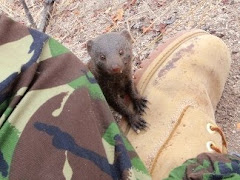
Could it be that they were starving? It’s been a bad year for bugs (as my skinny mongooses can attest); maybe the colony has scoffed its winter honey stores and is simply desperate? 
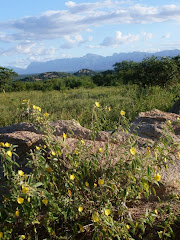
But then I looked at the exuberance of daisies currently blooming in my garden.
Nary a bee.
Hmm...

My scorned Namaqua daisies.


Evidence that other pollinators find my daisies attractive.

Craftily I moved the mealworm basins in amongst the flowers, hoping the bees might get the hint.
They didn’t.
But at least they all drifted out of the house, gathering in a massive, swirling column above the victuals. I discovered that if I laid out a smorgasbord of titbits (sugar water, maize meal and an open packet of cake flour), they deserted my traumatised mealworms and I was able to sneak the containers back indoors.
To what extent my mealworms have been scarred by this ghastly experience, I do not know. Caterpillars go off their food when bees buzz overhead (nibbling only one-third as much as usual). But the species used in this experiment (beet armyworms) sport special sensory hairs that respond to the vibration of buzzing wings (to track incoming parasitic wasps). As far as I know, my mealworms are hairless, so maybe they’ll make a full recovery.

Of course the bees are behaving most amicably and I remain unstung. However, the psychological impact on my dogs may be a problem. It was while I was fishing drowning bees out of a 0.5 mm smear of sugar water, that I noticed Wizard staring at me with a look of astonished disbelief. He’d come dashing over to interpose himself between me and whoever I was talking to (as alpha male he feels he has the right of veto), only to discover I was conversing with bees. Since then his attitude to our insect plague has changed: whenever a bee buzzes him, or lands in his bowl, or entangles in his fur, he fixes me with a look of profound reproach.


‘Hey look: it's a squashed bee!’
My dogs aren’t alone in disliking bees. When researchers played bee recordings to herds of snoozing elephants, the pachyderms immediately fled the scene, retreating about 60 m (200 ft) with their tails in the air. This little guy, however, hasn’t fallen victim to a bee (or car); he’s just annoying Mum by playing on the road.

Now it’s no surprise that bees are well-equipped to garner pollen (and flour?) but they’ve got one adaptation that’s genuinely electrifying. When bees zip around in their busy buzzing way, their bodies are bombarded by dust motes and other little bits of air-borne grunge. These minor collisions scrape electrons off the bee’s outer waxy cuticle and, voila, you get a positively charged bee. Flowers - in contrast to bees - sport a negative electrical field (at least on sunny days) and we all know how opposites attract. So when a positive little bee comes hovering down, the flower’s pollen flies up to the bee, like iron filings to a magnet.

But the niftiness doesn’t stop there.
Bees can also discern the electrical fields of flowers. When a conscientious worker bee touches down on a bloom, she neutralises its negative charge, and it takes a couple of minutes for the flower’s negativity to restore itself (rather like when I eat a piece of chocolate). This means that bees zooming about above a field of flowers can spot which ones have just been plundered and save themselves a fruitless nectarless visit.


It’s the bees’ flagella (the very tips of their antennae) that sense electrical fields. Pushed or pulled by an electrical charge, the flagellum’s tiny movements are monitored by touch-sensitive fibres within the bee’s antenna joints. When researchers unkindly immobilised these joints (by covering them with wax), the bees could no longer tell positive from negative.
Photo posted on Flickr by Johan J. Ingles-Le Nobel.

I have decided that today is D-day. I’m withdrawing all aid. I’ve carefully hidden my mealworm containers away inside my wardrobe (hey, who needs clothes?) and have locked up all cereal products.
Fingers crossed that the bees will leave!


Sweet-toothed, mead-guzzling humans have kept Apis mellifera for at least 3000 years. Archaeologists uncovered 30 hives (made of straw and unbaked clay) dating from about 900 BC at a dig in Israel’s Jordan Valley. However, it wasn’t until the 18-19th century that people learnt how to pinch the honey without killing the golden goose colony. Photo by Gwendolyn Stansbury.


The local little bee-eater family (Merops pusilla): possible justification for indoor foraging?
Related Posts Plugin for WordPress, Blogger...