Wednesday, April 28, 2010

Flowers galore


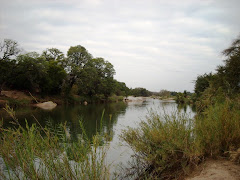
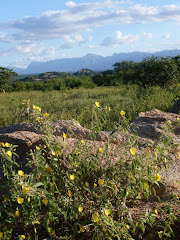
It's like paradise here now, thanks to the unseasonable rain.
I counted 41 species of wildflower while walking the dogs last night. I know the names of three!


I was so preoccupied peering at flowers, that I didn't watch where we were walking. Glancing up, I discovered Magic nose to nose with a huge snake. My view was obscured by the dogs, and I thought it was a puff adder (very common here and potentially lethal). Unexpectedly, I screamed (didn't think I was the screaming type) and dragged Magic away; then discovered that it was actually an African rock python. While this was a relief, it shattered my consoling belief that the local pythons would be inactive by now. After all, my resident red toad has been torpid for more than a week, tucked away inside my down sleeping bag.


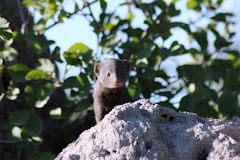
Of course, all this lush growth is a nightmare for data collection. I simply can't see what the mongooses are doing. In fact, I'm having trouble finding their termite mounds, much less the mongooses themselves!

Tuesday, April 27, 2010

When cats monkey about


When you live close to wildlife you learn to expect the unexpected.
But today something really surprising happened.

The weather was cool and dreary, so I decided to stay in and analyse my daunting stockpile of mongoose video tapes. However, my highly playful cat, Silver, had other ideas. He was in a mischievous mood and spent the entire morning leaping at the TV to paw at the on-screen mongooses, wrestling my video camera, scuffing up my check sheets and batting my pen under the sofa. Eventually, in exasperation, I took a break outside. Silver came too, slipping under the back fence to race about wildly, tearing up and down the trunk of a large buffalo-thorn tree.

I wasn't paying him much attention until I noticed the surrounding trees were suddenly alive with vervet monkeys. I thought at first I must have disturbed them (the troop often sleeps the night in the trees outside my house) but then I realised they were bounding towards us, not away. And they were all heading for Silver. My cats normally stay on the garden side of the fence; had Silver breeched some unwritten rule of monkey etiquette?

                 Vervets staring at Silver.
There were about six monkeys and they were all youngsters. They came excitedly gathering around Silver (who was now sitting sedately on the garden wall), slithering down trunks or dangling precariously from drooping branches to get close to him. They completely ignored me, although I was standing quite close. I thought they must be curious about Silver's previous absurd behaviour. But then I looked more closely. They were lounging coyly on their backs, heads upside down and wiggling back and forth. And some of them had their eyes half shut and their mouths open in the classic primate 'play-face'.
They were inviting Silver to play with them!

If you're good at spotting wildlife, you'll find a monkey at the very top edge, centre, of this photo.

 After about five minutes, when Silver had made it clear he wasn't going to oblige them, they just melted off into the trees, presumably to rejoin their troop. Had they played with Silver before? They certainly seemed to expect him to join in. Where would they have got the idea of playing with cats, if not from mine? Having spent five years of my life studying play behaviour, you'd think I'd know better than be surprised at anything, but this really was unexpected!

A young vervet monkey (Cercopithecus aethiops) in play invitation mode. Photo taken by Megan Bradfield and borrowed from here.

Monday, April 26, 2010

Meet a mongoose: Baloo

One of the greatest joys of my research is getting to know individual animals, discovering their personalities and sharing in the day-to-day excitement of their lives. I thought I'd try to share this pleasure with you by introducing you to some of my special mongooses.

Today's 'focal animal' is Baloo.

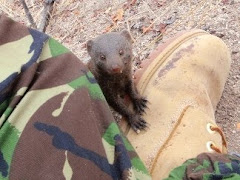
When you visit Bugbears, it won't take you long to notice Baloo. A sleek youngster with an intense expression and greenish eyes (mongooses' eyes grow browner as they age), he'll come dashing up to stand by your feet. For a moment he'll stare intently into your eyes and then he'll race off, jinking past the more sedate members of the group. Baloo never walks when he can run. He's bursting with nervous energy and he always seems to be exuberantly enjoying life.


Baloo at four months of age.

Baloo was born last October just before I left for a holiday in Kanha National Park, India. This tropical forest was the setting for Rudyard Kipling's Jungle Book, so the choice of Baloo's name was obvious. In hindsight, I couldn't have chosen better because the little mongoose's personality bears a remarkable resemblance to that of the insouciant bear in Walt Disney's animated version (although I admit he doesn't sing or juggle mangos).

The drama in Baloo's life began early.
Iorek gave birth to Baloo's litter in a large termite mound overlooking the creek. Newborn pups (4 to 6 in a litter) are blind and helpless, and they normally spend their first few weeks hidden away in the depths of the mound. They're highly sought after by numerous predators so someone stays behind to guard them whenever the group goes off foraging. Babysitting is a hungry and dangerous job, so the mongooses take turns, normally for half a day at a time. If a predator turns up at the mound, the babysitter, with teeth bared and fur erect, blocks the entrance with its body and snaps, spits and growls ferociously. Unfortunately, some predators can't be deterred, and when the babysitter's own life is threatened (and it's not unusual for babysitters to be killed), it will snatch up one of the pups and make a run for it.
This is what happened to Bugbear's litter. I don't know which predator ate his siblings, but it was Baloo that drew the lucky straw.


 Mongoose pups (these are 3.5 weeks old) depend on the group for protection. Alone, they're an easy snack for raptors, snakes and monitors, wild cats, jackals, civets, honey badgers and even neighbouring mongoose groups.

Life as an 'only pup' comes with mixed blessings.
On the up-side, you never go hungry.
In the true spirit of 'all for one and one for all', subordinate female mongooses often produce milk to help feed the dominant female's pups. And dwarf mongooses don't have to get pregnant to do this, a trait unique among wild mammals. Female group members frequently undergo 'pseudo-pregnancy' in which they experience the physiological changes of pregnancy (including milk production) even though they haven't actually conceived. So Baloo not only got to guzzle a whole litter's worth of milk from his mum, but could then totter across and snack from Cricket and Rupert as well. (No, Rupert isn't male; even dwarf mongooses aren't that good. What can I say? Pups are difficult to sex.). Anyway, Baloo had a bonanza, and he grew so fat and roly-poly that I wondered how his stumpy legs could support him.

On the down-side, 'only pups' don't get to lie in bed all day. Babysitting isn't only dangerous, it's energetically costly. For example, in meerkats (who have a very similar social system), babysitters can lose up to 11% of their body weight during the four-week pup-minding period. Understandably, Bugbears was hesitant to invest such a lot in just a single pup. Their solution? They carried Baloo with them wherever they went.

Mongoose carrying a pup (sorry for lousy quality).

Every day the tiny pup, bumbling about with his eyes barely open, was dragged off through thorn thickets and bumped over rocks. His neck fur was constantly matted with saliva and he looked like he had mange from all the scrapes and scratches. Whenever the group settled to forage, they'd stow Baloo beneath a rock or shove him into a rotting log, before wandering off to search for food nearby. Of course, mongooses are highly attuned to pup distress calls, and they'll come at gallop for the slightest peep, but Baloo got so used to being left alone, he never cried out (as pups normally do) even when the group moved far away. I feared that this would prove fatal. Whenever the group moved on, I'd hold my breath: would they remember Baloo? Often they'd move quite a long way before someone, usually one of the females, would suddenly stop in her tracks and dash back to snatch him up. I was convinced, each time I visited the group, that I'd find him missing; it seemed inevitable that a predator would find him in his makeshift shelters, or the group would - one day - leave him behind.

But I was wrong. Despite his many abrasions, Baloo thrived. Having no littermates to play with could have been a hardship, but not for Baloo. Leaping on the adults, he'd drape his body across their shoulders, biting on their ears, or pounce on their heads, to hang by his teeth from their noses (watching it made my eyes water).
Now Baloo is six months old, and he's slimmed down a lot (he has to catch his own food!). However, I think his early initiation into group life has given him his bouncy self-assurance and a great enthusiasm for everything and anything that's going on.

Friday, April 23, 2010

Walking with Wizard


My dog Wizard may look like a wolf,
but underneath all the fur he's a wimp.

My dogs (photo taken before my Belgian
shepherd was snatched by a crocodile).

Now you may think that a dog who's been savaged by a crocodile, eye-sprayed by a cobra and gored by a warthog has every right to be a bit timid. But Wizard isn't afraid of dangerous animals (that would save on vet bills, after all).

 
Wizard's fears:

1. Fireworks
2. Gun fire (sounds like fireworks)
3. African fish eagle calls (sound like the
       whistling of firework rockets)
4. Waterbucks


African fish eagle (Haliaeetus vocifer)
Photo by Rudi Skea and borrowed from here.

 Spot the odd one out? This last item is a new addition.

Waterbucks (Kobus ellipsiprymnus) are horse-sized antelopes with coarse shaggy coats and a white ring encircling their rumps. You can tell when they're around because they smell strongly of musky creosote. Unlike most antelope, they need to drink daily, so I usually encounter them when walking the dogs along the river. Until recently, this hasn't been a problem.
However, about two weeks ago we were strolling across the river flat when we met a small herd of females and calves. The females trotted off into the trees (they see us every day, so they're pretty chilled) but the calves lingered to get a better look at us. They stood gazing curiously as we passed, and then, as we walked away, they came creeping after us. Necks outstretched, ears cocked forward, and moist noses whiffling, they followed along behind us. As we walked away, they grew more confident, jogging and jostling one another like small boys egging each other on in a dare.

Waterbucks plotting Wizard's downfall.
Photo by Michelle Viljoen and borrowed from here.

Now, I found this behaviour endearing. Wizard perceived it quite differently. In his mind, there's only one reason why something creeps up behind you. He's now convinced that all waterbucks are out to get him. Each time we meet one, he goes into 'drag' mode, lowering his head and tail and hauling me homeward as quickly as possible.

Wizard feeling scared.

Thursday, April 22, 2010

A smelly favourite

Today while searching for Bugbears, I stumbled upon my favourite animal.
Nocturnal, solitary and rare, this creature has influenced human culture for thousands of years.

At first I just glimpsed movement, and then - barely visible in a tangle of leaves - a patch of soft grey fur, patterned with spots of black. I froze, as did the animal, and we both waited. Eventually, with head lowered, the creature crept slowly from the bushes.
It was an African civet.

African civets (Civettictis civetta) look like huge soft toys. Their thick fur is decorated with black splodges, bars and stripes, and their faces are masked just like a racoon's. When alarmed, civets raise a crest of black and white hair that grows along their backs, making them look one third larger. They also give deep, menacing growls which are quite unnerving.
But today's civet was peacefully snooping about for food. This species doesn't only share the racoon's facial markings, it also shares its omnivorous diet, munching on fruit, bugs, small vertebrates and carrion. Unlike the raccoon, however, civets are designed for life on the ground, and their small paws are dog-like and not at all dexterous.

Civets, along with mongooses and genets, are viverrids. They closely resemble the ancestors of all of today's carnivores. Their teeth and skeletons have barely changed during the last 30-40 million years.
Photo by Neil Roux and borrowed from here.

Like mongooses, civets mark their territories with secretions from their anal glands. Reversing up to trees or rocks, they smear on a vile-smelling, thick, yellowish grease that remains detectable for at least four months. Now you might be thinking 'ooh yuk', but are you wearing perfume? Expensive perfume? If so, you probably have a little bit of civet goo on you right now.

The anal gland secretion of African civets ('civet musk') has been traded commercially for thousands of years. Originally used medicinally, it was valued more highly than gold, ivory or myrrh, and was employed as currency in ancient Ethiopia. For many centuries it's been integral to perfume-making because the refined product, civetone, 'fixes' other fragrances and – when highly diluted (1 kg of civet musk makes 3000 litres of perfume) – has a pleasant musky scent. It also seems to be a natural attractant (e.g. field biologists in Central America report that the civetone in Calvin Klein's Obsession is great for attracting jaguars).

Although artificially synthesised civetone has been available since the 1940s, many of the 'exclusive' perfume manufacturers continue to use animal-derived civetone. This is where it gets ugly. Ethiopia produces 90% of the world's civet musk, exporting 1000 kg annually; 85% of which goes to France. The musk is obtained from about 3000 captive civets held on 200 civet farms. A large male civet (who has his anal glands scraped out weekly) produces about 30 g of musk monthly. In 1999, the WSPA (World Society for Protection of Animals) undertook surveys in Ethiopia and reported widespread animal cruelty, with many civet-farmers failing to meet even the most basic husbandry needs, and animals living out their lives in crates too small for them to turn around. At that time, three major perfume manufacturers - Chanel, Lancome and Cartier - admitted to using animal-derived civetone.

I guess what I find most shocking, is that although civiculture has been practiced in Ethiopia for centuries, they've never succeeded in breeding an African civet in captivity! (Apparently Jersey Zoo has done it.) All farmed civets are captured from the wild, and up to 40% die from stress within the first three weeks. With the rampant deforestation that has occurred in Ethiopia over the last couple of decades, I can't imagine how the country's dwindling civet population can possibly sustain this onslaught.


Photo by Maureen Jarratt and borrowed from here.

If you want to read more:
Sustainable Utilisation of the African Civet (Civettictis civetta) in Ethiopia, by Yilma D. Abebe. 2000.
Scent-marking by the African Civet Civettictis civetta in the Menageha-Suba State Forest, Ethiopia. B. Tsegaye, A. Bekele & M. Balakrishnan. 2008.

Sunday, April 18, 2010

Springing into autumn


I had a wonderful morning in the field today.
The recent heavy rain (so late in the season) has brought on an Indian spring (can you have an Indian 'spring'?).
The weather here in late autumn and winter is always idyllic: sunny, blue skies and temperatures in the high 20's Celsius. This loveliness, however, is normally marred by the dry season with forbs and grasses shrivelling and trees losing their leaves. Not this year; everything is burgeoning and green, the air is rose-scented and scores of butterflies are flitting and hovering amid banks of flowers.


I'm afraid I can't tell you the names of these flowers because there's no field guide available for this part of South Africa (a bit strange considering that Kruger is such a popular tourist destination).

The mongooses are also enjoying the unexpected reprieve.
When the soil dries out, beetle larvae and other soil-dwelling critters retreat down deep, but after rain these consumables (apologies to any entomologists) resurface, back within reach of industrious mongoose claws. This morning, Ecthelion group was lounging contentedly, with rounded tummies and a self-satisfied air. Of course even well-fed mongooses don't stay still for long, and soon everyone was bounding about in play. Teaming up in pairs and trios they chased and wrestled, rearing up on their hind legs to clasp one another around the shoulders and tussle back and forth like little sumo wrestlers. Everywhere I looked there were mongooses leaping in the air or clasped together in mock battle, rolling over and over, with teeth clamped firmly on any available ear or limb.


Related Posts Plugin for WordPress, Blogger...