Tuesday, June 7, 2011

This morning I showered with a murderer

I did it yesterday too.

Now you mustn't imagine that I enter into such liaisons lightly.
But there's only so long that one can go unwashed in order to avoid unsavoury company.

Maybe I should start at the beginning...

About a week ago, I woke at 3 am to the sound of screaming.
Never a good sign.
The dogs, Wobbly Cat and I hurtled out of bed, in a tangle of blankets, flailing limbs and stepped-on paws, and blundered to the bathroom; source of the shrieks. What we found was grisly.

Now I want you to imagine the shower scene from Psycho. Not the bloody bit (which, by the way, was actually the chocolate saucy bit, because Hitchcock thought stage-blood looked wishy-washy in black and white) but the suspenseful build-up. OK, you need to tweak things a little; make the victim rather short and dumpy, and she's snoozing in the cubicle rather than actually showering, but otherwise everything is bona fide horror movie.
The assailant's stealthy approach, the victim blithely unaware... the weapon silently raised, ready to strike... And then AAAAHH!

Well we stumbled in at the AAAH part to find the killer dangling from the light fitting with the terrified victim struggling in his jaws. This was disturbing because the victim was a friend; she'd lived in my house for more than a year. OK, I admit she was a frog, but foam nest frogs are endearing creatures. Creamy coloured with huge jewel eyes and suction-pad toes, she'd munch any mealworm tossed her way, and - along with her gentlemen friend - had faithfully guarded the entry to my shower for the last two months; one atop each door post like a pair of animated gargoyles.

And now here she was scrabbling frantically in mid air, squawking in distress, with the killer's jaws clamped over her back and her huge hind feet wind-milling.


My dearly departed southern foam nest frog (Chiromantis xerampelina). R.I.P.
You can read about this critter's idiosyncrasies here.


And the perpetrator? Still only half-emerged from a small hole in the ceiling, the assassin was slicked out in glistening brown. He was, of course, legless (what else would a snake-phobic expect to find in their bathroom at 3 am). Not large enough to send me into a full-scale panic attack (at a bit less than a metre long (2' 6") and 2 cm (0.8'') thick), the murderer glared down at me with the eyes of a cat: bright gold with a vertical pupil.

'The Beast, I presume', I thought grimly.

Those of you imprudent enough to follow this blog will know I live in fear of The Predatory Beast that haunts my ceiling. Since I've never had the courage to climb up and identify The Beast (you can read of my ongoing cowardice here and here) I guess it's inevitable that he would eventually come to me. But at 3 am, identifying him was beyond me (actually that's an excuse; it's beyond me at anytime).
Was this snake venomous? Was it dangerous?

The frog's shrieks and cries were so heart-rending I considered launching a rescue mission. After all, how in Heaven was this snake going to gobble down an amphibian four times wider than his own head? Yet something in the snake's bitterly determined, clamp-jawed expression ("All I have to do is keep my mouth shut and wait") suggested my shower accessory was already doomed. The pets and I trudged sadly back to bed and lay trying not to hear the pitiful – and now weakening - shrieks.

By 6 am, I knew I had a problem. The snake was still hanging from the bathroom light, his head and throat bizarrely distended to accommodate the first inch of limp, dangling frog. And to me, it was appallingly clear that - like Pooh Bear after a honey binge – this snake, post breakfast, was not going to fit back through the hole from whence it came. Oh God!


The killer - a marbled tree snake (Dipsaloboa aulica) - was identified, from a mug shot, by the folk at SA Reptile Forum. (I guess I'm now honour-bound to stop suggesting they're a little bit barmy). The bulge on the perp's right side is my friend's hind feet, and the rest of her is contained within the swelling on the left.

I didn't photograph the whole frog-swallowing thing (sorry) for fear that any intervention by the paparazzi might induce vomiting, and my friend would then have died in vain. Marbled tree snakes hang out in lush riverside forest in the lowveld (a strip of low-altitude, bushy savannah edging South Africa's eastern border). They specialise in hunting tree frogs and geckos by night and, although venomous, they aren't considered dangerous to people (fingers crossed). I suppose it's fitting that my resident tree frog should die at the hands fangs of an arch nemesis.

By 7 am, breakfast was consumed (miraculously) and The Beast retreated to my shower cubicle, coiling up neatly in the grooves of the aluminium frame over the doorway.
He's been there ever since.


Ophidiophobia mutating into ablutophobia (fear of snakes, and bathing, respectively). This photo was taken from inside my (tiny) shower cubicle looking up at the lintel. When I'm showering, those coils are only 1 foot from my nose; genuine immersion therapy.

Initially I abstained from showering (hoping to wait out the digestion period), but the creature's shown no inclination to leave even now he's svelte. Bathing is tense for us both: he tightens up into a bundle, with just his snout peeping out over his coils, and I edge nervously into the cubicle and press myself against the far wall. We then try to avoid making eye contact more than, oh, forty times per shower. He's an awesome water saving device though.

Figuring that he was pretty harmless, I'd resigned myself to his winter-long presence (snakes have to hibernate somewhere I suppose), but then one of my resident toads came hopping into the bathroom. Instant serpent action! Arrgh! I didn't know snakes could move that fast. Fortunately, I managed to shove the toad out the door before tooth-contact was made, but my fumbling attempts at snake removal (unravelling coils from the light/toilet/tap/shower-head/sink using a broom handle) were laughable (yes, I know snakes don't laugh, but he was doing his best).


Making light of murder. My resident snake (I go cold just writing those words) enthusiastically making dinner plans.

So The Beast continues to squat in my shower cubicle believing my bathroom is a larder. And I'm getting neurotic trying to remember to keep the bathroom door closed to avert further carnage.

Ahh, don't you just love snakes...

My squatter expressing his feelings toward the landlord.

Saturday, May 21, 2011

The month of yes you May

Tra la! It's May!
The lusty month of May!
That lovely month when ev'ryone goes
Blissfully astray.

It's here, it's here!
That shocking time of year
When tons of wicked little thoughts
Merrily appear!

                          
                     It's May! Camelot, the musical.


Now I appreciate that the Arthurian legend originated in the UK, and that Camelot, however mythical, was never situated in the southern hemisphere.
So the above song must refer to the delights of spring.
Nevertheless, it's entirely appropriate to what's going on here right now.

Outside, my neighbours are rushing around in a frenzy of lust.
The air is reverberating with the bellows of macho guys proclaiming their supremacy, and furtive couples peep from behind every bush. 

Yep, it's the mating season. Tra la!

And don't imagine that I've escaped unscathed.
Every day I'm meeting tall, dark strangers who threaten to sweep me off my feet (and trample me under foot hoof too, but I guess you can't have everything).


Winning by a neck. When push comes to shove, a greater greater kudu (Tragelaphus strepsiceros) will win the ladies.
Photo by Arno & Louise Meintjes.

It's all very hectic. Pumped up on a seasonal high of testosterone, the kudus and waterbucks are strutting around like body-builders with a severe case of mumps, and the wildebeests are actually frothing at the mouth. OK, I don't blame the wildebeests. Around here the species doesn't migrate, so the males have been sitting about alone - minding their territories - for the last eleven months. It's understandable that they're a wee bit excited now. They've got just three weeks to get a bit of the action.


You wanted what??

The territories of male wildebeests are absurdly small (around 1 ha/2.5 acres) but, despite this intensive living, fewer than half of the adults manage to bag a suitable domicile. You see any old bachelor pad won't do; it must be a chick-magnet. And when the girls do come wandering through, all Hell breaks loose. The resident bull dances out to meet them, showing off his best rocking canter and calling feverishly (pinch your nose and say 'G-NU' in a deep voice).

For as long as there are ladies visiting, he hasn't time to eat or rest. And all those civilised rituals - of head-shaking, kneeling and ground-horning - that he's been exchanging with neighbours for months, are forgotten. Any male fool enough to poke his nose in, simply gets head-slammed.

When lady guests are present, a male dashes about herding them away from the neighbours and blatantly checking out the talent. With nose and tail outstretched, he sniffs butt, and the girls oblige by dribbling a little tell-tale urine for him to taste. (Yes, it does make his lip curl, but this wafts the pee into his vomeronasal organ for chemical analysis, and does not signify impoliteness or any disrespect for the fairer smaller sex).

When in heat, female wildebeests are usually ready and willing, but if some little floozy starts giving him the run around, he reminds her of what she's missing by rearing up in front of her with a full erection! 

Male wildebeests (Connochaetes taurinus) are not sophisticated lovers. They repeat the act of love dozens of times (twice a minute) for as long as their partner will stand still. But you can't fault them on efficiency: adult females enjoy a conception rate of 95%.

Of course, in the heat of the moment, it's easy for an excited Romeo, wildly pursuing a coy lady friend, to fail to notice a researcher sitting quietly, surrounded by small, busy mongooses.
So far, no one has actually made hoof contact, but there have been some pretty near misses. And the way I've been feeling lately (after losing two of my three cats to Feline Leukaemia Virus), I'm tempted to fling myself down before them, crying, 'Bring on the hooves!'


But I guess trampling isn't likely to be fatal.


Love is in the air... At four months old, this little guy won't join the landed gentry (who corner the mating market) for 4 or 5 years.
But, come on, it doesn't hurt to try!

But much more annoying than amorous wildebeests (everyone loves a lover, after all) are the male waterbucks. These large shaggy antelopes also hold down territories year round, but they're more up-market in their choice of real estate. As suggested by the name, waterbucks must drink daily (slurping up 25% more water even than cattle) so snagging property with water-frontage is a real boon. However, prices are exorbitant and battles fierce.

So for me, driving home (on a track that follows the river) is like blundering into a film shoot of Gladiator. The horse-sized warriors stand broadside on the road, necks arched, tails stuck out and eyes locked. Without warning, they leap toward one another, thrusting and parrying, but without making contact. Eventually someone breaches the gap, slamming into their opponent with a terrifying crash, and the pair staggers back and forth, horns locked together in a battle of might.

Fighting fit. The horns of male waterbucks (Kobus ellipsiprymnus) are heavily ridged so they lock with a rival's weapons, reducing skewering accidents. The male's neck and shoulders are also armour-plated (with 2 cm/0.8" thick skin) but stab wounds to the chest or belly can still prove fatal. Photo by Johann du Preez.

But unlike sparring impalas or love-smitten wildebeests, battling waterbucks let NOTHING distract them. A car? So what.
One evening, as my dogs and I sat in the car waiting (as usual) for two huge males to sidle aggressively back and forth across the road, Magic leapt out of the window. Yapping hysterically, she raced over to lunge and snap at the combatants' fetlocks.

I stopped breathing, envisioning my beloved dog impaled on a 2m (6ft 5") long lance. But I needn't have worried; the champions totally ignored her. Not even a glance.

After a few minutes of valiant effort, she trotted forlornly back to the car, looking as if all joy had gone from the world. Wizard, who's long harboured a mistrust of waterbucks, watched this silently from the security of the vehicle, and then gave me such a look of 'I told you so' that he might as well have uttered the words.

I'm not even going to mention the lunatic way the impalas (Aepyceros melampus) are behaving right now, since I talked about them last breeding season. Suffice to say that any animal whose grunt is audible for 2 km (1.2 miles) should be a little bit more circumspect in its mating habits.
Photo by John Samuel.


Tuesday, May 17, 2011

So you think you know why animals play...


For this post I need to redirect you to Scientific American's guest blogs.

Don't worry, it's no more scientific than usual (hope they don't mind!).


Friday, April 22, 2011

Running scared

Running just isn't my thing.

I've never understood what people gain from jogging (apart from joint problems) or why any sane biped would want to run a marathon.

Of course I did do cross-country running for PE back in high school (we jogged out the school gates, sauntered to a friend's house, drank coffee for two hours and then jogged back in through the gates). I guess that doesn't count.

However, since coming to Africa, I've discovered that there are times when I'm happy to run with the best of them.

And yesterday was one of them.


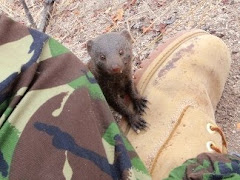
The occupational hazards of a mongoose researcher: I've taken to my heels to avoid ostriches, bulls, poachers, rhinos, elephants and a hand-raised ground squirrel. Said demonic ground squirrel (sporting HUGE teeth and an ankle-biting fetish) shown above.


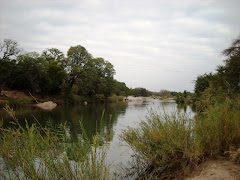
When I first moved into this house (located right on the banks of the Oliphants River) I was very cautious about walking by the water's edge. You see this river is home to a multitude of Nile crocodiles: little cute teeny ones – goggle-eyed and stripy in black, yellow and green - who high-tail it for the water the moment they see you, up to massive behemoths 5 m (16.5 ft) long who just lie there and watch as you pass. They bask on the beaches, waddle along the roads between river and dams, and creep out at night to drag away anything unwise enough to die within 500m of the river.


A Nile crocodile (Crocodylus niloticus) paddling in the dam near my house. When I stopped to photograph his grisly prize (an ill-starred waterbuck the size of a large horse), he hastily towed it further off shore.

So when it came to walking with my dogs in the river bed, I was initially very wary about getting too close to the water. After all, I'd seen those scary wildlife documentaries where the crocodiles leap out of the water to snatch milling wildebeests off the bank. And let's not forget killer whales, beaching themselves on the sand for a mouthful of unsuspecting seal pup.
You simply can't trust aquatic predators to stay in their rightful element.

Yet after three years of riverbank rambles, free of anyone trying to eat me, I've become a little blasé.

Well yesterday I got a shock.

The dogs and I were wending our way along the river bed, ploughing through the drifted sand and clambering over rocks, when I spotted a huge crocodile basking on the beach of a mid-stream island. It was one of the really massive ones, close to 4 m (13 ft) long and it looked more like a felled rainforest tree than an actual animal. I cannot describe to you how awesome these creatures are. It's not so much their length as their immense bulk; they can weigh up to 1000 kg (2200 lbs). I can never look at them without shivering inside and feeling that reptiles simply should NOT get this big. And they've effectively cured me of a lifelong desire to meet a dinosaur.


The world's worst photograph of a mammoth crocodile (sorry!). Crocs have all sorts of spiffy adaptations, like a palatial valve (a fleshy flap at the back of the tongue) which seals their throat when below water. Normally crocs dive for up to 15-20 minutes but, when harassed, they can stay below for 2 hours, reducing their heart rate to 2-3 beats a minute and closing their heart valves to redirect blood to only essential organs.


The dogs and I picked our way across the sandy beach toward the creature, stopping about 3 m (10 ft) from the water's edge. I'd been a bit hesitant about approaching it so directly as I didn't want to disturb it, but these big guys tend to be very confident and there was about 25 m (82 ft) of fast-flowing river swirling between us. The dogs, of course, simply didn't see it (they never see crocodiles unless they move) and I was keen for them to do so, so they'd understand why I keep insisting the water is dangerous.

While we were standing on the beach, enjoying the vicarious thrill of gazing at such an awesome predator, the awesome predator lurched to its feet - standing up on fully straightened legs (called a 'high-walk' in crocodile parlance) which made it waist-height - swung round to face us and plunged into the river. It came surging toward us through the water at full speed (about 15 kph/10 mph according to the books), and it took me a moment or two to realise, 'hey, it's coming straight at us!'

Coincidence, surely.

I walked a few steps downstream and it immediately altered its path so its trajectory would intercept us.

Oh God!

By now it was half way across the river and I felt a rush of alarm, disbelief and dismay as I realised we were now on the menu. I envisioned the beast hurtling out of the water in front of us; a creature at least ten times my own body mass.

It was at this point that I turned and ran.

Fast.

I'm afraid I cannot tell you whether the crocodile actually emerged on to our beach, as I didn't stop to look back.
And neither did the dogs.
We just ran.

And from now on, I'm going be to very cautious again!


I thought you should see what these big guys are capable of. If you go here you can view a series of eight photos showing what happened during this horrible interaction.
Photo by Martin Nyfeler/Barcroft Media, and posted on Flickr by Arno Meintjes.


Tuesday, April 12, 2011

Spots before my eyes...

During the last couple of days I've been seeing spots.
And no ordinary spots.
Yesterday's were sublime; today's ghastly.

Let's start with the sublime.

When I set out to walk the dogs last night, I forgot to put my camera in my pocket. Realising while still in the garden, I chose not to go back. 'Bring on the leopards', I quipped to the dogs (dogs respond more favourably to quipping than cats or mongooses).

Twenty minutes later, Magic (my husky-cross) began tugging at the leash, eager to chase something she'd spotted up ahead. There was a noisy mob of guinea-fowl strutting about the track where it crested the hill ahead of us, so I assumed Magic was keen to sup on fowl (which are very spotted too, by the way).

We trekked on up the hill, Magic dragging me along (boy, can huskies pull) and the guinea-fowl squawked and squabbled their way off into the bush. But as we rounded the next bend, two things happened simultaneously. My dogs caught a whiff of something VERY exciting at the edge of the path (jerking me almost off my feet as they doubled back to investigate) and I glanced up to see a very large leopard 30 m (100 ft) away. He was nonchalantly strolling along the track ahead of us, oblivious to our presence. His pace was so relaxed and leisurely, I could almost see him smelling the flowers.


The cat's whiskers. Meeting a leopard (Panthera pardus) is a rare and wonderful privilege.
Photo by A & L Meintjes.

White-tipped tail held jauntily high, he sauntered over to a trackside shrub, sniffed at the foliage and then luxuriously rubbed his cheeks against the twigs. He then turned, backed up to the shrub and sprayed a jet of urine up on to the leaves. With his scent-marking efforts complete, he strolled on. Meanwhile my dogs, busy feasting (metaphorically) on his previous contribution, didn't even see him.

Although I regularly come across leopard prints, I've only met a leopard in-the-fur twice before; despite three years of daily dog walking. This macho lad regularly enlivens our walks by leaving stinky stop signs at all the prominent road junctions. Worryingly large, these piles of droppings are always chockfull of fur, so while the dogs enjoy a sniffing-fest, I struggle to identify the ill-fated fur-bearer.

Yesterday's leopard was big. I don't know why our leopards are bigger than other people's, but every time I see a documentary on the leopards of the Cedarburg, or the Cape, or the coast, I go into shock. How can those squat little animals be leopards? Yesterday's cat was almost hip-height and close to 2 m (6 ft) long. I guess it's part and parcel of the species' versatility: these professional killers pad about all over Africa and across Asia as far as Korea and Manchuria. They're the only large carnivore stalking around the rainforests of Africa, and a frozen leopard carcass was found stuck in the ice at 5692 m (18,700 ft) on Mt Kilimanjaro (perhaps not a wise choice of habitat, in retrospect). They even cling on in places where smaller carnivores have been eradicated. How? Catholic tastes. A study in the Serengeti, for example, found that leopards munched 30 different prey species compared with only 12 chomped by lions.


Room with a view. Leopards are renowned for hauling their meals up into trees, but they only indulge in this habit if other big meat-eaters live in the area.
Photo by A & L Meintjes.

At about the same time that my dogs caught sight of yesterday's leopard, he became aware of us, turning to look back over his shoulder. Instantly he dropped into a low, slinking crouch and bounded away into the bush. I was left wrestling with my dogs (trying desperately to thwart their suicidal desire to give chase) and was quite unable to stop smiling.

Well they were the sublime spots, now for the ghastly.

Pepper ticks.
The Devil's own condiment.

Pepper ticks are just like normal, everyday ticks except they're tiny. Three could sit comfortably on the head of a pin (maybe four if they scrunched up). Just like regular ticks, they guzzle blood, inject you full of horrible parasites and leave huge, itchy lumps. And each one must be individually extracted and crushed (they do make a satisfying pop). However, unlike normal ticks, they hunt in swarms. Stumble on a pepper-tick hideout and you're polka-dotted with misery.

I'm not going to tell you how much pepper ticks make me suffer, or how they drive me into a frenzy of rage. Suffice to say that today, after a very pleasant morning with Ecthelion, I painstakingly removed 437 of them. And yes, I did count every one.


Overcome by pepper ticks?
Photo by Arno & Louise Meintjes (what wonderful people).

Tuesday, April 5, 2011

More snakes and adders


The one thing that most people know about mongooses is that they kill and eat snakes.
This is like knowing that humans eat lasagne.

Of course, there are snakes and there are snakes.
Big snakes are only too happy to kill and eat little mongooses.
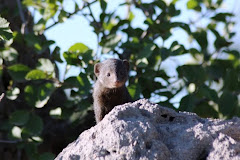
And my dwarf mongooses are the teeniest mongooses there are.
Being rat-sized and the weight of half a can of baked beans, they're ideal snack snake food.
But ONLY if they're caught unawares.


The spotted bush snake (Philothamnus semivariegatus) is about the largest snake my dwarfs can kill. It's a slick, zippy snake, about 1 m (3 ft) long and the thickness of my thumb. Sadly, only the group's oldest members can feast on the spoils because no one else's teeth are hefty enough to pierce the skin.


When walking in the bush alone I rarely see a snake.
But 'see' is the critical word here. Add 15 mobile snake-detectors and it's a whole different story. Last Sunday I spent an hour pottering along with Ecthelion. In that time we met two large puff adders and a Mozambique spitting cobra.

When a mongoose meets a life-threatening snake, it hollers for the group using a special, high-pitched 'snake' call. Everyone immediately comes running. It's a moment I dread. All the mongooses cluster around the snake, flattening themselves down on their tummies, calling and spitting. The snake coils into the smallest possible bundle and assumes strike position. I bite my nails.
At this point, puff adders demonstrate why they're so named. They produce a loud, ominous noise: a deep whooshing hiss like a deflating football, which lasts around 3 seconds and is then repeated over and over. The mongooses are not deterred. Individually they try to dart in and nip the snake's body, leaping backward as it lunges for them. Some even cartwheel half a metre into the air to evade the striking snake. I stand well back, wincing and squirming, with my eyes screwed half shut.


This is an action shot. Unfortunately it features two cryptic species. Can you spot the puff adder (lower centre) and two mongooses (upper right and upper left beneath the grass tussock)?

From my (wimpy) perspective, snake-mobbing is worst when - as now - the group has small pups. I've seen a puff adder (undetected by me or the group) snatch a mongoose pup almost at my feet. It's not an experience I wish to repeat.

But snake-baiting appears to be a learned behaviour in mongooses and the pups are totally clueless. On Sunday, Ecthelion's three smallest members came trotting over to see what all the fuss was about, wending in and out of the mobbing adults and blithely ignoring the huge puff adder poised inches above them. I actually stopped breathing when Hiccup marched right over the adder's coils. But no one else even noticed. The snake and the mobbing mongooses were focussed exclusively on one another; neither could afford a moment's distraction in the deadly exchange of bite and counter bite.

This whole awful scenario ends after about five minutes, when the mongooses lose interest and wander away. I know this is sounds like an anticlimax, but once the mongooses know the snake's presence, and the snake knows it has a whole group to contend with, the peril is over.


A puff adder (Bitis arietans) feeling put upon. Snakes breathe by moving their ribs (called a costal pump) and a puff adder uses the ribs along its entire trunk to 'puff'. Both the inhalation and exhalation are disturbingly loud (75 decibels - the same volume as a vacuum cleaner at 1 m/yard).


Puff adders are the sluggards of the snake world. During the day they lie about cryptically in thickets or rocks, and at night they lie about cryptically on pathways waiting for edible things to stumble into them. Of course this indolent lifestyle has its consequences: although they only grow to about 1.2 m (4 ft) in length, they get embarrassingly rotund, weighing up to 7 kg (15 lbs). If given unlimited food in captivity, they'll literally eat themselves to death.


Puff adders are responsible for more than 60% of serious snake bites in southern Africa. Their long fangs (12-18mm/0.5-0.7") are capable of penetrating soft leather and they inject a potent cytotoxin that causes severe swelling, pain and necrosis. Around 10% of untreated bites prove fatal (due to kidney failure or complications from the swelling) but loss of an appendage is much more common.

Despite the puff adder's reputation, this is the snake I've grown to feel most warmly towards. Why would someone who's snake-phobic feel warmly toward any legless beast? Gratitude, pure and simple.

You see, in my experience, puff adders behave with exemplary restraint. Once, when I was crawling about a termite mound, neatly piling up mongoose droppings (so I could tell if anyone subsequently visited the latrine), I suddenly realised that my scrabbling fingers were only 2" away from the nose of a very large puff adder. It lay perfectly still but its golden eyes were watching me intently. I'm not sure how it felt when a look of horrified recognition passed over my features, but it maintained its perfect immobility.

In a more testing situation, once (while walking the dogs) I glanced down to see a puff adder right beneath my feet. The snake's thickened body was coiled up beside the track, but its head and neck lay out across the path (presumably in wait for passing rodents). I'd actually passed over the snake before I saw it, but not so my dog, who was following along behind me. With horror, I watched as she lowered her hind paw directly down on to the snake's head. But to my amazement, at the very last moment, the adder flicked its head sideways, out of her way, and the dog marched on, quite oblivious. I think I lost a few years off my life, but I can't help but feel profound gratitude that it did not strike.

A coat of many colours. During spring, male puff adders trail females (who waft an alluring pheromone) and neck wrestle each other to win their regard. Mothers bear 20-40 mini adders in late summer.


Related Posts Plugin for WordPress, Blogger...