Friday, April 22, 2011

Running scared

Running just isn't my thing.

I've never understood what people gain from jogging (apart from joint problems) or why any sane biped would want to run a marathon.

Of course I did do cross-country running for PE back in high school (we jogged out the school gates, sauntered to a friend's house, drank coffee for two hours and then jogged back in through the gates). I guess that doesn't count.

However, since coming to Africa, I've discovered that there are times when I'm happy to run with the best of them.

And yesterday was one of them.


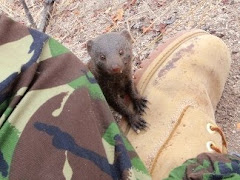
The occupational hazards of a mongoose researcher: I've taken to my heels to avoid ostriches, bulls, poachers, rhinos, elephants and a hand-raised ground squirrel. Said demonic ground squirrel (sporting HUGE teeth and an ankle-biting fetish) shown above.


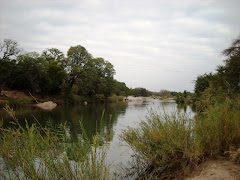
When I first moved into this house (located right on the banks of the Oliphants River) I was very cautious about walking by the water's edge. You see this river is home to a multitude of Nile crocodiles: little cute teeny ones – goggle-eyed and stripy in black, yellow and green - who high-tail it for the water the moment they see you, up to massive behemoths 5 m (16.5 ft) long who just lie there and watch as you pass. They bask on the beaches, waddle along the roads between river and dams, and creep out at night to drag away anything unwise enough to die within 500m of the river.


A Nile crocodile (Crocodylus niloticus) paddling in the dam near my house. When I stopped to photograph his grisly prize (an ill-starred waterbuck the size of a large horse), he hastily towed it further off shore.

So when it came to walking with my dogs in the river bed, I was initially very wary about getting too close to the water. After all, I'd seen those scary wildlife documentaries where the crocodiles leap out of the water to snatch milling wildebeests off the bank. And let's not forget killer whales, beaching themselves on the sand for a mouthful of unsuspecting seal pup.
You simply can't trust aquatic predators to stay in their rightful element.

Yet after three years of riverbank rambles, free of anyone trying to eat me, I've become a little blasé.

Well yesterday I got a shock.

The dogs and I were wending our way along the river bed, ploughing through the drifted sand and clambering over rocks, when I spotted a huge crocodile basking on the beach of a mid-stream island. It was one of the really massive ones, close to 4 m (13 ft) long and it looked more like a felled rainforest tree than an actual animal. I cannot describe to you how awesome these creatures are. It's not so much their length as their immense bulk; they can weigh up to 1000 kg (2200 lbs). I can never look at them without shivering inside and feeling that reptiles simply should NOT get this big. And they've effectively cured me of a lifelong desire to meet a dinosaur.


The world's worst photograph of a mammoth crocodile (sorry!). Crocs have all sorts of spiffy adaptations, like a palatial valve (a fleshy flap at the back of the tongue) which seals their throat when below water. Normally crocs dive for up to 15-20 minutes but, when harassed, they can stay below for 2 hours, reducing their heart rate to 2-3 beats a minute and closing their heart valves to redirect blood to only essential organs.


The dogs and I picked our way across the sandy beach toward the creature, stopping about 3 m (10 ft) from the water's edge. I'd been a bit hesitant about approaching it so directly as I didn't want to disturb it, but these big guys tend to be very confident and there was about 25 m (82 ft) of fast-flowing river swirling between us. The dogs, of course, simply didn't see it (they never see crocodiles unless they move) and I was keen for them to do so, so they'd understand why I keep insisting the water is dangerous.

While we were standing on the beach, enjoying the vicarious thrill of gazing at such an awesome predator, the awesome predator lurched to its feet - standing up on fully straightened legs (called a 'high-walk' in crocodile parlance) which made it waist-height - swung round to face us and plunged into the river. It came surging toward us through the water at full speed (about 15 kph/10 mph according to the books), and it took me a moment or two to realise, 'hey, it's coming straight at us!'

Coincidence, surely.

I walked a few steps downstream and it immediately altered its path so its trajectory would intercept us.

Oh God!

By now it was half way across the river and I felt a rush of alarm, disbelief and dismay as I realised we were now on the menu. I envisioned the beast hurtling out of the water in front of us; a creature at least ten times my own body mass.

It was at this point that I turned and ran.

Fast.

I'm afraid I cannot tell you whether the crocodile actually emerged on to our beach, as I didn't stop to look back.
And neither did the dogs.
We just ran.

And from now on, I'm going be to very cautious again!


I thought you should see what these big guys are capable of. If you go here you can view a series of eight photos showing what happened during this horrible interaction.
Photo by Martin Nyfeler/Barcroft Media, and posted on Flickr by Arno Meintjes.


Tuesday, April 12, 2011

Spots before my eyes...

During the last couple of days I've been seeing spots.
And no ordinary spots.
Yesterday's were sublime; today's ghastly.

Let's start with the sublime.

When I set out to walk the dogs last night, I forgot to put my camera in my pocket. Realising while still in the garden, I chose not to go back. 'Bring on the leopards', I quipped to the dogs (dogs respond more favourably to quipping than cats or mongooses).

Twenty minutes later, Magic (my husky-cross) began tugging at the leash, eager to chase something she'd spotted up ahead. There was a noisy mob of guinea-fowl strutting about the track where it crested the hill ahead of us, so I assumed Magic was keen to sup on fowl (which are very spotted too, by the way).

We trekked on up the hill, Magic dragging me along (boy, can huskies pull) and the guinea-fowl squawked and squabbled their way off into the bush. But as we rounded the next bend, two things happened simultaneously. My dogs caught a whiff of something VERY exciting at the edge of the path (jerking me almost off my feet as they doubled back to investigate) and I glanced up to see a very large leopard 30 m (100 ft) away. He was nonchalantly strolling along the track ahead of us, oblivious to our presence. His pace was so relaxed and leisurely, I could almost see him smelling the flowers.


The cat's whiskers. Meeting a leopard (Panthera pardus) is a rare and wonderful privilege.
Photo by A & L Meintjes.

White-tipped tail held jauntily high, he sauntered over to a trackside shrub, sniffed at the foliage and then luxuriously rubbed his cheeks against the twigs. He then turned, backed up to the shrub and sprayed a jet of urine up on to the leaves. With his scent-marking efforts complete, he strolled on. Meanwhile my dogs, busy feasting (metaphorically) on his previous contribution, didn't even see him.

Although I regularly come across leopard prints, I've only met a leopard in-the-fur twice before; despite three years of daily dog walking. This macho lad regularly enlivens our walks by leaving stinky stop signs at all the prominent road junctions. Worryingly large, these piles of droppings are always chockfull of fur, so while the dogs enjoy a sniffing-fest, I struggle to identify the ill-fated fur-bearer.

Yesterday's leopard was big. I don't know why our leopards are bigger than other people's, but every time I see a documentary on the leopards of the Cedarburg, or the Cape, or the coast, I go into shock. How can those squat little animals be leopards? Yesterday's cat was almost hip-height and close to 2 m (6 ft) long. I guess it's part and parcel of the species' versatility: these professional killers pad about all over Africa and across Asia as far as Korea and Manchuria. They're the only large carnivore stalking around the rainforests of Africa, and a frozen leopard carcass was found stuck in the ice at 5692 m (18,700 ft) on Mt Kilimanjaro (perhaps not a wise choice of habitat, in retrospect). They even cling on in places where smaller carnivores have been eradicated. How? Catholic tastes. A study in the Serengeti, for example, found that leopards munched 30 different prey species compared with only 12 chomped by lions.


Room with a view. Leopards are renowned for hauling their meals up into trees, but they only indulge in this habit if other big meat-eaters live in the area.
Photo by A & L Meintjes.

At about the same time that my dogs caught sight of yesterday's leopard, he became aware of us, turning to look back over his shoulder. Instantly he dropped into a low, slinking crouch and bounded away into the bush. I was left wrestling with my dogs (trying desperately to thwart their suicidal desire to give chase) and was quite unable to stop smiling.

Well they were the sublime spots, now for the ghastly.

Pepper ticks.
The Devil's own condiment.

Pepper ticks are just like normal, everyday ticks except they're tiny. Three could sit comfortably on the head of a pin (maybe four if they scrunched up). Just like regular ticks, they guzzle blood, inject you full of horrible parasites and leave huge, itchy lumps. And each one must be individually extracted and crushed (they do make a satisfying pop). However, unlike normal ticks, they hunt in swarms. Stumble on a pepper-tick hideout and you're polka-dotted with misery.

I'm not going to tell you how much pepper ticks make me suffer, or how they drive me into a frenzy of rage. Suffice to say that today, after a very pleasant morning with Ecthelion, I painstakingly removed 437 of them. And yes, I did count every one.


Overcome by pepper ticks?
Photo by Arno & Louise Meintjes (what wonderful people).

Tuesday, April 5, 2011

More snakes and adders


The one thing that most people know about mongooses is that they kill and eat snakes.
This is like knowing that humans eat lasagne.

Of course, there are snakes and there are snakes.
Big snakes are only too happy to kill and eat little mongooses.
And my dwarf mongooses are the teeniest mongooses there are.
Being rat-sized and the weight of half a can of baked beans, they're ideal snack snake food.
But ONLY if they're caught unawares.


The spotted bush snake (Philothamnus semivariegatus) is about the largest snake my dwarfs can kill. It's a slick, zippy snake, about 1 m (3 ft) long and the thickness of my thumb. Sadly, only the group's oldest members can feast on the spoils because no one else's teeth are hefty enough to pierce the skin.


When walking in the bush alone I rarely see a snake.
But 'see' is the critical word here. Add 15 mobile snake-detectors and it's a whole different story. Last Sunday I spent an hour pottering along with Ecthelion. In that time we met two large puff adders and a Mozambique spitting cobra.

When a mongoose meets a life-threatening snake, it hollers for the group using a special, high-pitched 'snake' call. Everyone immediately comes running. It's a moment I dread. All the mongooses cluster around the snake, flattening themselves down on their tummies, calling and spitting. The snake coils into the smallest possible bundle and assumes strike position. I bite my nails.
At this point, puff adders demonstrate why they're so named. They produce a loud, ominous noise: a deep whooshing hiss like a deflating football, which lasts around 3 seconds and is then repeated over and over. The mongooses are not deterred. Individually they try to dart in and nip the snake's body, leaping backward as it lunges for them. Some even cartwheel half a metre into the air to evade the striking snake. I stand well back, wincing and squirming, with my eyes screwed half shut.


This is an action shot. Unfortunately it features two cryptic species. Can you spot the puff adder (lower centre) and two mongooses (upper right and upper left beneath the grass tussock)?

From my (wimpy) perspective, snake-mobbing is worst when - as now - the group has small pups. I've seen a puff adder (undetected by me or the group) snatch a mongoose pup almost at my feet. It's not an experience I wish to repeat.

But snake-baiting appears to be a learned behaviour in mongooses and the pups are totally clueless. On Sunday, Ecthelion's three smallest members came trotting over to see what all the fuss was about, wending in and out of the mobbing adults and blithely ignoring the huge puff adder poised inches above them. I actually stopped breathing when Hiccup marched right over the adder's coils. But no one else even noticed. The snake and the mobbing mongooses were focussed exclusively on one another; neither could afford a moment's distraction in the deadly exchange of bite and counter bite.

This whole awful scenario ends after about five minutes, when the mongooses lose interest and wander away. I know this is sounds like an anticlimax, but once the mongooses know the snake's presence, and the snake knows it has a whole group to contend with, the peril is over.


A puff adder (Bitis arietans) feeling put upon. Snakes breathe by moving their ribs (called a costal pump) and a puff adder uses the ribs along its entire trunk to 'puff'. Both the inhalation and exhalation are disturbingly loud (75 decibels - the same volume as a vacuum cleaner at 1 m/yard).


Puff adders are the sluggards of the snake world. During the day they lie about cryptically in thickets or rocks, and at night they lie about cryptically on pathways waiting for edible things to stumble into them. Of course this indolent lifestyle has its consequences: although they only grow to about 1.2 m (4 ft) in length, they get embarrassingly rotund, weighing up to 7 kg (15 lbs). If given unlimited food in captivity, they'll literally eat themselves to death.


Puff adders are responsible for more than 60% of serious snake bites in southern Africa. Their long fangs (12-18mm/0.5-0.7") are capable of penetrating soft leather and they inject a potent cytotoxin that causes severe swelling, pain and necrosis. Around 10% of untreated bites prove fatal (due to kidney failure or complications from the swelling) but loss of an appendage is much more common.

Despite the puff adder's reputation, this is the snake I've grown to feel most warmly towards. Why would someone who's snake-phobic feel warmly toward any legless beast? Gratitude, pure and simple.

You see, in my experience, puff adders behave with exemplary restraint. Once, when I was crawling about a termite mound, neatly piling up mongoose droppings (so I could tell if anyone subsequently visited the latrine), I suddenly realised that my scrabbling fingers were only 2" away from the nose of a very large puff adder. It lay perfectly still but its golden eyes were watching me intently. I'm not sure how it felt when a look of horrified recognition passed over my features, but it maintained its perfect immobility.

In a more testing situation, once (while walking the dogs) I glanced down to see a puff adder right beneath my feet. The snake's thickened body was coiled up beside the track, but its head and neck lay out across the path (presumably in wait for passing rodents). I'd actually passed over the snake before I saw it, but not so my dog, who was following along behind me. With horror, I watched as she lowered her hind paw directly down on to the snake's head. But to my amazement, at the very last moment, the adder flicked its head sideways, out of her way, and the dog marched on, quite oblivious. I think I lost a few years off my life, but I can't help but feel profound gratitude that it did not strike.

A coat of many colours. During spring, male puff adders trail females (who waft an alluring pheromone) and neck wrestle each other to win their regard. Mothers bear 20-40 mini adders in late summer.


Saturday, April 2, 2011

Rewind (unwind?)


With another birthday (and large quantities of celebratory chocolate mousse) under my belt, I feel it's time for a (slightly queasy) rethink.

I began this blog about a year ago because I wanted to tell someone about the small everyday adventures of living here.
Working and living alone, I've no one to share the tingle of apprehension at a snake encounter, the jump of pleasure as monkeys dangle upside-down to peer in my window or the small frission of excitement at seeing an unexpected beast or weird behaviour (hopefully not my own).

Gradually, as time's passed, I've moved away from this original purpose; my posts have grown twice as long and much less frequent. And now, when I'm beset by feelings of ineptitude (common) and everything I write seems clumsy, disjointed and just plain dull, I lack the motivation to continue.

In an effort to resolve this difficulty, I've decided to revisit my original intention.
So come, gird your loins for boredom!
Day to day happenings it is!

Starting appropriately (considering this blog's inaugural post) with last night's midnight intruder.

I was woken at the witching hour by the dogs barking hysterically in the lounge room. Stumbling out to investigate (I don't remember deciding to do this), I came-to abruptly. My wavering torch beam revealed a large python, sinuously entwined around the burglar-bars of the window and draped, like a Christmas garland, along the curtain rail. This was bad news. Outside, under that particular window, is where my deaf cat (Fatcat) habitually sleeps the night. But a hasty scan of the snake (about 2.5 m/8 ft long) revealed no cat-sized lumps, and a quick head count confirmed that all my pets were alive and kicking (or barking). Actually - in truth - Fatcat was curled up, totally oblivious, under the toilet.


Curtains for my cat? Not this time. Southern African rock pythons (Python natalensis) routinely grow to 5 m (16 ft) during their 30-year lifespan, so this one's only a young'n.

But how to get it out? With great determination it kept trying to nose its way up into the ceiling, and I was equally determined not to let it. Shoving its movable end back out the window with a broom had no effect beyond eliciting much loud and emphatic hissing, which seriously freaked out my cats. OK, I know that a normal person would've just grabbed the thing, but the salutatory effects of immersion-therapy have only reduced, not eliminated, my ophiophobia. Anyway, I couldn't see how I'd be able to unwind all its twists and turns, even if I was brave enough to handle the creature. And African rock pythons are renowned for being antsy.
My reptile field guide says,
 "They lunge and bite readily in defence. The teeth are very large and can inflict painful ripping wounds."
And of course they've got more than 100 of those teeth, backward curving and blade-like...

Or how about this testimony from the ever redoubtable reptile forums:
"I kept an adult (rescue) and it's the most evil and one of the most dangerous species I have ever come across, would never trust it or get complacent. Are they common in the US? Rare in the UK, would love another."


Snake removal, a knotty problem, tale tail.

And let's not forget that large African rock pythons do occasionally eat people. If Wikipedia is to be believed, they show a strange penchant for 13-year-old boys. However, thinking about it, this mightn't be so surprising, if the victims aren't entirely blameless. A recent, non-fatal attack in Kenya occurred after an adult man accidentally stepped on the snake. In this case, the python dragged him, encoiled, up into a tree, but the guy managed to ring for help on his cell phone (I knew they had to be useful for something).

But of course this is mere sensationalism. The specimen dangling off my curtain rail had a heck of lot of growing to do before adding annoying adolescents to its menu.


Going off the rails (me, not the python). Notice the cobwebs festooned on its nose (oh, the shame).

Deciding to play it safe, I dragged, carried or chased all edible fauna into my bedroom and closed the door on them. Then, in the silence and the dark, the snake and I waited... and waited... and waited. Pythons are big on the whole cryptic bit. Eventually, after an hour or so, it finally began seeking a way out, and with some judicious poking (using the broom of course) when it headed the wrong way, it eventually slide back out the window. Once it touched ground, it glided off into the bush as fast as its legs leglessness would carry it.


Despite a fearsome reputation, African rock pythons are caring mums. Within a termite mound or aardvark burrow, they coil around their 30-50 orange-sized eggs, protecting and warming them for the 2- 3 months until they hatch. Even then, they guard and shepherd the little ones until they find their feet (so to speak) at around two weeks of age. Photo by Arno & Louise Meintjes.

Friday, March 18, 2011

A blessing of bee-eaters


When I first learned what bee-eaters ate I was shocked.

I mean common names are almost always wrong, right?

You don't see honeyeaters plundering bee hives or oystercatchers diving for pearls. An antbird wouldn't be seen dead consuming ants, miners don't venture underground and blacksmith plovers show no interest in metalwork. And as for goatsuckers (nightjars), well...

Anyway, who in their right mind would want to eat bees?

Well, swooping and gliding in the airspace outside my house is a flock of around 10 birds that do precisely that.

They're white-fronted bee-eaters and they just love noshing on stinging things.


White-fronted bee-eaters (Merops bullockoides) always remind me of an Australian aboriginal creation myth that says birds arose when a rainbow shattered and the falling fragments took flight.
Now that's nicer than descending from dinosaurs, isn't it.
Photo by Nathan Rupert.


Looping the loop on slick wings, bee-eaters will snap up other flying critters too (no airborne grasshopper, wasp, cicada or termite is safe) but they actually prefer to feast on bees. Calling to each other with noisy enthusiasm and settling in gregarious clusters on the overhead power lines, they sit scanning the sky for quarry, whimsically tilting their heads to one side and then the other and staring intently straight up into the blue. In Malaysia, olive bee-eaters can spot a 1 cm (0.4") wasp from 80-95 m (260-310 ft) away, and I'm sure my locals are just as astute. Once they detect a victim they dash out in aerial pursuit. Their long curved bill – so like a nectar feeder's – allows them to keep their eye on the ball bee right up to the moment of capture (which is marked with an audible snap). They then zoom back to their perch for a bit of bug-processing.

I love the way my resident clan constantly narrates their activities. They have appealing upward-inflected calls; a tasteful combination of squeaking-door and balloon-rub (I know that doesn't sound pleasant but it is).


Assault and battery. Bee-eaters use violence to de-venom their prey. First they beat the hapless victim senseless and then carefully rub its nether parts against the perch (as you'd move an eraser) to tear away the noxious bits. Photo by Arno & Louise Meintjes.

When I first moved here I was startled to come across what looked like a pile of used Christmas wrappings strewn on the sandy track by the river. As I got closer I realised it was actually a gathering of white-fronted bee-eaters. But 'Oh my God', they'd been massacred!

They were lying perfectly still in a tumbled heap, their wings outspread and their heads, with eyes closed, kinked at horrible neck-broken angles. I stared aghast. Who was responsible for this dreadful carnage? Only when I came within a couple of metres (6 ft) did an eye open, and then another. I could almost hear the exasperated sighs as the sleeping birds slowly struggled to their feet, ruffled their feathers back into place and glared up at me. Oh, they'd been sunning.

But bee-eater weirdness isn't limited to a taste for venom-toting bugs and melodramatic basking behaviour. They burrow too. Yep, they use that constantly-growing beak to gouge out a one metre (3 ft) long tunnel from a cliff face. Their short-legs and tiny feet are specially designed (I'm sounding very creationist today) for earthmoving, with two toes fused partway along their length for improved shovelling power.


Nesting in large colonies, white-fronted bee-eaters can pepper a cliff face with ten burrows per square metre. Their tunnels slope upward - presumably to avoid runoff - but the egg chamber is rimmed with a lip to prevent accidents. Photo by Sander Kuulkers.


My local bee-eaters used to nest in the river bank near my house but they've abandoned the site. You can see why here. The little holes are the original nest tunnels and the big ones are nests excavated by predators. Prime suspects (based on claw-mark size): Nile monitors and honey badgers.


I you haven't already guessed, White-fronted bee-eaters are special. They possess one of the most complex social systems in the avian world. They're like those large, jolly southern European families that feature in Hollywood movies. Pairs team up for life, but they're often helped in their chick-rearing duties by one or two other birds (usually kids who've chosen to loiter at home). While this sort of cooperative breeding is fairly common in birds, white-fronted bee-eaters go even further. Each family unit joins forces with two or three other units to create a big sociable clan (of up to 12 adults). Clan members happily visit one another's nests and forage together, and if one family loses its brood, it will switch to helping raise its neighbour's. But just like feuding Capulets and Montagues, bee-eater clans are intolerant of one another.

Although breeding colonies normally house three to six clans, each one chases rival clan members away from its nests and fiercely defends its own exclusive feeding territory. Since the clan's feeding territory is normally located around 1 km (0.4 miles) from the nesting site, the birds must wing it all the way back each time they want to feed the kids. And this is no mean feat, considering that a bee-eater nestling munches around 50 insects a day (all individually delivered). Phew!

There are currently two other species of bee-eater helping to keep my garden bee-free. The European bee-eaters are migrants, winging in at the start of December for four months of bee-filled R & R. This species is a bit schizophrenic in South Africa. While the ones around here are holidaying after the stress of chick-rearing in southern Europe or the Middle East, those further south are busy stuffing bees into fledglings in preparation for their winter vacation to central Africa.
My third species, the little bee-eater, resides here fulltime. Each year a vociferous pair raises its family in the roof of an old aardvark hole inside one of the mongooses' favourite termite mounds. We've all got used to the scolding.


Bringing home the bacon bee. When breeding a European bee-eater (Merops apiaster) needs to catch around 225 bee-sized insects daily to maintain itself and its chicks. Photo by Joaquim Coelho.


Of the 24 bee-eater species that grace our world, the little bee-eater (Merops pusillus) is the teeniest. It's about the size of a sparrow. Photo posted on Flickr by Lip Kee.

Friday, February 18, 2011

Crying out loud


Have you ever lain awake in the night listening to the terrible shrieks, yowls and screams of something unknown?

Inevitably it happens when you're out camping, and all that separates you and the night is a thin smear of nylon.

Of course you know it's only some animal. Right?

I mean, there's no way it's a banshee, a victim of torture or that second-grade teacher you knew was a witch.
And while you're rationally thinking this, your body is preparing for the worst. Your palms grow sweaty, your breathing quickens and you leap neurotically at the smallest noise. Meanwhile your mind, consciously refusing houseroom to thoughts of ghouls, ghosts and gremlins, merrily conjures images of maimed animals; innocent creatures twisting in the agony of trap or snare, desperately gnawing at their own mangled legs.

What's prompted me to reminisce about such fun experiences?
Well I recently came across an entertaining article ('5 lovable animals you didn't know are secretly terrifying') and one of the critters it lists is the red fox. In an amusing transcript, the article describes - with quite uncanny accuracy - my own first reaction to red fox calls (although I hasten to add I wasn't stoned at the time). If you're not familiar with the dreadful noises a red fox can make, there's video clip in the article. But be warned: humans aren't alone in responding badly. An innocent click on the play button launched a large husky into my lap as she lunged head first into my computer screen, and the cats' fur took more than an hour to resume normal orientation.


Black-backed jackals are up there with the best when it comes to weird calls. Listen to them here (by clicking the website's speaker icon) if you doubt me.
Photo by Johann du Preez.

Of course animal calls are usually only harrowing because you don't know who's doing the shrieking. And like a good crime novel, it's always the most unlikely suspect. A top contender for the 'shock-value' award must surely be the hyrax (or dassie). These innocuous little creatures look like those fabric-covered brick doorstops (complete with button eyes and nose) that kids make at school in the lead up to Father's Day. Rock hyraxes have no appreciable legs, and spend most of their time sitting about in clusters atop boulders, soaking up the sun. Sometimes they'll scamper down the rocks to munch grass or totter about - with endearing ineptitude – in the branches, snacking on leaves. A colony hangs out on the koppies at my study site, and although I see them daily, nary a squeak do they make. But on bright moonlit nights, when you're least expecting it, male hyraxes let rip. Their shocking, maniacal cries (please listen to one here) terrify rivals and humans alike. Tree hyraxes have gone even further to perfect their cover, secreting themselves away by day in tree hollows so they can creep out at night and horrify unsuspecting bystanders.


A rock hyrax (Procavia capensis) trying to look innocent although clearly it's just mugged a picnicker. Hyraxes have changed little during the last 45 million years, apart from varying in size – one species grew lion-sized (urrgh!).
Photo by Arno & Louise Meintjes.

But my favourite alarming call comes from the Kalahari Desert. I worked for many years on the Kalahari Meerkat Project, and each year a new crop of volunteer field assistants arrived. They were mostly young graduates from urban UK, and, initially, they tended to be a bit unsettled by the isolation and wide, desolate landscapes. Now you need to understand that these young people hadn't spent their childhood playing cowboys and Indians; this was the generation that duelled with light sabres, rescued Princess Leia and verbs at the end of their sentences put, hmmm. Now as it happens, the Sand People in Star Wars (those scary hooded entities that ambush Luke Skywalker in the desert of his home planet) communicated with eerie calls virtually indistinguishable from the braying of mules (used for transport by our farm workers). So for me at least, it was a wonderful moment when - trekking with a new volunteer across the dunes in the middle of nowhere - the brays of the Sand People reverberated around us. I loved the look of utter shock and consternation as - just for one moment - they were plunged within their childhood fantasies.

I've heard that the bugling calls of wapiti (North American elk) are very similar to the cries of the Nazgul in the Lord of the Rings movies, so perhaps a whole new generation will experience this same heart-stopping magic. I wonder where the calls of the Dementors in Harry Potter came from...


Impala aglow. This antelope's grunts and roars (hear them here) routinely send my new field assistants scuttling for home.
Photo by Arno & Louise Meintjes.

But the most alarming animal noise that I've ever experienced was made by creatures that potter around my garden nightly. And no, it's not the hippos.

It happened one night a couple of years ago. I was just getting ready for bed when the roaring growl of heavy machinery began emanating from my front garden. Above the steady roar of engines was a very loud pulsing whirr that had that ululating, come-and-go quality of an ambulance siren. The combined noise was so deafening that the student staying here at the time was convinced a helicopter had landed in the garden. To me, it sounded exactly like a UFO (or what a special effects team would conjure up as a scary, unearthly spaceship sound). Since my garden seemed to be free of luridly flashing green light, helicopters or earth-moving equipment, I decided I'd better go out and find out what was happening. Admittedly I did feel a touch of apprehension but, hang it, if a UFO was landing on my doorstep I wanted to know about it.

What I found couldn't have surprised me more, even if it had been a delegation of little green aliens.

Clumped around my compost heap were three highly agitated porcupines and one small honey badger. The honey badger (a species renowned for its 'nothing's too fearsome' approach to life) had clearly been trying it on, and the porcupines were rallying in defence. Now, when my dogs harass the porcupines (a nightly occurrence), the creatures respond by stamping their hind feet (like petulant children), coughing out a growl, and rattling their spines. Their tail quills are hollow so when the porcupine shivers its tail (as a horse shivers its skin to dislodge a fly) they do make quite a dramatic clashing sound (which you can hear here). But I'd no idea that, when seriously pressed, porcupines combined their cacophony of noises into such an amazing and other-worldly din.

If you know of a potential contender for 'Most Alarming Animal Noise', please, please nominate it in a comment.


Never underestimate a rodent. One of the Cape, or southern African, porcupines (Hystrix africaeaustralis) that visits my garden nightly.
Related Posts Plugin for WordPress, Blogger...